
Most ‘waterproof’ laminate floors on the market in 2026 won’t actually survive a burst pipe, despite what the shiny showroom labels might suggest. It’s frustrating when you’re searching for a high-quality floor laminate floor but feel buried under technical specs and conflicting advice. You likely want the timeless look of real European oak without the £85 per square metre price tag or the constant worry that a minor spill will cause your boards to swell and blow at the seams.
We believe you deserve the honest truth about what you’re paying for before you commit your hard-earned money. This guide cuts through the marketing noise to explain why a 12mm board isn’t always better than an 8mm one and how to interpret AC ratings so your hallway doesn’t look worn within 18 months. We’ll compare the reality of modern laminate against LVT and provide a clear roadmap for a successful DIY fitting that stays looking pristine for years.
Key Takeaways
- Cut through the marketing jargon to understand how HDF cores and multi-layer construction provide the foundation for a durable home.
- Master the technical side of AC ratings and board thickness to select a floor laminate floor that can actually handle your household’s daily traffic.
- Get the frank reality of water-resistance to determine if laminate is a sensible choice for your kitchen or bathroom.
- Weigh up the honest pros and cons of laminate versus real wood and LVT to ensure you get the best value for your budget.
- Learn how to accurately measure your space and why ordering samples is the only way to guarantee the right look before fitting begins.
What Exactly Is Laminate Flooring? A Straight-Talking Definition
Frankly, there is a lot of confusion about what actually makes up a modern floor. To understand what is laminate flooring, you have to look past the surface. It is a multi-layered synthetic product fused together through a high-pressure lamination process. We often find customers choosing a floor laminate floor because it offers a balance of performance and price that is hard to beat in a busy home.
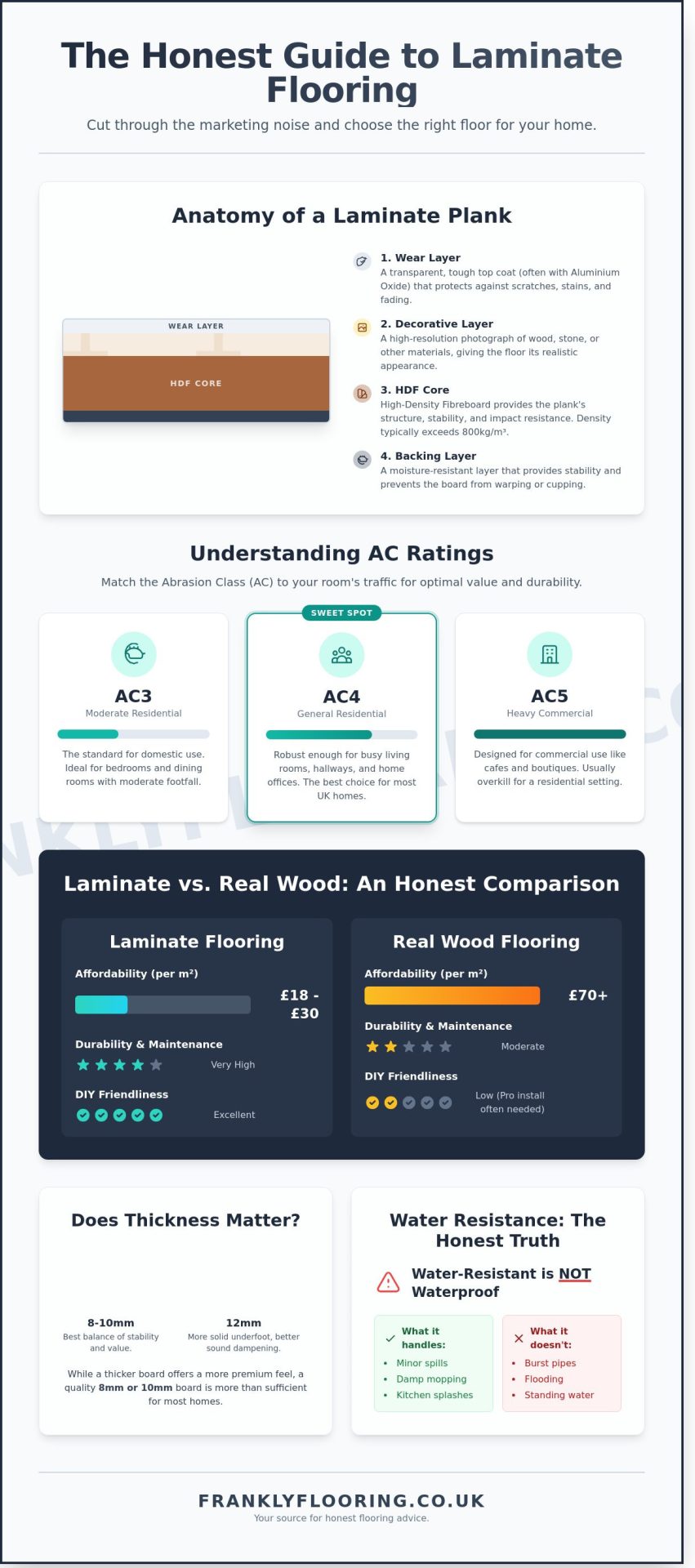
The construction relies on four distinct layers. At the base, a balancing layer provides stability. Above that sits the core, usually made of High-Density Fibreboard (HDF). This is topped with a high-resolution photographic image and a transparent wear layer. This final coating, often infused with aluminium oxide, acts as a shield against the daily grind of family life.
The Anatomy of a Laminate Plank
The backing layer is your first line of defence. It provides a moisture-resistant barrier that prevents the plank from warping or cupping when exposed to subfloor humidity. Without a high-quality backing, the floor would lose its shape within months. Above this sits the HDF core, the engine room of your floor. This compressed wood fibre has a density typically exceeding 800kg/m3, giving the plank the strength to withstand heavy furniture without denting.
The visual appeal comes from the decorative layer. Modern 3D printing technology now captures the intricate knots and grains of natural timber with incredible accuracy. This sits beneath the wear layer, which is rated using the AC (Abrasion Class) system. For most UK homes, an AC4 rating is the standard, providing enough protection to handle everything from dropped mugs to muddy paws.
Why Laminate Remains a Favourite in UK Homes
- Affordability: You can achieve a premium oak or stone aesthetic for roughly £18 to £30 per square metre. Compare this to solid wood, which frequently starts at £70 per square metre before you even consider the fitting costs.
- Durability: Unlike real timber, which scratches easily and requires regular oiling, a floor laminate floor is incredibly resilient. It resists fading from UV light and stands up to the frantic pace of high-traffic hallways and pet-filled living rooms.
- Ease of fitting: The introduction of the click-system in the late 1990s changed everything for DIY enthusiasts. Planks simply lock together without the need for messy adhesives or specialist nails, making it a straightforward weekend project for many homeowners.
We pride ourselves on providing honest advice about these materials. While laminate has evolved significantly since it first arrived on the market, choosing the right specification for your specific room is vital for long-term satisfaction. It is a reliable, cost-effective foundation for any room, provided you understand the technical details under the surface.
Understanding AC Ratings and Thickness: What Do You Actually Need?
Choosing the right floor laminate floor involves more than just picking a pretty wood grain. You need to look at the technical specifications to ensure your investment lasts. The industry uses AC (Abrasion Class) ratings to tell you exactly how much wear a board can handle before it loses its finish. Frankly, overspending on a high-traffic board for a guest bedroom is a waste of your budget, while under-specifying a hallway leads to premature wear.
An AC3 rating is the minimum requirement for any residential room because it provides the necessary resistance against the friction of daily movement and light furniture shifting. If you want a deeper dive into the technical construction of these boards, the World Floor Covering Association provides a guide to laminate flooring that explains these standards in detail. We believe in giving you the facts so you can make a sensible choice for your home.
The AC Rating Scale for Homeowners
- AC3: This is the standard for domestic use. It’s ideal for bedrooms or dining rooms where footfall is moderate and consistent.
- AC4: We often recommend this as the ‘sweet spot’ for busy UK households. It’s robust enough for living rooms, hallways, and home offices where chairs might scuff the surface.
- AC5: These boards are designed for commercial settings like boutiques or cafes. Unless you have a very hectic household with multiple large pets, this is usually more than you need.
Does Thickness Really Matter?
Laminate thickness typically ranges from 6mm to 12mm. Most homeowners find that 8mm or 10mm boards offer the best balance of stability and value. A thicker board doesn’t necessarily mean it’s more durable, but it does provide a more substantial ‘clunk’ when you walk on it, mimicking the feel of real timber. It also allows for a stronger click-lock system, which is vital for a long-lasting floor laminate floor fitting.
If you’ve got underfloor heating, thickness is a key factor. Thinner boards, around 8mm, allow heat to pass through more efficiently than a dense 12mm plank. However, if your subfloor has slight dips or peaks, a 10mm or 12mm board is more forgiving and helps mask those imperfections. Before you commit to a specific thickness, you can view our range of samples to feel the difference in quality for yourself. We’ll always tell you if a cheaper 8mm board is actually the better fit for your specific subfloor conditions.
Can You Use Laminate Flooring in Kitchens and Bathrooms?
To be perfectly frank, standard laminate and moisture are rarely a good match. Traditional boards are made from compressed wood fibres that act like a sponge if they encounter a plumbing leak or a heavy spill. However, modern manufacturing has changed the game. If you are looking for a floor laminate floor that can handle the occasional splash, you need to understand how water-resistant technology works. Unlike standard boards, these specialised options feature a high-density core treated with wax or water-repellent resins. The surface is also sealed more tightly to prevent moisture from seeping into the fibreboard below.
Success in a damp environment depends largely on the click system. A high-tension click profile ensures the planks are locked so tightly that water cannot penetrate the joints. When fitting these floors in bathrooms, we always recommend using a waterproof sealant around the perimeter and under the skirting boards. This creates a barrier against the steam and splashes common in British homes. It’s a straightforward step that makes a massive difference to the lifespan of your floor.
Water-Resistant vs Waterproof: Know the Difference
It’s a common misconception that any laminate can survive a flood. Even the best products aren’t truly waterproof if they’re submerged for long periods. Most manufacturers offer a 24-hour or 48-hour standing water guarantee, which means the floor will resist damage if you clear the spill within that timeframe. To understand the basics of these materials, you can read more about What is laminate flooring and how it’s constructed. For high-splash bathrooms where children might splash out of the tub, we often suggest LVT as a more robust, 100% waterproof alternative.
Protecting Your Floor in the Kitchen
Kitchens are high-traffic zones where the area around the sink and dishwasher is most at risk. Spills are inevitable, but they don’t have to be a disaster if you choose a board with a water-resistant surface. Using a high-quality underlay is non-negotiable here; it provides a level surface and helps manage minor subfloor moisture. To ensure your floor laminate floor lasts for years, focus on the finishing touches. You can check out our range of flooring accessories for the perfect finish, including moisture-resistant scotias and specialist sealants that keep the damp at bay.
Laminate vs Real Wood and LVT: An Honest Comparison
Solid wood is often viewed as the gold standard for flooring, but it is a poor fit for high-moisture environments. You might pay upwards of £80 per square metre for solid oak, only for the planks to cup or crown when the bathroom gets steamy. A quality floor laminate floor offers a similar aesthetic for a fraction of the cost, usually between £18 and £30 per square metre. While you can’t sand and refinish laminate like you can real timber, its resin-based wear layer is significantly harder. Most modern laminates carry an AC4 rating, meaning they’re built to survive heavy foot traffic for 20 years or more without the need for intensive maintenance.
Engineered wood is more stable than solid timber, but it still relies on a real wood top layer that can stain or swell. Laminate bypasses this issue with a high-density fibreboard (HDF) core. When compared to LVT (Luxury Vinyl Tile), the choice becomes about texture and resilience. LVT is entirely waterproof, yet it’s a softer material. If you have a 30kg Labrador or children who drop heavy toys, laminate is less likely to show deep gouges. It also provides a warmer surface underfoot than vinyl, which can feel thin and cold if installed directly over a concrete subfloor.
When to Choose Laminate Over Other Options
Laminate is the practical choice for budget-conscious renovations where you don’t want to sacrifice the look of a premium wood grain. It’s particularly effective in south-facing rooms. Real wood and some vinyl products can fade under intense UV light, but laminate’s aluminium oxide finish acts as a shield against sunlight. For households with pets, the scratch resistance of a floor laminate floor is simply superior to softer alternatives.
The Maintenance Reality Check
We believe in being direct about upkeep. You should never soak a laminate floor. A damp mop is perfect; a soaking wet one will eventually find its way into the joints, regardless of the waterproof coating. If you do manage to deeply scratch a board, you can’t sand it out. You’ll need to use a specialist repair paste or, in extreme cases, replace the individual plank. It’s a straightforward process, but it requires keeping a few spare boards from your original fitting. For a deeper dive into these differences, read our frank guide on LVT vs Laminate.
Ready to see the durability for yourself? Book a home visit with Frankly Flooring to compare our latest laminate and LVT samples in your own light.
Buying Your Floor Laminate Floor Online: Preparation and Samples
Buying your floor laminate floor online is convenient, but you shouldn’t rely on a screen alone. Screen resolutions and brightness settings vary wildly. The “warm oak” you see on your phone might look like “cool grey” in your actual bathroom. Always order a physical sample to see the true grain and tone in your own home’s light. Frankly, skipping this step often leads to expensive mistakes that are easily avoided with a bit of patience.
Measuring needs to be precise. Calculate your total square metres by multiplying the room’s length by its width, then add 10% for “wastage.” This extra stock covers the intricate cuts needed around pedestals, pipes, or door frames. If your bathroom is 8 square metres, you’ll need to purchase at least 8.8 square metres to avoid running short mid-job. It’s better to have two planks left over than to be one plank short on a Sunday afternoon.
Acclimatisation is a non-negotiable step for any floor laminate floor. Your new boards need 48 hours to sit in the room where they’ll be fitted. Because laminate contains real wood fibres, it reacts to temperature and humidity. Letting it settle prevents the floor from buckling or shrinking after it’s been laid. Keep the room at a normal living temperature during this period to ensure the material stabilises correctly.
When your delivery arrives, check the pallet before the driver leaves. Look for damaged corners or wet cardboard. If you spot issues, note them on the delivery slip immediately. Keeping your planks flat and horizontal during storage is vital; standing them upright will cause them to bow, making them nearly impossible to click together during the fitting process.
The Sample Process at Frankly Flooring
Don’t just look at a sample in your hand. Lay it on the floor against your skirting boards and bathroom cabinets. Watch how the colour shifts from 9:00 AM to 6:00 PM. Artificial LED light changes the tone differently than natural morning sunlight. Run your hand over the surface to check the texture of the decorative layer. High-quality laminate should feel substantial and have a grain that matches the visual pattern.
Preparing for Your Delivery
Clear a flat, dry space to store your planks. They must stay off damp concrete floors and remain in their original packaging until you’re ready to start. Ensure you’ve got your moisture-resistant underlay, matching scotia, and door trims ready for the day of the fitting. Having everything on hand makes the process straightforward and stress-free. Browse our full range of laminate flooring and order your samples today to get your project started the right way.
Take the Next Step Toward Your Ideal Home
Choosing the right floor laminate floor doesn’t have to be a headache. You now know that an AC4 rating is the sweet spot for busy UK hallways and that modern water-resistant boards mean you can finally bring that wood look into your kitchen. It’s about matching the 12mm thickness you need for stability with a style that suits your lifestyle. At Frankly Flooring, we’ve spent more than 20 years refining our approach as a family-run business. We don’t do hidden costs or corporate fluff; we provide straight-talking advice and reliable national UK delivery. We’ve helped thousands of homeowners find durable solutions that stand up to daily life without breaking the bank. Your perfect renovation starts with honest information and quality materials that arrive exactly when promised. We’re here to make sure your project is a success from the first measurement to the final plank.
Shop our honest range of laminate flooring at Frankly Flooring
You’ve done the research and have the facts. Now it’s time to see the quality for yourself and start your home’s transformation today.
Frequently Asked Questions
How long does laminate flooring usually last?
High-quality laminate typically lasts between 15 and 25 years in a standard domestic setting. The lifespan depends heavily on the AC rating; an AC4 rated floor laminate floor handles heavy footfall in busy hallways far better than thinner alternatives. While budget 7mm boards might show wear after 10 years, premium 12mm options often carry a 25-year residential warranty. Proper maintenance and keeping the subfloor dry are the most important factors for longevity.
Do I need underlay for laminate flooring?
You almost always need underlay unless the planks come with a backing layer already attached. It provides a vital moisture barrier and reduces impact noise by up to 20 decibels. If you’re fitting over a concrete subfloor, a damp-proof membrane is essential to prevent rising moisture from warping your floor laminate floor. Skipping this step often voids your manufacturer warranty and results in a hollow, noisy walking experience that feels unstable underfoot.
Can you lay laminate over existing carpet or vinyl?
You can lay laminate over existing vinyl if it is flat and secure, but you must never lay it over carpet. Carpet is too soft and allows the laminate joints to flex, which eventually causes the clicking system to snap. We always recommend removing old carpet to inspect the subfloor properly before fitting. For vinyl, ensure there are no bubbles or loose sections before you start laying your new planks on top.
Is laminate flooring suitable for underfloor heating?
Most modern laminate is perfectly safe for underfloor heating, provided the surface temperature does not exceed 27°C. It’s an efficient choice because the material transfers heat effectively without the warping risks associated with solid wood. You must check the manufacturer technical sheet to confirm the thermal resistance, known as the R-value. We suggest using a low-tog underlay specifically designed for heating systems to ensure the warmth reaches your feet quickly.
How do I clean laminate flooring without damaging it?
The best way to clean your floor is with a microfibre mop and a dedicated laminate cleaning spray. Never use a steam mop, as the 100°C heat and moisture can force their way into the joints and cause the core to swell. Use a damp mop rather than a soaking wet one. If you spill liquid, wipe it up within 30 minutes to prevent permanent staining or edge lifting on non-waterproof ranges.
What is the best way to cut laminate flooring planks?
A fine-toothed power saw or a dedicated laminate cutter provides the cleanest finish without jagged edges. If you’re using a jigsaw or circular saw, cut with the decorative side facing down to prevent the blade from chipping the surface. For hand saws, keep the decorative side facing up. Always measure twice and leave a 10mm expansion gap around the perimeter of the room to allow the boards to move naturally.
Why is my laminate floor ‘bouncing’ or creaking?
Bouncing usually happens because the subfloor is not level, with a tolerance of more than 3mm over a 2-metre area. Creaking is often caused by a lack of expansion gaps at the walls, meaning the floor has no room to expand and starts to bind. If the boards are tight against a door frame or radiator pipe, the tension creates noise. You need a clear 10mm gap around every fixed object.
Can I install laminate flooring myself or do I need a professional?
While laminate is designed for DIY fitting, hiring a professional ensures a flawless finish and protects your warranty. A professional fitter handles the tricky bits like door architraves and subfloor levelling, which are the most common points of failure for beginners. Frankly, we believe your peace of mind is worth the investment. We provide a comprehensive service that covers everything from the initial measurement to the final sweep-up of your room.