
Choosing a new floor shouldn’t feel like a full-time research project, yet many homeowners spend over 15 hours trying to decode the differences between LVT collections before they even speak to a fitter. You likely already know that a karndean herringbone floor is the gold standard for adding character and value to a British home; it’s a timeless look that bridges the gap between traditional charm and modern durability.
It is frustrating when the “perfect” floor comes with hidden technical hurdles or unexpected costs for subfloor preparation that weren’t mentioned in the showroom. We believe in being completely frank about what it takes to get this look right. This guide explains how to choose the best range for your budget and why the fitting format you pick is just as important as the colour on the plank.
We will walk you through the differences between herringbone and chevron patterns, compare glue-down versus rigid core options, and help you prepare for a seamless installation that adds genuine value to your property.
Key Takeaways
- Compare the Art Select, Van Gogh, and Knight Tile ranges to find a style that balances your design aspirations with your project budget.
- Navigate the technical differences between glue-down and rigid core formats to choose the right karndean herringbone for your specific subfloor.
- Learn why professional moisture testing and meticulous subfloor preparation are non-negotiable for a floor that stands the test of time.
- Discover the essential maintenance routines and the specific cleaning systems required to preserve the authentic wood-effect finish of your investment.
- Gain a frank understanding of the fitting process, ensuring you know exactly what to expect from the initial measurement to the final sweep-up.
The Timeless Appeal of Karndean Herringbone: Why It Is the UK’s Favourite Pattern
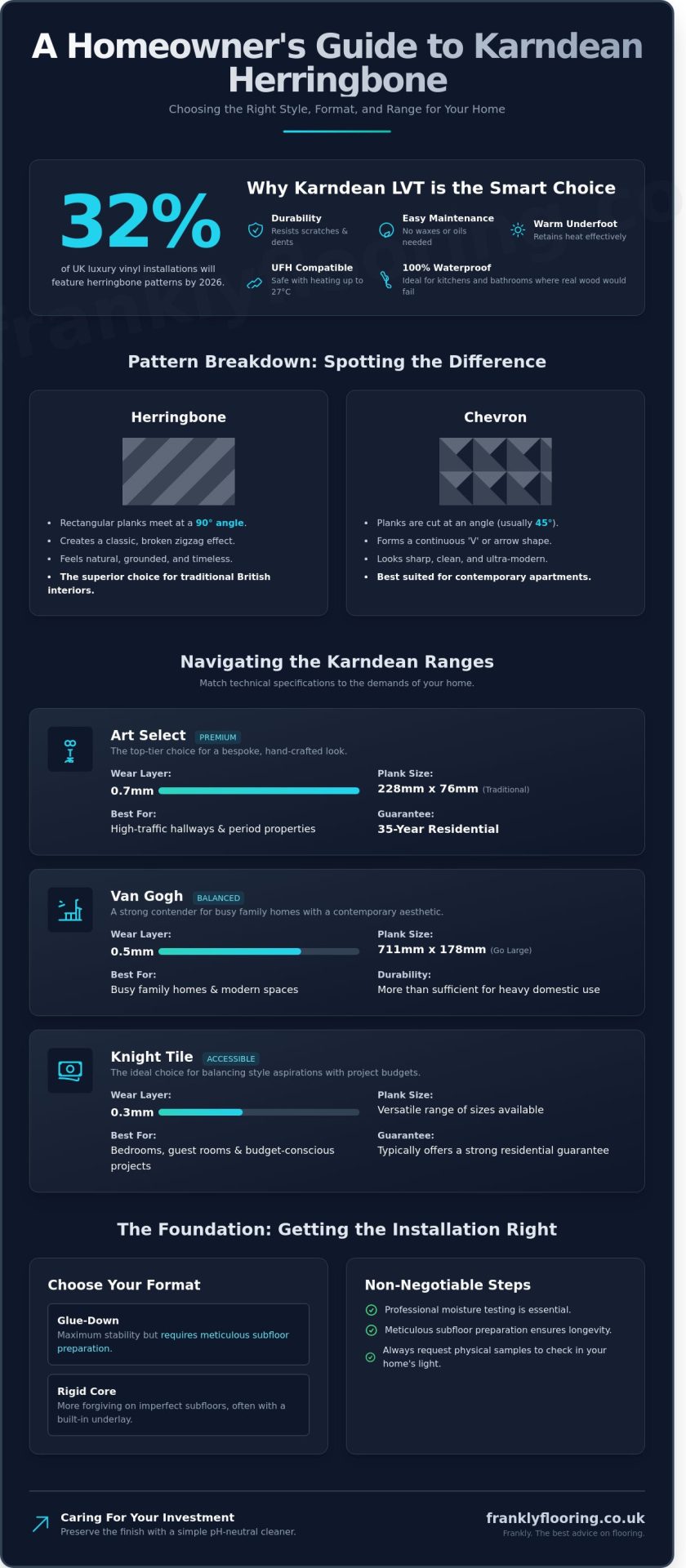
Karndean herringbone isn’t just a floor; it’s a way to bring the classic look of a 19th-century manor into a modern semi-detached home without the headache of sanding and oiling. Frankly, the appeal of this luxury vinyl tile (LVT) lies in its ability to replicate traditional wood parquet with startling accuracy. By 2026, market data suggests that herringbone patterns account for approximately 32% of all luxury vinyl installations in British homes. This isn’t just a passing trend. It’s a shift toward flooring that offers character, texture, and longevity.
Real wood has its charms, but it’s often impractical for a busy household. Natural timber expands when your radiators kick in and can’t handle a spilled drink in the kitchen. Karndean herringbone solves these issues. It’s stable, warm underfoot, and requires nothing more than a quick mop. In smaller spaces like hallways or lounges, the diagonal lines of the pattern draw the eye toward the corners. This creates a visual stretch that makes a narrow Victorian corridor feel wider and more inviting.
- Durability: Unlike real oak, LVT doesn’t scratch or dent when you move furniture.
- Maintenance: There is no need for specialist waxes or oils; a simple pH-neutral cleaner does the job.
- Warmth: It retains heat much better than stone or ceramic tiles, making it comfortable for bare feet.
Herringbone vs Chevron: Spotting the Difference
The main difference is the cut. Herringbone planks are rectangular and meet at a 90-degree angle, creating a broken zigzag. Chevron planks are cut at a mitre, usually 45 degrees, to form a continuous “V” shape. While chevron looks sharp in ultra-modern apartments, herringbone remains the superior choice for traditional British interiors. It guides the eye across the room in a way that feels natural and grounded, whereas chevron can sometimes feel a bit too clinical.
The Practical Benefits of Karndean LVT
Karndean LVT is built for the realities of home life. Most ranges feature a wear layer between 0.5mm and 0.7mm, providing a robust shield against scuffs and pet claws. It’s 100% waterproof, making it a safe bet for bathrooms where real wood would fail within months. Crucially, it’s fully compatible with underfloor heating systems up to 27°C. This ensures your home stays cosy without the risk of the planks warping or lifting over time. It’s a straightforward, high-performance solution for any room in the house.
Navigating the Karndean Ranges: Finding Your Perfect Herringbone Match
Choosing a karndean herringbone floor involves more than just picking a pretty colour. It’s about matching the technical specifications to the demands of your home. Karndean splits their offerings into distinct collections, each with different price points and durability ratings. The cost variation usually stems from the thickness of the wear layer, which is the clear protective coating on top of the design. A thicker wear layer means the floor can withstand more scratches, scuffs, and heavy foot traffic before the pattern itself is affected.
To get the best result, you should request at least three physical samples of your favourite designs. Lighting in a showroom is rarely the same as the natural light in a north-facing lounge or a kitchen with LED spotlights. Place these samples on your floor and watch how the tones shift throughout the day. A cool grey might look modern at noon but feel clinical by 6:00 PM; a warm oak could look honeyed in the sun but turn orange under warm evening bulbs. Taking this step prevents an expensive mistake.
Art Select: The Premium Parquet Experience
Art Select is the top-tier choice for homeowners seeking a bespoke look. These planks feature hand-crafted textures that follow the grain of the wood perfectly. The collection boasts a 0.7mm wear layer, which is the thickest available. This makes it the ideal karndean herringbone option for high-traffic hallways or period properties where you want the floor to last for decades. The standard plank size for this range is 228mm x 76mm, providing a traditional, intricate parquet feel that suits Victorian or Edwardian renovations. It comes with a 35-year residential guarantee, reflecting its heavy-duty construction.
Van Gogh and Knight Tile: Balancing Style and Budget
If you prefer a more contemporary aesthetic, the Van Gogh range is a strong contender. It uses a 0.5mm wear layer, which is more than sufficient for busy family homes. Van Gogh herringbone planks are often larger, measuring 711mm x 178mm. This “go large” approach creates a modern, airy feel that works well in open-plan extensions. It offers a 30-year residential guarantee, providing a solid middle ground between luxury and value.
Knight Tile serves as the entry-level collection. It features a 0.3mm wear layer, making it thinner than the other ranges. While I wouldn’t recommend it for a busy commercial entrance, it’s a brilliant, cost-effective choice for low-traffic areas like bedrooms or guest ensuites. You can find out more about which range suits your specific room by looking at our honest guide to floor durability. Choosing a thinner wear layer in rooms that see less action is a sensible way to manage your budget without compromising on the Karndean style.
- Art Select: 0.7mm wear layer, lifetime/35-year guarantee, traditional small planks.
- Van Gogh: 0.5mm wear layer, 30-year guarantee, larger contemporary planks.
- Knight Tile: 0.3mm wear layer, 10 to 20-year guarantee, most affordable price point.
Choosing the Right Format: Glue-down, Rigid Core, or LooseLay?
Most homeowners spend weeks agonising over the perfect shade of oak, yet they spend five minutes deciding on the installation format. This is a mistake. The way your karndean herringbone is secured to the floor dictates the final aesthetic, the cost of labour, and how the floor handles the quirks of your property. You aren’t just buying a pattern; you’re buying a technical system.
The three main formats offer different solutions for different problems. Glue-down provides the most creative freedom. Rigid Core solves the issues of uneven British subfloors. LooseLay offers speed for specific environments. Understanding these differences helps you avoid expensive mistakes during the fitting process.
The Pros and Cons of Glue-down Herringbone
Glue-down is the traditional method and remains the gold standard for a premium finish. Every individual plank is bonded to the floor with specialist adhesive. This format is the only way to achieve bespoke design features. If you want a “shaker” style perimeter or contrasting borders that frame the room, glue-down is the essential choice. It feels solid underfoot and eliminates any “bouncing” sensation.
The drawback is the demand for perfection. Glue-down requires a subfloor that is flat, dry, and free of debris. In most UK homes, this means professional subfloor preparation is mandatory. This involves installing 6mm or 9mm marine-grade plywood over timber or applying a smoothing compound over concrete. Because the material is thin, any bump in the base will eventually show through. We always suggest professional fitting for this format. It’s a skilled job that requires a steady hand and a deep understanding of adhesive cure times.
Rigid Core: A Problem-Solver for UK Homes
Many UK properties, particularly Victorian terraces or 1930s semis, have subfloors that are far from level. Karndean Rigid Core is a click-locking system designed to bridge these gaps. Its solid heart doesn’t flex, which means it can be fitted over existing hard floors like ceramic tiles or floorboards with minimal fuss. The built-in acoustic underlay is a significant benefit, often reducing noise transfer by up to 21dB. This makes it a quiet, warm choice for busy households.
While Rigid Core is often marketed as “DIY-friendly”, it has limitations. The click-lock mechanism means you can’t easily incorporate the complex borders or tramlines found in glue-down ranges. You are essentially trading design flexibility for a faster, cleaner installation. It’s an honest trade-off. If your priority is a beautiful karndean herringbone floor without the week-long upheaval of intensive floor prep, Rigid Core is your best bet.
LooseLay is the third option, using a friction-grip backing to hold the planks in place. It’s a specialist choice, often used in commercial settings or temporary retail spaces where the floor needs to be lifted quickly. While available in herringbone patterns, it’s less common in residential living rooms because it lacks the permanent feel of the other two formats.
Preparation and Fitting: Getting the Foundation Right
To be perfectly frank, your new floor is only as good as the surface beneath it. Because Karndean is a luxury vinyl tile (LVT), it’s designed to be thin and flexible. This means it will telegraph every lump, bump, or imperfection in your subfloor. If your floor isn’t flat, your karndean herringbone pattern won’t align properly, and you’ll end up with unsightly gaps or “lipping” where tiles meet. It’s a mistake that’s difficult and expensive to fix once the adhesive has set.
Testing for moisture is a non-negotiable step, particularly for ground floors or new-build homes. In the UK, we follow BS 8203 standards, which dictate that a subfloor must have a relative humidity (RH) level below 75% before fitting begins. If it’s higher, you’ll need a liquid damp-proof membrane (DPM) to prevent the adhesive from failing and the tiles from lifting. We’ve seen many DIY attempts fail because this one 10-minute test was skipped.
Subfloor Preparation Checklist
We don’t cut corners when it comes to the base. A professional finish requires a meticulous approach to the following steps:
- Clear the deck: You must remove all old floor coverings, carpet grippers, and every scrap of stubborn adhesive residue.
- The 3mm rule: Your subfloor must be level to within a 3mm deviation over a 2-metre span. We use high-quality self-levelling compounds on concrete or 6mm SP101 grade plywood on timber floors to achieve this.
- Acclimatisation: Karndean planks need to adjust to your home’s environment. Place the boxes flat in the room for at least 24 to 48 hours before the fitting starts.
The Fitting Process: What to Expect
Fitting a karndean herringbone floor is an art form that starts in the middle of the room, not at the wall. We establish a “spine” down the centre of the space. This ensures the pattern is perfectly balanced and doesn’t look skewed when you walk through the door. It takes significantly more time to set out than a standard plank, but the result is a symmetrical, bespoke look that defines the room’s character.
Precision is everything during the final lay. We maintain a consistent expansion gap around the perimeter to allow for natural movement. While the main floor is bonded with heavy-duty pressure-sensitive adhesive, we use professional tools and the correct carpet adhesive spray for specific perimeter details to ensure a seamless finish. We don’t rush this. A standard 20-square-metre room usually takes a skilled fitter two full days to prepare and lay correctly.
Caring for Your Investment: Maintenance and Long-Term Value
Choosing a karndean herringbone floor is an investment in your home’s aesthetic and its future resale value. While the durability of Luxury Vinyl Tile is legendary, it isn’t indestructible. Maintaining that fresh, out-of-the-box look requires a straightforward approach rather than a complex cleaning regime. Daily care is as simple as a quick sweep or vacuum with a soft brush attachment to remove loose grit. This is vital because approximately 80 percent of floor scratches are caused by dirt particles being ground into the surface by foot traffic.
When it comes to mopping, avoid the temptation to grab a generic supermarket floor cleaner. Many high-street brands contain soaps or high-alkaline chemicals that leave a cloudy residue on the textured grain, making your floor look dull over time. We always recommend the Karndean Clean system. It’s a pH-neutral solution designed to break down dirt without damaging the protective wear layer. It’s better for the floor, and frankly, it makes the weekly chore much faster.
Physical protection is the final piece of the puzzle. Use heavy-duty felt pads on the bottom of all furniture legs, especially chairs that move frequently. We also advise placing high-quality entrance mats at every external door. A good mat can trap up to 90 percent of tracked-in moisture and debris, significantly extending the life of your floor’s finish.
Routine Maintenance Tips
- Dealing with spills: LVT is the undisputed king of kitchen flooring. Unlike real wood or laminate, it’s waterproof. If you drop a glass of wine or a pan of water, it won’t soak in or warp the boards. Just wipe it up and move on.
- Deep cleaning: Every 12 to 18 months, your floor will benefit from a “Remove and Refresh” treatment. This process strips away any stubborn grease and applies a fresh protective film to restore the original satin glow.
- Repairing damage: One of the biggest benefits of a glue-down karndean herringbone system is its modular nature. If a single plank is badly gouged, a professional can heat the adhesive, lift the damaged piece, and fit a new one without disturbing the rest of the room.
Why Order from Frankly Flooring?
We are a family-run business with over 20 years of experience in the flooring trade. We don’t believe in high-pressure sales or confusing jargon. Our goal is to provide honest, no-nonsense advice so you get the right floor for your specific needs. We offer transparent pricing across our entire range and provide reliable nationwide UK delivery to your doorstep. We handle the logistics so you can focus on the transformation of your home. Ready to start? Browse our Karndean Herringbone collection today and see the quality for yourself.
Taking the Next Step with Karndean Herringbone
Choosing the right karndean herringbone floor is about more than just picking a pretty pattern; it’s a decision that balances personal style with the practical needs of your home. Whether you opt for the permanent finish of a glue-down range or the swift fitting of a rigid core format, the result is a timeless aesthetic that stands up to daily life. We’ve spent over 20 years as a family-run business helping homeowners navigate these choices without the fluff or high-pressure sales tactics. You deserve a floor that’s fitted properly and built to last.
At Frankly Flooring, we believe in straightforward advice and direct-to-consumer prices that keep premium LVT affordable. We know that getting the subfloor preparation right is just as vital as the tiles you choose. If you’re still weighing up your options, you can read our expert guide on what is LVT flooring to understand the technical benefits. Our team is ready to help you find a floor that fits your lifestyle and your budget perfectly.
Explore our range of Karndean Herringbone LVT and order your samples today
We’re looking forward to helping you transform your home with a quality floor you’ll love for years to come.
Frequently Asked Questions
Is Karndean herringbone suitable for bathrooms?
Yes, Karndean herringbone is completely waterproof and ideal for high-moisture areas like bathrooms or en-suites. Unlike natural oak or laminate, these luxury vinyl tiles won’t swell, warp, or crack when they get wet. Most ranges also carry an R10 slip resistance rating, which provides a safer surface underfoot for your family when stepping out of the shower.
Can I fit Karndean herringbone myself or do I need a professional?
You should hire a professional floor layer because herringbone is one of the most complex patterns to install correctly. Setting out the central spine requires 100% accuracy to prevent the pattern from running squint across the room. Frankly, DIY attempts often lead to expensive mistakes and may void your Karndean lifetime warranty if the subfloor isn’t prepared to British Standards.
How much extra flooring should I order for a herringbone pattern?
You should order 10% to 15% extra material to account for the increased wastage created by the pattern. Because the planks meet the walls at 45-degree angles, there are significantly more cuts required than a standard straight-lay floor. Ordering a 15% buffer ensures your fitter has enough planks to complete the perimeter detail without delays or batch colour variations.
Is Karndean herringbone scratch-proof for pets?
Karndean herringbone is highly scratch-resistant but no floor is entirely scratch-proof. Each plank features a protective K-Guard+ surface coating that handles pet claws and heavy foot traffic better than real timber. If a 30kg dog skids across the floor, it might leave a mark, but the durable 0.5mm or 0.7mm wear layer provides the best protection available in modern flooring.
Do I need underlay for Karndean herringbone flooring?
The requirement for underlay depends entirely on whether you choose the Gluedown or Rigid Core range. Gluedown planks are bonded directly to a prepared subfloor and don’t use underlay at all. If you choose a Karndean herringbone Rigid Core product, it often comes with a pre-attached acoustic backing that reduces noise transfer to rooms below by up to 21dB.
What is the difference between Karndean Art Select and Knight Tile?
The primary differences are the wear layer thickness and the level of realistic detail in the design. Knight Tile is the entry-level range with a 0.3mm wear layer, making it a budget-friendly choice for domestic use. Art Select is a premium collection featuring a 0.7mm wear layer and handcrafted textures that mimic the grain of real wood 100% more accurately.
Can Karndean herringbone be laid over underfloor heating?
Yes, all Karndean herringbone products are compatible with underfloor heating systems up to a maximum temperature of 27°C. It’s vital that the heating system is switched off 48 hours before fitting and remains off for 48 hours after the job is finished. This allows the adhesive to cure properly and prevents the planks from shifting or gapping as the temperature fluctuates.
How long does Karndean herringbone flooring last?
You can expect your Karndean herringbone flooring to last between 20 and 35 years in a typical family home. Many of the premium ranges come with a lifetime residential guarantee, reflecting the brand’s confidence in their product’s durability. To reach this lifespan, you must ensure your subfloor is perfectly flat and use the manufacturer’s recommended cleaning solutions instead of harsh bleach.