
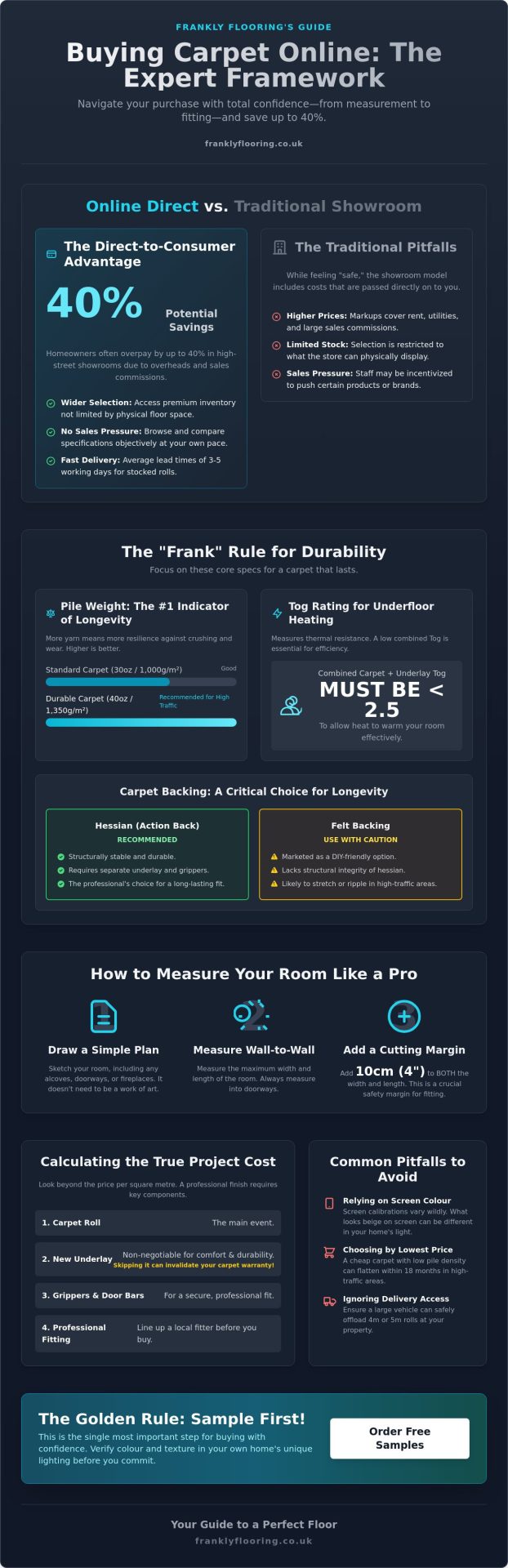
According to 2025 industry price comparisons, homeowners often overpay by up to 40% when they source flooring exclusively from traditional high-street showrooms. While a physical shop feels like a safety net, the reality of buying carpet online uk in 2026 is that it offers far better value and a much wider selection. We know the risks feel high. It’s natural to worry that your laptop screen is masking the true colour of a pile or that a small error in your measurements will result in a wasted roll of wool blend.
Frankly, you shouldn’t have to choose between a fair price and a professional finish. We agree that technical terms like Saxony or twist can feel like a different language designed to keep you in the dark. This guide provides a straightforward, expert-led framework to help you measure with precision and select materials with total confidence. We will walk you through the entire journey from ordering samples to the final sweep-up after fitting, ensuring you get a durable, high-quality carpet without the showroom premium.
Key Takeaways
- Learn how the direct-to-consumer model makes buying carpet online uk the most transparent way to access premium inventory without the usual showroom markups.
- Discover the “Frank” rule for durability, focusing on pile weight and why the choice between hessian and felt backing is critical for the longevity of your floor.
- Master the art of professional measuring by using a simple floor plan and adding a 10cm cutting margin to avoid common fitting mistakes.
- Understand the true project budget, including why skipping new underlay can invalidate your warranty and lead to higher costs in the long run.
- See why our “Sample First” approach is essential for verifying colour and texture under your own home’s unique lighting before you commit to a purchase.
The Reality of Buying Carpet Online in the UK: Is It Right for You?
Buying carpet online in the UK has evolved into a transparent, direct-to-consumer process that prioritises your budget over a retailer’s overheads. In the past, you had to visit a retail park, deal with high-pressure sales staff, and settle for whatever was in stock. Now, the model has shifted. By bypassing the physical showroom, online retailers remove the costs of expensive floor space and large sales commissions. This allows for a much wider inventory and lower price points that physical stores simply cannot match.
By 2026, the industry has refined its logistics to a professional standard. You can expect real-time GPS tracking for your delivery and lead times that have dropped to an average of 3 to 5 working days for stocked rolls. While some feel hesitant about not touching the fabric first, the modern sampling process solves this. Reputable sites now dispatch swatches within 24 hours, letting you examine the Carpet construction and materials in your own home. It’s a straightforward way to see how a wool blend or a durable synthetic performs under your specific lighting conditions.
The Pros and Cons of Skipping the Showroom
The primary benefit is the lack of sales pressure. You can browse at your own pace without a floor manager hovering nearby. This honest approach lets you compare specifications objectively. However, you must be prepared to manage the measurements yourself. Accuracy is vital. We also recommend having a local fitter lined up before you click buy. Most independent fitters prefer working with high-quality rolls you’ve sourced yourself, as it keeps the project timeline clear and manageable.
Avoiding Common Online Carpet Buying Pitfalls
Don’t rely solely on your smartphone screen to pick a shade. Screen calibrations vary, and a “warm beige” can look entirely different in a north-facing room. Always use the sampling service. Another pitfall is choosing based on the lowest price alone. If the pile density is too low for a high-traffic area like a hallway, the carpet will likely flatten within 18 months. Cheap often ends up being expensive if you have to replace it twice as fast. Finally, check your delivery access. British streets are notoriously narrow, so ensure a delivery vehicle can safely offload 4m or 5m rolls at your property.
When you approach buying carpet online uk with a clear plan, it’s a seamless experience. It’s about being informed and taking control of your home renovation. We believe in providing the facts so you can make a decision that lasts for years, not just until the next trend arrives.
Understanding Carpet Specifications: A Frank Guide to Materials and Piles
When buying carpet online uk, you’re relying on technical data rather than the “hand-feel” you get in a traditional showroom. To make an informed choice, you need to look past the pretty photos and focus on the specifications. Pile weight is your primary indicator of longevity. A carpet with a pile weight of 40oz (approximately 1,350g/m²) contains more yarn than a 30oz (1,000g/m²) version, which means it will resist crushing and wear for much longer. It’s a simple equation: more material equals a longer lifespan.
The Frank rule for any savvy buyer is to always check the backing type. Most quality carpets use a hessian backing, also known as action back. This requires a separate underlay and grippers to ensure a stable, long-lasting fit. You’ll also see felt-backed carpets which are often marketed as a DIY-friendly option that doesn’t need underlay. Frankly, we advise against this for main living areas. Felt backing lacks the structural integrity of hessian and will likely stretch or ripple within 24 months in high-traffic spots.
UK homeowners also need to consider Tog ratings, especially with the rise of underfloor heating. A carpet’s Tog rating measures its thermal resistance. For underfloor heating to work efficiently, the combined Tog of your carpet and underlay should not exceed 2.5. If the rating is too high, your carpet acts as an insulator, trapping the heat underneath the floor instead of letting it warm your room. If you find that a product’s specifications are misleading or if the delivered goods don’t match the description, your consumer rights provide a safety net for online purchases.
Choosing Between Wool, Polypropylene, and Blends
Wool is the natural, resilient choice for living rooms. It’s sustainable, flame-retardant, and has a natural “bounce back” that prevents tracking. However, it requires specialist cleaning. Polypropylene is the “life-proof” alternative for families. It’s inherently stain-resistant and bleach-cleanable, making it ideal for dining rooms where spills are inevitable. Many British homes opt for an 80/20 blend, which mixes 80% wool for luxury with 20% synthetic fibre for added durability.
Pile Types Explained: Twist, Saxony, and Berber
Twist piles are the workhorses of the UK home. The yarn is tightly twisted to create a slightly textured surface that hides footprints and vacuum marks, making it the best choice for busy hallways and stairs. Saxony piles offer a deep, cut-pile finish that feels incredibly soft underfoot. It’s pure luxury for a master bedroom, though it will show every footprint. Berber or loop piles are durable and modern, but they come with a specific warning for cat owners. Claws can easily snag the loops, leading to unsightly pulled threads that are difficult to repair.
- Hallways & Stairs: High-density Twist (80/20 blend recommended).
- Living Room: Wool Twist or deep Saxony for comfort.
- Dining Room: Polypropylene (must be bleach-cleanable).
- Bedrooms: Luxury Saxony or soft Polyester.
Selecting the right specification ensures your investment looks as good in five years as it does on fitting day. If you want to see how these materials look in a real-world setting, you can browse our curated collections to find the right match for your project.
How to Measure for Your New Carpet Like a Professional
Accurate measurements are the difference between a seamless finish and a costly mistake. When you’re buying carpet online uk, you don’t have a fitter on-site to double-check your math before the order is placed. Start with a clear sketch of the floor plan. You don’t need to be an architect; a simple birds-eye view on a piece of paper will do. Mark every alcove, chimney breast, and doorway clearly.
Most UK manufacturers produce rolls in standard widths of 4 metres and 5 metres. If your room measures 4.1 metres at its widest point, you should opt for the 5-metre width. While it feels like paying for extra material, a single piece of carpet is always superior to a join. Seams often become dirt traps and can fray over time, especially in high-traffic areas like hallways or lounges. Ordering the correct width also simplifies the job for the fitter, which can often lead to a smoother installation process.
Frank Tip: Always measure into the door frame. Many people make the mistake of stopping their tape measure at the skirting board. You must measure to the halfway point under the door where the carpet will meet the next floor type. If you don’t, you’ll end up with an unsightly gap between rooms that even a threshold bar won’t cover.
Measuring Simple Rectangular Rooms
Use the “cross-hair” method by measuring the absolute maximum length and width of the room, passing through the centre. This ensures you catch the widest points, even if the walls aren’t perfectly parallel. Don’t ignore fixed objects like radiator pipes or the footprint of fitted wardrobes. You must measure right into the back of any alcoves. Cutting waste is the essential 10cm safety margin added to your final dimensions to account for wonky walls and minor trimming during fitting. In a typical UK Victorian terrace, walls can be out of alignment by as much as 5cm from one end to the other, so that extra 10cm is your insurance policy.
The Complexity of Stairs, Hallways, and Landings
Stairs require a bit more arithmetic than a standard bedroom. You need to count your “risers” (the vertical part of the step) and “treads” (the horizontal part you step on). Add the height of one riser and the depth of one tread together, then multiply by the number of steps to find your total linear length. Consistency is vital here. You must ensure the pile direction, often called the “nap,” runs the same way from the landing down the flight of stairs. If the nap is reversed, the carpet will look like two different colours because of how light hits the fibres. Proper preparation is key to a long-lasting stair carpet, so ensure you read our carpet gripper guide to get your stairs ready for a professional fit. Always add an extra 15cm to your final stair calculation to allow for the wrap around the top and bottom steps.
Calculating the True Cost: Beyond the Price Per Square Metre
When you’re buying carpet online uk, the price you see on the screen is rarely the final figure you’ll pay. To avoid surprises, you should budget for the carpet itself to represent approximately 60% of your total project spend. The remaining 40% covers the essential components that ensure your floor lasts for its intended lifespan.
Frankly, the biggest mistake homeowners make is trying to save money by reusing old underlay. It’s a false economy. Old underlay is already compressed, full of years of dust, and lacks the structural integrity to support new fibres. Most UK manufacturers will void your wear warranty immediately if you don’t install new underlay. Beyond the padding, you must factor in the cost of grippers, door bars to bridge the gaps between different floor types, and specialist adhesives for stairs. Delivery levels also impact your bottom line. A basic “to the door” service is standard, but if you live in a flat or can’t lift heavy rolls, a “room of choice” service is a necessary upgrade that usually adds £25 to £45 to your delivery fee.
The Essential Role of Underlay and Grippers
Underlay isn’t just a hidden extra; it’s the engine room of your carpet. A high-density PU foam underlay, usually between 10mm and 11mm, offers the best balance of comfort and thermal insulation. This density protects the carpet backing from premature wear. Your choice of padding depends heavily on the room’s usage; choosing the right carpet involves pairing the material with an underlay that can handle the specific footfall of that area. You also need the correct grippers for your subfloor. Wood-floor grippers feature long nails that bite into floorboards, whereas concrete-floor grippers use specialized pins designed to prevent the subfloor from cracking during installation.
Factoring in Delivery, Trimming, and Fitting Costs
In 2026, professional fitting rates in the UK generally sit between £5.50 and £7.50 per square metre. Most independent fitters now apply a minimum call-out charge of £75 to £95 for smaller areas like landings or box rooms. You should also prepare for the “door trim” issue. Because modern carpets and high-density underlays are often thicker than older products, your doors may not clear the new floor height. A fitter will typically charge between £15 and £30 per door to trim them down. Finally, consider the disposal of your old flooring. Professional uplift and removal services usually cost around £3.00 per square metre. This is often more cost-effective than hiring a skip, which currently averages over £250 in many UK council areas.
Want a transparent breakdown for your next project? Get an honest quote from Frankly Flooring today.
Ordering with Confidence: Samples, Delivery, and Next Steps
Buying carpet online uk shouldn’t feel like a gamble. At Frankly Flooring, we believe in a straightforward process that removes the guesswork. Our descriptions are honest, and the price you see is the price you pay. We don’t hide extra costs in “cutting fees” or “processing charges” at the final checkout. Once you’ve narrowed down your choices, the final steps are about verification and preparation to ensure your home transformation is seamless.
Why Free Samples are Non-Negotiable
Screens lie, but textures don’t. A shade that looks like a warm beige on your phone might look like a cold grey in a north-facing British lounge. We recommend ordering 3 to 5 variations of your preferred style. This allows you to compare subtle shifts in tone against your existing skirting boards and furniture at different times of day. Natural morning light and evening lamplight will change how the pile reflects colour.
Don’t just look at the sample; test it. Perform a “crush recovery” test by placing a heavy object, like a cast-iron pan or a stack of books, on the sample for 60 minutes. Once removed, see how quickly the fibres spring back. This gives you a realistic expectation of how the carpet will handle furniture legs over the next 10 years. The reality of buying carpet online uk is that success depends on the physical testing you do before the roll even arrives.
Receiving Your Delivery and Preparing for the Fitters
Standard carpet rolls are often 4 metres wide and can weigh upwards of 75kg. Most delivery drivers operate on a kerbside or “to the door” basis, so ensure at least one capable person is home to help move the roll inside. Before the fitting date, clear the room entirely. This includes removing all furniture and giving the subfloor a thorough vacuuming to remove grit that could degrade the carpet backing over time.
- Acclimatise: Lay the carpet flat in the target room for at least 24 hours before fitting. This allows the backing to settle and reach room temperature, making it more pliable for the fitter.
- Inspect: Unroll the first metre to check for manufacturing defects or transit damage. It’s much easier to resolve an issue before the carpet is cut and tucked.
- Clearance: Check that your doors will clear the new pile height. You might need to trim the bottom of your doors by 5mm to 10mm if you’ve chosen a thick saxony and high-quality underlay.
Taking these final steps ensures that when your fitter arrives, the job goes quickly and the finish is professional. Ready to start your project? Browse our full range of carpets and order your free samples today.
Take the Next Step Toward a Better Home
Choosing the right flooring is a foundational decision for your home’s character. Buying carpet online uk doesn’t have to be a gamble when you focus on technical specifications and accurate measurements. You now know how to calculate the true cost of a project, looking past the initial price per square metre to include essential extras like underlay and fitting accessories. This transparency is exactly how we’ve operated as a family-run business for over 20 years. We believe in direct, honest communication without any hidden fees or high-pressure sales tactics.
Our team manages everything from the initial advice to direct delivery across the UK, ensuring your experience is seamless and professional. We’ve built our reputation on being the reliable experts you can trust with your house keys. It’s about getting the job done right. Before making your final choice, it’s vital to see the materials in your own light and space. This prevents surprises and ensures the durability meets your specific household needs. We’re ready to help you get your project moving with the same care we’d give our own homes.
Explore our honest range of carpets and order your free samples today
Frequently Asked Questions
Is it cheaper to buy carpet online or in-store?
Frankly, you’ll usually find lower prices online. Digital retailers avoid the high business rates and staffing costs of a physical showroom, which can save you up to 25% on the list price. However, you must factor in delivery fees and the cost of a local fitter. A cheap online deal looks less attractive if you have to pay £15 per square metre for a third-party fitting service.
How do I know what width of carpet I need?
Most UK carpets are manufactured in standard widths of 4 metres or 5 metres. You should measure the widest part of your room and add 10cm for cutting and trimming. If your room is 4.2 metres wide, you’ll need a 5-metre roll to avoid unnecessary seams. Buying carpet online uk requires precision, so double-check your measurements against these standard roll sizes before ordering.
Can I fit a carpet myself if I buy it online?
You can fit a carpet yourself, but we don’t recommend it for most homeowners. Professional fitting ensures the carpet is stretched correctly using a knee-kicker, which prevents ripples and premature wear. Industry data suggests a poorly fitted carpet can lose 30% of its lifespan. If you choose the DIY route, ensure you have the right grippers and a sharp utility knife for a clean finish.
What is the best carpet material for high-traffic areas like stairs?
An 80% wool and 20% nylon blend is the gold standard for stairs. This specific ratio provides the natural resilience of wool with the added durability of synthetic fibres. For a more budget-friendly option, look for a “heavy domestic” rated polypropylene with a high twist count. These materials resist flattening even after thousands of footsteps, keeping your hallway looking fresh for years.
Do online carpets come with a warranty?
Yes, most reputable online retailers provide a 10-year or 15-year wear warranty as standard. You’ll often see a separate stain guarantee for synthetic carpets, which can last up to 20 years. Always check the manufacturer’s documentation for specific terms. These warranties usually require professional fitting and a new underlay to remain valid, so keep your receipts for both services to ensure you’re covered.
How long does delivery usually take when buying carpet online in the UK?
Delivery typically takes between 3 and 7 working days for items in stock. If you order a bespoke range, this can extend to 14 days. Most UK couriers provide a 2-hour delivery window on the day. Since carpet rolls are heavy, often weighing over 50kg, ensure someone is available to help the driver move the roll into a ground-floor room safely.
What happens if I measure the room incorrectly?
If you measure incorrectly, you’ll likely have to pay for a replacement. Most online carpet is cut to your specific dimensions, meaning it’s exempt from standard 14-day return rights under UK Consumer Contracts Regulations. A 5cm mistake could leave you with a visible gap or an expensive waste of material. We suggest measuring twice and drawing a floor plan to avoid these costly errors.
Should I buy my underlay from the same place as my carpet?
Buying your underlay and carpet together is the most straightforward way to ensure compatibility. Using a high-quality 10mm or 11mm polyurethane foam underlay can improve heat insulation by up to 15%. When you source both from the same supplier, you often save on delivery costs. It also simplifies things if you ever need to make a warranty claim regarding the carpet’s performance over time.