
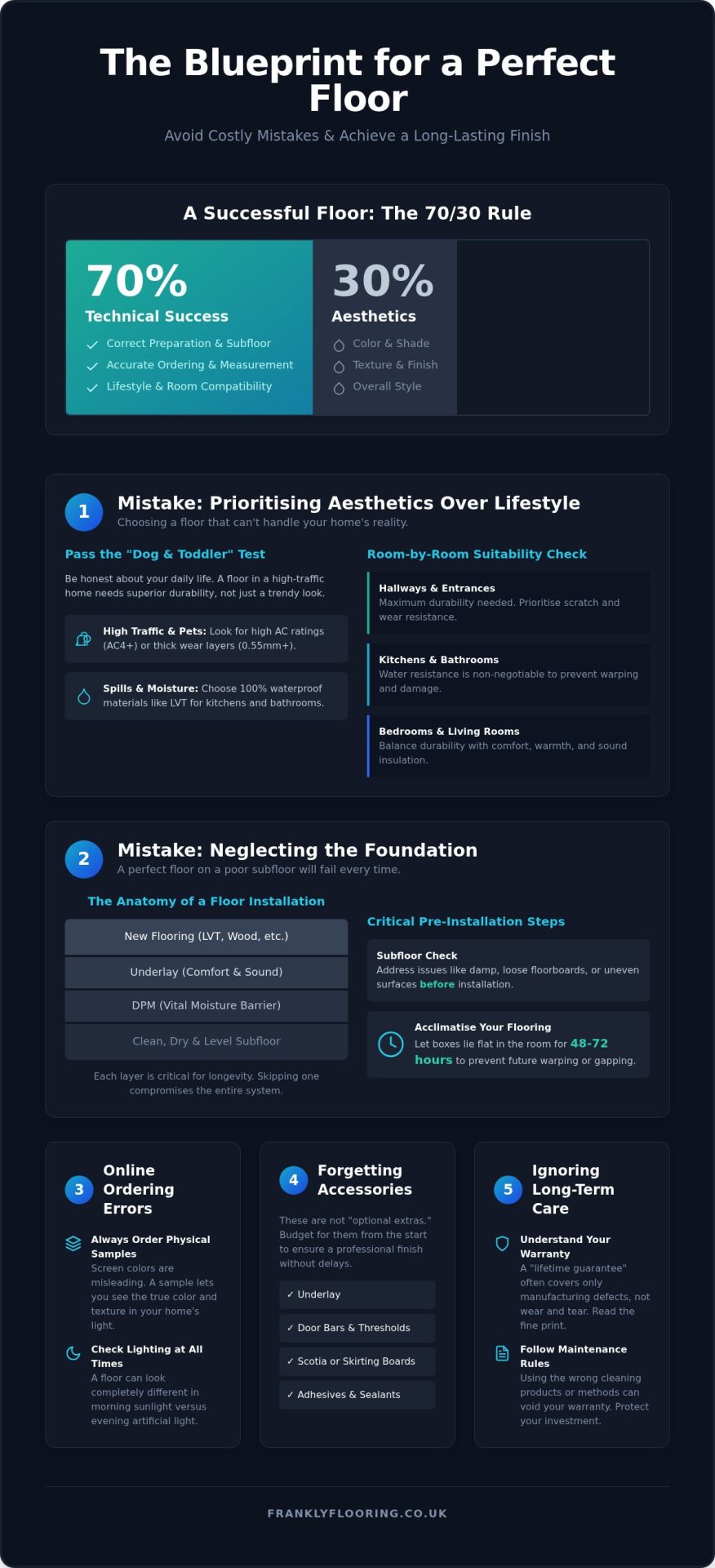
A successful floor is 30% aesthetics and 70% preparation, ordering accuracy, and lifestyle compatibility. While most homeowners spend weeks obsessing over the perfect shade of oak or the softest carpet pile, they often overlook the technical nuances that actually determine longevity. Understanding the common flooring buying mistakes to avoid is the difference between a stunning home renovation and a costly mid-project disaster. Frankly, it’s easy to feel overwhelmed by AC ratings, wear layers, and subfloor requirements; getting it right shouldn’t feel like a gamble.
We know that choosing a new floor for your UK home is a significant investment. The fear of picking a material that won’t stand up to your family’s daily life is completely valid, especially when hidden costs for accessories like underlay or door bars start to mount up. This guide will strip away the marketing jargon to show you exactly how to secure a beautiful, long-lasting finish without the typical stress. We’ll walk through everything from identifying hidden installation costs to choosing the right specifications for your specific household needs, giving you total confidence in your online purchase.
Key Takeaways
- Learn why prioritising looks over your household’s daily reality is one of the most common flooring buying mistakes to avoid and how to pick a material that truly lasts.
- Understand why your subfloor is the most critical part of the project and how to identify typical UK issues like damp or loose floorboards before you start.
- Discover the importance of ordering physical samples to see how your chosen floor reacts to your home’s unique lighting conditions rather than relying on a digital screen.
- Ensure a professional finish by accounting for essential accessories like underlay and door bars early in your budget to avoid mid-project delays and unexpected costs.
- Protect your investment by learning the difference between wear warranties and lifetime guarantees, including the specific maintenance habits that keep them valid.
Prioritising Aesthetics Over Lifestyle Realities
Choosing a floor based solely on a high-resolution photo is a recipe for regret. A floor that looks pristine in a studio setting might look like a disaster after a week of real-life use. We see it often: homeowners falling in love with a delicate, pale wood only to realise it cannot handle the grit from a gravel driveway or the claws of a Golden Retriever. This is where the “Dog and Toddler” test becomes vital. If your household involves high traffic, spilled juice, or pets, you need a material with a robust wear layer. While natural wood offers unmatched character, Luxury Vinyl Tiles (LVT) often provide the resilience needed for busy British homes without sacrificing the aesthetic.
Understanding the balance between beauty and utility is essential. One of the most common flooring buying mistakes to avoid is ignoring the physical demands of your specific environment. A floor that is too soft will dent under furniture, while a floor that is too smooth can become a skating rink for the family dog. It’s about being frank with yourself about how you actually live, rather than how you want your home to look in a single staged photograph.
The Problem with Trends vs. Longevity
“Instagrammable” floors often fail the reality check of a British winter. Those trendy, high-gloss finishes show every muddy footprint and speck of dust, turning maintenance into a full-time job. Instead, consider matte or textured finishes. They hide minor scratches and daily wear far better than their shiny counterparts. Trends fade, but a floor is a long-term foundation. Choosing a timeless oak effect or a neutral stone look ensures your home doesn’t feel dated in three years. Focus on the physical texture; a slight grain doesn’t just look natural, it provides essential slip resistance when you’re coming in with wet boots.
Room-by-Room Suitability Check
Each area of your home has unique demands. Ignoring these room-specific requirements is another of the common flooring buying mistakes to avoid. You shouldn’t treat a guest bedroom the same way you treat a busy entrance hall.
- Kitchens and bathrooms: Water resistance is non-negotiable. Steam and occasional leaks will warp standard laminate or solid wood. Opt for 100% waterproof LVT or vinyl to ensure the floor doesn’t lift or swell.
- Bedrooms: You can afford to prioritise comfort here. While durability still matters, sound insulation and a warmer underfoot feel are often more important than a commercial-grade AC rating.
- Hallways: This is your home’s frontline. You need a high AC rating (AC4 or AC5) or a thick wear layer (0.55mm+) to survive the constant friction of foot traffic and outdoor debris.
Matching material properties to the specific moisture and heat levels of a room prevents premature failure. It’s a simple step that saves thousands in replacement costs later.
Neglecting the Foundation: Subfloor and Moisture Pitfalls
Your new floor is only as good as the surface beneath it. One of the most common flooring buying mistakes to avoid is treating subfloor preparation as an afterthought in your budget. In many UK homes, especially older properties, you’ll encounter damp, unevenness, or loose floorboards that can ruin an expensive installation within weeks. If you ignore these issues, your high-quality LVT or wood will eventually crack, lift, or develop annoying squeaks. Prep isn’t just a suggestion; it’s a structural requirement that ensures your floor stays flat and functional for decades.
Acclimatisation is another critical step often skipped in the rush to finish a project. Installing wood or LVT the day it arrives is a major error. These materials need time to adjust to your home’s specific temperature and humidity levels. Typically, this means leaving the boxes flat in the room for at least 48 to 72 hours. Skipping this step leads to planks warping or gaps appearing as the material shrinks or expands after it’s been laid. It’s a simple wait that prevents a massive headache later.
Moisture: The Silent Floor Killer
Moisture testing is essential for any ground-floor installation. Even if a concrete slab looks dry, it can still hold enough residual moisture to destroy your floor’s adhesive or cause wood to swell. A Damp Proof Membrane (DPM) acts as a vital shield, protecting your investment from rising damp. UK weather also brings significant humidity swings. These changes cause natural materials to move, so ensuring your subfloor is dry and using the correct underlay is non-negotiable for long-term stability.
Levelling and Smoothing
A perfectly level subfloor is the secret to a professional finish. For concrete, you might need a self-levelling compound to iron out dips and ridges. For timber subfloors, plywood overboarding is often the best way to create a flat, stable surface. If your floorboards have a “bounce,” a modern click-system will eventually fail under the pressure of foot traffic. Identifying these issues early allows you to fix the underlying structure before the first plank is laid. You can find all the necessary flooring accessories and tools to handle these preparation stages properly on our site. Remember, a clean, grit-free surface is the only way to ensure your adhesive or underlay performs as intended.
Online Ordering Errors: Samples, Lighting, and Quantity Calculation
Buying a whole house of flooring based on a digital screen is a gamble you don’t need to take. While modern photography is excellent, your laptop screen or smartphone cannot replicate the physical texture or the way a specific finish interacts with your room’s unique environment. One of the most common flooring buying mistakes to avoid is skipping the sample stage. A colour that looks like a warm “honey oak” online might appear surprisingly grey in a north-facing room with limited natural light. You need to see the product in your own space, under your own conditions, before committing your budget.
Lighting is the most deceptive factor in flooring selection. A sample that looks perfect in a bright, sunlit kitchen will look completely different in a dim hallway or under warm LED spotlights in the evening. This shift in appearance can lead to major disappointment once the full floor is laid. Beyond colour, ordering the exact square meterage of your room is a recipe for disaster. You must account for the “waste factor.” Between intricate cuts around door frames and the occasional measurement error, you’ll find that an exact order leaves you short, often at the most critical point of the installation.
How to Properly Use Flooring Samples
When your samples arrive, don’t just glance at them in the hallway. Move them around. Place them against your skirting boards and next to your existing furniture at different times of the day. You should view them in natural daylight and again under your artificial evening lights. We also recommend a “stress test.” Don’t be afraid to try and scratch the sample with a key or spill a bit of coffee on it. It’s better to discover how a material handles a stain now than after you’ve spent thousands on the full project.
The Frank Guide to Measuring and Estimating
Calculating square meterage for complex or L-shaped rooms requires a methodical approach. Break the space down into simple rectangles, calculate each area, and then add them together. Always apply the 10% rule. This extra buffer covers your cuts, mistakes, and provides a small stash for future repairs. This is particularly vital because of batch matching. Manufacturers often produce flooring in runs; if you order “one more box” six months later, the colour might not perfectly match your original batch. Keeping one spare box from your specific production run is the only way to ensure a seamless repair if a plank gets damaged years down the line.
Forgetting the Finishing Touches: Underlay and Accessories
Many homeowners spend months debating the exact shade of grey for their new carpet or the grain pattern of their LVT, only to treat accessories as an afterthought. This is one of the most common flooring buying mistakes to avoid. Your floor isn’t just the visible surface; it’s a complete system. If you scrimp on the “invisible” elements, you risk the structural integrity and the final look of the entire project. Professional-grade adhesives, the correct spacers, and high-quality tools are what separate a DIY-looking mess from a showroom finish.
The “Door Bar” dilemma is a classic example of poor planning. If you haven’t calculated the combined height of your new floor and its underlay, you might find that your internal doors no longer close. Shaving down doors is an avoidable expense if you choose the right profiles from the start. Similarly, expansion gaps are essential for wood and laminate. Accessories like scotia or new skirting boards aren’t just decorative; they are functional covers that allow your floor to breathe without leaving ugly gaps around the perimeter of the room.
Choosing the Right Underlay
Underlay is never an optional extra. It acts as a shock absorber, a moisture barrier, and an insulator. Your priority depends on your room. If you’re in a flat, sound reduction is vital to keep the neighbours happy. In a drafty ground-floor lounge, thermal insulation takes precedence. If you’re installing over heating, you need specialist underlays with low tog ratings to let the warmth through. For more detail on matching these to specific materials, check out our Engineered Wood Flooring guide for expert tips.
Grippers, Bars, and Profiles
Don’t let cheap components ruin a premium product. Low-quality carpet grippers can fail to hold the tension, leading to ripples and premature wear in your new pile. You can find professional advice on this in our Carpet Gripper guide. Transitioning between rooms also requires care. Matching your door bars to your flooring creates a seamless flow, while the wrong profile can create a trip hazard. You can browse our full range of flooring accessories and finishing trims to ensure you have everything ready before your fitter arrives on-site.
Long-Term Regrets: Ignoring Maintenance and Warranty Terms
The finish line isn’t the moment the last plank clicks into place. In fact, some of the most expensive common flooring buying mistakes to avoid happen months after the installation is complete. Homeowners often treat their new floor like the old one it replaced, using the same harsh chemicals or abrasive tools. This neglect doesn’t just dull the finish; it can actively destroy the material and void your protection. A floor is a foundational element of your home’s character, and protecting that investment requires a shift in how you view long-term care.
Preventative measures are the cheapest insurance policy you’ll ever buy. Simple felt pads on the bottom of furniture legs prevent deep gouges in LVT and wood that are nearly impossible to buff out. Likewise, placing mats at every entrance to catch grit before it reaches your hallway will extend the life of your floor’s wear layer by years. Being frank about maintenance means acknowledging that no floor is truly “indestructible.” Even the toughest commercial-grade surfaces require the right approach to stay looking new.
The Reality of Flooring Warranties
Understanding warranties is an area where many get caught out. A “lifetime guarantee” sounds ironclad, but it usually specifically refers to a “wear warranty.” This means the manufacturer guarantees the decorative layer won’t wear through to the core under normal domestic use. It rarely covers accidental damage, scratches, or fading from direct UK sunlight. You should also be aware that “waterproof” terms in a warranty usually refer to surface spills cleared within a specific timeframe, such as 24 or 72 hours. They do not cover flooding from a burst pipe or rising damp from an unsealed subfloor. Always keep your proof of purchase and batch numbers; you’ll need them if you ever have to make a claim.
Maintenance Habits That Kill Floors
Some modern cleaning tools do more harm than good. Steam mops are the primary enemy of laminate and engineered wood. The high-pressure heat forces moisture into the joints, causing the edges to swell and peel. Even when hoovering, using a brush head designed for thick carpet on a smooth LVT surface can leave fine micro-scratches that trap dirt over time. We recommend using a soft-bristled attachment and a pH-neutral cleaner specifically designed for your floor type. Our top tip for longevity is simple: ditch the bucket and mop for a spray-mop system. It uses the minimum amount of liquid required, ensuring your floor stays dry and the core remains stable for a decade or more.
Securing Your Perfect Finish
A beautiful home starts from the ground up, but reaching that goal requires more than just a good eye for colour. By understanding the common flooring buying mistakes to avoid, you shift your focus from temporary trends to long-term durability. To see how these principles are applied to high-quality projects, you can explore Flooring Material Sales and Installation options for expert guidance on selecting the right materials. Whether it’s testing physical samples in your own light or ensuring your subfloor is perfectly prepped, these steps are the difference between a floor that lasts decades and one that fails in months. The invisible elements like underlay and moisture barriers are just as vital as the planks themselves.
At Frankly Flooring, we believe in total transparency. As a family-run UK business with over 20 years of experience, we provide the straight-talking advice you need on every product page. We’ve made it simple to get everything you need, from high-quality LVT and wood to the exact underlay and door bars required for a professional result, all in one place. Browse our full range of quality flooring and accessories at Frankly Flooring today. With the right preparation and the correct materials, you can invest in your home with complete confidence.
Frequently Asked Questions
What is the most common mistake when buying flooring online?
The most frequent error is purchasing a full room based on a digital screen alone. Screen resolutions and brightness settings vary wildly, meaning the “warm oak” you see on your phone might look grey in your lounge. Ordering physical samples is the only way to verify the true colour and texture against your specific home lighting. This is one of the most common flooring buying mistakes to avoid for those new to online shopping.
How much extra flooring should I order for wastage?
You should generally add 10% to your total square meterage for standard rooms. If you’re laying complex patterns like herringbone or working in an L-shaped space with many corners, increase this to 15%. This buffer covers cutting errors and ensures you have a spare box from the same production batch for future repairs. It’s much safer to have one box left over than to run short mid-project.
Do I really need to buy new underlay if my old one looks fine?
Yes, you should always replace the underlay when installing a new floor. Even if the old material looks intact, it has likely lost its structural resilience and acoustic properties over time. Using old underlay can lead to uneven wear and may even void your new floor’s warranty. Investing in fresh underlay ensures your new surface has the support it needs to stay flat and quiet underfoot for years.
Why does the floor colour look different in my house than on the website?
This is due to a phenomenon called metamerism, where different light sources change how we perceive colour. A website photo is taken under studio conditions, while your home might have north-facing natural light or warm-toned LEDs. Even the colour of your walls can reflect onto the floor, shifting the tone. This is why viewing a sample in the actual room at different times of the day is absolutely essential.
Can I install my new flooring as soon as it is delivered?
No, you must allow the material to acclimatise to your home’s environment first. Most wood and LVT products require 48 to 72 hours to adjust to the temperature and humidity of the room where they’ll be installed. If you skip this, the planks may expand or shrink after they are fitted, leading to unsightly gaps or boards that lift and buckle. It is a simple wait that protects your investment and ensures long-term stability.
What happens if I do not leave an expansion gap?
Without an expansion gap, your floor has nowhere to go when it naturally expands. All flooring materials react to temperature and humidity changes. If the planks are fitted tight against the walls, they will eventually push against each other, causing the floor to “peak” or buckle in the centre. This pressure can also snap the delicate click-locking systems, leading to a permanent structural failure that is very difficult to repair.
Are all LVT floors waterproof?
While the LVT planks themselves are typically 100% waterproof, the installation as a whole is not. Water can still seep through the joints if a spill is left standing for too long, which can damage the subfloor or cause mould growth beneath the planks. In a bathroom or kitchen, it’s vital to clear up standing water quickly to protect the foundation of your home, regardless of the material’s specific waterproof rating.
Is it cheaper to buy flooring and accessories separately?
It is rarely cheaper to source items separately once you factor in multiple delivery charges. Buying your flooring, underlay, and accessories in one order ensures that every component is technically compatible. It also simplifies the project by having everything arrive together, preventing delays where a fitter is on-site but you’re still waiting for door bars or adhesive from a different supplier. This helps you skip several common flooring buying mistakes to avoid.