
The most expensive option isn’t always the best investment for your home. You’ve likely spent hours scrolling through samples, trying to figure out why one plank costs double the price of another when they look almost identical on a screen. It’s frustrating to face a wall of jargon about wear layers and click systems when you just want a floor that won’t chip when you drop a mug or warp when the dog comes in from the rain. When comparing lvt vs laminate flooring uk homeowners often feel pressured to choose the premium label without knowing if it actually fits their specific daily needs.
We believe in being frank about what you’re buying. You deserve a home that looks high-end without the hollow sound of cheap materials or the stress of a botched DIY job. This guide provides a transparent breakdown of how these materials perform in real British kitchens and lounges. We will compare their durability over a ten year lifespan, explain the true difference between waterproof and water-resistant cores, and help you decide if you can realistically tackle the installation yourself this weekend.
Key Takeaways
- Understand why 100% waterproof LVT is the essential choice for bathrooms, whereas high-quality laminate often provides superior surface protection against scratches from pets.
- Learn how to manage acoustic performance to prevent that “hollow” walking sound and compare the thermal comfort of lvt vs laminate flooring uk products underfoot.
- Discover why LVT requires a perfectly level subfloor compared to the more forgiving nature of rigid laminate planks during a DIY installation project.
- Get a direct, room-by-room verdict to help you choose a floor that balances your upfront budget with the long-term durability your specific home requires.
Understanding the Core: What Actually Are LVT and Laminate?
Walking into a room today, you’d be hard-pressed to tell the difference between a high-end vinyl and a premium laminate. Modern 2026 printing technology has advanced so far that texture, grain patterns, and even the “feel” of wood are replicated with staggering accuracy on both surfaces. However, beauty is only skin deep. If you’re deciding between lvt vs laminate flooring uk homeowners need to look beneath the photographic layer to understand how these materials actually function under pressure.
Choosing the wrong material isn’t just a minor aesthetic slip; it’s a financial risk. If you put a standard wood-based board in a moisture-heavy bathroom, you’re looking at warped edges within months. Conversely, overspending on a fully waterproof floor for a dry bedroom might not be the most efficient use of your budget. Understanding what these products are made of is the first step in making a choice you won’t regret in five years.
The Anatomy of Luxury Vinyl Tile (LVT)
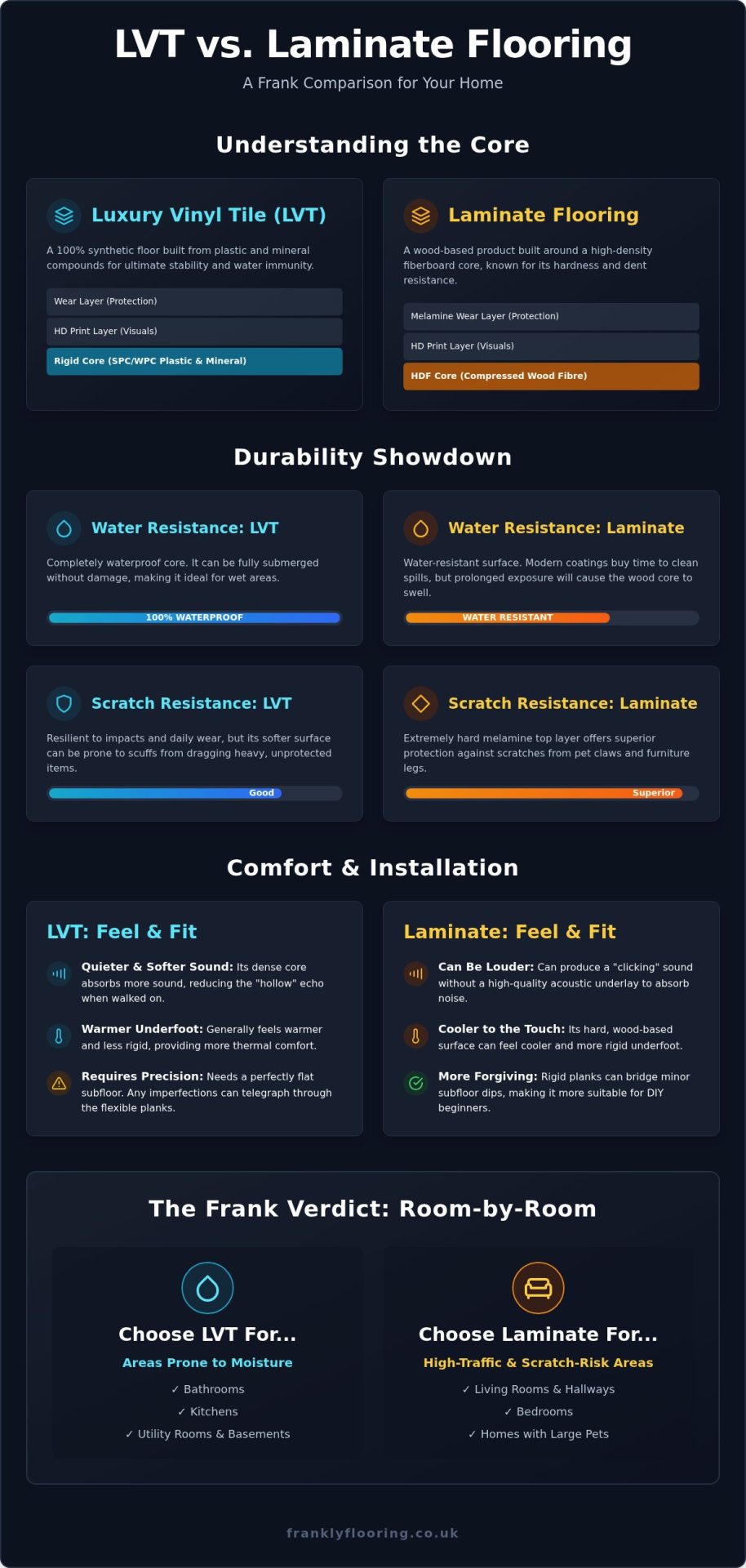
LVT is a multi-layered synthetic floor. Its foundation is usually a rigid core made from either Stone Plastic Composite (SPC) or Wood Plastic Composite (WPC). This is topped with a high-definition print layer and a transparent wear layer that protects against scuffs. While it’s technically a descendant of the Vinyl composition tile (VCT) used in commercial spaces for decades, modern LVT is far more sophisticated and durable.
Vinyl planks are naturally thinner than laminate, often ranging from 2mm to 6mm, yet they’re significantly denser. This density makes the material incredibly stable. If you want to dive deeper into the specifics of this material, you can read our What is LVT flooring? guide for a more technical breakdown. The key takeaway is that LVT is essentially plastic and mineral, making it immune to water damage from the inside out.
The Anatomy of Modern Laminate
Laminate takes a different approach. It’s a wood-based product, built around a core of High-Density Fibreboard (HDF). This HDF is made from compressed wood fibres and resin, which provides a sturdy, dent-resistant base. On top sits a melamine-infused wear layer that is notoriously difficult to scratch. This makes it a favourite for households with large dogs or heavy furniture that gets moved frequently.
In 2026, the big shift in laminate technology is the “hydro” coating. Manufacturers now treat the edges and surface of the HDF core with water-repellent chemicals. This doesn’t make the floor 100% waterproof like LVT, but it gives you a much larger window to clean up spills before the wood fibres begin to swell. It’s a massive improvement, but it still relies on a core that can technically absorb moisture if left soaking.
The Durability Showdown: Water, Scratches, and Daily Wear
Durability isn’t just about how many years a floor lasts. It’s about how it handles the chaos of a Tuesday morning when the dishwasher leaks or the dog decides to do a burnout in the hallway. When comparing lvt vs laminate flooring uk homeowners often assume that “more expensive” automatically means “tougher”. That isn’t always the case. Each material has a specific set of strengths and a “breaking point” you need to know before you buy.
The biggest point of confusion is the difference between waterproof and water-resistant. LVT is a plastic and mineral product. It is 100% waterproof from top to bottom. If you submerged an LVT plank in a bucket of water for a week, it would come out exactly the same shape. Laminate is different. While modern 2026 “hydro” coatings are impressive, the core is still made of wood fibres. It is water-resistant, meaning it buys you time to mop up a spill, but it isn’t a permanent barrier against standing water.
Scratch resistance tells a different story. If you have a busy household with large pets, laminate often has the upper hand. The melamine wear layer on a high-quality laminate is incredibly hard and difficult to pierce with claws or furniture legs. LVT is slightly softer. While it’s more resilient to heavy impacts, it can be more prone to surface scuffs if you drag heavy appliances across it without protection. If you want to see the difference in person, you can browse our full range to compare the textures and wear layers of both materials.
Can You Put Laminate in a Bathroom?
The frank answer is: usually, no. Standard laminate is a gamble in a room with high humidity and potential puddles. If water sits in the joints, it seeps into the HDF core. This causes the edges to “mushroom” or lift, a defect that cannot be repaired. You must use a specific moisture-rated laminate for these areas. For bathrooms and wet rooms, LVT remains the undisputed king because it simply cannot swell or rot.
Pet-Friendly Flooring: Claws, Paws, and Accidents
Living with pets requires a specific type of resilience. Laminate is excellent for scratch protection, provided you choose a product with a high AC (Abrasion Class) rating. An AC4 or AC5 rating is ideal for high-traffic homes. However, LVT is often better for “accidents”. Because it’s non-porous, it won’t absorb liquids or lingering odours if a pet has a mishap. It also tends to offer slightly better traction for older dogs who might find glossy laminate a bit too slippery.
Sunlight is the final factor. If your room has large South-facing patio doors, LVT can be sensitive to extreme heat. It may expand more than laminate, requiring a generous expansion gap around the perimeter to prevent the floor from buckling. Laminate is generally more stable under direct heat, though both materials now feature high-quality UV-resistant print layers to prevent fading over time.
Aesthetics and Comfort: Which Feels (and Sounds) Better?
Choosing a floor isn’t just a visual decision. It’s a sensory one. You’ll spend thousands of hours walking on these surfaces, often in bare feet, so the way a material handles sound and temperature matters just as much as the pattern on the box. When weighing up lvt vs laminate flooring uk buyers often overlook the “clack” factor until the first time they walk across their new lounge in hard-soled shoes. Aesthetics have come a long way, but the physical experience of living with these floors remains quite different.
In terms of pure realism, both materials now offer Embossed in Register (EIR) finishes. This technology ensures the physical texture of the plank matches the grain of the wood in the photographic layer. If there’s a knot in the oak image, you’ll feel a dip in the surface. This level of detail has closed the gap between synthetic floors and real timber, making either choice a win for kerb appeal within your home.
Acoustics and the Clack Factor
Laminate has a long-standing reputation for sounding “hollow” or “tinny”. Because it’s a rigid, wood-based board floating over a subfloor, it can act like a drum skin, echoing footsteps throughout the house. This is a major pain point in upstairs bedrooms or flats. LVT is naturally quieter. Its composition is denser and more flexible, which helps it absorb impact rather than reflecting it back into the room. It creates a more “solid” feel underfoot that mimics the weight of real stone or glued-down hardwood.
You can significantly bridge this gap by investing in the right support. A high-quality acoustic underlay can dampen the vibrations of a laminate floor, turning a sharp “clack” into a duller thud. For a deeper look at how to prep your floor for silence, check out The Frank guide to underlay and accessories. Without a decent barrier, even the most expensive laminate can end up sounding cheap.
Warmth and Softness
LVT is generally warmer to the touch. PVC and mineral cores don’t pull heat away from your feet as quickly as the high-density fibreboard found in laminate. In a typical drafty British home, this makes a noticeable difference on winter mornings. LVT also has a slight “give” to it. While it’s still a hard floor, it’s more forgiving on your joints if you’re standing at a kitchen island for long periods.
Both materials are compatible with underfloor heating (UFH), but LVT is the more efficient partner. Because it’s thinner and denser, heat transfers through the planks more rapidly. Laminate acts as a slight insulator, meaning your system might take a little longer to reach the desired temperature. Whether you use electric mats or water-based pipes, always check the manufacturer’s maximum temperature limit to ensure your chosen lvt vs laminate flooring uk product doesn’t warp under the heat.
Installation and Cost: DIY Ease vs Long-Term Value
The price tag on a single plank is rarely the final figure you’ll see on your bank statement. When you’re deciding between lvt vs laminate flooring uk homeowners need to account for the “hidden” requirements of each material, specifically the preparation of the subfloor and the complexity of the fitting process. One might be cheaper to buy, but significantly more expensive to actually get onto your floor.
LVT is notoriously fussy about what lies beneath it. Because it’s thinner and more flexible than laminate, it suffers from a phenomenon called “telegraphing”. This means that every tiny bump, grit, or uneven dip in your subfloor will eventually show through the surface of the vinyl. If your subfloor isn’t perfectly level, you’ll likely need to spend extra on self-levelling compound or high-quality plywood. Laminate’s rigidity is its secret weapon here. Its thicker HDF core can bridge minor imperfections in the subfloor, often saving you a full day of prep work.
Can a DIYer Install LVT or Laminate?
Laminate is the undisputed king of the weekend DIY project. The click-lock systems are intuitive and the boards are easy to cut with a standard handsaw or a jigsaw. If you can measure a straight line and use a spacer, you can lay a laminate floor. Click-system LVT is also accessible for beginners, but glue-down LVT is a different beast entirely. We’ll be frank: glue-down installation requires a level of precision and subfloor perfection that is usually best left to a professional. To succeed with either, you’ll need a basic kit including a tapping block, pull bar, and spacers to maintain that essential expansion gap.
The Real Cost of Ownership
Budgeting for a new floor requires looking past the initial transaction. A very cheap laminate can often be a false economy. If it lacks a decent water-resistant coating, a single plumbing leak could force you to replace the entire room. LVT generally commands a higher material price, but it offers a different kind of long-term value. In the UK property market, high-quality LVT is increasingly viewed as a premium upgrade, similar to stone or engineered wood, which can be a selling point for future buyers.
Before you commit to a specific material, it’s worth checking our Laminate Flooring UK Buying Guide for a deeper dive into the specific specs you should look for. Longevity in a high-traffic hallway usually comes down to the wear layer. Whether you choose the scratch-resistance of laminate or the waterproof nature of LVT, the thickest wear layer your budget allows will always be the best investment. To see how these costs balance out for your specific project, you can view our latest flooring deals and compare the two options side-by-side.
The Frank Verdict: Which Flooring Should You Choose?
After weighing up the technical nuances, the choice between lvt vs laminate flooring uk homes often comes down to one simple question: how do you use your space? There is no “perfect” floor, only the floor that is perfect for your specific household. If you have a busy home with toddlers and a golden retriever, your needs are vastly different from someone refreshing a guest bedroom in a quiet flat.
We want to be direct. If you prioritise a 100% waterproof guarantee and a floor that feels solid and quiet underfoot, LVT is your winner. If you’re working to a tighter budget, want a straightforward DIY project, and need maximum protection against surface scratches, laminate is likely the better fit. The “Frank” middle ground is rigid core LVT. It combines the stability of a thicker plank with the waterproof nature of vinyl, offering a robust solution for almost any room.
Room-by-Room Recommendations
Living rooms are often the heart of the home. Here, laminate usually wins. It offers a warmth and “cosiness” that feels right for relaxing, and because it’s a dry area, you don’t need to pay the premium for fully waterproof materials. In contrast, for bathrooms and kitchens, LVT is the only sensible choice. Steam, splashes, and the occasional leak will destroy a laminate core, but LVT will handle it without a single warped plank.
Hallways present a unique challenge. They face the highest foot traffic and the most grit from outside. While laminate is scratch-resistant, a high-end LVT with a thick wear layer often provides better long-term durability against the moisture brought in by wet shoes and umbrellas. It handles the “wet-to-dry” transition of a British front door far better than a wood-based product.
Summary Comparison Table
This quick-reference guide helps you match your lifestyle to the right material at a glance.
| Feature | Luxury Vinyl Tile (LVT) | Modern Laminate |
|---|---|---|
| Water Resistance | 100% Waterproof | Water-resistant (Hydro-coated) |
| Scratch Resistance | Good | Excellent (AC4/AC5 rated) |
| DIY Difficulty | Moderate (Click) / Hard (Glue) | Easy (Click-system) |
| Best For | Kitchens, Bathrooms, Pets | Bedrooms, Lounges, Budgets |
Before you click “buy”, run through this final checklist. Order physical samples to see the colour in your own light. Check your subfloor levels to see if you need extra prep work. Finally, ensure you’ve selected the correct underlay for your chosen material. Making an informed choice now saves you a headache in five years. You can browse our full range of LVT and Laminate flooring to find the perfect match for your project.
Make Your Move to a Better Floor
Choosing between lvt vs laminate flooring uk doesn’t have to be a gamble. You now know that LVT is your reliable, waterproof partner for high-moisture zones like bathrooms, while modern laminate remains a powerhouse for scratch-prone living areas. Both options have evolved to offer incredible realism. Your final decision should rest on your room’s specific humidity levels and how much subfloor preparation you’re willing to undertake before the planks go down.
As a family-run UK business providing expert flooring advice since 2004, we’re here to ensure you get the right material at a fair price. We prioritize no-nonsense pricing and honest guidance. This approach helps you avoid the high-pressure tactics found in traditional showrooms. Whether you’re planning a full renovation or a quick weekend refresh, we have the stock and the expertise to help you finish the job with confidence.
Browse our Frank range of LVT and Laminate flooring today and start your home transformation with a team that values integrity as much as craftsmanship. You’ve done the research. Now it’s time to enjoy the results.
Frequently Asked Questions
Is LVT better than laminate for kitchens?
LVT is the superior choice for kitchens because it is 100% waterproof. Unlike laminate, which relies on a wood-based core that can swell if a dishwasher leaks or a pipe bursts, LVT is made from synthetic materials that won’t warp. It handles high humidity and frequent mopping without any structural risk. While modern hydro-coated laminate is an improvement, it doesn’t offer the same total peace of mind in a wet environment.
Does LVT flooring need underlay?
Most modern click-system LVT planks come with a pre-attached acoustic underlay. If yours doesn’t, you must use a specific, high-density LVT underlay rather than the thicker foam used for laminate. Because LVT is thinner and more flexible, it needs a firm base to protect the click joints from snapping. Glue-down LVT doesn’t require underlay at all, as it’s adhered directly to a perfectly smooth subfloor or plywood.
How long does laminate flooring last compared to LVT?
Both materials can last between 10 and 25 years if you choose a high-quality product and maintain it correctly. Laminate is incredibly durable in dry rooms like bedrooms or lounges, but its lifespan drops significantly if it’s exposed to moisture. LVT generally offers better long-term value across the whole home because it isn’t susceptible to rot or water damage. The actual longevity often depends on the thickness of the wear layer you select.
Can I lay LVT over my existing laminate floor?
You shouldn’t lay LVT over an existing laminate floor. Laminate is a “floating” floor that expands and contracts with temperature changes. If you place LVT on top, the movement of the old floor will cause the new one to buckle or the joints to fail. For a professional finish, you must remove the old laminate and ensure the subfloor is level before starting your lvt vs laminate flooring uk installation.
Is LVT or laminate better for underfloor heating?
LVT is the more efficient partner for underfloor heating systems. Its dense, thin composition allows heat to transfer into the room much faster than the thicker, wood-based core of a laminate plank. While both are compatible with most water and electric systems, laminate acts as a slight insulator. This means your heating system has to work a bit harder and run for longer to reach the same level of warmth underfoot.
Which is more scratch-resistant: LVT or laminate?
High-quality laminate with an AC4 or AC5 rating is generally more resistant to surface scratches than LVT. The melamine-infused top layer is exceptionally hard, which makes it ideal for homes with large, active dogs. LVT is resilient and handles heavy impacts well without chipping, but it can be more prone to fine scuffs if heavy furniture is dragged across it. Always use felt pads on chair legs regardless of your material choice.
Is LVT more expensive than laminate?
LVT is typically more expensive than laminate when you account for both the material and the necessary subfloor preparation. While budget vinyl exists, a high-quality rigid core product usually carries a higher price per square metre than a mid-range laminate. Additionally, LVT requires a much flatter surface, which can add to your initial labour costs. Many homeowners view the waterproof nature of lvt vs laminate flooring uk products as a worthwhile long-term investment.
Can I use a steam mop on LVT or laminate flooring?
You should never use a steam mop on either LVT or laminate flooring. The intense heat and pressurised moisture can force their way into the joints and break down the adhesive bonds or cause the core materials to swell. Even on waterproof LVT, the heat can cause the planks to warp or de-layer over time. A damp microfibre mop with a pH-neutral cleaner is the safest and most effective way to keep your floors clean.