
A door bar is a structural necessity rather than just a decorative trim, and choosing the wrong profile can compromise your entire floor’s lifespan. You’ve likely spent hours picking the perfect pile or the right shade of oak, so it’s frustrating when a fraying edge or a clumsy trip hazard catches your eye. It’s a common issue that ruins the aesthetic of a well-planned home, but it’s one that’s easily avoided with the right technical knowledge and a bit of candid advice.
We believe in being direct about the details that matter. This guide will help you master the art of floor transitions by teaching you how to select, measure, and fit the perfect carpet door bars for any room. You’ll learn how to achieve a seamless finish that matches your door handles and hinges while ensuring long-lasting durability. We’ll walk you through the different profiles available, the nuances of measuring for varying floor heights, and the professional techniques used to secure a transition that stays put. By the end, you’ll have the confidence to finish your project with the same precision as a seasoned tradesman.
Key Takeaways
- Learn why high-quality carpet door bars are the essential structural bridge needed to prevent frayed edges and protect your flooring’s lifespan.
- Understand how to select the correct profile for your specific project, whether you’re joining two carpets or transitioning to a thinner hard floor like LVT.
- Discover the best materials for your home’s aesthetic, comparing the longevity of solid brass against aluminium in modern 2026 finishes.
- Master the technical side of the job with professional advice on measuring the door rebate and selecting the right tools for a clean cut.
- Find out why trade-standard accessories are the non-negotiable final step for ensuring your floor transition looks seamless and stays secure for years.
What Are Carpet Door Bars and Why Are They Essential?
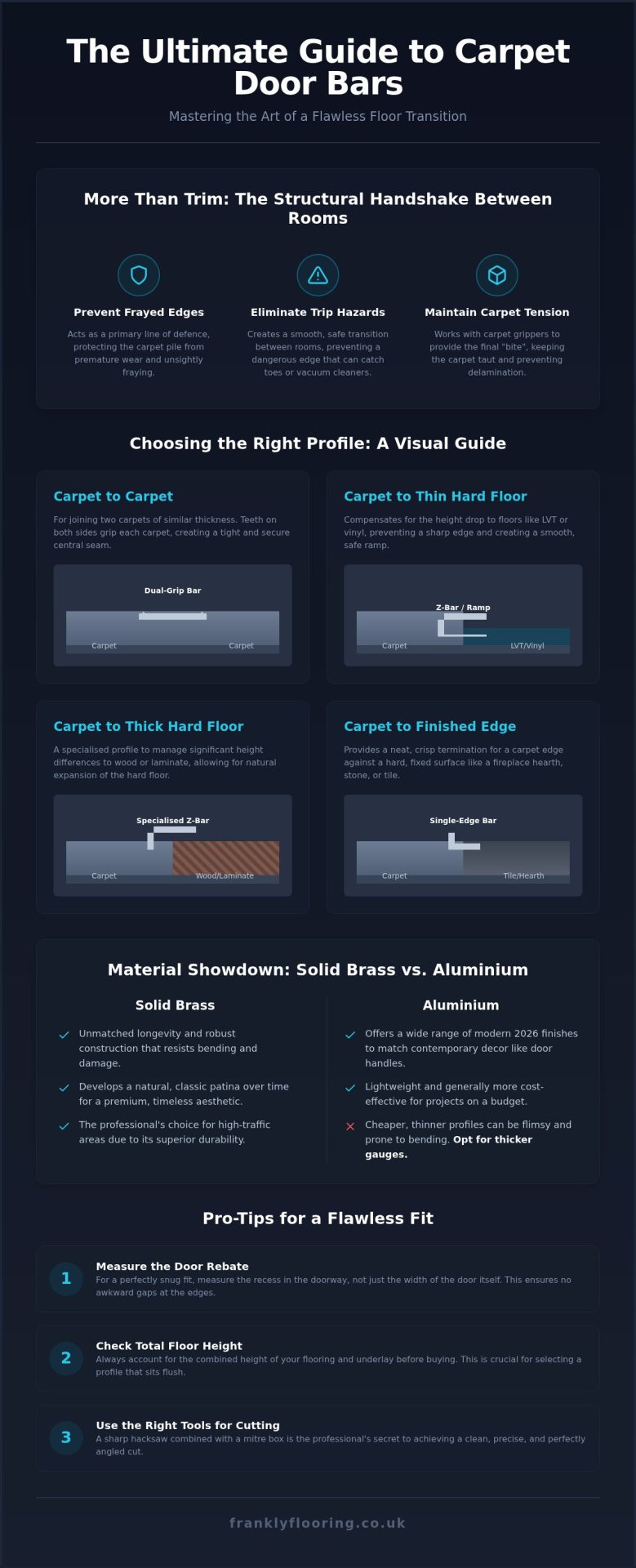
Think of carpet door bars as the structural handshake between two rooms. They serve as the vital bridge where different floor coverings meet, acting as an anchor that keeps everything in place. While many see them as a minor finishing touch, they’re actually a primary line of defence for your home. Without a proper transition, the “nap” or pile of your carpet is exposed to premature wear at the edge. This leads to unsightly fraying and, eventually, a dangerous trip hazard that can catch a toe or a vacuum cleaner head. It’s a small detail that prevents a very large, expensive problem.
In the trade, you’ll hear terms like thresholds or transition strips used interchangeably. Strictly speaking, a door bar refers to the metal or wood strip that secures the floor edge at a doorway. A threshold is often the wider piece of timber or stone that sits beneath the door itself; transition strips is a broader category for any profile that joins two surfaces. Understanding these subtle differences helps you choose the right part for the job without getting bogged down in industry jargon.
The Structural Role of a Door Bar
A quality bar doesn’t just sit there; it works in tandem with your carpet gripper to maintain essential surface tension. The gripper holds the carpet across the room, but the door bar provides the final “bite” at the entrance. If you skip this or use a sub-standard product, the carpet will eventually pull away from the doorway. This causes delamination, where the carpet backing separates from the fibres, making the floor look tired and neglected long before its time. In high-traffic areas like the hallway or lounge, that extra grip is what keeps your investment looking fresh and taut.
Anatomy of a Professional Transition
To appreciate a professional-grade bar, you need to look at its construction. A standard dual or z-bar consists of a base that sits on the subfloor, a set of sharp teeth to grab the carpet, and a decorative cover that hides the join. We often see thin, cheap aluminium bars that bend or snap under the pressure of a heavy footfall. They’re simply too flimsy to handle daily life in a busy household. By 2026, design has evolved toward more robust, solid profiles that offer better weight distribution and more refined finishes. Choosing a bar with a thicker gauge ensures it won’t buckle the first time someone steps on it with heavy boots.
Choosing the Right Profile: Carpet to Carpet vs. Hard Floor
Choosing a door bar isn’t just about picking a colour; it’s about the physics of the threshold. If you’re joining two carpets of equal thickness, a dual-grip bar is your standard choice. It features teeth on both sides to pull the carpets together, creating a tight, secure seam. However, things get trickier when you transition to a thinner hard floor like LVT or vinyl. Here, you need a profile that compensates for the height drop, often referred to as a “ramp” or “diminishing” bar. This prevents a sharp edge that could damage the thinner flooring or cause a trip.
When moving from carpet to thicker laminate flooring or solid wood, the height difference can be significant. You’ll often need a specialised Z-bar or a ramp profile that allows for the natural expansion of the hard floor. If you ignore this height imbalance, you’ll end up with a “step” that catches feet and collects dust. We always advise checking the total height of your floor including the underlay before you buy your carpet door bars to ensure the profile actually fits. It’s a simple check that saves a lot of frustration later.
Z-Bars and Dual-Grip Profiles
A Z-bar is the professional’s secret for a “tucked” finish. It allows you to tuck the carpet edge under the metal lip, hiding the cut ends completely. This is particularly effective when transitioning from a thick carpet to a hard surface where you want a minimal metal profile showing. Dual-grip profiles, on the other hand, are the workhorses of the industry. They provide maximum security for carpet-to-carpet joins, ensuring neither side creeps or bunches over time. If you’re unsure which one suits your specific subfloor, it’s worth browsing our range of professional-grade accessories to see the profiles in detail.
Single Edge and Cover Strips
Single edge bars are designed for thresholds where one side is a “finished” edge, like stone, tile, or a fireplace hearth. They provide a neat finish without needing to grip the hard surface. Cover strips are the “universal” fix. They sit over the top of a gap, making them ideal for renovation projects where you aren’t replacing both floors at once. Just remember that floating floors, such as laminate, need space to move. A cover strip should be fixed to the subfloor, not the flooring itself, to allow for that essential expansion. This prevents the floor from buckling when the temperature changes.
Material and Finish: Aesthetics That Last
Selecting the right material for your carpet door bars is where aesthetics meet endurance. Most homeowners default to aluminium because it’s cost-effective and lightweight, but there’s a significant gap between standard grade and professional-grade metal. Solid brass is the gold standard for longevity. It’s heavier, denser, and won’t buckle under the weight of furniture or heavy foot traffic. While the initial cost is higher, brass transitions can last decades, whereas cheap alternatives often need replacing after a few years of scuffs and knocks.
Avoid “wrapped” or “foiled” bars at all costs. These are usually plastic or low-grade metal cores covered in a thin decorative film designed to look like wood or premium metal. In a busy UK household, that film will inevitably scratch, peel, or bubble. Once the surface is compromised, the bar looks shoddy and there is no way to repair it. Stick to solid metal finishes that maintain their integrity even when they take a beating from school shoes and vacuum cleaners. For 2026, the trend has shifted heavily toward Matt Black and Anthracite finishes, which offer a bold, architectural look that hides minor scuffs better than polished surfaces.
Coordinating with Home Hardware
A common mistake is treating door bars as an isolated purchase. For a truly professional finish, you should match your transitions to your existing home hardware, such as door handles, hinges, and even light switches. Our frank advice is to stick to one metal tone per floor level. If your hallway has polished chrome handles, using an antique brass door bar will create a jarring visual break that disrupts the flow of your home. Whether you prefer the warmth of Antique Brass or the clinical sharpness of Polished Chrome, consistency is the key to a high-end look that feels intentional rather than accidental.
Durability Ratings for Busy Households
Hallways and landings are the highest-traffic areas in any home, so they require finishes that can resist deep scratches. Anodised aluminium is a specific type of metal where the surface has been thickened through an electrochemical process to increase its natural resistance to wear and corrosion. This makes it an excellent choice for transitions into bathrooms or kitchens where moisture might be a factor. If you’re choosing a coloured finish like Matt Black, ensure it has been powder-coated or anodised. This ensures the colour is part of the metal’s surface rather than just a layer of paint that will chip away at the first sign of use.
Measuring and Fitting: The Frank Guide to a Snug Fit
Fitting carpet door bars is where your technical patience is tested. A millimetre too short and you’ve got an ugly gap; a fraction too long and the metal will snag on the door frame. Precision starts with measuring the “rebate” correctly. This is the inner part of the door frame where the door sits when it’s closed. Your bar should be positioned directly under the door leaf so that the transition is completely hidden when the door is shut. It’s a simple rule that separates a professional job from a rushed DIY attempt.
Once you’ve marked your width, use a fine-toothed hacksaw to make a clean, square cut. Avoid using a standard wood saw or blunt snips, as these will burr the metal and ruin the finish. If you’re working on a timber subfloor, you can screw the bar directly into the wood. For concrete floors, you’ll need to drill and plug the holes first. We recommend using a 5mm masonry bit and high-quality wall plugs to ensure the bar doesn’t work loose over time. If you have underfloor heating, skip the screws entirely and use a high-grab professional adhesive to avoid puncturing a pipe.
The “tucking” technique is the final secret to a trade finish. After the bar is secured, use a carpet bolster or a blunt screwdriver to firmly push the carpet edge into the “jaw” or teeth of the bar. This creates a neat, rolled edge that looks seamless and prevents the pile from fraying. If you’re ready to start your project, you can find the right professional-grade carpet door bars in our accessories range to match your new flooring.
Tools You Actually Need
You don’t need a van full of gear, but you do need the right basics. A sharp hacksaw, a reliable tape measure, and a decent screwdriver are non-negotiable. If you’re fixing into concrete, a power drill is essential. While some bars come with “standard” screws, we often suggest upgrading to slightly longer, more robust screws if your subfloor is uneven. This provides the extra bite needed to keep the bar flush against the floor without it rattling every time someone walks over the threshold.
Common DIY Mistakes to Avoid
The most frequent error we see is the “short cut” mistake. People often measure the distance between the architraves rather than the full width of the rebate. This leaves a small, visible gap at either end of the bar. Another common pitfall is over-tightening the screws. If you drive them in too hard, the metal can buckle or “dimple,” which ruins the flat aesthetic of the finish. Finally, always check the door swing. If your new bar is too high or the carpet is particularly thick, the door might catch. Check this clearance before you commit to the final fix to avoid having to plane the bottom of your door later.
Completing Your Project with Frankly Flooring
Choosing the right components shouldn’t be a guessing game. We’ve spent over 20 years refining our selection to ensure every product we stock meets trade standards. A quality carpet deserves more than a flimsy, off-the-shelf trim that will buckle within months. We believe that professional-grade carpet door bars are the only choice for a high-end finish that lasts. When you buy from a family-run UK expert, you’re getting more than a product; you’re getting a commitment to transparency. We don’t hide behind corporate jargon or high-pressure sales tactics. Instead, we offer the same honest, straight-talking advice we’d give to a regular trade fitter.
Our curated range of accessories is designed specifically to complement our premium floors. We understand that a transition isn’t just a piece of metal; it’s the final element that defines the character of your room. By providing carpet door bars that match the durability of our carpets and LVT, we ensure your home remains a source of pride rather than a list of maintenance tasks. We simplify the selection process by offering only what works, cutting through the noise to help you finish your project with confidence.
The Frankly Flooring Difference
Technical depth is at the heart of what we do. Our team views every transition as a foundational element of a home’s character. This means we only stock profiles that we know will stand up to the rigours of a busy household. You get direct access to decades of industry experience, ensuring you select the right profile the first time. We prioritise your long-term satisfaction over quick wins, which is why our advice is always grounded in technical craftsmanship and real-world performance.
Next Steps for Your Home Renovation
The best way to start is by ordering samples to see how our metal finishes look against your specific lighting and door hardware. Once you’re happy with the choice, you can combine your order with underlay and gripper for national UK delivery. This end-to-end approach simplifies the logistics of your renovation and ensures all your professional-grade materials arrive together. If you’re dealing with a particularly tricky transition or an unusual subfloor, don’t hesitate to contact our team for bespoke project advice. We’re here to guide you through the full project lifecycle, from that first measurement to the final, professional cleanup.
Finishing Your Floor with Precision
A successful floor transition relies on technical precision and the right materials. You now understand that carpet door bars are much more than a cosmetic choice; they are a structural anchor that prevents premature fraying and secures your carpet’s tension. By selecting solid metal profiles over flimsy alternatives and matching your finish to your home’s existing hardware, you ensure a result that is both durable and aesthetically consistent.
At Frankly Flooring, we bring over 20 years of industry experience to help you navigate these details with candour. As a family-run business, we prioritise your long-term satisfaction by providing the same professional-grade accessories used by trade fitters across the country. Whether you need a Z-bar for a clean tuck or a ramp profile for uneven heights, we simplify the process with expert advice and reliable national UK delivery.
Browse our range of professional door bars at Frankly Flooring and get the perfect finish for your home renovation. You’ve done the hard work of choosing your floor; now it’s time to secure it properly.
Frequently Asked Questions
Can I fit carpet door bars myself or do I need a pro?
You can certainly fit them yourself if you have basic DIY tools like a hacksaw, tape measure, and drill. Most homeowners find the process straightforward as long as they measure accurately. If your subfloor is particularly uneven or you are dealing with expensive solid brass bars, a professional fitter can provide the precision needed to avoid any costly cutting errors.
How do I choose a door bar if my two floors are different heights?
You should select a ramp or diminishing profile for height imbalances. These bars are engineered to bridge the gap between a thick carpet and a lower surface, such as vinyl or LVT. They create a subtle slope that removes trip hazards. Always calculate the total height of your carpet and underlay combined to ensure the ramp profile is steep enough to cover the drop.
What is the best door bar for joining carpet to LVT?
A Z-bar or a single-edge ramp is the most effective choice for joining carpet to LVT. Because LVT is much thinner than a carpet and underlay combination, the bar needs to protect the hard floor’s edge while providing a secure grip for the carpet. Using professional-grade carpet door bars ensures the transition remains flush and doesn’t lift over time in high-traffic doorways.
Do I need to drill into my floor to fit a door bar?
It depends entirely on your subfloor material. Timber floors allow you to screw the bar directly into the wood without much preparation. Concrete floors require you to drill and plug the holes to ensure the screws have a permanent bite. If you have underfloor heating, we advise using a high-strength professional adhesive instead of drilling to prevent any catastrophic damage to your heating pipes.
Can I use a self-adhesive door bar on a carpet?
No, self-adhesive bars are not designed for carpets. The glue cannot bond to carpet fibres and the bar will quickly work loose underfoot. These products are only suitable for transitions between two hard floors. For any project involving carpet, you must use a bar with a mechanical fix, such as screws or a baseplate with teeth, to keep the floor covering under tension.
What length do carpet door bars come in as standard?
Standard lengths in the UK are typically 90cm, which is sufficient for a normal internal doorway. For wider openings like double doors or modern bi-fold thresholds, you can order 180cm or 270cm lengths. We always recommend measuring the widest part of your door rebate before you buy. It is better to have a longer bar you can trim down than one that leaves a gap.
How do I stop my carpet from pulling out of the door bar?
The secret is leaving enough carpet material to tuck firmly into the bar’s teeth. If you cut the carpet too flush, there isn’t enough fabric for the bar to grab. Use a carpet bolster or a blunt tool to push the edge deep into the profile. This creates a secure, rolled edge that works with your gripper rods to keep the carpet taut and tidy.
Should the door bar be positioned directly under the door?
Yes, the bar must sit centrally beneath the door leaf when it is in the closed position. This ensures the transition is completely hidden from view regardless of which room you are in. If the bar is positioned too far forward or back, you will see a strip of the contrasting floor peeking through the gap, which disrupts the professional look of your home.