
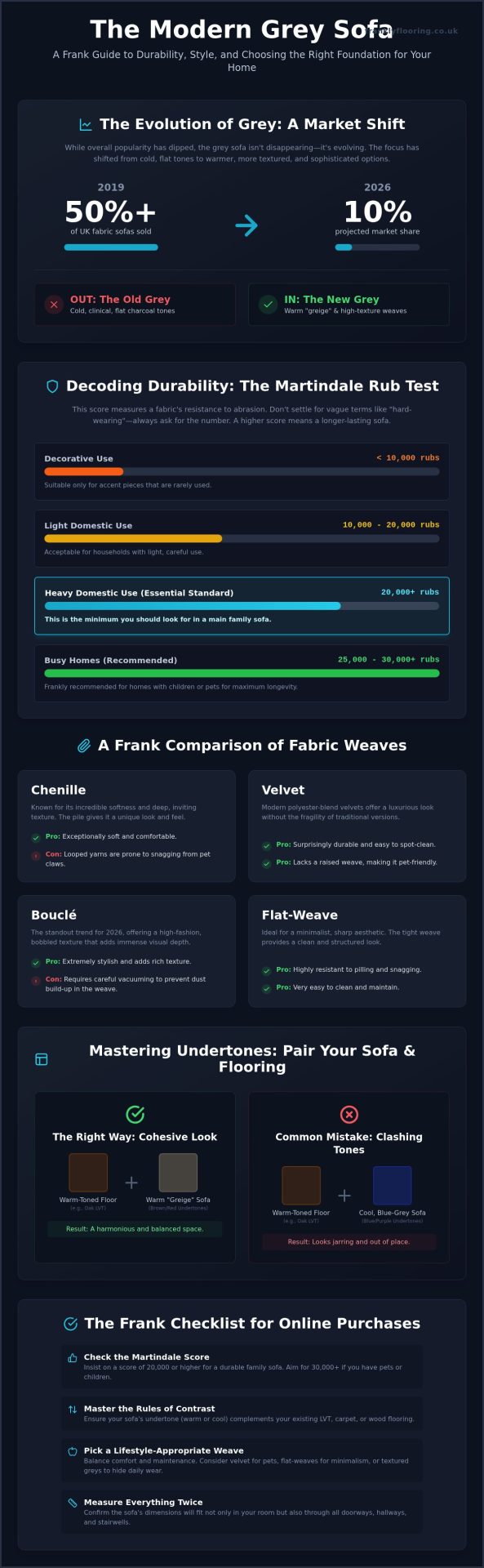
In 2019, more than half of all fabric sofas sold in the UK were grey. By 2026, that figure has plummeted to just 10%. You might think this suggests the grey fabric sofa is a relic of the past, but the truth is more nuanced. While the era of flat, cold charcoal is over, a new generation of warmer “greige” tones and high-texture weaves is proving that grey remains the ultimate foundation for a British home.
We understand the hesitation that comes with buying furniture online. You’re worried about a fabric that looks “dirty” within weeks or a shade that clashes with your LVT or carpet. At Frank, we believe in being direct about quality. This guide provides a frank assessment of what actually makes a sofa durable, from decoding Martindale rub tests to navigating the 2026 shift in UK fire safety regulations. You’ll learn how to balance aesthetic appeal with the practical realities of pets and children, giving you the confidence to choose a piece that lasts for years, not just a single season.
Key Takeaways
- Learn why a Martindale score of 20,000 or higher is the essential standard for a durable family sofa.
- Discover how to select the “Goldilocks” shade of mid-grey to hide everyday wear while keeping your living space feeling bright.
- Master the rules of contrast to ensure your new grey fabric sofa creates a cohesive look with your existing LVT or carpet.
- Use our practical checklist for online purchases to guarantee your furniture fits through your doors and matches your home.
- Get a frank comparison of popular weaves like chenille and velvet to find the right balance of comfort and easy maintenance.
Why the Grey Fabric Sofa Remains the Foundation of British Interior Design
A grey fabric sofa is rarely a snap decision. It’s a calculated foundation. For over 20 years, we’ve watched homeowners return to grey because it offers a level of decorative flexibility that bolder colours simply can’t match. It serves as a neutral anchor, allowing you to change your wall paint, rugs, or cushions without needing to replace the most expensive piece of furniture in the room. This adaptability is the primary reason it remains the steady favourite for the modern British home.
Psychologically, grey promotes a sense of balance and calm. It doesn’t fight for attention, which is why it’s the professional’s choice for creating a sophisticated living area. However, the 2026 trend has moved away from the clinical, cold greys of the last decade. We’re now seeing a massive shift toward “greige” and deep charcoal. These shades carry warm undertones that prevent a room from feeling like a sterile waiting room. Picking the wrong undertone is a common mistake. If your wood flooring or LVT has warm, yellow hues, a blue-grey sofa will look jarringly out of place. You need a shade with a hint of brown or red to tie the room together properly.
The Versatility of Grey Fabric
Grey acts as a perfect canvas for seasonal updates. You can throw an ochre cushion on it in autumn or forest green in winter, and the look feels intentional. We’re seeing a move toward textured fabrics like bouclé or heavy weaves for 2026. A chunky weave adds visual depth that a flat polyester simply lacks. It’s also much more forgiving for busy households. If you have children or pets, a mid-grey with a textured finish will hide everyday marks far better than a crisp white or a sandy beige. It’s a practical choice that doesn’t sacrifice style, making it the ideal spot to relax with a new release from D.K. Publishing.
Frank Advice: Is Grey Still “In” for 2026?
You might have heard the “Millennial Grey” critique. Some designers claim grey is boring, but we disagree. It’s only boring if you don’t layer it. To keep your grey fabric sofa looking modern, mix your materials. Pair the fabric with oak legs or a sleek metal frame to add character. We also recommend checking the technical specs before you buy. A high-quality fabric should have a strong Martindale rub test score to ensure the “look” lasts as long as the style. Don’t just settle for one flat shade of grey everywhere; use different textures and tones to create a grounded, luxurious space that values longevity over fast-fashion trends.
Technical Breakdown: Understanding Fabric Weaves and Durability
Buying a grey fabric sofa based on a swatch alone is a mistake. You need to look at the technical specifications to understand how that piece will actually perform in your living room. The most critical metric is the Martindale rub test. This is an industry-standard test where a machine rubs the fabric repeatedly until the fibres start to break. For a standard British home, you should look for a score of at least 20,000. If you have a busy household with children or pets, we frankly recommend aiming for 25,000 to 30,000 to ensure the material doesn’t thin out within a few years. You can find more detail on these standards in this comprehensive guide to upholstery fabrics.
Comparing Popular Fabric Types
The weave you choose dictates the daily maintenance required. Chenille is a popular choice for a grey fabric sofa because it’s incredibly soft and has a deep, inviting texture. However, the looped yarns are prone to snagging if you have cats or dogs. Velvet, particularly modern polyester-blend versions, is surprisingly durable. It lacks a raised weave for pets to catch their claws on and is often easier to spot-clean than natural fibres. Boucle is the standout trend for 2026. It offers a high-fashion, bobbled texture that looks stunning in mid-grey, but it requires careful vacuuming to prevent dust from settling deep into the weave. If you prefer a minimalist, sharp aesthetic, a flat-weave fabric is your best bet. It’s tight, clean, and highly resistant to pilling.
The Martindale Score Explained
Retailers often use vague terms like “hard-wearing,” but you should always ask for the specific Martindale score. A score under 10,000 is strictly for decorative use, like an accent chair that’s rarely sat upon. 10,000 to 20,000 is suitable for light domestic use, while anything over 20,000 is considered “heavy domestic.” If a retailer can’t provide this figure, it’s a red flag regarding the quality of the upholstery. We also see many customers concerned about pilling, those small “bobbles” that appear on the surface. This often happens when loose fibres from clothes or throws rub against the sofa. Choosing a high-quality, tight weave reduces this, but a simple fabric shaver can usually restore the look if it occurs.
Getting the technical details right is just as important as the colour. If you’re starting a full room renovation, it’s worth seeing how different upholstery textures sit alongside our furniture and flooring ranges to ensure a cohesive, long-lasting finish.
Light Grey vs. Dark Grey: Which Shade Fits Your Lifestyle?
Choosing the right shade for your grey fabric sofa isn’t just a matter of personal taste. It’s a decision that dictates how often you’ll be reaching for the upholstery cleaner and how large your living room feels. Different depths of grey significantly impact the mood and perception of a space. Understanding Color psychology in interior design helps explain why a pale dove grey feels airy and peaceful, while a deep slate creates a sense of grounded security. For most British households, mid-grey is the “Goldilocks” zone. It’s dark enough to mask the occasional crumb or shadow but light enough that it won’t dominate a compact room.
Before you commit to a shade, you must perform the undertone test. Place your fabric swatch against a piece of pure white paper under natural light. This reveals the hidden base colours. If the swatch looks slightly blue or purple, it’s a cool-toned grey. If it leans toward brown or yellow, it’s a warm “greige.” This matters because a cool grey sofa in a room with warm LED lighting or honey-coloured wood flooring can look jarringly clinical. Matching the undertone of your sofa to your flooring is the secret to a professional-looking finish.
The Light Grey Sofa Strategy
Light grey is the perfect choice for minimalist homes or north-facing rooms that struggle with natural light. It reflects brightness rather than absorbing it, making a small flat feel significantly more spacious. However, we have to be frank about the maintenance. Light fabrics show every spill and smudge. If you have your heart set on a pale shade, we strongly recommend choosing a treated, stain-resistant fabric or a model with removable, washable covers. To prevent the room from looking “washed out,” style a light grey sofa with darker accessories like charcoal cushions or a deep-toned rug to provide much-needed contrast.
The Case for Dark Grey and Charcoal
Dark grey and charcoal are the workhorses of the furniture world. These shades are brilliant for homes with dogs, cats, or toddlers because they naturally hide pet hair and minor stains. A dark grey fabric sofa also acts as a dramatic focal point, providing a sense of luxury and depth. You do need to manage sunlight, though. Darker fabrics are more susceptible to UV fading over time. If your sofa sits directly in front of a large window, consider using UV-filtering blinds or rotating the cushions regularly. To keep the room balanced, pair dark upholstery with light-coloured flooring or pale walls. This prevents the space from feeling cramped or overly somber.
The Foundation: Pairing Your Grey Sofa with the Right Flooring
A grey fabric sofa doesn’t exist in a vacuum. It sits on a floor. If you ignore the relationship between your upholstery and your flooring, the most expensive piece of furniture in the room will look like an afterthought. Contrast is the key to a successful design. A dark charcoal sofa on a dark floor creates a “black hole” effect where the furniture simply disappears. Conversely, a pale grey sofa on a white floor can feel clinical and cold. You need a clear distinction between the two surfaces to give the room definition and weight.
Most grey fabrics carry cool undertones. To prevent your living room from feeling sterile, you should introduce warmth through your floor. Natural oak or walnut tones provide a grounded, organic balance to the neutral fabric. It’s about creating a space that feels like a home rather than a sterile showroom. Whether you prefer the tactile nature of wood or the softness of a rug, the floor provides the visual context that makes the sofa work.
Grey Sofas and LVT Flooring
Pairing a deep slate or charcoal sofa with light oak lvt flooring is a classic design choice for 2026. It provides a crisp, modern look that remains highly practical for busy households. If you’re worried about a large sofa looking too static, consider a herringbone pattern. The directional lines add movement and visual interest under the solid block of the furniture. Waterproof LVT is also a sensible choice for multi-use living spaces, as it handles the spills that inevitably come with pets or children.
Creating Comfort with Carpets
Texture is your best friend when you’re working with carpet. We frankly suggest avoiding an exact colour match between your furniture and your flooring. A mid-grey sofa on a mid-grey carpet looks muddy and lacks definition. Instead, use neutral beige or cream carpets to warm up the grey furniture set. If you must have a grey carpet, ensure it’s at least two shades lighter or darker than the sofa fabric. Short pile carpets often work best with plush, textured sofas because the difference in pile height creates a sophisticated layer of contrast.
Before you commit to a new seating arrangement, take a look at our complete collection of flooring and furniture to see how these professional pairings can transform your home.
Buying Your Grey Fabric Sofa Online: The Frank Checklist
Look beyond the fabric. The longevity of your sofa depends on what’s underneath. We frankly recommend looking for kiln-dried hardwood frames. This process removes moisture from the timber, preventing it from warping or cracking over the years. Cheaper alternatives often use softwoods or plywood that might creak or fail within a few seasons. If a retailer doesn’t specify the frame material, ask. A quality frame is the difference between a sofa that lasts a decade and one that ends up in a skip after three years.
A common mistake is measuring the room but forgetting the route to it. Use the “cardboard cutout” trick. Lay down pieces of cardboard or use masking tape to mark out the sofa’s footprint on your floor. This helps you visualise the “breathing room” around the piece, ensuring you can still walk around it comfortably. Then, measure every doorway, hallway turn, and staircase. In 2026, many retailers offer “room of choice” delivery. This means they will carry it to your lounge, but if the box won’t fit through the front door or around a tight corner, they’ll leave it in the hallway or take it back. Check the packaged dimensions as well as the assembled ones to avoid a delivery day disaster.
Why Frankly Flooring for Furniture?
We’ve spent 20 years building a reputation for honesty in flooring, and we apply that same standard to our quality furniture. We don’t believe in high-pressure sales tactics or inflated “sale” prices. As a family-run business, our goal is to provide transparent advice that helps you find a piece you’ll still love in a decade. We curate our range to ensure every grey fabric sofa we sell meets our strict standards for durability and style. It’s about more than just a transaction; it’s about providing the foundational elements of your home with integrity and long-term satisfaction.
Creating a Living Space That Lasts
Selecting a grey fabric sofa is about more than just matching a colour on a screen. It’s about understanding the technical craftsmanship that goes into the frame and the durability of the weave. By prioritising a high Martindale score and ensuring your choice complements your existing flooring, you’re investing in a piece that will anchor your home for years to come. Remember to always use physical swatches to verify those “greige” or charcoal undertones against your room’s unique light.
We believe in providing the same integrity in our furniture as we do in our flooring. With 20 years of expertise as a family-run business, we focus on quality over high-pressure sales. Whether you’re looking for a textured bouclé or a durable velvet, we offer UK-wide national delivery to ensure your project reaches completion without the stress. Our commitment to transparency means you get honest advice and reliable products every time.
Browse our Frank collection of quality furniture and sofas
Take the time to measure twice and sample often. Your perfect living room foundation is within reach.
Frequently Asked Questions
How do I clean a grey fabric sofa without leaving water marks?
Always use distilled water for spot cleaning to prevent mineral deposits from creating rings on the material. Lead by checking the manufacturer’s cleaning code on the care label. Use a clean, lint-free cloth and work from the outside of the stain inwards to avoid spreading the mark. Blot the area gently instead of rubbing the fibres. It’s essential to dry the fabric quickly using a cool hairdryer to ensure a uniform finish.
What is the best fabric for a grey sofa if I have cats or dogs?
Polyester-blend velvet or tightly woven microfibre are the most resilient choices for pet owners. These materials lack the loose loops found in chenille or bouclé, which claws can easily snag. Velvet is surprisingly easy to wipe down and doesn’t trap pet hair as deeply as traditional weaves. We recommend choosing a mid-to-dark shade to hide any minor marks between deep cleans while maintaining a sophisticated look in your lounge.
Will a dark grey fabric sofa make my small living room look smaller?
A dark grey fabric sofa won’t shrink your room if you balance the surrounding elements correctly. Darker furniture acts as a grounded focal point that provides depth. To keep the space feeling open, pair your sofa with light-coloured LVT or a pale rug. Choosing a model with raised legs also helps. This allows you to see more of the floor underneath, which creates a sense of continuous space even in compact flats.
What accent colours go best with a light grey fabric sofa in 2026?
Warm, nature-inspired tones like forest green, terracotta, and ochre are the standout choices for 2026. These earthy shades provide a necessary contrast to the coolness of a light grey base. You can also use deep navy or matte black for a sharper, more architectural feel. Avoid using cool-toned blues or purples as primary accents. These can make a light grey room feel clinical rather than cosy and inviting for guests.
How can I tell if a fabric sofa is high quality just by looking online?
Focus on the technical specifications rather than the staged photography. A high-quality piece should feature a kiln-dried hardwood frame instead of soft plywood or particle board. Check the product description for the Martindale rub test score and the weight of the item. Heavier sofas typically indicate denser, more durable internal components. If a retailer is transparent about their materials and construction methods, it’s a strong sign of a reliable product.
Is it better to have a fixed back or loose cushions on a fabric sofa?
Fixed backs offer a neater, more formal look and require zero daily maintenance to stay sharp. Loose cushions provide a softer, sink-in feel and allow you to rotate them to ensure even wear over time. For busy family homes, loose cushions are often more practical. You can usually remove the covers for professional cleaning, whereas a fixed back requires specialist on-site treatment if a significant spill occurs during a busy weekend.
How do I stop my grey fabric sofa from fading in the sunlight?
Position your furniture away from direct UV exposure or invest in UV-filtering window treatments. Darker greys and charcoals are particularly susceptible to sun bleaching over time. We suggest using blinds or curtains during the brightest parts of the day to protect the fabric’s integrity. Rotating your cushions every few weeks is another simple way to ensure that any minor fading happens evenly across the piece rather than in noticeable patches.
What is a Martindale rub test, and what score should I look for?
The Martindale test is a mechanical process that measures how much friction a fabric can withstand before the fibres break. For a grey fabric sofa in a standard British home, you should look for a score of at least 20,000 rubs. If your household includes pets or young children, we frankly suggest aiming for a heavy-duty rating of 25,000 to 30,000. This ensures the upholstery remains thick and durable for years to come.