
The “waterproof” label on a box of laminate might be the most misleading thing in the flooring industry today. While modern manufacturing has certainly improved, choosing between laminate flooring vs lvt requires more than just reading a glossy brochure. You likely feel the pressure to get this right, fearing planks that peak at the edges or that hollow clicking sound every time the dog walks across the room. It is frustrating trying to calculate the true cost when underlay and accessories are often left out of the initial quote.
We believe in being frankly honest about what you are putting in your home. You deserve a straight-talking comparison that clears up the confusion around moisture resistance and real-world maintenance requirements. This guide provides a definitive answer on which material suits your specific room and your budget. We will break down the technical differences in core construction, the reality of “waterproof” claims, and the total investment required for a successful project. By the end, you will have the confidence to choose a floor that serves as a reliable, lasting foundation for your home’s character.
Key Takeaways
- Understand the core construction differences, from laminate’s high-density fibreboard to the advanced limestone-composite layers found in modern LVT.
- Get a frank look at waterproof claims to understand why LVT is the only reliable choice for bathrooms and utility rooms.
- Compare laminate flooring vs lvt based on your subfloor’s condition to avoid common issues like peaking or uneven surfaces.
- Factor in the total cost of your project, including underlay and accessories, so you can find the best fit for your budget.
- Identify which material offers the best long-term value for specific rooms, from the warmth of a lounge to a high-traffic hallway.
The Frank Breakdown: What Exactly Are LVT and Laminate?
To choose the right floor, you need to look past the surface. At first glance, a high-quality laminate and a premium LVT might look identical. Modern printing technology, specifically Embossed in Register (EIR) textures, allows both materials to mimic the grain, knots, and character of real oak or stone with incredible precision. However, the real difference in the laminate flooring vs lvt debate lies in the core construction. One is fundamentally a wood-based product, while the other is a high-grade synthetic composite.
Think of it as a choice between two different engineering philosophies. Laminate aims to provide the rigid, substantial feel of timber at a fraction of the cost. LVT is designed for ultimate resilience and moisture protection. Understanding these internal “blueprints” is the only way to predict how your floor will handle a spilled drink or a heavy piece of furniture five years from now. We believe in being frank about these materials because their chemistry dictates where they can and cannot be installed.
The Anatomy of a Laminate Plank
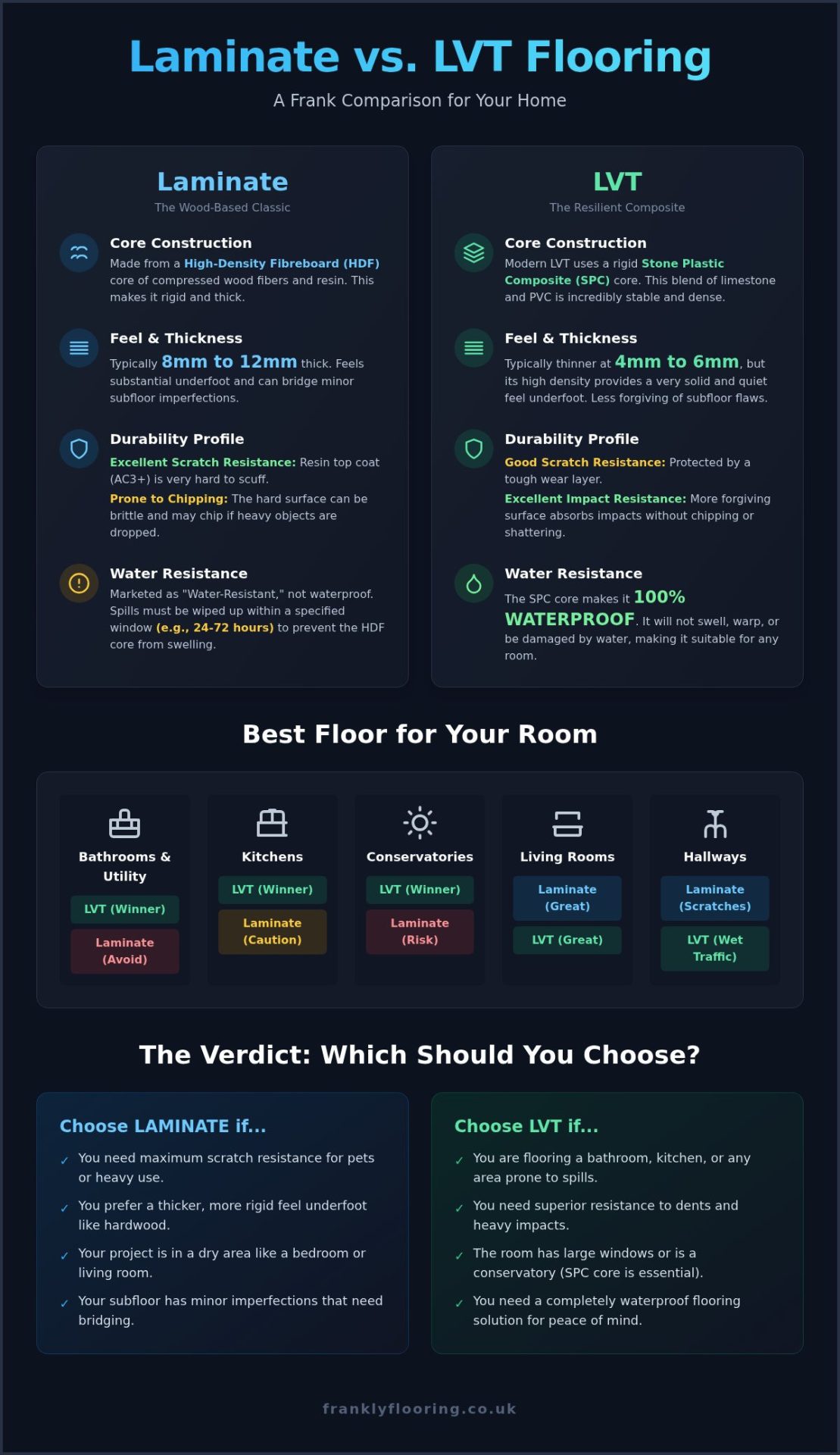
Laminate flooring is constructed using a High-Density Fibreboard (HDF) core. This core is made from compressed wood fibres and resin, which gives the plank its characteristic rigidity and thickness, often ranging from 8mm to 12mm. This thickness provides a “bridge” over minor subfloor dips, making it feel solid and substantial underfoot, much like traditional hardwood.
Durability is graded by an Abrasion Class (AC) rating. For most UK homes, an AC3 rating is the standard for residential use, providing enough protection against daily foot traffic. Because the core is wood-based, it remains naturally susceptible to moisture. If water gets into the joints, the HDF core can swell and cause the edges to peak. This is why even “water-resistant” laminates have strict time limits on how long a spill can sit before damage occurs.
Inside a Luxury Vinyl Tile (LVT)
LVT has moved far beyond the thin, flexible vinyl of the past. By 2026 standards, many high-quality options use a Rigid Core, specifically Stone Plastic Composite (SPC). This core blends limestone powder and stabilisers with PVC to create a plank that is 100% waterproof and incredibly stable. It won’t expand or contract like wood-based products do when temperatures change, which is a massive advantage in sun-drenched conservatories.
You will generally find LVT in two formats: click and glue-down. Click LVT uses a locking system similar to laminate, while glue-down requires a permanent adhesive. While LVT is usually thinner than laminate, typically 4mm to 6mm, its density makes it remarkably tough. The protective wear layer, often 12 mil for residential applications, ensures the photographic layer stays protected from scratches and scuffs in high-traffic zones like hallways and kitchens.
Durability and Water Resistance: Where the Differences Show
Choosing between laminate flooring vs lvt often comes down to one question: will it survive your daily life? While both are tough, they handle stress differently. Laminate relies on a resin-based top coat that is incredibly hard to scratch. It is the reason why Consumer Reports flooring tests often rank high-quality laminate at the top for resisting scuffs from dragging chairs or pet claws. However, that hardness makes it brittle. If you drop a heavy cast-iron pan in the kitchen, laminate is more likely to chip than LVT.
LVT offers a different kind of resilience. Its surface is more forgiving, which helps it absorb impacts without shattering. By 2026 standards, the introduction of SPC (Stone Plastic Composite) cores has also solved the old problem of vinyl warping in the sun. If you are flooring a conservatory or a room with large south-facing windows, a modern rigid-core LVT will stay flat and stable where older vinyl might have buckled. This makes it a reliable choice for areas with fluctuating temperatures.
The Truth About Waterproof Laminate
The marketing around “waterproof” laminate needs a frank reality check. In most cases, this refers to topical water resistance rather than total core protection. While the surface repels spills, the HDF core remains susceptible to moisture if water seeps through the joints. Most manufacturers specify a “mop-up window” of between 24 and 72 hours; leave a leak longer than that, and the core will likely swell. Joint Guard technology in 2026 laminate products uses a hydrophobic coating on the click system to prevent water from reaching the core, but it is still not a substitute for a truly waterproof material.
LVT Wear Layers and Lifespan
When you look at LVT, the wear layer is the most important spec. For a busy UK home with kids and pets, a 0.55mm wear layer is the sweet spot for longevity. This transparent top layer protects the photographic design from wearing through over its 20 to 30-year lifespan. Unlike cheaper vinyl, high-grade LVT won’t show permanent indentations from heavy wardrobes or sofas. If you want to dive deeper into the technical specs, read our Frank Guide to Luxury Vinyl Tile. If you are looking for a floor that can handle the chaos of a family home, you can browse our latest collections online to see the options available.
Installation and Subfloor Prep: The DIY Reality Check
Many homeowners look at a box of LVT and assume it is the easier weekend project. They see the thin planks and the “score and snap” method using a simple utility knife and think they can skip the heavy tools. While it is true that LVT is cleaner and quieter to install than laminate, which requires a saw and creates plenty of dust, the real work for vinyl happens before the first plank is laid. In the laminate flooring vs lvt debate, laminate is the forgiving friend, while LVT is the perfectionist that demands a flawless foundation.
Both floors require an expansion gap around the perimeter of the room. It is a common mistake to think that because LVT is plastic-based, it won’t move. While laminate expands and contracts with changes in humidity, LVT reacts to temperature. Without a 10mm gap, both floors are prone to “peaking,” where the planks push against the walls and lift in the centre of the room. This is a technical failure that is entirely avoidable with the right spacers and a bit of patience.
Subfloor Requirements for LVT vs Laminate
LVT is highly susceptible to “telegraphing.” Because the material is flexible, it will eventually mould itself to every lump, bump, or screw head in your subfloor. Industry standards, supported by the Resilient Floor Covering Institute, suggest a subfloor must be flat within 3mm over a 2-metre span. If you are laying over old floorboards, you will almost certainly need to ply-line the floor first to create a smooth surface. Laminate, being thicker and more rigid, can bridge minor dips and gaps, making it the faster and often cheaper “cover-up” solution for uneven floors.
The Underlay Essential
You cannot use standard laminate underlay for LVT. Laminate underlay is designed to be thick and cushioning, but that same “bounce” will ruin an LVT floor. Because LVT click joints are smaller and more delicate, they need a high-density, low-compression underlay to stay locked together. If the underlay is too soft, the joints will flex every time you walk on them until they eventually snap. When you are planning transitions between different rooms, you may also need to consider how the floor heights meet, perhaps using specific carpet grippers or door bars to ensure a safe and professional finish.
Cost, Lifespan, and Maintenance: The Long-Term View
When comparing the cost of laminate flooring vs lvt, the initial price tag on the box often tells a misleading story. Laminate is almost always the winner on the basic price per square metre, making it an attractive choice for large projects or tight budgets. However, a savvy homeowner looks at the total project cost. You must account for the specific high-density underlay required for vinyl and the meticulous subfloor preparation we discussed earlier. While you might save money today with laminate, LVT often provides a better return on investment over its 15 to 25 year lifespan, compared to the 10 to 20 years you typically get from a laminate floor.
Maintenance is where many people accidentally ruin their investment. Stop using steam mops on either of these floors. The intense heat and moisture can delaminate the layers of a vinyl plank or cause the HDF core of a laminate to swell instantly. A well wrung damp mop is all you need for either material. LVT is slightly more forgiving for heavy duty cleaning, but treating both with care will keep them looking fresh for decades. If you are looking for a floor that balances cost and quality, you can shop our full range of LVT and laminate online to find the right fit for your home.
Value for Money vs. Upfront Saving
Choosing a bargain LVT with a thin wear layer is often a false economy. You are usually better off with a premium laminate that offers superior texture and impact resistance than a cheap vinyl that might feel flimsy. The price gap between mid-range laminate and mid-range LVT is a reflection of the latter’s complex synthetic construction and total moisture resistance; it typically requires a higher initial investment for the materials alone. In the 2026 UK housing market, a high-quality LVT installation is increasingly viewed as a premium feature that adds tangible character and appeal to a property.
Keeping Your Floor Looking New
Gloss finishes are beautiful but show micro-scratches more easily than matt or textured EIR finishes. If you do damage a plank, click-system floors can be difficult to repair mid-room because you often have to lift the floor from the nearest wall to reach the damaged piece. LVT has a slight edge here; if you choose a glue-down format, a single damaged tile can be heated and replaced without disturbing the rest of the floor. For a deeper dive into making the right choice, check out our Laminate Flooring UK: The Frank 2026 Buying & Installation Guide.
The Verdict: Which Floor Wins for Your Specific Room?
The “best” floor doesn’t exist in a vacuum. It only exists in the context of your specific home, your lifestyle, and your budget. When we look at laminate flooring vs lvt, the winner changes the moment you cross the threshold from one room to another. A floor that performs brilliantly in a quiet bedroom might be a disaster in a busy utility room where the washing machine has a habit of leaking. We believe in being frank about these limitations so you don’t end up with a failed floor and a wasted investment.
In bathrooms and utility rooms, LVT is the undisputed champion. There is no debate here. The 100% waterproof nature of a vinyl or SPC core means it can handle standing water and high humidity without any risk of swelling. While some modern laminates claim to be waterproof, they usually rely on topical coatings that can’t match the inherent moisture resistance of LVT. For bedrooms and lounges, however, laminate often takes the crown. It provides a natural warmth and a thicker, more substantial feel underfoot that LVT can sometimes lack, all while offering excellent value for money in larger, dry spaces.
The kitchen remains the ultimate “Frank” debate. LVT offers peace of mind against fridge leaks and dropped pans, but a high-quality, water-resistant laminate is often half the price and can handle the occasional spill if you’re quick with a cloth. For high-traffic hallways, we recommend LVT with an SPC core as the 2026 pro choice. These rigid cores are incredibly dense, meaning they won’t dent under the pressure of heavy furniture or show wear from the grit and dirt that inevitably gets tracked in from the front door.
Room-by-Room Cheat Sheet
- Kitchens: LVT is the safer bet for long-term moisture protection, but laminate is a smart way to save on your budget if the subfloor is already flat.
- Conservatories: Rigid Core (SPC) LVT is the industry standard here. It remains stable during the extreme temperature fluctuations that would cause laminate or older vinyl to buckle.
- Basements and Damp Areas: Avoid laminate entirely. Even with a moisture barrier, the HDF core is too risky in environments with high subfloor humidity.
Final Checklist Before You Buy
Before you make your final decision, ask yourself these four questions. Are you planning to DIY the installation or hire a professional? Laminate is generally more forgiving for a first-timer, whereas LVT requires a perfectionist’s touch with subfloor prep. What is your subfloor made of? If it’s uneven floorboards, laminate will hide those flaws better. How long do you plan to live in the property? If it’s your “forever home,” the 25-year lifespan of a premium LVT is worth the extra upfront cost.
Ready to choose? You can browse our full range of LVT and laminate flooring online to find the perfect match for your home’s character.
Choose the Foundation for Your Home with Confidence
Choosing between laminate flooring vs lvt doesn’t have to be a gamble. You now understand that while LVT offers the ultimate waterproof protection for bathrooms, laminate remains a heavyweight contender for living rooms where warmth and budget are the priorities. Remember that your subfloor’s condition is the deciding factor for installation success. A flat surface is non-negotiable for vinyl, whereas a sturdy laminate plank can bridge those minor imperfections in older UK properties.
We’ve spent 20 years vetting our flooring range to ensure every product we sell meets our standards for durability and style. Our family-run team is committed to providing honest advice and reliable UK-wide delivery, helping you avoid the common pitfalls of “waterproof” marketing and hidden costs. It’s time to stop second-guessing and start transforming your space. Explore our frankly priced LVT and Laminate collections today and find a floor that will stand the test of time. Your perfect home renovation is just a few clicks away.
Frequently Asked Questions
Is LVT better than laminate for dogs and pets?
LVT is generally the superior choice for households with pets. While laminate has a harder top coat that resists claws, it is often more slippery and will swell if pet accidents are not cleaned up immediately. LVT is 100% waterproof and offers better grip for paws. This makes it a more reliable long-term investment for animal lovers who want to avoid permanent floor damage from spills or moisture.
Can I lay LVT directly over my old laminate flooring?
You should never lay LVT directly over old laminate. Laminate is a floating floor that expands and contracts with humidity; installing another floor on top creates an unstable foundation. LVT requires a dead-flat, rigid subfloor to prevent the click joints from failing or the planks from telegraphing imperfections. Always remove the old laminate and inspect the subfloor underneath to ensure it meets the necessary flatness standards before starting your project.
Which flooring is warmer underfoot: LVT or laminate?
Laminate flooring is typically warmer underfoot because its high-density fibreboard core acts as a natural insulator. It is also thicker than LVT, which creates a more substantial barrier against a cold subfloor. While LVT can feel cooler to the touch, it is highly compatible with underfloor heating systems. If you don’t have heating installed, laminate provides a more comfortable, room temperature feel in bedrooms and living areas during the colder months.
Does LVT flooring need underlay if it has a built-in backing?
If your LVT has a built-in backing, you should not add an extra layer of underlay. Doing so makes the floor too soft and bouncy, which puts excessive pressure on the click joints and eventually causes them to snap. Manufacturers design integrated backings to provide the exact level of support needed. Always check the specific installation guidelines for your product to ensure you aren’t voiding your warranty by adding unnecessary layers.
Is laminate flooring still popular in 2026?
Laminate remains incredibly popular in 2026 because it offers the best balance of realistic texture and cost-effectiveness. Recent manufacturing improvements, such as Embossed in Register (EIR) technology and enhanced Joint Guard moisture protection, have kept it competitive against newer materials. It is still the go-to choice for homeowners who want the look of authentic timber in dry rooms without the higher price tag associated with the laminate flooring vs lvt debate.
Can I use a steam mop on LVT or laminate floors?
You should avoid using a steam mop on both LVT and laminate floors. The intense heat can cause the layers of LVT to peel or delaminate, while the forced moisture can penetrate the joints of a laminate floor and cause the core to swell. For safe maintenance, use a well-wrung damp mop and a manufacturer-approved cleaner. This simple approach protects the integrity of your floor and ensures it reaches its full expected lifespan.
What happens if laminate flooring gets wet?
When laminate flooring gets wet, the wood-based HDF core absorbs the moisture and begins to expand. This often results in peaking, where the edges of the planks push upwards and create uneven ridges. If the water sits for too long, the internal fibres can break down, leading to permanent structural damage that cannot be sanded out. It’s vital to dry any spills immediately to prevent the joints from becoming compromised and blown.
Which is easier to repair: LVT or laminate?
LVT is generally easier to repair, particularly if you have chosen a glue-down format. Individual tiles can be heated, lifted, and replaced without disturbing the rest of the floor. With click-system floors, whether choosing laminate flooring vs lvt, you typically have to take up the floor from the nearest wall to reach the damaged plank. This makes the initial choice of installation method very important if you are worried about potential future damage.