
That stunning floor you saw in the high-street showroom doesn’t actually cost that much to manufacture; you’re often just paying for the salesperson’s commission and the shop’s expensive rent. It’s frustrating when you want a durable, high-end look for your home but feel buried under confusing talk of wear layers, SPC, and WPC. You’re right to be wary of buying luxury vinyl tile flooring UK online because nobody wants a floor that arrives looking like cheap, shiny plastic.
At Frankly Flooring, we believe in being direct about what you’re actually paying for. This 2026 guide is our frank look at the industry, designed to strip away the marketing fluff and give you the technical truth so you can secure a professional finish without the hidden markups. We’ll break down exactly how to choose the right wear layer for your pets, the reality of DIY installation, and how to spot a genuine bargain from a flimsy imitation. By the time you’ve finished reading, you’ll have the confidence to skip the showroom and order a floor that handles real life beautifully.
Key Takeaways
- Learn why the wear layer is the most critical spec for your floor’s lifespan and how to choose between 0.3mm and 0.55mm options.
- Understand the technical differences between SPC and WPC cores to ensure your new floor handles UK underfloor heating without issues.
- Discover how to buy luxury vinyl tile flooring UK online to avoid the typical markups found in high-street showrooms.
- Compare the long-term stability of professional glue-down LVT against the DIY-friendly speed of click-lock systems.
- Identify the 2026 design trends that offer a high-end look, including the lasting appeal of herringbone and large-format stone effects.
What is Luxury Vinyl Tile (LVT) and Why is it Dominating UK Homes?
Luxury vinyl tile is a multi-layered hard flooring designed to mimic natural wood or stone with startling realism. It is a massive leap forward from the thin, flexible vinyl your grandmother might have had in her kitchen. By 2026, luxury vinyl tile flooring UK has officially overtaken laminate and engineered wood as the most popular choice for British homeowners. It offers the warmth of wood and the aesthetic of stone without the warping, cracking, or high maintenance that usually comes with natural materials.
The British climate presents unique challenges for flooring. Between damp winters and the humidity of our kitchens and bathrooms, traditional materials often struggle. LVT has dominated the market because it is inherently moisture-resistant and thermally stable. It doesn’t expand or contract like solid wood, making it a reliable foundation for any room in the house.
The Multi-Layer Construction Explained
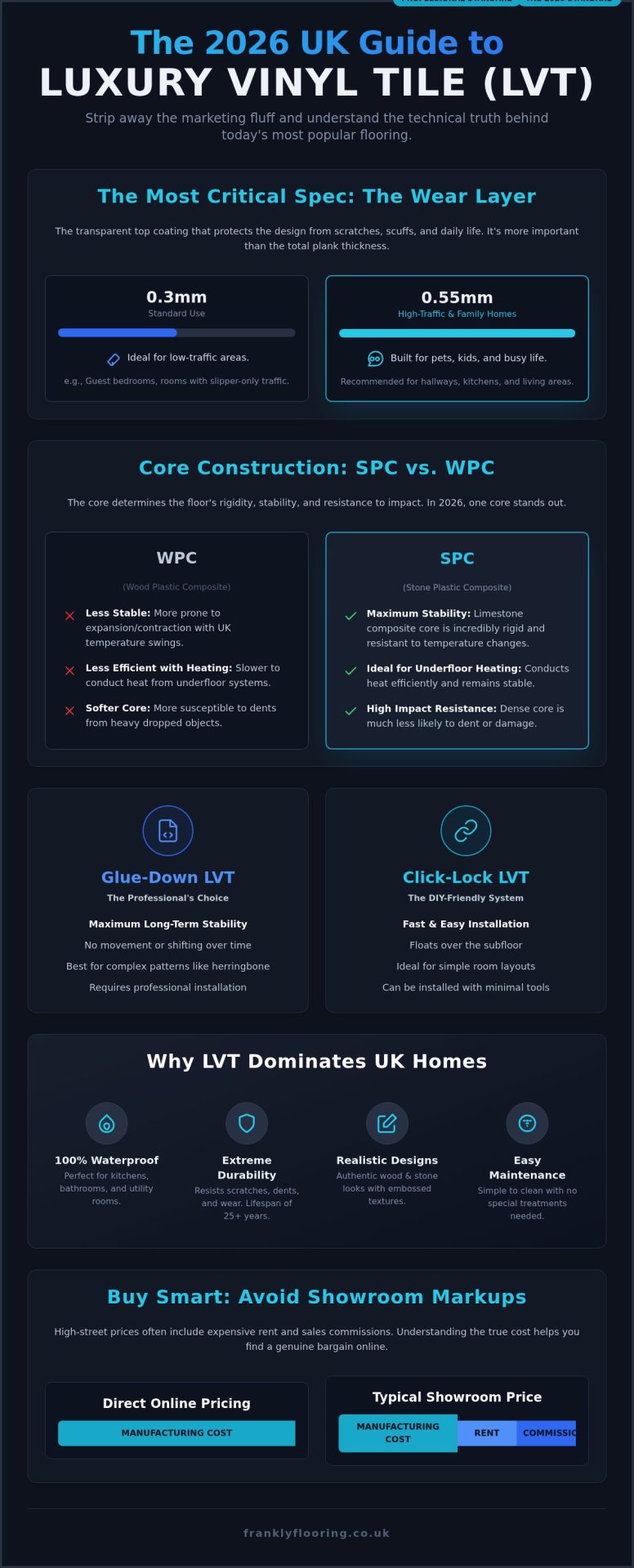
To understand why LVT lasts, you need to look at what’s inside. It isn’t a single piece of plastic; it’s a sandwich of high-performance materials. At the top, a UV coating protects the floor from fading. This is essential if you’re installing it in a bright conservatory or a south-facing lounge. Below that sits the wear layer. This clear, protective coating determines how well your floor handles scratches and scuffs. For most busy UK homes, a 0.55mm wear layer is the professional standard for longevity. Finally, the decorative layer uses high-definition printing and embossing to create textures that even experts struggle to tell apart from the real thing.
LVT vs. Traditional Vinyl: A Frank Comparison
The “luxury” in LVT isn’t just a marketing buzzword. While traditional sheet vinyl is thin and flexible, LVT is thick and rigid. This structural integrity means it doesn’t “telegraph” every tiny bump in your subfloor through to the surface. It feels more substantial underfoot and offers far better durability.
- Lifespan: A high-quality LVT installation can last for 25 years or more. Basic sheet vinyl often needs replacing within 5 to 10 years.
- Maintenance: It’s waterproof and slip-resistant. You can mop it thoroughly without worrying about the boards swelling like laminate might.
- Stability: It handles the moisture and temperature swings of the UK climate far better than natural wood or older vinyl products.
LVT has become the 2026 standard because it solves the biggest headache for homeowners. It’s the search for a floor that looks high-end but survives spills, pets, and muddy boots. It’s a “set and forget” investment that adds genuine character to a home without the fragility of traditional materials.
The Technical Truth: Wear Layers, Cores, and R-Ratings
Showrooms often try to sell you on the overall thickness of a tile because a chunkier product feels more substantial in your hand. This is a distraction. The most important specification for luxury vinyl tile flooring UK isn’t how thick the plank is, but the thickness of the wear layer on top. A 5mm thick tile with a 0.3mm wear layer will look worn and “plastic” far sooner than a 4mm tile with a 0.55mm wear layer. The wear layer is the transparent coating that protects the design from your daily life.
Choosing the Right Wear Layer for Your Room
For a guest bedroom or a room that only sees slipper traffic, a 0.3mm wear layer is perfectly adequate and saves you money. However, for hallways, kitchens, or any area where kids and pets roam, we recommend a 0.55mm wear layer as the professional standard. This thickness provides the durability needed to handle high heels and pet claws without scuffing the decorative layer beneath. While premium 0.7mm options exist for commercial spaces, 0.55mm is the “sweet spot” for a home floor intended to last 25 years.
SPC (Stone Plastic Composite) – The 2026 Standard
In 2026, the industry has largely shifted toward rigid core construction, specifically SPC. Stone Plastic Composite (SPC) is a hybrid of limestone and stabilisers designed for maximum rigidity. This core makes the floor incredibly stable, which is vital for the UK’s fluctuating temperatures. If you have underfloor heating, SPC is the superior choice over older WPC (Wood Plastic Composite) cores because it conducts heat more efficiently and won’t expand or contract as much when the heating kicks in. It also offers better impact resistance; if you drop a heavy cast-iron pan in the kitchen, an SPC core is much less likely to dent.
Safety and sound are the final technical hurdles. In bathrooms or utility rooms, look for an R10 rating, which indicates a standard level of slip resistance for wet areas. If you’re installing flooring in a flat or an upstairs bedroom, pay attention to the decibel (dB) rating. Many modern LVT products come with an integrated acoustic underlay that can reduce impact noise by up to 19dB, keeping things quiet for the rooms below. If you’re unsure which spec fits your project, you can browse our full range of luxury vinyl tile flooring UK to see the technical breakdowns for each style.
Glue-Down vs. Click LVT: Which Should You Actually Choose?
When you’re browsing luxury vinyl tile flooring UK, the first major decision isn’t the colour or the pattern. It’s how the planks actually connect to your home. You’ll find two main camps: click-lock and glue-down, which is often called dryback. While both look identical once installed, they behave differently under your feet and require very different levels of preparation.
When to Choose Click-Lock Flooring
Click-lock LVT is the go-to for quick room refreshes. It’s a floating floor system where the planks snap together using a tongue-and-groove mechanism. This means you can often install it directly over existing hard floors, provided they are flat and stable. Many modern click products come with a built-in acoustic underlay, which saves you the extra step and cost of buying a separate roll. If you’ve ever looked at Laminate Flooring UK options, you’ll recognise the click system, but LVT offers much better moisture resistance.
The quality of the “click” is paramount. Cheaper products often have brittle joints that can gap over time if the subfloor isn’t perfectly level. Click-format LVT starts from £42.99 per square metre for supply only, making it a premium DIY choice. If you do the work yourself, you’ll save on professional labour costs, which typically range from £15 to £30 per square metre in the UK. Just don’t cut corners on the product quality just to save on the fit.
The Case for Glue-Down LVT
Glue-down is the professional’s choice for a reason. Because every tile is bonded directly to the subfloor, it’s incredibly stable and doesn’t require expansion gaps around the perimeter of the room. This makes it the superior choice for large open-plan spaces where a floating floor might feel bouncy or move slightly under heavy furniture. It’s also surprisingly easier to repair; if you damage a single tile, a pro can heat the adhesive and swap that one piece out without lifting the whole floor.
The frank truth about glue-down is the subfloor preparation. You can’t just slap adhesive on floorboards. You’ll likely need to install 6mm plywood over timber or a self-levelling compound over concrete. This preparation can add between £5 and £15 per square metre to your project cost. While the material itself is often cheaper than click-lock, the total cost for supply and fit usually averages around £45 per square metre. It’s an investment in permanent stability over DIY convenience.
Design Trends: Herringbone, Stone, and Wood-Effect
Choosing the right pattern is where most homeowners get stuck between what looks good in a magazine and what actually works in a narrow British semi-detached. In 2026, the trend for luxury vinyl tile flooring UK has shifted toward extreme realism. Manufacturers now use embossed-in-register (EIR) technology. This process matches the surface texture perfectly with the printed grain beneath it. When you run your hand over a plank, you feel the knots and grooves exactly where you see them. It’s the difference between a floor that looks like wood and one that feels like it.
While wood-effect remains the standard, stone and concrete effects are surging in popularity for kitchens and open-plan extensions. Large-format tiles, often measuring 600mm by 1200mm, create a seamless, industrial look without the “cold feet” associated with real porcelain or polished concrete. If you’re looking to make a small room feel larger, consider wide-plank formats. Planks measuring 220mm to 300mm across create fewer visible seams, which simplifies the visual landscape of a room and makes it feel significantly more open.
Mastering the Herringbone Pattern
Herringbone remains the top design choice in the UK, but there’s a frank truth most retailers won’t tell you: it requires more material. Because of the intricate cuts, you should order 10% to 15% more than your room’s actual square footage to account for waste. In smaller spaces like hallways, use a smaller plank size to ensure the pattern repeats enough times to be visible. Adding a border detail around the perimeter of the room can elevate the finish from a standard DIY job to a professional-grade installation. For more pattern inspiration, read our What Is LVT Flooring? A Frank Guide.
Colour Palettes for 2026
The era of “cool grey” is over. The 2026 palette is dominated by “greige,” dusty taupes, and soft sage tones that bring a biophilic, natural feel into the home. These warmer tones are more forgiving with pet hair and everyday dust than the starker greys of the last decade. Pay attention to the Light Reflectance Value (LRV) of your chosen tile. The LRV is a scale from 0 to 100 that tells you how much light the floor reflects; a higher number will help brighten a dark, north-facing room, while lower values create a moody, high-end aesthetic in dining areas.
Ready to see these textures for yourself? Shop our 2026 LVT collection and find the perfect match for your home’s character.
How to Buy LVT Online Without the Showroom Markup
Walking into a high-street showroom feels reassuring, but that feeling comes at a price. Every square metre of flooring in a physical shop carries a hidden tax to cover the building’s rent, the heating, and the salesperson’s commission. By sourcing your luxury vinyl tile flooring UK online, you’re choosing to pay for product quality rather than a retailer’s overheads. It’s the most effective way to get a premium 0.55mm wear layer for the price of a budget high-street alternative.
The sample strategy is your best defence against a poor purchase. Showroom lighting is notoriously deceptive, often using bright fluorescent tubes that don’t exist in your home. When your samples arrive, test them in the room they’re intended for. Look at them in the morning light, under your evening lamps, and even on a rainy afternoon. This is the only way to see the true “greige” or oak tones without the showroom’s artificial tint.
Measuring correctly is where most homeowners feel the most anxiety. We recommend measuring your room’s widest and longest points, then multiplying them to get the square footage. Always add 10% for wastage to cover the cuts at the edges. If you’ve chosen a herringbone pattern, increase that to 15%. Don’t forget the logistics; LVT is incredibly heavy. A full floor order could involve 40 packs arriving on a pallet. Most deliveries are kerbside, so ensure you have a plan to move the stock into your home as soon as it arrives.
The Frankly Flooring Approach
We don’t believe in high-pressure sales tactics or confusing jargon. Our goal is to use our 20 years of flooring experience to guide you toward a product that actually fits your lifestyle. We focus on the technical truth because we’ve seen how the right specifications lead to long-term satisfaction. We also make sure you can get your adhesives and accessories in the same order, so you aren’t left hunting for the right technical components halfway through your project.
Checklist for a Successful Online Purchase
- Order 10-15% extra: This covers mistakes and ensures you have spare tiles for any future repairs.
- Match the wear layer to the room: Stick to 0.55mm for hallways and kitchens to ensure the floor lasts 25 years.
- Prep the subfloor: Ensure your floor is dry, level, and clean before the delivery truck pulls up.
- Check the batch: When the packs arrive, verify they are all from the same batch number to ensure perfect colour consistency.
Ready to Build a Floor That Lasts?
Choosing the right luxury vinyl tile flooring UK shouldn’t be a gamble based on showroom lighting or high-pressure sales pitches. By focusing on the technical truth, such as the importance of a 0.55mm wear layer and the stability of an SPC core, you’re investing in a home that handles real life beautifully. You’ve learned that the secret to a high-end finish lies in meticulous subfloor preparation and avoiding the unnecessary markups that come with physical storefronts.
At Frankly Flooring, we bring over 20 years of family-run expertise directly to your door. We provide no-nonsense technical advice and national UK delivery to ensure your project stays on track from the first sample to the final plank. Browse our full range of Luxury Vinyl Tiles at Frankly Flooring and find a floor that combines 2026 design trends with genuine craftsmanship. You’re now equipped with the frank reality of LVT; it’s time to stop browsing and start transforming your space with confidence.
Frequently Asked Questions
Is LVT flooring waterproof and suitable for bathrooms?
Yes, luxury vinyl tile flooring UK is completely waterproof, which makes it the ideal choice for bathrooms and utility rooms. Unlike laminate or natural wood, the synthetic layers don’t absorb moisture, so the planks won’t swell or warp when exposed to spills or high humidity. It’s important to ensure your subfloor is properly prepared to prevent water from sitting underneath the tiles, as this can lead to mould growth over time.
Does LVT flooring need underlay if it has a built-in backing?
No, you shouldn’t add a separate underlay if your LVT already has a built-in acoustic backing. Adding an extra layer creates too much “bounce” in the floor, which puts unnecessary stress on the click-lock joints and can cause them to snap. If you’re using a dryback product without a pre-attached backing, you’ll need to bond it directly to a smooth subfloor rather than using a traditional foam underlayment.
Can I install LVT flooring over my existing tiles?
You can install click-lock LVT over existing ceramic tiles, but the surface must be perfectly level and stable. If your grout lines are deep or wide, they may “telegraph” through to the surface of the LVT over time, creating visible indentations on the new floor. For a professional finish, we recommend filling the grout lines with a smoothing compound or removing the old tiles entirely to start with a flat subfloor.
How long does LVT flooring typically last in a busy home?
A high-quality LVT installation can last for 25 years or more in a busy home, provided you choose the correct wear layer. For areas with high foot traffic, a 0.55mm wear layer is the professional standard for longevity. While cheaper 0.3mm options are available, they’ll likely show signs of wear much sooner. Regular cleaning and using felt pads under heavy furniture will also help extend the life of your investment.
Is LVT flooring compatible with electric underfloor heating?
Yes, LVT is compatible with most electric underfloor heating systems, provided the floor temperature doesn’t exceed 27°C. SPC cores are particularly effective here because they are more thermally stable and conduct heat efficiently. Always check the specific manufacturer’s guidelines for your chosen luxury vinyl tile flooring UK, as some systems require a specific type of underlay or adhesive to handle the heat cycles without the planks warping or lifting.
How do I clean and maintain my luxury vinyl tiles?
Maintenance is straightforward; simply sweep or vacuum regularly to remove grit that could scratch the surface. Use a damp mop with a pH-neutral cleaner designed specifically for vinyl floors. Avoid using steam mops, as the intense heat can potentially weaken the adhesive bond or damage the core of the planks. For stubborn scuffs, a soft cloth and a specialized vinyl floor restorer will usually do the trick without damaging the protective wear layer.
Is LVT flooring better than laminate for homes with pets?
LVT is generally superior to laminate for pet owners because it’s more resistant to scratches and completely impervious to liquid accidents. While modern laminates have improved, they can still swell if liquid sits in the joints for too long. The textured surface of many luxury vinyl tiles also provides better grip for paws, which reduces the risk of your pets slipping and sliding as they move across the room.
What is the average cost per square metre for quality LVT in the UK?
The cost of luxury vinyl tile flooring UK depends on the technical specifications you choose, such as the wear layer thickness and core construction. A product with a 0.55mm wear layer and a rigid SPC core represents a higher initial investment but offers much better long-term value. By ordering online, you can often secure these premium specifications for a price similar to entry-level products found in showrooms, as you aren’t paying for their overheads.