
A bigger wear-layer number doesn’t automatically mean a better floor for your home. Specifications can be difficult to compare, especially when one product lists thickness and another uses a rating. Understanding flooring wear layers starts with knowing what the figure describes and which material it applies to.
It’s sensible to look for a clear sign of durability, but one number can’t guarantee how flooring will perform in every room. The relevant specification depends on the floor’s construction, expected foot traffic and the demands of your household.
This guide explains what a wear layer does and where its protection has limits. You’ll learn how LVT measures its protective top layer in mils, how engineered wood’s real-wood veneer is measured in millimetres, and why laminate is usually compared using an AC rating. You’ll also see how to weigh those specifications against room use and daily routines, so you can compare options with more confidence.
Key Takeaways
- Understanding flooring wear layers means looking beyond a headline thickness figure to what the surface layer actually does.
- Compare LVT, laminate and engineered wood according to their own construction and specification conventions. Their figures are not interchangeable.
- Separate thickness measurements from performance ratings, and consider what each can and can’t tell you about a floor.
- Use the room’s traffic and your household’s everyday needs to guide your choice, rather than applying one rule to every space.
- Review the full product specification, including care guidance and construction details, before deciding which flooring suits your home.
What Is a Flooring Wear Layer, and What Does It Protect?
A flooring wear layer is a surface layer designed to resist everyday wear. It sits at the top of a floor’s construction and helps protect the material or decorative detail beneath it from regular use. The term is useful, but it doesn’t mean exactly the same thing on every type of flooring.
Understanding flooring wear layers also means recognising their limits. A wear layer is one part of a floor’s construction, not a complete measure of quality or a guarantee of how the whole floor will perform.
Where the wear layer sits in a floor
To picture a layered floor, start at the surface and work down. The exact construction varies by material, but these examples show how the parts relate:
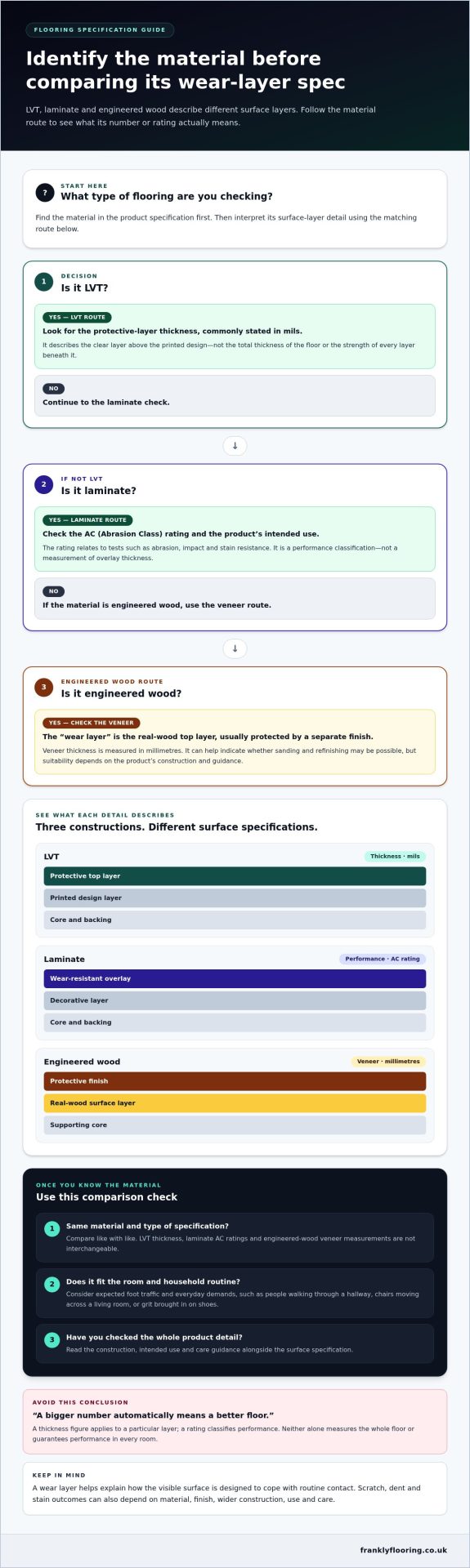
- LVT: protective top layer, printed design layer, core and backing.
- Laminate: wear-resistant overlay, decorative layer, core and backing.
- Engineered wood: protective finish over a real-wood surface layer, with a supporting core beneath.
In LVT and laminate, the surface layer sits above the printed image that gives the floor its appearance. In engineered wood, “wear layer” commonly refers to the real-wood veneer itself, while a separate finish protects its surface. The core and backing have different roles: they form the body and underside of the flooring rather than its visible protective surface. For a general overview of vinyl flooring construction, including its vinyl flooring wear layer, see the linked reference.
These are simplified examples, not a universal blueprint. Product construction can vary, so use the product specification to understand what each named layer means for a particular floor.
What a wear layer can and cannot tell you
A wear layer is relevant to how the visible surface is designed to cope with routine contact. Consider people walking through a hallway, moving a chair across a living room or bringing grit in on shoes. The wear layer helps explain the surface’s role, but it doesn’t tell you how the whole floor will respond to every household demand.
The term alone doesn’t guarantee resistance to scratches, dents or stains. Those outcomes can depend on the material, finish and wider construction, as well as how the floor is used and cared for. A larger thickness figure, where one is given, shouldn’t be treated as a universal promise of better performance.
Read wear-layer information alongside the rest of the product details. Check which material and layer the figure describes, any stated performance classification, the intended use and the care guidance. This gives you a more useful basis for comparison than relying on one headline measurement.
How Wear Layers Differ Across LVT, Laminate and Engineered Wood
“Wear layer” can refer to different parts of a floor, depending on the material. LVT, laminate and engineered wood have distinct constructions, so their specifications use different measurements or ratings. Comparing their headline figures as if they described the same thing can lead to the wrong conclusion.
| Material | What the surface layer refers to | What to check |
|---|---|---|
| LVT | A clear protective layer above the printed design. | The stated wear-layer thickness and the rest of the product specification. |
| Laminate | A wear-resistant overlay above the decorative paper and core. | The AC rating and the product’s intended use. |
| Engineered wood | The top layer of real wood, usually protected by a separate finish. | The veneer construction, finish and care guidance. |
What the wear layer means on LVT and vinyl
On LVT, product information may describe a clear protective layer over the printed design. Specifications commonly express its thickness in mils, a unit used for very thin layers. The figure describes that protective layer, not the total thickness of the flooring or the strength of every part beneath it.
Compare the same type of LVT specification across products, then read it alongside the overall construction and intended use. One thickness figure cannot describe every aspect of surface performance. Vinyl flooring covers different product constructions, so the wording on the individual product matters. For broader material context, see this LVT flooring guide.
Why laminate and engineered wood use different measures
Laminate is generally compared using an AC (Abrasion Class) rating rather than an LVT-style wear-layer thickness. The rating relates to performance across tests such as abrasion, impact and stain resistance. It’s a classification, not a measurement of the overlay’s thickness, so an AC figure shouldn’t be compared directly with an LVT thickness.
Engineered wood uses “wear layer” differently. It refers to the real-wood veneer at the top of the board, not a clear vinyl coating. Veneer thickness can help indicate whether sanding and refinishing may be possible, but suitability depends on the product’s construction and guidance. Its measurement in millimetres describes a different component from the LVT top layer.
The practical lesson in understanding flooring wear layers is to identify the material first, then interpret its specification on its own terms. For more material-specific context, see the engineered wood flooring guide. As you compare options, browse LVT and other flooring choices alongside their product details, rather than ranking them by unrelated numbers.
How to Compare Wear-Layer Thickness and Flooring Ratings
A thickness measurement tells you how thick a particular layer is. A performance classification, such as a laminate AC rating, groups a product according to results across specified tests. They answer different questions, so a number from one system can’t be converted into or ranked against a number from another.
| Material | Specification type | What it indicates | What it cannot prove |
|---|---|---|---|
| LVT | Wear-layer thickness, often stated in mils | The thickness of the stated protective surface layer | How the complete floor will perform in every home or how long it will last |
| Laminate | AC rating | A performance class based on tests that include abrasion, impact and stain resistance | A direct thickness comparison with LVT or a guaranteed number of years in use |
| Engineered wood | Real-wood veneer thickness, often stated in millimetres | The depth of the wood surface layer, which can be relevant to refinishing | The resistance of its finish to every type of damage |
Compare specifications only within the same material and product context. A larger thickness figure isn’t a universal ranking of flooring durability. Understanding flooring wear layers means checking what a number describes before deciding what it means for your rooms.
Reading an LVT wear-layer figure
Look in the product details or technical specification for a field labelled “wear layer” or similar, and note both the figure and its unit. A mil is one-thousandth of an inch, so don’t confuse a wear-layer measurement with the total thickness of an LVT plank or tile. The figure is most useful when comparing LVT products with similar constructions and intended applications. It helps you assess the stated surface layer, but it doesn’t set a guaranteed lifespan or identify one thickness that suits every household.
Understanding laminate ratings and product claims
Laminate commonly uses an AC rating rather than an LVT-style thickness figure. The class indicates an intended level of use: AC1 is for light residential use, AC2 for general residential use, AC3 for heavy residential or moderate commercial use, AC4 for general commercial or heavy residential use, and AC5 for heavy commercial use. These categories aren’t years of service, and they can’t be directly compared with an LVT thickness measurement.
Check what the rating applies to and whether it aligns with the product’s stated application. For engineered wood, read the veneer thickness alongside the finish and care instructions. A veneer around 3-4mm is common for residential flooring and can allow at least one refinishing, but the product’s own specification should guide expectations. Compare full product details, including construction and care guidance, as you browse flooring options.
Match a Flooring Wear Layer to Your Rooms and Routine
A specification is useful only if it makes sense for the room and the way you live in it. A hallway crossed throughout the day has different demands from a spare bedroom, while a living space may see repeated chair movement, play or pets. Use this process to narrow down what to look for, without assuming one figure works for every home.
- Identify the room. Note whether you’re choosing flooring for an entrance, a busy walkway, a living space or a lower-traffic room. Consider where people enter, turn or gather. Use is often concentrated in particular areas rather than spread evenly across the floor.
- Estimate everyday traffic. Consider how often people cross the room and whether it connects frequently used spaces. A route between an entrance and kitchen may see more regular footfall than a guest room used occasionally.
- Factor in household needs. Children playing, pets moving through the space, outdoor footwear and chairs being pulled in and out all affect the demands on a surface. These are useful context, not a promise that a particular specification will prevent scratches, dents or other damage.
- Compare within the material. Once you understand the room’s demands, compare the relevant specification for that flooring type. LVT thickness, laminate ratings and engineered wood veneer details describe different things, so they shouldn’t be ranked against each other on one durability scale.
Start with the room and expected traffic
Give busy walkways and entrances particular thought. Grit brought in on shoes and repeated foot traffic can put more demand on the surface. In living spaces, consider furniture movement and where people tend to sit or play. A quieter room may see less activity, but that doesn’t make every lower specification automatically suitable. Household routines differ, so base your comparison on likely use rather than the room label alone.
Check other product details before deciding
Wear-layer information is only one part of the decision. Read it alongside the product’s intended use, construction and care instructions. Moisture suitability and cleaning requirements need separate checks: a wear-layer figure by itself doesn’t tell you whether a floor suits a room’s conditions or cleaning routine. Appearance is separate too. A sample can help you judge colour and finish in your home, but it can’t demonstrate technical performance.
Understanding flooring wear layers is most useful when it helps you assess the full specification: does the material suit the room, and do its stated use and care requirements fit your household? Keep those checks together rather than letting one number make the decision.
With your room and routine in mind, compare flooring options by material and product details to find specifications that make sense for your home.
Use Flooring Wear-Layer Specifications to Make a Confident Choice
A product specification is most useful when you read its details together, not in isolation. The wear-layer figure or rating can help you compare suitable options, but it won’t tell you whether the floor’s construction, care requirements and intended use fit your room. Use this checklist to keep the comparison clear and practical.
A quick checklist for comparing product specifications
As you shortlist flooring, note the same information for each option. This makes differences easier to spot and stops an impressive-sounding number from overshadowing practical details.
- Material: Record whether the flooring is LVT, laminate or engineered wood. The material determines what the layer or rating refers to.
- Specification wording: Write down the exact term and unit, such as LVT wear-layer thickness, a laminate AC rating or engineered wood veneer thickness. Don’t treat different measures as interchangeable.
- Intended use: Check the rooms or applications the product is described as suitable for, then consider whether that matches your household’s expected activity.
- Care and limitations: Read the maintenance guidance and any stated product limitations. These details help you judge whether the floor fits your everyday routine.
- Construction: Look beyond the surface figure to the overall product build and other relevant specification details.
Compare like with like. Two LVT products with comparable constructions may be meaningfully compared by their stated wear-layer details. An LVT thickness figure and a laminate rating, however, don’t form a simple ranking. Keep track of units and terminology to avoid confusing the wear layer with total product thickness or a different layer altogether.
When a product specification needs more context
A single number can’t establish overall quality or suitability. It describes one aspect of a product, while the right choice also depends on the room, the floor’s construction and how you expect to care for it. Moisture conditions, cleaning needs and the look and feel you want deserve their own consideration alongside wear-layer information.
If you’re comparing products online, review the full product details rather than relying on a headline claim. Product specifications explain construction and stated use, while appearance is a separate consideration. Keep both in mind as you make a considered choice.
For wider advice on weighing up products and practical details while shopping online, Frankly Flooring’s guide to buying flooring online offers useful context. Understanding flooring wear layers doesn’t mean choosing the biggest number. Choose a specification that fits the material, intended use and your routine, then browse Frankly Flooring’s options to compare available flooring and product details.
Choose Flooring That Fits Your Home
Let your room and routine guide the decision, not the largest number on a product page. Understanding flooring wear layers gives you a clearer starting point, but the right choice also needs to suit your home and the way you’ll care for it.
Frankly Flooring is a family-run business with over 20 years of flooring-industry experience. Its online range includes LVT, wood, laminate, vinyl and carpet, giving you different materials to consider as you compare product details and styles.
Take the next step at your own pace. Browse flooring at Frankly Flooring and explore options for your home.
Frequently Asked Questions
Can a flooring wear layer be repaired without replacing the floor?
Sometimes, but it depends on the flooring material and the type and extent of damage. A small surface mark may be treatable with a product-approved repair method, while damage through the surface or into the design may be harder to disguise. Don’t sand or apply a coating without checking the manufacturer’s care instructions first. Use guidance intended for that specific floor rather than a general repair tip.
Does a wear layer make flooring waterproof?
No. A protective surface layer doesn’t by itself make the whole floor waterproof. Moisture performance can depend on the flooring’s core, joins, edges and intended use. A floor may resist surface spills but still be unsuitable for standing water or persistent damp. Check the product’s stated moisture suitability and cleaning guidance for the particular room, especially where spills or splashes are part of daily use.
Can furniture or chair legs damage a flooring wear layer?
Yes, furniture can mark or wear a floor’s surface, particularly if a leg has a rough edge or trapped grit underneath. Repeatedly dragging a dining chair is different from placing it and leaving it in one spot. Keep furniture feet clean and use suitable protectors that won’t discolour the surface or trap moisture against it. For office chairs, check the flooring guidance before choosing a castor type or protective mat.
Does a wear layer protect flooring from sunlight and fading?
Not necessarily. The presence of a wear layer doesn’t confirm that the floor resists colour change from sunlight. Exposure can vary across a room, so a rug or piece of furniture may leave areas that look different over time. Check product information for specific guidance about sunlight or fading, and consider window coverings or rearranging rugs periodically. These steps can help manage uneven exposure, but they aren’t a substitute for a stated product performance claim.
Can you refinish or sand a flooring wear layer?
Only some flooring constructions are suitable for refinishing. Engineered wood may be sandable if its real-wood top layer and product guidance allow it, but the finish and remaining veneer depth matter. LVT and laminate aren’t wood surfaces, so sanding them isn’t an equivalent way to refresh the floor and may damage the design or protective surface. Check the specific product instructions before attempting refinishing work.
Does cleaning the floor incorrectly wear down its protective layer?
It can. Abrasive pads, unsuitable chemicals or excessive water may harm some floor finishes or surfaces, even if the damage isn’t immediately obvious. Start with the product’s cleaning instructions, including the recommended tools and solutions, rather than assuming one method suits every material. A cleaner intended for one floor type, for example, may leave residue or affect another. Sweep or remove loose grit before wiping to reduce avoidable abrasion.
Is a wear-layer specification the same as a flooring warranty?
No. A wear-layer specification describes a product feature or classification; a warranty sets out particular terms and conditions. It may define what is covered, for how long, and any limits or care requirements. Neither should be treated as a guarantee against every mark or form of damage. Read the warranty alongside the product specification and keep the care guidance available so you understand the conditions that apply to your flooring.