
The quickest adhesive to apply can be the wrong choice for a vinyl floor. Vinyl spray adhesive may seem convenient, but the application format alone doesn’t tell you whether it’s compatible with your flooring or subfloor.
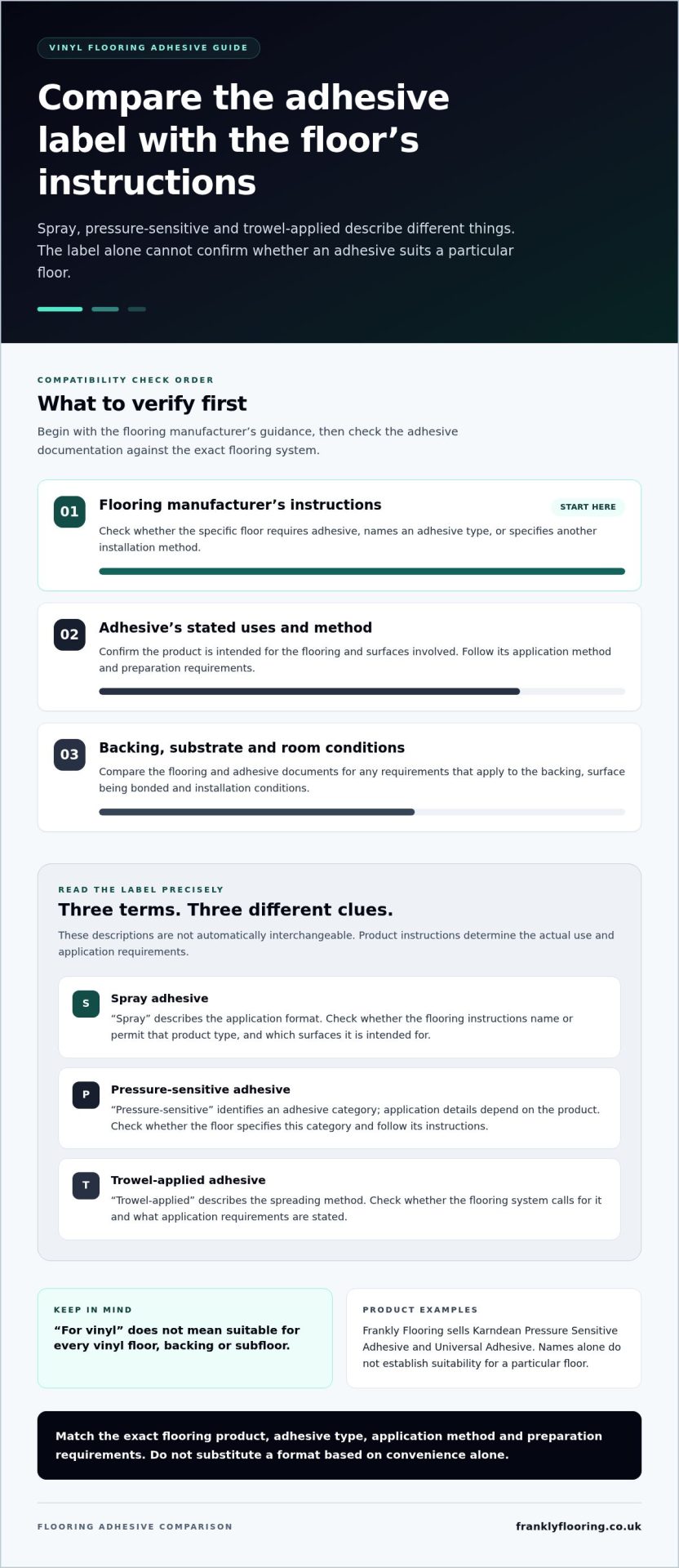
Spray, pressure-sensitive and trowel-applied adhesives work differently. The safest starting point is the flooring manufacturer’s installation guidance, followed by the adhesive’s stated uses and application requirements. Choosing by a broad label such as “for vinyl” can overlook differences between floors, backings and substrates.
This guide explains where spray adhesive may fit, how it compares with pressure-sensitive and trowel-applied adhesives, and what to check before buying. Frankly Flooring sells flooring adhesives and accessories, including Karndean Pressure Sensitive Adhesive and Universal Adhesive. Use the practical checks below to compare product information with the requirements of your chosen floor.
Key Takeaways
- Vinyl spray adhesive describes an application format, not compatibility with every vinyl floor.
- Compare spray, pressure-sensitive and trowel-applied options with the flooring manufacturer’s instructions.
- Check the exact flooring product, backing, substrate and room conditions against the floor and adhesive documentation.
- Before applying adhesive, follow its instructions for surface preparation, work area and application method.
- Frankly Flooring’s adhesive and accessory range includes products such as pressure-sensitive and universal adhesives to compare with your flooring choice.
What Is Vinyl Spray Adhesive, and Where Does It Fit in Flooring?
“Spray” describes how an adhesive is applied, not which flooring it can bond. A product labelled for vinyl isn’t automatically suitable for every vinyl floor, backing or subfloor. Start with the flooring manufacturer’s installation instructions, then check the adhesive’s technical information for the intended use and method.
Vinyl spray adhesive is applied by spraying, but that format alone doesn’t establish whether it suits a particular floor or how it will perform. Check the specific product’s stated uses and instructions rather than relying on broad category labels or assumptions about convenience.
What does vinyl spray adhesive do?
Its intended role is to bond flooring materials to a surface when the adhesive manufacturer specifies that use. The product instructions determine which materials it suits, how to apply it and what preparation or conditions are required. The word “spray” doesn’t tell you about bond strength, repositioning, moisture resistance or suitability for a particular room.
That’s different from Pressure-sensitive adhesive (PSA), which describes an adhesive category. Some products may combine a particular adhesive behaviour with a spray application format, but don’t assume that every spray adhesive is pressure-sensitive or that every PSA is sprayed. Check the individual product information.
Not every vinyl floor needs adhesive. Some products use other installation methods, while others require a specified adhesive system. Applying adhesive simply because a floor is vinyl can create an unsuitable combination. Check the flooring instructions first, then match the adhesive to the specified method.
Which flooring projects might prompt buyers to consider it?
The flooring type helps frame the question, but it doesn’t settle it. Sheet vinyl, vinyl tiles and luxury vinyl tile (LVT) differ in format and construction, so their installation requirements may differ too. Even products in the same broad category can have different instructions.
- Sheet vinyl: Check whether the product instructions specify adhesive, another fixing method or particular requirements for the backing and subfloor.
- Vinyl tiles: Look for the exact adhesive type and application method named by the flooring manufacturer. Don’t treat spray as interchangeable with trowel application unless the documentation says so.
- LVT: Follow the instructions for the specific LVT product, including its guidance on adhesive and substrate. Our guide, “What Is LVT Flooring? A Frank Guide for UK Homes,” explains how LVT fits into vinyl flooring choices.
Check the backing and substrate as well as the visible floor type. The product instructions may set conditions for the surface being bonded, so compare the flooring and adhesive documents before buying. The right choice isn’t simply the format that looks easiest to apply. It’s the adhesive and method specified for that flooring system.
Spray vs Pressure-Sensitive vs Trowel-Applied Adhesive: What Should You Compare?
Adhesive labels describe different things. “Spray” generally tells you how a product is applied, “pressure-sensitive” names an adhesive category, and “trowel-applied” describes a method. These terms can overlap, so compare the flooring instructions with the adhesive’s technical information before choosing.
Adhesive formats aren’t interchangeable unless the flooring instructions permit them. A product intended for a similar floor may still have different application requirements or compatibility limits. Compare the exact flooring product, approved adhesive type, application method and preparation instructions instead of choosing by format alone.
| Format or category | What the label tells you | What to compare |
|---|---|---|
| Spray adhesive | Application is by spraying, as specified by the product instructions. | Whether the flooring instructions name or permit that product type, and which surfaces it is intended for. |
| Pressure-sensitive adhesive | The adhesive belongs to a particular category. Application details depend on the product. | Whether the floor specifies a pressure-sensitive adhesive and what its instructions require. |
| Trowel-applied adhesive | The instructions specify spreading the adhesive with a trowel. | Whether the flooring system calls for this method and the stated application requirements. |
How does spray adhesive differ from pressure-sensitive adhesive?
A spray label describes an application format; pressure-sensitive describes an adhesive category. One term doesn’t automatically tell you the other. Read the product documentation to establish how the adhesive should be applied and which flooring it is intended for. Similar intended uses don’t prove that two products are compatible or interchangeable.
Frankly Flooring sells Karndean Pressure Sensitive Adhesive. Its name identifies it as pressure-sensitive, but the product instructions and relevant flooring guidance determine how it should be applied and whether it suits a particular floor. Don’t assume it is a spray product or use it as a substitute for one unless the flooring instructions permit that choice.
When should buyers compare other adhesive formats?
Compare trowel-applied options whenever the flooring specification names that method. A trowel-applied adhesive and a spray product may have different application processes, so base any change of format on the flooring and adhesive manufacturers’ documentation, not convenience alone. Frankly Flooring also sells Morleys HT100 and Universal Adhesive. A product name by itself doesn’t establish compatibility with a particular floor.
If indoor air quality is part of your product comparison, read the relevant certification information alongside the flooring and adhesive instructions. FloorScore® certification for indoor air quality explains the programme, but certification information doesn’t replace checking whether an adhesive suits your flooring system.
Compare the floor’s specified adhesive type with the information for each product, then explore Frankly Flooring’s flooring adhesives and accessories as part of choosing a compatible system.
How to Check Whether Vinyl Spray Adhesive Suits Your Floor
A label that says “suitable for vinyl” doesn’t establish compatibility with every vinyl floor. The right adhesive depends on the specific floor, its backing, the surface beneath it and the installation method. Verify compatibility in the flooring and adhesive technical documents rather than inferring it from a broad product description.
Before buying vinyl spray adhesive, gather the flooring product information and the adhesive’s technical data sheet. Compare their guidance on use, preparation and application. If the documents don’t support the combination, don’t assume it will work.
Check the flooring, backing and substrate
Start with the exact floor product, not just its general category. Find its installation method and adhesive requirements, and note the backing type and any instructions that affect how the floor is fixed. Then compare the substrate requirements in both documents. The flooring and adhesive guidance should align on surface condition and preparation. Don’t assume an adhesive suits concrete, wood or another substrate unless its product information says so.
Check room conditions and product documentation
Look for stated room-use limits and environmental requirements. These vary by product. Drying time, coverage and open time also depend on the individual adhesive and its application instructions, so don’t estimate them from another product or a general guide. For broader advice on checking product specifications before ordering, consult Buy Flooring Online with Confidence: UK Guide 2026.
| Check | Why it matters | Where to verify |
|---|---|---|
| Exact flooring product and installation method | Different vinyl floors may call for different fixing methods. | Flooring manufacturer’s installation instructions |
| Backing and substrate | The adhesive and floor need to be specified for the materials and surface involved. | Flooring and adhesive technical documents |
| Room use and environmental conditions | A product may have stated limits or conditions for particular settings. | Adhesive technical data sheet and flooring instructions |
| Application details and timing | Preparation, coverage, drying and open time can vary by product. | Adhesive instructions for the exact product |
Use the documents together. The flooring guide identifies the required installation system; the adhesive data sheet explains the product’s stated uses and application method. If the flooring instructions name a specific adhesive category or method, don’t replace it with spray simply because the packaging mentions vinyl.
Keep the product details to hand while comparing options. Checking each requirement against the relevant document is more reliable than relying on assumptions about what “vinyl adhesive” means.
How to Prepare and Apply Vinyl Spray Adhesive Carefully
Preparation and application requirements vary. Follow the instructions for the exact adhesive and flooring, including the safety information. Don’t borrow timings or techniques from another product. If you’re considering vinyl spray adhesive, first check that the flooring instructions permit that adhesive type and method.
Prepare the floor and work area
Before opening the adhesive, read its label and technical and safety information. These documents set out the required surface condition, preparation, application method, room conditions and precautions. Cleanliness and dryness requirements vary, so don’t assume what’s suitable for one product applies to another.
- Confirm the system. Compare the flooring manufacturer’s fitting instructions with the adhesive’s stated uses. If they don’t support the planned combination, pause rather than improvising.
- Inspect and prepare the surface. Follow the flooring and adhesive documents for substrate condition and preparation. Don’t apply over a surface unless the instructions allow it.
- Set up the work area. Plan the sequence, have the flooring ready as directed and protect adjacent surfaces where appropriate. Before opening the adhesive, check its safety information for ventilation, protective equipment, handling and other precautions.
- Test only where instructed. If the flooring or adhesive manufacturer calls for a test or trial, follow its specified method. Don’t replace the manufacturer’s guidance with an improvised test.
Apply, position and finish according to instructions
Use the product label as your guide throughout application. It determines details such as spray distance, coat count, coverage, tack or drying time, and whether repositioning is allowed. If the instructions don’t specify a detail, don’t guess or use a figure from another adhesive.
- Apply as directed. Use the stated sequence and technique for the chosen adhesive, following its requirements for the floor and substrate.
- Position the flooring as directed. Follow the flooring manufacturer’s fitting instructions for placement and handling. Don’t assume the material can be adjusted after application unless both sets of instructions support it.
- Observe the stated conditions. Follow instructions on timing, access and any other requirements before proceeding. The product label, not a generic online tip, governs its use.
- Finish and clean up safely. Follow the product’s instructions for finishing and cleanup. Continue to observe its safety guidance when handling the adhesive and packaging.
Before starting, make sure the work area is clear, the flooring system is compatible and the product-specific instructions are close to hand. For flooring and accessories to compare as part of your project planning, explore Frankly Flooring’s online range.
Choosing Flooring Adhesive from Frankly Flooring: A Clear Next Step
A sound adhesive choice starts with the floor, not the format that looks quickest to apply. Identify the exact flooring product, find its specified installation method, then compare adhesives against that guidance. This keeps the choice grounded in the flooring system rather than assumptions based on labels such as “vinyl” or “spray”.
What should buyers compare before adding adhesive to their order?
Use this sequence to narrow down your options:
- Identify the floor. Check the product details and fitting instructions for the exact flooring you’ve chosen, including its stated fixing method.
- Match the method. Look for the adhesive type and application method specified by the flooring manufacturer. Don’t treat a format name as proof that a product is a suitable substitute.
- Compare product information. Read the adhesive documentation for stated uses, preparation and application requirements. Make sure it aligns with the flooring instructions before buying.
Frankly Flooring sells Karndean Pressure Sensitive Adhesive and Universal Adhesive. These products are options to compare, not a blanket recommendation for every vinyl floor. Suitability depends on the flooring and the relevant product instructions. The same applies to vinyl spray adhesive: choose it only where the flooring guidance supports that adhesive type and method.
Accessories are another part of planning. Bihui Fan Spreaders are among the flooring accessories sold by Frankly Flooring, but a tool’s presence in the range doesn’t mean it suits every adhesive or application. Check the adhesive instructions for the tool and method required rather than assuming one accessory works across all products.
Explore flooring adhesive and accessory options
Frankly Flooring is a family-run online retailer with over 20 years of experience in the flooring industry, selling flooring, adhesives and related accessories. Browse these categories together to consider adhesive as part of your wider flooring choice, then compare product information with the installation requirements for your selected floor.
Keep the flooring instructions and adhesive documentation in view as you browse. If a product description doesn’t answer a compatibility question, use the technical information for the exact products rather than interpreting a category name as approval. Identify the floor, confirm its specified method, then compare suitable adhesive options.
Browse flooring adhesives and accessories to explore the available options alongside your flooring choice.
Make Your Next Flooring Choice with Confidence
Before placing adhesive in your basket, keep the flooring product details and adhesive instructions together. This gives you a clear basis for comparing options and helps prevent a convenient application format from becoming a costly assumption. If you’re considering vinyl spray adhesive, let the documented flooring system guide your choice, not the word “spray” on its own.
Frankly Flooring’s online range includes flooring adhesives and accessories, with options such as Karndean Pressure Sensitive Adhesive and Universal Adhesive. Compare their product information with the instructions for your chosen floor, and select only an adhesive whose stated use matches the installation requirements.
Check the details, compare compatible options and choose the one that fits the flooring instructions. Browse flooring adhesives and accessories as you plan your project.
Frequently Asked Questions
Can vinyl spray adhesive be used for LVT flooring?
Only if the instructions for the exact LVT product specify or permit spray adhesive. Check the flooring’s fitting guide against the adhesive’s technical sheet before choosing. Victoria Universal 55 Herringbone is listed in glue-down and click versions, so the format matters: don’t assume both versions use the same adhesive system or installation method.
Is vinyl spray adhesive waterproof?
You can’t tell whether an adhesive is water-resistant from the word “spray” or its adhesive category. Check the individual product’s technical information for its intended conditions and any stated limitations. Also distinguish an adhesive claim from a flooring claim: don’t describe the complete floor as waterproof unless the flooring manufacturer says so for that exact product and installation system.
How long does vinyl spray adhesive take to dry?
There’s no single drying time for every vinyl spray adhesive. Timing varies by product and installation conditions, so follow the adhesive label or technical sheet for application, tack and curing instructions. These are separate stages, and the stated time for one shouldn’t be substituted for another. Don’t judge readiness by appearance alone or rely on timings from a different adhesive.
Can vinyl spray adhesive be used with underfloor heating?
Use it with underfloor heating only if the instructions for both the flooring system and adhesive support that application. Check the guidance for any operating conditions before choosing or fitting the floor. A flooring product may be listed as compatible with underfloor heating, but that alone doesn’t establish that a particular spray adhesive is suitable. Check the adhesive’s stated use as well.
How do you remove vinyl spray adhesive overspray?
Check the adhesive manufacturer’s cleanup instructions before trying to remove overspray. The right method can depend on the adhesive and the surface it has reached, so a cleaner or tool suitable for one material may damage another. Test only in the way the instructions permit. Avoid solvents or scraping methods unless they’re approved for the affected flooring, and follow the product’s safety guidance during cleanup.
How much vinyl spray adhesive do I need?
Use the coverage stated for the exact adhesive, not a generic estimate. Coverage can depend on the product, surface and application instructions. Find the project area, then use the packaging or technical documentation to calculate the amount required, following any stated conditions. Don’t transfer a coverage figure from another adhesive: formulations and application methods can have different stated coverage.
Can vinyl spray adhesive be used on stairs?
Only if the instructions for the specific flooring and adhesive cover the intended stair application. Check that both documents address the surface and fitting method involved, and follow any stated limitations. A product described for vinyl flooring isn’t automatically suitable for stairs. Don’t assume it will provide the required result or make safety judgements from the adhesive format alone; rely on the manufacturers’ guidance.