
The hardest-wearing floor isn’t always the best fit for your home. In the choice between LVT vs porcelain tiles, appearance is only part of the decision. Consider how each floor feels underfoot, the room’s moisture exposure and the condition of the subfloor.
It’s easy to assume porcelain is always the safer choice for durability, or that LVT is automatically easier to live with. Both can suit busy homes, but they behave differently. The right option depends on the room, the product and your priorities.
This guide compares comfort, water resistance, durability, installation and upkeep. It also explains why preparation matters for both materials and which product details to check before you buy. Use the room’s conditions and the exact product specifications to make a decision, rather than choosing by appearance alone.
Key Takeaways
- LVT and porcelain are different flooring materials, so compare their practical performance as well as their appearance.
- With LVT vs porcelain tiles, weigh water exposure, wear, comfort and cleaning needs, including the role of seams, edges and grout.
- Check the existing floor before choosing. Both options need a suitable base, but preparation depends on the substrate and the specific product.
- Match the flooring to the room and household, especially in bathrooms where product suitability and fitting details matter.
- Compare exact product specifications and use samples to assess colour and texture at home before deciding.
LVT vs porcelain tiles: what are you actually comparing?
Although both can imitate the look of wood or stone, LVT and porcelain aren’t simply different patterns of the same flooring. They’re made from different materials and have distinct physical properties. LVT is a layered, resilient flooring product made with vinyl. Porcelain is a ceramic tile formed by firing clay-based materials. These definitions are a useful starting point, but they don’t tell you how a particular product will perform in your room.
The central difference is how each feels and behaves underfoot. LVT is generally thinner and more yielding, while porcelain has a hard, rigid surface. This affects the feel of a room, but the exact result also depends on the product, how it’s fitted and the floor beneath it. In the LVT vs porcelain tiles comparison, material labels are the beginning of the decision, not the answer.
How LVT and porcelain tiles are made
LVT is constructed in layers, though materials and specifications vary between products. Its printed design may reproduce wood grain, stone or another pattern, but appearance alone doesn’t establish wear performance or suitability for a particular room. The overview of Luxury Vinyl Tile (LVT) gives useful background on the material and its forms. For a home-focused introduction, Frankly Flooring’s LVT flooring guide explains the category in more detail.
Porcelain tiles are manufactured ceramic tiles. Their appearance and performance are shaped by their composition and production. They can also be designed to resemble natural materials, but the visual effect doesn’t make them behave like timber or stone. For either floor, look beyond the image and check the product’s stated construction and intended use.
Why the right choice depends on the room
A floor that suits one space may be less appropriate elsewhere. Assess the conditions and priorities of each room rather than assuming a material is right throughout the home. Bathroom choices, in particular, shouldn’t be treated as a verdict on flooring for every room.
- Moisture exposure: Consider where water is likely to reach the surface and how joints, edges or grout may affect the finished floor.
- Floor condition: The existing base and its preparation can influence which product and fitting method are suitable.
- Comfort: Think about how the surface will feel where you stand or walk regularly, and whether a harder finish suits you.
- Appearance: Compare the colour and pattern in the room’s light, but don’t use appearance as a substitute for checking product details.
Keep these factors separate to make the comparison practical. Start with the room’s conditions, then consider the product and the floor it will sit on. This helps you avoid choosing on pattern alone while allowing for differences between individual LVT products and porcelain tiles.
LVT vs porcelain tiles: compare water, wear, comfort and care
Both materials can work in busy homes, but their everyday differences are worth weighing before you choose. The table gives a broad comparison, not a substitute for the technical guidance for a specific product or the requirements of your room.
| Factor | LVT | Porcelain tiles |
|---|---|---|
| Water exposure | The surface may resist water, but joints, edges and the floor beneath still matter. Product suitability varies. | The tile itself is impervious to water, but grout, edges and the underlying floor form part of the finished assembly. |
| Surface wear | May mark or dent, depending on the product, impact and use. Check its wear layer and care guidance. | The hard surface can chip if struck by a heavy or sharp object. Tile specifications and installation affect performance. |
| Underfoot feel | Resilient and generally softer underfoot than tile. | Hard and rigid underfoot. Room temperature and floor construction influence comfort. |
| Routine care | Regular sweeping or vacuuming and product-appropriate cleaning help manage everyday dirt. | Sweep or vacuum, then clean the tile and grout with suitable products. Grout may need separate attention. |
Water resistance is not the same as a waterproof floor assembly
A water-resistant surface doesn’t automatically protect every part of the floor. With LVT, moisture can reach joints or edges, particularly if the product and fitting details aren’t suited to the room. Porcelain tile itself doesn’t absorb water, but grout and the layers beneath it still matter. Bathroom comparisons, including DDL’s, can raise useful questions about exposure, but they aren’t universal rules for every bathroom or product.
Think about where water may collect, how it could reach the perimeter and what lies beneath the finish. The effects of a leak can vary with the product, joints and floor construction. For a broader industry comparison of material characteristics and applications, see the Tile Council of North America’s Porcelain Tile vs. LVT/LVP Comparison.
Wear, comfort and cleaning depend on everyday use
Porcelain offers a firm, hard surface; LVT has a more resilient feel. Neither description predicts exactly how a floor will feel in your home. Room temperature, underfloor heating and the rest of the floor build-up matter. If heating is planned, check the individual product’s instructions for compatibility and any temperature limits rather than assuming either material is suitable.
Scratches, chips, dents and stains depend on the product, the cause of damage and how the floor is maintained. A dropped object may chip a tile; furniture or grit may mark a resilient surface. Follow the manufacturer’s cleaning advice and don’t assume a product can tolerate every cleaner or cleaning method.
Material type sets broad expectations, but the product specification and the way the floor is built matter just as much. To compare LVT finishes at home, browse Frankly Flooring’s LVT options and request free samples.
Installation and floor preparation: where LVT and porcelain differ
In the LVT vs porcelain tiles decision, the condition of the floor underneath can be as important as the covering. Both materials need a suitable base, but preparation and fitting depend on the existing substrate and exact product. A floor that looks flat at a glance may still have uneven areas, movement or damage that affect the finished result.
The fitting methods differ. LVT may come in click or glue-down formats, each with its own product requirements. Porcelain tiles are fixed in place and finished with grout between them. Neither material has one preparation specification that suits every room, so follow the selected product’s instructions rather than applying a general rule.
Subfloor condition and finished floor height
Before choosing, consider what the new floor will sit on. Unevenness can show through or affect the fit of some flooring. Movement or damage may also mean the base needs attention. The appropriate preparation depends on the substrate, flooring format and manufacturer’s instructions. A level, sound base is a planning priority, not a single specification that applies to every home.
Height matters too. Compare the combined build-up of the new floor with the flooring it replaces, then consider door clearance and the join to adjoining rooms. A change in level at a doorway may need a suitable transition, while a thicker finished floor could affect how a door opens. It’s easier to account for these details before selecting materials than after the floor is in place.
- Look at the existing surface: Note uneven, loose or damaged areas that may affect preparation.
- Compare finished heights: Consider doors, thresholds and neighbouring floor coverings.
- Read the product guidance: Follow the chosen flooring’s requirements for the base and fitting method.
Glue-down and click LVT are not interchangeable
“LVT” describes a flooring category, not one fitting system. Click and glue-down products have different constructions and preparation requirements, so don’t assume that instructions for one format apply to another. The product specification should guide decisions about the substrate, any required materials and the fitting method. For a closer look at format differences, see this guide to Karndean glue-down and click LVT.
Porcelain involves a different process: tiles are fixed to the prepared base, with grout in the joints. Tile size, layout and floor condition can all affect planning. The same principle applies to either choice: the product and room determine the appropriate preparation. Frankly Flooring’s LVT range includes products with different specifications, so compare the exact format and fitting guidance rather than treating all LVT as alike.
Which suits your room: LVT or porcelain tiles?
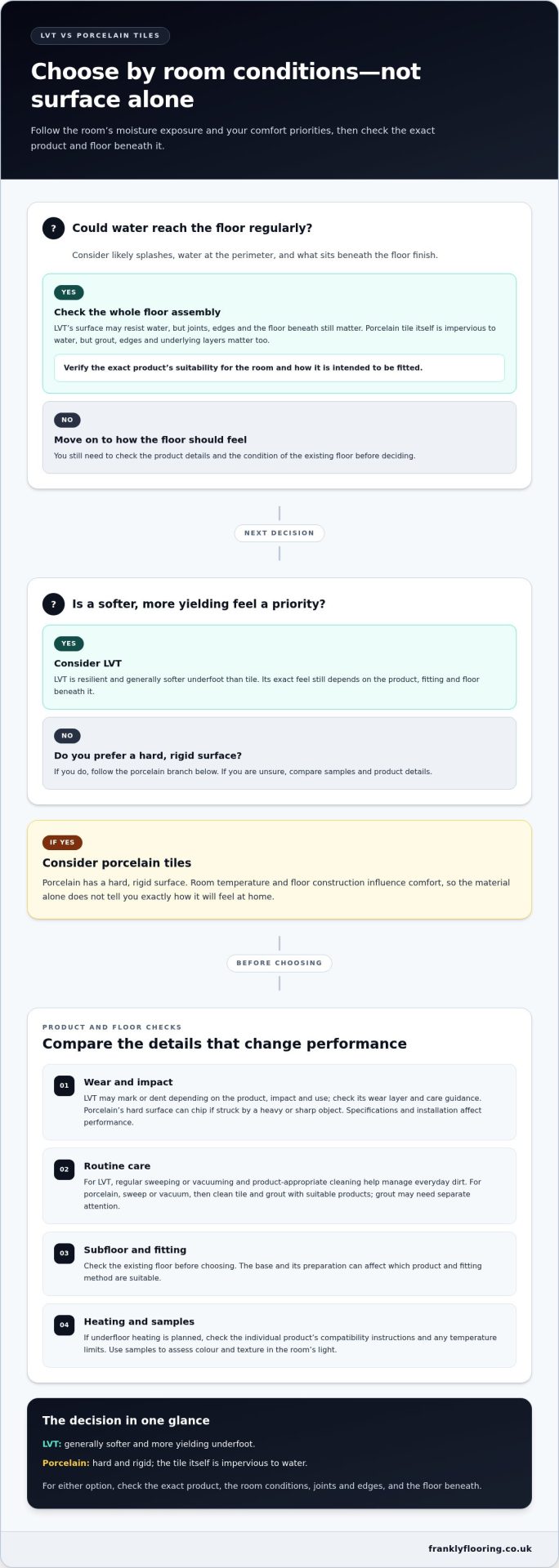
There’s no single winner for every home. The useful question is which material and product fit the room’s conditions, your comfort preferences and the floor already in place. This room-by-room guide helps narrow the choice, but product instructions still matter, especially where water exposure or fitting details are involved.
| Room or priority | LVT may suit if… | Porcelain may suit if… |
|---|---|---|
| Bathroom | You prefer a resilient surface and choose an LVT product specifically suitable for the room. Consider joints, edges and layout, particularly near a shower or bath. | You want a hard tile surface and can plan the tile, grout, edges and floor assembly for the room’s water exposure. |
| Kitchen or hallway | Underfoot comfort and a resilient feel matter, and the selected product’s specification suits the expected household traffic. | You prefer a firm, hard surface and are comfortable with tile and grout as part of the finished floor. |
| Living space | You’re drawn to wood- or stone-effect designs and want a softer feel underfoot. Compare the exact product’s construction and care guidance. | You favour the look and feel of tile and prioritise a hard surface over a more yielding one. |
| Height or comfort priority | The format and finished build-up work with adjoining floors, door clearance and the room’s comfort needs. | The tile build-up and transitions fit the space, and a hard surface matches your preference. |
Decision rule: Start with the room’s exposure and floor constraints, then choose the material whose verified product details best meet your comfort, appearance and care priorities.
When porcelain may match your priorities
Porcelain may be a good fit if you favour a firm tile surface and the room can accommodate the floor preparation, finished height and grouted joints. For bathrooms, consider where water can reach and how the floor meets a shower or bath. Tile alone doesn’t settle those details: the selected product and full installation need to suit the layout and conditions. A hard surface can still chip or need grout care.
When LVT may match your priorities
LVT may appeal if you value a more resilient feel or are working around a floor-height constraint. Its designs and fitting formats offer choices, but don’t assume every LVT product performs alike or suits every wet area. Compare the specific product’s intended use and instructions. The label “LVT” doesn’t make it an inferior choice; product construction and suitability matter more than the category name alone.
For a real-world comparison, request free samples of LVT and view them in the room’s own light alongside existing finishes. Check the exact specification as well as the appearance, then weigh both against your priorities. Explore LVT options and request free samples to compare finishes at home.
Choosing LVT or porcelain tiles: make a confident flooring decision
A sound choice comes from matching the product to the room, not relying on a broad label. Use this sequence to turn the LVT vs porcelain tiles comparison into a practical buying decision:
- Define the room conditions. Note where water may reach the floor, how much daily foot traffic to expect and who uses the space. Include comfort and appearance priorities.
- Check the floor requirements. Consider the existing base, preparation guidance, fitting format and finished floor height. Think about door clearance and transitions to adjoining rooms.
- Compare exact products. Review each product’s stated format, wear layer, thickness, intended room suitability and installation instructions. For porcelain, read the relevant tile and fitting guidance as well.
- Review samples. Compare colours and patterns in the room before settling on a finish.
This process helps avoid a common assumption: that every LVT product has the same performance profile. Specifications differ, so don’t apply a feature listed for one product to the whole category.
A practical checklist before choosing
Keep your notes beside you while browsing. For each candidate, record whether its listed uses suit your room, what its product information says about construction and wear, and which fitting instructions apply. Then compare those details with the floor condition and household use you’ve already identified. For more practical advice on buying flooring online, use this guide to buying flooring online with confidence.
A specific LVT example shows why the details matter. Karndean Knight Tile Lime Washed Oak KP99 is a glue-down product with a 0.3 mm wear layer. Its listing identifies several domestic rooms as suitable and doesn’t list it for commercial use. Those details apply to this product, not every LVT range. Read the listing for the exact product you’re considering.
Compare LVT samples and product specifications
A sample lets you see how a colour, pattern and finish look alongside your walls, furniture and existing materials. Check it in different lighting conditions if you can, since it may look different at home than it does on a screen. Samples help with visual comparison; they don’t demonstrate how a floor will perform over time or predict the result of fitting.
Once the product details and appearance both suit your priorities, you can decide with fewer assumptions. Explore LVT flooring at Frankly Flooring, and request free samples to compare colours at home.
Take the next step with a floor that fits
The best choice is the one that makes sense for your room and how you live in it. Let the product details guide you, then see how the finish works with the light, furnishings and colours already in your home. That’s a more dependable way to settle the LVT vs porcelain tiles decision than choosing from a picture alone.
Frankly Flooring is a family-run flooring business with over 20 years of industry experience, offering LVT options from brands including Karndean and Victoria. Free samples give you a practical way to compare colours and finishes at home before deciding.
Explore LVT flooring and request free samples to compare options for your space and take the next step towards a floor that fits your home.
Frequently Asked Questions
Can LVT be laid over existing porcelain tiles?
It may be possible, but only if the existing surface and chosen LVT instructions allow it. Check for loose or cracked tiles, pronounced grout lines and uneven areas, since these can affect the finished surface or preparation. Adding another floor layer also raises the finished height, which may affect doors and thresholds. Don’t assume an overlay is suitable just because the tiles look intact.
What happens if water gets beneath LVT flooring?
The effects depend on how water entered, how long it remained and the floor construction beneath the LVT. Moisture at joints or edges may affect the flooring, adhesive or subfloor, but the outcome varies. If you suspect a leak, address its source and have the affected area assessed before covering it again. Follow the product’s care and repair guidance.
Can porcelain tiles be replaced individually if one cracks?
Often, a single cracked tile can be removed and replaced, but the work takes care. The grout around it needs to be cleared and the damaged tile lifted without harming neighbouring tiles or the base. A close match can also be difficult if the original tile is unavailable or has aged. Check the condition of the substrate before fitting a replacement.
Do porcelain tiles need grout sealing?
The porcelain tile surface and the grout are separate materials, so sealing advice for one doesn’t automatically apply to the other. Porcelain itself generally doesn’t require sealing, but grout may need it depending on its type and the manufacturer’s instructions. Sealing grout can help resist staining; it doesn’t make the whole floor waterproof. Check the product guidance for both tile and grout before choosing a cleaner or sealant.
Can LVT and porcelain tiles meet at the same doorway?
Yes, they can meet at a doorway if the finished floor heights and edges are planned together. Compare the full build-up on each side, including the tile, fixing materials and LVT format, then choose a suitable transition detail for any level difference. A poorly planned join can leave an awkward edge or create a trip point. Plan the doorway before either floor is fitted.
Are porcelain tiles suitable for every room in a home?
No, suitability depends on the tile, room conditions and intended use. For example, a bathroom or entrance may call for careful consideration of wet grip, while a living room may bring comfort and room temperature higher on the list. Check the tile’s product information and how it will be fitted in that space. Don’t treat one tile’s specification as a recommendation for every room.
Does LVT come in patterns that resemble porcelain tiles?
Some LVT designs reproduce the look of stone or tile, but patterns and finishes vary by product. If you’re comparing an LVT tile-effect design with porcelain, look at the pattern scale, surface detail and how the design will sit with the room’s furnishings. A sample can help you judge the colour and finish in your own lighting. Check the product listing for its exact design and specification.