
A natural lawn is often the most expensive and time-consuming feature in a British garden, costing the average homeowner upwards of 120 hours of maintenance every year. You’ve likely spent your fair share of weekends wrestling with a mower or scrubbing muddy paw prints off the kitchen tiles after a rainy November afternoon. We agree that your outdoor space should be a place for children to play safely rather than a source of constant chores, which is why high-quality artificial grass has become the standard for modern, functional homes. It’s frustrating when the promise of a perfect garden leads to nothing but patchy soil and endless weeding.
Frankly, choosing the right turf shouldn’t feel like a gamble. We’re here to explain exactly what terms like Dtex and gauge mean for your garden’s longevity in 2026, without the usual marketing fluff or high-pressure sales tactics. You’ll learn how to identify a durable product that will realistically last for 15 years while avoiding the common pitfalls of flimsy alternatives found in large retailers. This guide provides an honest, technical deep-dive into the selection process, from initial measurements to the final fitting, so you can achieve a lush, green finish that stays perfect all year round.
Key Takeaways
- Learn to decode technical jargon like Dtex and pile height to identify which material blends offer genuine durability rather than just a soft initial feel.
- Discover practical, honest solutions for managing summer heat and maintaining pet hygiene to keep your outdoor space fresh and comfortable year-round.
- Master a straightforward framework for measuring your garden, including why you must factor in a 10% waste margin and how to choose roll widths that minimize seams.
- Understand the evolution of modern artificial grass and why high-performance polymers are now the preferred, long-term choice for UK homeowners.
- Gain the confidence to select a lawn based on professional flooring standards, ensuring you invest in a product that stands up to the realities of British weather.
The Frank Truth About Artificial Grass in 2026
Forget the neon green, abrasive plastic carpets of the 1980s. By 2026, the industry has undergone a massive shift toward high-performance polymers that mimic the irregular growth patterns of real fescue or rye. Artificial grass is a multi-layered synthetic surfacing system designed for drainage and durability. UK homeowners are increasingly ditching the lawnmower in favour of these advanced materials, specifically UV-stabilised polyethylene and polypropylene blends. These fibres are engineered to withstand the erratic British weather while maintaining a soft, realistic texture underfoot.
The The Frank Truth About Artificial Grass is that it represents a significant upfront financial commitment. You should expect to pay between £65 and £95 per square metre for a professional fitting, including the necessary subfloor preparation. While this is higher than the cost of a few rolls of turf, the long-term value is found in the reclaimed time. A 50 square metre natural lawn typically requires 35 hours of maintenance annually. By switching, you’re essentially buying back a full working week every year for the next decade.
Is Fake Grass Right for Your Garden?
You need to assess your lifestyle before committing to a purchase. If your garden is a high-traffic zone for three large dogs or a local football team of toddlers, you’ll need a dense pile height of at least 35mm to ensure the blades don’t flatten permanently. We’ll be frank about the environmental side: a synthetic lawn isn’t a replacement for a natural ecosystem. It doesn’t support biodiversity in the same way as soil. To counter this, 65% of our clients now integrate “wild zones” or raised planters alongside their turf to keep local pollinators happy. In the damp UK climate, a quality artificial grass installation will last between 12 and 15 years before the pile shows visible signs of wear.
Common Misconceptions vs. Reality
Don’t fall for the “zero maintenance” marketing fluff. While you won’t be mowing, you’ll still need to clear organic debris like leaves and twigs. If left to rot, this material turns into a silty layer that can clog the drainage holes. You should also be wary of “bargain” products. Opting for the cheapest £12 per square metre options usually results in the backing delaminating within 24 months, forcing a costly replacement. Quality is a non-negotiable factor if you want longevity.
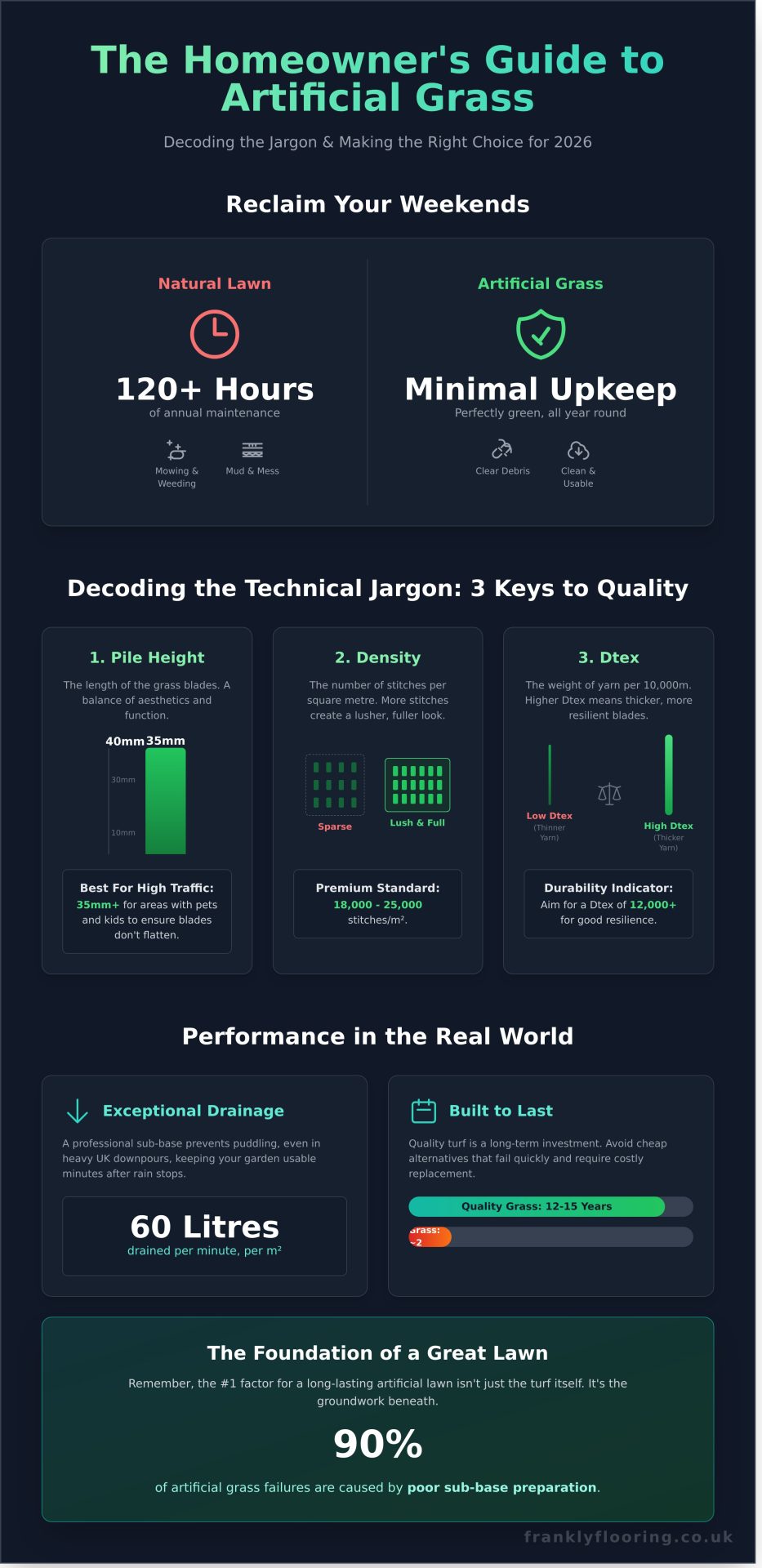
Drainage is another area where myths often outweigh facts. Many people worry about puddling during a typical British downpour. A standard, professionally installed sub-base allows for roughly 60 litres of water to drain through every square metre per minute. This capacity far exceeds the intensity of even the heaviest UK storms, ensuring your garden remains usable within minutes of the rain stopping. We believe in getting the groundwork right the first time, as 90% of failures in artificial grass systems are caused by poor sub-base preparation rather than the turf itself.
Deciphering the Jargon: Pile Height, Density, and Dtex
Let’s be frank about the technical side of artificial grass. Most retailers will try to dazzle you with high pile heights, but the real quality lies in the components you can’t see at a glance. The blades are typically made from three materials: Polyethylene (PE), Polypropylene (PP), or Nylon. PE is the standard for most UK gardens because it balances softness with resilience. PP is often used in the “thatch” layer, the curly brown fibres at the base, to provide support. Nylon is the toughest of the bunch, often found in high-end commercial installs because it resists melting and crushing better than the others. When considering the environmental and health impacts of these plastics, choosing high-grade, lead-free polymers ensures your lawn is safe for both children and pets.
Dtex sounds like industry babble, but it’s actually quite simple. It’s a weight measurement. If a product has a Dtex of 12,000, it means 10,000 metres of that specific yarn weighs exactly 12 kilograms. A higher Dtex usually indicates a thicker, more durable blade that won’t flatten the moment someone walks on it. However, a high Dtex with a low stitch rate will look sparse. You want a balance. Density is determined by the gauge, usually 3/8 inch in quality lawns, and the stitch rate. A premium product typically features around 18,000 to 25,000 stitches per square metre. This creates that lush, “foot-sink” feeling that mimics a well-fed natural lawn.
Choosing the Right Pile Height for Your Needs
Pile height is a matter of lifestyle, not just aesthetics. A 20mm to 30mm pile offers a “just mown” look. It’s the practical choice for heavy foot traffic or garden sports because the shorter blades stay upright more easily. The 30mm to 40mm range is our most popular “family lawn” option. It feels soft underfoot and looks realistic without becoming a maintenance burden. If you go for 40mm or higher, you’re buying into a luxury aesthetic. Be aware that these longer blades require brushing every 14 to 21 days to prevent them from matting down under their own weight.
Backing and Drainage Technology
The backing is the foundation of your artificial grass. Most standard products use a SBR Latex backing, which is reliable and cost-effective. However, if you have dogs, we recommend Polyurethane (PU) backing. Since 2019, we’ve seen a 40% increase in homeowners switching to PU because it doesn’t absorb moisture or pet urine, significantly reducing lingering odours. Quality backing must have drainage holes every 10cm to 15cm, allowing for a flow rate of roughly 60 litres per minute per square metre. To test quality, try to pull a tuft of grass from the backing; it should resist firmly. If it sheds easily, the primary and secondary backings haven’t been bonded correctly. If you’re unsure which sample feels right, come and visit our showroom to see the differences in person before you commit to a fitting.
Practical Realities: Pets, Kids, and Summer Heat
Frankly, we need to address the most common concern homeowners bring into our showroom: the heat. It is a biological fact that synthetic materials retain more thermal energy than natural blades of grass. On a typical 25°C afternoon in the UK, the surface of your lawn can reach temperatures exceeding 45°C. While this won’t cause immediate injury, it can feel uncomfortable for bare feet or sensitive paws. We always advise our customers to test the surface with the back of their hand during peak sun hours before letting pets or toddlers roam free.
Durability is the second pillar of a functional garden. For families with climbing frames or swings, safety is a non-negotiable requirement. If your play equipment has a potential fall height greater than 0.6 metres, a standard installation isn’t enough. We fit 20mm or 25mm shock pads beneath the artificial grass to meet EN 1177 safety standards. This ensures the ground provides adequate impact absorption, reducing the risk of serious injury during a tumble. It turns a decorative lawn into a high-performance safety surface that remains green 365 days a year.
Longevity depends entirely on UV stabilisation. Without proper chemical treatment during the manufacturing process, the sun’s rays break down the polymers, leading to brittle blades and fading. We only supply products tested to ISO 4892-3 standards, which simulate 3,000 to 5,000 hours of intense sunlight. This technical rigour ensures your garden won’t shift from a vibrant forest green to a dull grey within three seasons. Most of our range comes with a 10-year UV guarantee to give you that long-term peace of mind.
Artificial Grass for Dogs: A Honest Checklist
Pet owners face unique challenges, specifically regarding drainage and hygiene. A 30mm pile height is generally superior to a 40mm version for dog owners; it makes waste removal straightforward and prevents debris from getting lost deep in the thatch. To prevent the buildup of ammonia smells, we recommend using Zeolite infill instead of standard kiln-dried sand. Zeolite is a volcanic mineral that traps odours at a molecular level. A quick rinse with a 50/50 water and white vinegar solution once a month keeps the area fresh and sanitary.
Managing Heat and Static
The shape of the yarn significantly impacts how much heat the lawn retains. Flat blades have more surface area exposed to the sun, whereas C-shaped or W-shaped blades allow for better airflow and reflect light at different angles. This structural choice can keep the artificial grass up to 10 degrees cooler than cheaper, flat alternatives. If the mercury rises during a heatwave, a quick 30-second spray with a garden hose will drop the surface temperature by 15°C almost instantly through evaporative cooling. This also helps eliminate any static buildup that occasionally occurs in very dry, low-humidity conditions.
Measuring and Choosing: A Homeowner’s Framework
Measuring your garden for artificial grass requires more than a quick pace-out. You’ll need a steel tape measure and a sketch pad to avoid expensive errors. Start by calculating the total area by multiplying the longest length by the widest width. We always advise adding a 10% waste margin to your final figure. This buffer isn’t a sales tactic; it’s a necessity for trimming around borders and ensuring you aren’t left with a 5cm gap at the edge of your patio.
Roll widths are the next hurdle. Most quality products come in 2m, 4m, or 5m widths. Your goal is to choose a width that minimizes the number of seams. If your lawn is 3.8m wide, buying a 4m roll is the smartest move. It results in a seamless finish that looks far more natural than two 2m rolls joined down the middle. Seams are often the first point of failure in a DIY project, so reducing them is a priority.
Samples are essential, but they can be deceptive. When yours arrive, don’t just look at them on the kitchen table. Use the ‘look-from-the-window’ test. Place the samples in the garden and view them from your house at different times of the day. The UK’s shifting light can make a vibrant lime green look neon at noon but perfectly natural at 5 PM. If it doesn’t look right from your sofa, it won’t look right once it’s fitted.
Budgeting involves more than just the grass itself. Accessories are the hidden cost of a quality installation. Expect to pay roughly £1.20 per linear metre for joining tape and around £9.00 for a 310ml tube of specialist adhesive. Galvanized U-pins, which secure the perimeter, usually cost about £12.00 for a pack of 50. These small items ensure your lawn stays put during a British winter.
The ‘Frank’ Guide to Measuring Complex Gardens
L-shaped gardens are best handled by dividing the space into two distinct rectangles. If you’re tackling a circular lawn, measure the widest diameter and treat it as a square to ensure full coverage. Pile direction is the most critical factor here. All pieces must have the blades leaning toward your main viewing point, usually the back door. Frankly, you should never mix different roll widths on the same lawn. A 2m roll and a 4m roll from the same range can have slight colour variations that become glaringly obvious once the sun hits them.
Fitting and Installation: DIY vs. Professional
The longevity of your lawn depends on the sub-base. In the UK, a 75mm layer of compacted Type 1 MOT is non-negotiable to prevent sinking and ensure drainage. A heavy-duty weed membrane should be placed beneath this base to stop growth while allowing 60 litres of water per minute to drain through. If your garden is larger than 45 square metres, the physical demand of moving 4 tonnes of aggregate is significant. That’s usually the point where the expertise of a professional fitter becomes a calculated investment rather than an added expense.
If you’re unsure how much material your project requires, we can help. Get a clear, honest assessment by booking a professional measurement service today.
Why Buy Artificial Grass from Frankly Flooring?
Choosing a supplier for your garden renovation is a decision that impacts your home for at least the next 15 years. At Frankly Flooring, we bring a 20-year heritage in the UK flooring industry directly to your outdoor space. Based in Radstock, our family-run team understands that a lawn needs to be as resilient as a high-traffic hallway carpet while maintaining the drainage and UV stability required for the unpredictable British climate. We’ve spent two decades sourcing materials that last, and we apply that same rigorous vetting process to every roll of artificial grass we sell.
We take a different approach to our inventory than the big-box retailers. You won’t find 50 confusing variations of green plastic in our warehouse. Instead, we offer the ‘Frank’ selection. This is a curated range of turf that we’ve personally tested and would be happy to install in our own gardens. By focusing on a smaller, premium range, we maintain higher quality control and deeper stock levels. This means you get a product that looks realistic under the grey Somerset clouds, not just under bright showroom lights.
Our business model is built on transparency and value. Because we operate as a direct-to-consumer business without the overheads of expensive high-street showrooms, we pass those savings directly to you. Customers typically save between 15% and 25% on their project costs compared to traditional retail quotes. You get premium, high-density turf without the unnecessary markup, backed by the honest, no-nonsense advice our Radstock team is known for.
The Frankly Flooring Quality Guarantee
We believe in being straight with our customers about technical specifications. While some suppliers hide low-density products behind fancy names, we provide clear Dtex ratings and stitch counts for every product. This ensures you know exactly how much yarn you’re getting for your money. Our logistics team manages fast UK-wide delivery from our central hub, ensuring your lawn arrives in perfect condition. We also supply the essential extras, from weed membranes to specific adhesives, so your fitting process is seamless from the first roll to the final trim.
Start Your Garden Transformation Today
The best way to appreciate the quality of our turf is to feel it. You can order free samples through our website to compare the pile heights and textures in your own light. For the 2026 season, our best-sellers include the ‘High-Density 40mm’ for family play areas and the ‘Evergreen 35mm’ for those seeking a freshly mowed aesthetic. Our team is ready to help you calculate exactly how much artificial grass you need to minimize waste and keep your costs down. When you’re ready to upgrade your outdoor living space, browse our full range of Artificial Grass and experience a straightforward, honest approach to garden improvement.
Making the Right Choice for Your 2026 Garden
Choosing the right garden surface shouldn’t feel like a gamble. By 2026, the market has shifted toward high-density yarns and better thermal regulation, meaning you need to look past the marketing fluff. Focus on the Dtex and pile density to ensure your lawn stands up to the 15 years of footfall it’s designed for. Whether you’re balancing the needs of a busy family or a high-energy dog, the right artificial grass should feel as good as it looks.
At Frankly Flooring, we believe in being upfront about what you’re buying. As a family-run UK business with over 20 years of flooring expertise, we don’t hide behind vague descriptions. We provide transparent technical specifications for every product so you can make a choice based on facts; not sales pitches. It’s about finding a fitting that lasts and a look that stays green through every British summer.
Shop our honest range of Artificial Grass
We’re here to help you get your garden right the first time.
Frequently Asked Questions
Is artificial grass safe for dogs and cats?
Yes, artificial grass is perfectly safe for pets. Most quality ranges are non-toxic and manufactured without lead or harmful chemicals. For dog owners, we recommend a pile height between 30mm and 35mm to ensure durability against heavy use. It’s easy to clean; 95% of pet waste can be rinsed away with a garden hose, provided you have a porous backing for drainage.
How much does artificial grass cost per square metre in the UK?
Frankly, the cost varies based on the quality of the product you choose. You can expect to pay between £15 and £35 per square metre for the artificial grass itself. If you require a professional fitting service, the total project cost typically ranges from £60 to £100 per square metre. This price includes the 100mm sub-base preparation and waste removal, ensuring a finish that lasts for 15 years.
Does artificial grass need a sub-base?
A proper sub-base is essential for a stable, long-lasting lawn. We typically install a 50mm layer of MOT Type 1 followed by 25mm of granite dust to create a solid, porous foundation. Without this 75mm structural layer, your lawn will likely sink or become uneven within 12 months. Skipping this step is the most common reason for fitting failure in UK gardens.
Can I lay artificial grass on top of my existing lawn?
You shouldn’t lay artificial grass directly onto an existing lawn. Living grass will eventually die and rot under the new surface, causing the ground to settle unevenly and create a lumpy finish. We always remove the top 50mm to 100mm of turf and soil before fitting. This process ensures the area is level and allows for proper drainage, preventing the bouncy feel of a poorly installed lawn.
How do I stop weeds growing through my fake grass?
To stop weeds, we install a heavy-duty geotextile membrane directly beneath the grass or under the sub-base. This layer blocks 99% of weed growth while still allowing water to drain through. While airborne seeds might occasionally sprout in the pile, these are easily pulled out by hand. Using a 100gsm membrane provides the best protection against persistent perennial weeds common in British gardens.
What happens to artificial grass when it rains heavily?
Modern artificial grass is designed to handle heavy UK downpours. Most products feature a perforated backing that allows water to drain at a rate of 60 litres per minute per square metre. As long as your sub-base is correctly constructed with porous materials like granite dust, you won’t see puddles. It actually dries faster than a natural lawn, often being ready to use 30 minutes after the rain stops.
Does artificial grass add value to a property?
A well-installed synthetic lawn can increase a property’s appeal, particularly for buyers seeking low-maintenance living. Real estate data suggests that a high-quality garden makeover can add up to 5% to a home’s overall value. However, it’s vital that the fitting is professional. A poorly laid lawn with visible seams can actually deter buyers, so we focus on a seamless finish that looks natural year-round.
How do I remove leaves and debris from my synthetic lawn?
Keeping your lawn tidy is straightforward. Use a leaf blower or a stiff-bristled plastic rake to clear debris once a week during autumn. Don’t use metal rakes, as these can damage the synthetic fibres. For a deeper clean, a quick brush against the pile with a power brush every 6 months will lift the blades and keep the grass looking lush and upright.