
You’ve found the perfect LVT flooring, but now you’re facing the decision that can make or break your entire project: the underlay. Does that LVT with ‘integrated’ backing really cut it, or will you end up with a floor that clicks and bounces underfoot? The fear of making a costly mistake is real, and frankly, the advice online can be more confusing than helpful. The search for the best lvt underlay shouldn’t feel like a gamble on the long-term quality of your home.
That’s why we’ve created this straightforward guide for 2026. We’re here to cut through the marketing jargon and give you an honest assessment of what your new floor actually needs to perform perfectly. We’ll walk you through the right choices for different subfloors, from concrete to timber, and explain exactly what to look for when it comes to noise reduction and warmth. Consider this your frank guide to achieving a quiet, stable, and perfectly fitted floor-without spending a penny more than you need to.
Key Takeaways
- Discover the crucial ‘integrated underlay’ rule to avoid making a costly mistake before you even start fitting.
- Understand the key numbers that matter-like density and thickness-to confidently select the best lvt underlay and ensure your floor lasts.
- Learn how to correctly match your underlay to your subfloor, whether you need moisture protection for concrete or stability for wooden boards.
- Get our straightforward comparison of the top underlays for sound, warmth, and budget, so you can make a choice that’s right for your home.
The Frank Truth: Do You Actually Need LVT Underlay?
Let’s be frank: the world of flooring accessories can be confusing, and LVT underlay is a frequent source of debate. Unlike laminate or wood, where underlay is almost always a given, the answer for Luxury Vinyl Tile is a firm “it depends.” The right choice hinges entirely on the type of LVT you’ve chosen and the state of your subfloor.
At its core, a specialist LVT underlay is a very thin, high-density layer designed to do two things: support the click-lock joints of floating LVT planks and smooth over negligible subfloor imperfections. Before we dive in, it helps to remember exactly What is Luxury Vinyl Tile (LVT); its flexible composition is key to understanding why its underlay needs are so specific.
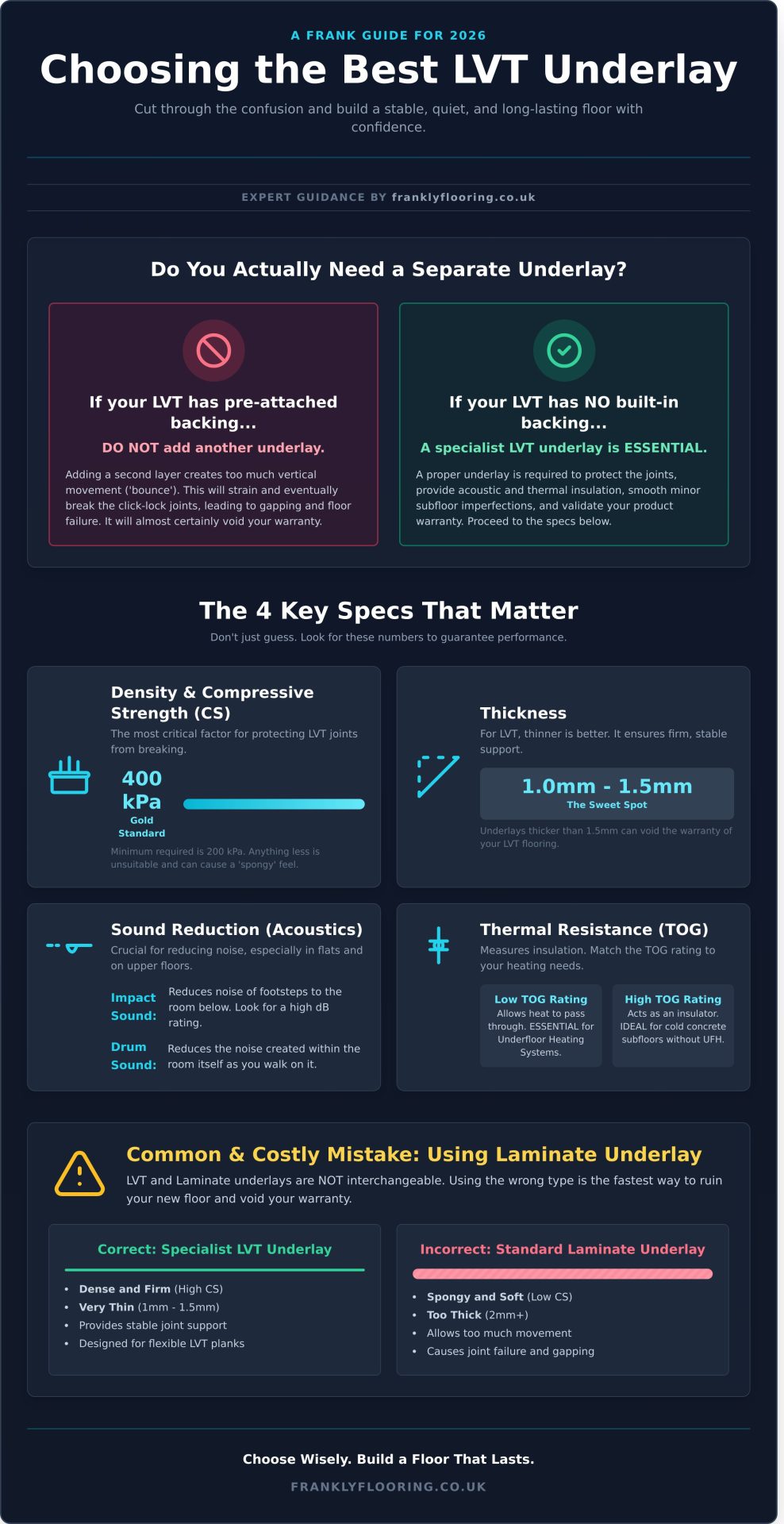
The most important rule is the ‘Integrated Underlay’ rule. Many modern LVT planks come with a pre-attached backing made of cork or foam. If your flooring has this, you must not add another layer of underlay. Doing so creates too much vertical movement, or ‘bounce’, which will strain and eventually break the click-lock joints.
However, for planks without a built-in backing, underlay is often essential. You will almost certainly need it if:
- You live in a flat: Many building regulations and leasehold agreements require acoustic underlay to reduce noise transmission to neighbours below.
- Your subfloor is cold: A quality underlay provides a thermal barrier, which is especially welcome over concrete subfloors.
- Your warranty requires it: Most manufacturers specify an underlay to protect their product and validate your warranty.
Frankly, if you have a perfectly flat and level screeded subfloor and your LVT has an integrated backing, you may not need an underlay at all. But for most UK homes, it provides a vital layer of protection.
LVT vs. Laminate Underlay: Why They Aren’t Interchangeable
Using leftover laminate underlay for your LVT fitting is a costly mistake. The thick, spongy foam designed for rigid laminate boards is the enemy of flexible LVT. It allows too much movement, leading to gapping and joint failure. The best lvt underlay is dense and thin, offering firm support. Compression Strength (CS) is the most critical metric for LVT longevity, measuring the underlay’s ability to resist being crushed underfoot.
Checking Your LVT Warranty Requirements
Always read the manufacturer’s instructions before buying your underlay. Most brands specify a maximum thickness, usually between 1mm and 1.5mm, and a minimum CS rating. ‘Over-padding’ your floor with a thick, non-specialist underlay is one of the fastest ways to void your warranty. Choosing the right product ensures your floor performs as it should for years to come. To understand more about the flooring itself, our What Is LVT Flooring? A Frank Guide provides a comprehensive overview.
Technical Specs: What Makes a ‘Best’ Underlay in 2026?
When choosing the best lvt underlay, the technical specifications on the packaging are not just numbers; they are promises of performance. Understanding these metrics is the most straightforward way to ensure your new floor feels solid, quiet, and warm for years to come. Frankly, this is where a quality underlay proves its worth, acting as a high-performance layer between your subfloor and your LVT planks. While many resources discuss the basics of Wood Underlayments for Resilient Flooring, LVT has its own unique demands.
Here are the four key specifications to look for:
- Density and Compression (kPa): Luxury Vinyl Tile requires a very firm, stable base to protect its click-lock joints. Look for a Compressive Strength (CS) of at least 200 kPa (kilopascals). Anything less can lead to a spongy feeling underfoot and may cause the joints to flex and eventually fail. The industry gold standard is moving towards 400 kPa for ultimate stability.
- Thickness: With LVT, thicker is not better. The ‘sweet spot’ for underlay thickness is between 1mm and 1.5mm. This is thin enough to provide unwavering support for the locking mechanism but substantial enough to smooth minor subfloor imperfections and provide acoustic benefits.
- Sound Reduction (dB): This measures how well the underlay blocks noise. It’s important to distinguish between impact sound (footsteps heard in the room below) and drum sound (the noise created in the room itself).
- Thermal Resistance (TOG): A TOG rating measures how well the underlay insulates. A low TOG allows heat to pass through easily, which is essential for underfloor heating. A higher TOG will retain heat, which can be useful for cold subfloors.
Acoustic Performance for Flats and First Floors
If you live in a flat or are fitting LVT on an upper floor, acoustic performance is paramount. To meet UK building regulations for impact sound, look for an underlay with a rating between 18dB and 22dB. This significantly reduces the transmission of footsteps to your neighbours below. For in-room noise, a good underlay dampens the ‘clatter’ often associated with hard flooring. Acoustic underlay for LVT must balance sound absorption with high density to ensure the floor doesn’t feel spongy.
Thermal Efficiency and Underfloor Heating
Using the right underlay with underfloor heating (UFH) is non-negotiable. For your UFH system to work effectively and efficiently, you need an underlay with a very low TOG rating-typically below 0.5. This allows the heat to transfer into your room with minimal resistance, keeping your heating bills down. Conversely, if you’re laying LVT over a cold concrete ground-floor slab without UFH, an underlay with a slightly higher TOG rating can provide a welcome layer of thermal insulation, making the floor feel warmer underfoot.
The Best LVT Underlays of 2026: Comparison and Rankings
Navigating the market for LVT underlay can feel overwhelming. Frankly, many products sold in DIY stores are simply not suitable for the unique demands of luxury vinyl tile. They are often too soft, causing the LVT’s click-lock joints to fail over time. To find the right solution, you must prioritise density and stability over simple thickness or a low price tag. Here, we break down our top recommendations based on the most common needs we encounter in UK homes.
The Best All-Rounder: High-Density Pressure Resistant Underlay
For most residential projects, a 1.5mm high-density (HD) underlay is the safest and most reliable choice, making it the best lvt underlay for general use. It’s thin enough to provide a firm, stable base for the LVT, yet offers just enough cushioning and sound absorption for everyday comfort. These are typically made from either high-density rubber or cross-linked polyethylene (XLPE) foam. Rubber offers superior density and acoustic performance, while XLPE foam often provides slightly better thermal insulation, making it a good option for cooler rooms. Many of these all-rounders also include a built-in Damp Proof Membrane (DPM), an essential feature for fittings on concrete ground floors.
The Best for Noise: Acoustic-Focused LVT Support
If you live in a flat, apartment, or have a multi-story home, impact sound reduction is a primary concern. Look for specialist acoustic underlays with a certified decibel (dB) rating. The market leaders in 2026 consistently offer impact sound reduction figures of 19dB to 22dB. These products are almost always made from dense recycled rubber, which absorbs vibrations from footsteps far more effectively than standard foam. While they come at a premium, the peace and quiet they provide for you and your neighbours is often well worth the investment.
The Best for Budget: When You Just Need the Basics
We understand that not every project has an unlimited budget. However, choosing the wrong ‘cheap’ underlay is a false economy that will ruin your new floor. The key is to avoid the thick, spongy foam rolls designed for laminate flooring at all costs. The integrity of the LVT click-system is paramount, a standard reinforced by industry bodies like the Resilient Floor Covering Institute (RFCI), which advises against using overly soft underlayment. If your budget is tight, a basic, thin (1mm-1.5mm) but dense polyethylene foam is a far better choice. Frankly, if your subfloor is perfectly level and dry, skipping underlay altogether is a better option than installing one that will cause your floor to fail.
Subfloor Matching: The Right Underlay for Your Room
A beautiful LVT floor is only as good as the foundation it sits on. Choosing the best lvt underlay isn’t just about the product itself; it’s about matching it perfectly to your existing subfloor. Frankly, getting this step right is the difference between a floor that lasts for decades and one that fails within a year. Different subfloors present unique challenges, from moisture to movement, and your underlay is the first line of defence.
Let’s be clear: underlay is a performance enhancer, not a miracle cure for a poor subfloor. Before you lay a single plank, you must ensure your subfloor is clean, dry, and flat. If you’re covering old tiles or vinyl, they must be impeccably secure and level-any damage or movement will telegraph through to your new LVT over time. The professional approach is always to start with a perfectly prepared surface.
Preparing Concrete for LVT
Concrete is notorious for holding moisture, which can become trapped under your flooring and cause serious damage. For this reason, an underlay with an integrated Damp Proof Membrane (DPM) or silver foil vapour barrier is non-negotiable. Before any fitting begins, a professional should conduct a moisture test to ensure the concrete is sufficiently dry. Skipping this vital check is a risk we would never take.
Fixing Bouncy Wooden Floors
Original floorboards have character, but they can also be uneven, gappy, and bouncy. While a good quality underlay can smooth over minor imperfections, it cannot fix structural movement. If your floorboards have significant bounce, they must be overlaid with plywood to create a stable, rigid base. Underlay is simply not a substitute for proper preparation. For a detailed walkthrough, see our guide on How to Lay LVT Flooring: A DIY Guide.
Underfloor Heating Considerations
If you have underfloor heating (UFH), your choice of underlay is critical. A thick, insulating product will act like a blanket, blocking the heat from reaching your room and making your system inefficient. You need a specialist UFH underlay with a very low TOG rating. As a rule of thumb, the combined TOG rating of your LVT and underlay should not exceed 1.5, but always check the manufacturer’s specifications to ensure compatibility and optimal performance.
Buying and Fitting Your LVT Underlay: A Frank Checklist
You’ve done the research and selected a quality underlay for your luxury vinyl tile. Frankly, that’s half the battle won. But the success of your new floor now hinges on the fitting. A perfect product fitted poorly will always underperform. This straightforward checklist covers the essential steps and common pitfalls to ensure your investment is built on a solid, reliable foundation.
Before you begin, get the practicalities sorted:
- Calculate Your Needs: Measure the square meterage of your room and then add a minimum of 10%. This crucial buffer accounts for wastage, awkward cuts, and trimming, ensuring you don’t run out mid-project.
- Gather Your Tools: You only need a few key items for a professional job: a sharp utility knife for clean, precise cuts and a roll of high-quality, waterproof vapour tape for sealing the seams.
- The ‘Tape the Seams’ Rule: An unsealed underlay is a failed underlay. Taping the joints creates a continuous, sealed layer that protects against moisture and stops the individual sections from shifting apart under your LVT.
- Plan the Full Picture: To guarantee a seamless finish, it’s wise to select your LVT, underlay, and accessories like door bars and beading together. This ensures perfect compatibility in terms of height, function, and style.
Installation Tips from the Fitters
Our fitters have laid thousands of metres of flooring. Their advice is simple but non-negotiable: lay the underlay perpendicular to the direction of your LVT planks to prevent seams from lining up, which adds stability. Crucially, never overlap the edges of the underlay; they must be butted up tightly together to create a perfectly flat surface. Always use a specialised joint tape to seal underlay seams, preventing moisture ingress and movement.
Common Mistakes to Avoid
Choosing the best LVT underlay for your home can be undone by simple errors. The most common mistake we see is people attempting to reuse old carpet underlay. It is far too soft and compressible, which will cause the LVT locking mechanisms to flex and eventually break. Another critical error is ignoring subfloor ‘high spots’ and hoping the underlay will hide them. It won’t. Any significant lumps or bumps must be levelled before you begin, otherwise they will show through the final floor.
Getting these details right is the difference between a floor that lasts five years and one that lasts twenty. Ready to build your floor on the best foundation? Browse our full range of professional LVT underlays.
The Final Layer: Choosing Your LVT Underlay with Confidence
Choosing the right support for your luxury vinyl tile is, frankly, one of the most important decisions you’ll make. As we’ve covered, it’s not just about adding a layer; it’s about understanding when it’s truly necessary, prioritising high-density technical specifications, and matching the product to your subfloor. Ultimately, the best lvt underlay isn’t the most expensive one, but the one that provides the precise stability, sound reduction, and longevity your new flooring deserves.
Feeling ready to make a choice? As a family-run business with over 20 years of hands-on experience, we’ve selected only the most reliable products. You’ll find frank, expert advice on every product page to guide you. Shop our range of high-density LVT underlays today and benefit from free UK delivery on large orders.
Get this final, crucial step right, and you’re not just fitting a floor-you’re investing in a seamless, quiet, and beautiful foundation for your home that will stand the test of time.
Frequently Asked Questions About LVT Underlay
Can I use carpet underlay for LVT flooring?
Frankly, this is a definite no. Carpet underlay is designed to be soft and thick, which is the opposite of what LVT requires. Using it will create too much movement, or ‘bounce’, under the LVT planks. This flexing will damage the click-lock joints, causing them to separate and fail over time. LVT needs a firm, dense underlay to provide a stable and supportive base for a long-lasting, quality finish.
Do I need underlay if my LVT has a pre-attached backing?
In most cases, you will not need an additional underlay if your LVT already has a built-in backing. This attached layer is specifically engineered to provide the necessary support and acoustic properties for that particular product. Adding another layer of underlay can make the floor too soft, potentially compromising the click system and, crucially, may void the manufacturer’s warranty. Always check the fitting instructions for your specific flooring.
What is the best underlay for LVT on a concrete floor?
When fitting LVT over a concrete subfloor, the primary concern is moisture. The best LVT underlay for this situation is one with an integrated Damp Proof Membrane (DPM). This creates a vital barrier, preventing any damp from the concrete rising and damaging your new flooring. It’s a non-negotiable feature for ground-floor concrete subfloors to ensure the longevity and integrity of the LVT, providing you with complete peace of mind.
How thick should LVT underlay be?
LVT underlay is significantly thinner than underlay for carpet or laminate. The ideal thickness is typically between 1mm and 1.5mm. The key attribute isn’t thickness but density. A thin, dense underlay provides the firm support that LVT click systems require to remain stable and secure. Using an underlay that is too thick will introduce excessive movement, leading to gaps and damage to the joints over time.
Is acoustic underlay worth the extra cost for LVT?
Whether acoustic underlay is a worthwhile investment depends entirely on the room’s location. For flats, apartments, or any upstairs rooms like bedrooms, it is absolutely worth it. It makes a significant difference by reducing the sound of footsteps and other impact noises travelling to the floor below. However, for a ground-floor room with no living space beneath it, the extra expense is likely unnecessary for most homeowners.
Can I lay LVT underlay over underfloor heating?
Yes, you can, but it is essential that you choose a specialist underlay designed for this purpose. You must select an underlay with a very low tog rating, which allows heat to transfer efficiently from the heating system into your room. Using the wrong type of underlay will act as an insulator, trapping the heat and drastically reducing the effectiveness of your underfloor heating. Always check the product specifications for compatibility.
What happens if I don’t use underlay with LVT?
Forgetting to use underlay where it is required can cause a host of issues. Without it, your floor will feel harder and colder underfoot, and it will offer no sound reduction. More critically, minor imperfections in the subfloor may eventually become visible on the surface of the LVT. Most importantly, it places stress on the click-lock joints, which can lead to their failure, and will almost certainly void your flooring’s warranty.
Does LVT underlay help with cold floors?
Yes, it certainly does. While its primary role is support, a quality LVT underlay also provides a valuable thermal barrier. It helps to insulate the LVT from a cold subfloor, particularly concrete, making the surface feel noticeably warmer and more comfortable to walk on. This is especially beneficial during the colder winter months, adding a touch of warmth and cosiness to your room that you’ll be thankful for.