
Most homeowners believe solid oak is the ultimate gold standard for luxury, but for a modern UK home, it is often the least practical investment you can make. When you are searching for the best wood flooring for living rooms, the decision usually involves a stressful choice between traditional aesthetics and modern structural stability. It is completely natural to feel confused by the technical jargon surrounding engineered planks, or to worry that your investment might warp the moment you turn on the underfloor heating during a cold British winter.
We prefer to take a more candid approach to home improvement. You deserve a living room that looks premium and feels warm, but you should not have to pay a massive showroom markup just to get a reliable product. This guide offers a transparent look at the most durable and stylish wood options for 2026, cutting through the sales fluff to focus on long-term performance. We will compare the latest timber trends, explain how to spot genuine quality over brand-name hype, and outline a straightforward path to a floor that increases your property value and stands the test of time.
Key Takeaways
- Learn why engineered wood is the only practical choice for modern UK homes, providing the stability needed for underfloor heating without sacrificing the look of solid timber.
- Discover how to choose the best wood flooring for living rooms by balancing timeless oak textures with 2026’s most popular patterns like Herringbone and wide planks.
- Understand the essential “Frank” rules for preparation, including why moisture testing and the correct underlay are non-negotiable for a professional finish.
- Find out how buying directly from an online specialist helps you avoid high-street showroom markups while still receiving expert, family-run service.
Why Real Wood Remains the Gold Standard for Living Rooms
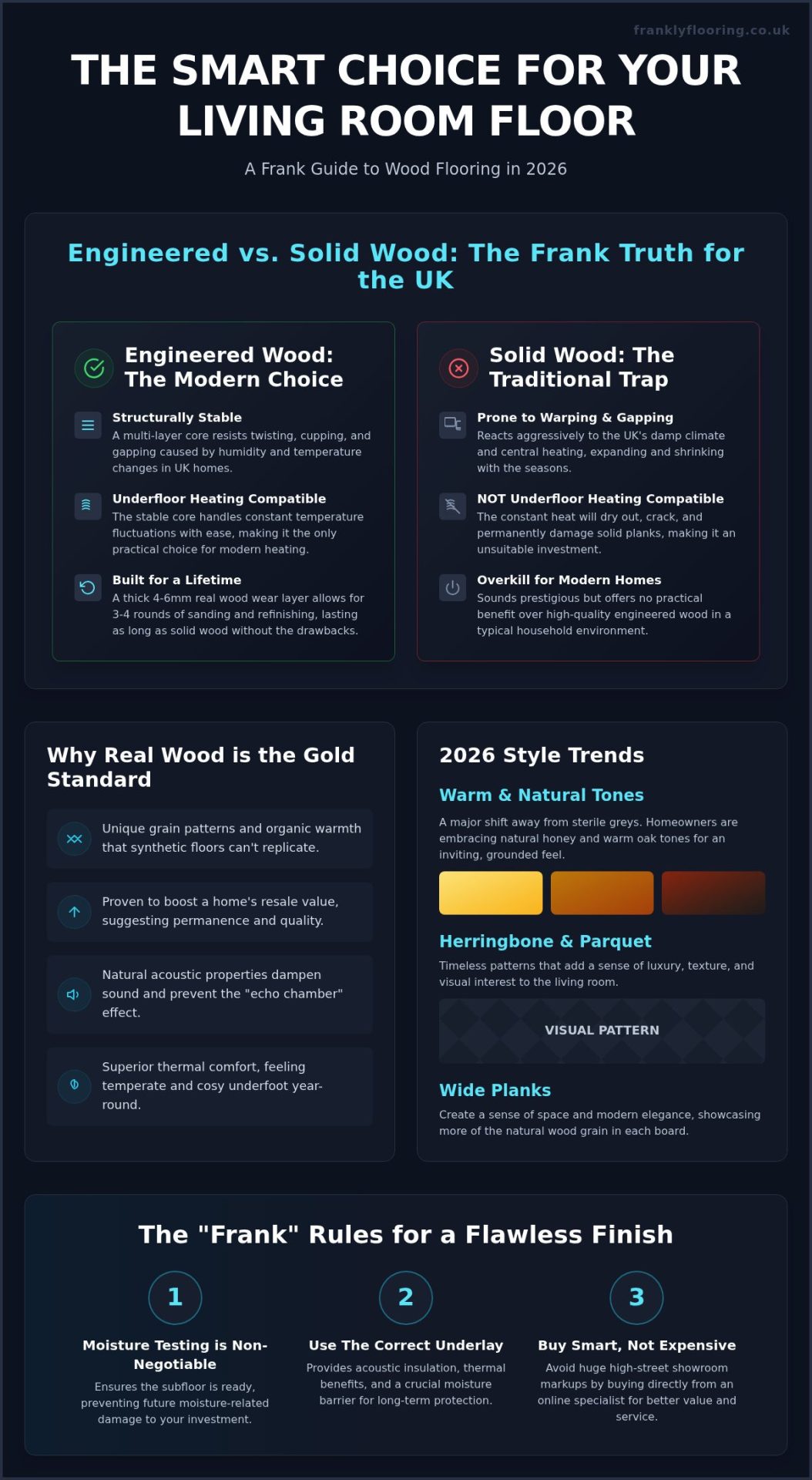
Real wood offers a sensory experience that synthetic alternatives simply cannot replicate. While high-quality LVT and laminate have their place, nothing matches the unique grain patterns and organic warmth of genuine timber. In 2026, we are seeing a significant shift away from the sterile “grey everything” trend that dominated the last decade. Homeowners are returning to natural honey and warm oak tones to create spaces that feel grounded and inviting. Choosing the best wood flooring for living rooms isn’t just about aesthetics; it is a savvy financial move. UK property experts frequently highlight high-quality wood flooring as a feature that can boost a home’s resale value, as it suggests a level of permanence and quality that carpet or vinyl lacks.
The psychological benefit of natural materials is equally important. In a social space like a living room, timber creates a sense of calm and connection to the outdoors. Unlike cold tiles or stone, wood feels soft and temperate underfoot, making the room feel inhabited rather than just decorated. It is the foundation of a home’s character, aging gracefully over decades rather than wearing out like synthetic substitutes.
The Living Room as a High-Traffic Hub
Your living room is the engine room of the home. It faces constant footfall, sliding furniture, and the occasional pet sprint. This environment requires a higher grade of durability than a guest bedroom or a home office. Our “Frank” take is that while solid wood sounds prestigious, it is often overkill for modern British houses. Solid planks are prone to shifting and gapping with seasonal humidity changes. For most living rooms, a high-quality engineered wood provides the same thick oak top layer but with a stable core that handles the daily stresses of a busy household much better.
- Footfall: Engineered wood with a thick wear layer can be sanded and refinished multiple times.
- Pets: Harder species like oak or walnut resist claw marks better than softer timbers like pine.
- Furniture: A stable construction prevents the floor from dipping or creaking under the weight of heavy sofas and bookcases.
Acoustics and Comfort Underfoot
Open-plan living is popular, but it can be noisy. Timber has natural acoustic properties that help dampen sound reverberation, preventing that “echo chamber” effect often found with large areas of porcelain tile. It also offers superior thermal comfort. Unlike stone, which feels icy on a winter morning, wood acts as a natural insulator that keeps the space feeling cosy. The higher the density of the wood species, the more effectively it retains ambient room temperature and prevents heat loss through the subfloor.
Engineered vs Solid Wood: The Frank Truth for 2026
Solid wood is a beautiful concept, but in practice, it’s often a liability for the modern homeowner. When you are looking for the best wood flooring for living rooms, engineered wood is almost always the superior choice. Solid planks consist of a single piece of timber that reacts aggressively to moisture and heat. Engineered wood uses a sophisticated layering system, featuring a top layer of genuine hardwood bonded to multiple layers of cross-grained plywood. This clever construction creates a balanced board that resists the natural urge of timber to twist, cup, or gap over time.
If you have underfloor heating, solid wood is essentially off the table. The constant temperature fluctuations cause solid timber to dry out and warp. Engineered wood handles this heat with ease because its structural layers move independently, absorbing the stress. Many people worry about the “wear layer,” believing solid wood offers better longevity because it can be sanded more often. In reality, a high-quality engineered floor with a 4mm to 6mm wear layer can be sanded three or four times. Since most homeowners only refinish their floors once every 15 to 20 years, an engineered floor will easily last a lifetime without the structural headaches of solid planks.
Why Engineered Wood Wins in the UK
The British climate is notoriously damp, and our reliance on central heating creates a challenging environment for natural materials. Solid wood expands when it’s humid and shrinks when the radiators come on, leading to unsightly gaps. The cross-layered plywood core in engineered products provides the stability needed to counteract these forces. It is the most reliable way to ensure your floor stays flat and beautiful regardless of the weather. For a deeper dive into making the right investment, check out our Engineered Wood Flooring: The Frank 2026 Guide to Quality & Value.
Wood vs LVT: Making a Candid Choice
Sometimes, even the best timber isn’t the right fit for every household. If your living room flows directly into a kitchen or a high-spill area, you might consider LVT flooring. While modern LVT is incredibly realistic, there is still a slight “authenticity gap” in the tactile feel and sound of the boards. Real wood ages with a unique patina that synthetic products simply cannot mimic. However, LVT is waterproof and virtually indestructible. If you want the look of oak without the occasional need for oiling or lacquering, it is a sensible alternative. You can browse our current wood stock to see if the real thing fits your specific budget and lifestyle.
Selecting Your Style: Planks, Herringbone, and Parquet
Choosing the best wood flooring for living rooms often comes down to the visual rhythm you want to set. While the material’s construction ensures stability, the pattern dictates the room’s atmosphere. Traditional wide planks remain a staple for a reason. By using boards that are 180mm or wider, you reduce the number of seams across the floor. This creates a cleaner, more expansive feel, which is particularly effective in typical UK terraced houses where floor space is at a premium.
Herringbone is the standout trend for 2026. It brings a level of architectural detail that simple planks can’t match. However, we should be frank about the logistics: herringbone involves more intricate cutting and a higher percentage of wastage during installation. You will likely need to order 10 to 15% extra material compared to the standard 5 to 7% for straight planks. If you want that classic parquet look without the historic price tag, modern engineered parquet blocks offer a more accessible route to that sense of grandeur in a new build.
The finish you choose is just as vital as the pattern. Brushed and oiled floors are excellent for busy family life. The brushing process removes the softer grain to reveal a textured surface that hides scratches and scuffs naturally. If a small area gets damaged, you can spot-repair it with a bit of maintenance oil. Lacquered finishes provide a tougher, more water-resistant shield, but once they scratch, you often have to sand and reseal the entire room to fix the blemish.
The Impact of Plank Width and Length
Wide planks (180mm+) offer a contemporary, seamless look that suits open-plan extensions. Narrower planks, usually around 120mm to 150mm, lean into a traditional cottage aesthetic. Our advice is simple: match the plank to the room’s scale. In a massive living area, narrow planks can look busy and cluttered. In a smaller room, excessively long planks can make the space feel cut off. Balance is everything when trying to create a premium feel.
Colour Tones: From Smoked Oak to Natural Honey
Light oak and “unfinished” looks are ideal for airy, Scandinavian-inspired spaces. These tones reflect natural light, making the room feel larger and more breathable. If you want a cosy, traditional sanctuary, look toward smoked oaks or auburn walnut tones. Always check your samples against your living room’s specific light. A floor that looks warm in a bright showroom might feel dark and heavy in a north-facing UK lounge during the winter months.
Beyond antiques, handcrafted timber pieces can also add warmth to your home; if you are looking for a statement piece for your entry or living space, check out Urban Reclamation for a guide on choosing between mass-produced and handcrafted reclaimed wood.
Practical Realities: Installation, Underlay, and Protection
Even the best wood flooring for living rooms will fail if you ignore the surface beneath it. Our “Frank” rule is non-negotiable: always test your subfloor for moisture before a single plank leaves the box. Whether you have a concrete screed or old floorboards, excess dampness is the quickest way to ruin a premium floor. Using a professional moisture meter takes minutes but saves thousands of pounds in potential repairs. Once the subfloor is dry and level, your choice of underlay becomes the next priority. In a living room, you don’t just need underlay for cushioning; you need it to kill the “click-clack” sound of footsteps and provide that solid, high-end feel.
If you’re tackling the project yourself, the “click” system is your best friend. It allows for a floating installation that’s much more forgiving than traditional tongue and groove, which usually requires gluing or secret-nailing. Regardless of the method, don’t forget the finishing touches. You’ll need door bars to transition between rooms and potentially carpet grippers if your living room meets a carpeted hallway. These small details are what separate a DIY job from a professional finish.
Protecting Your Investment from Furniture
Living rooms house our heaviest furniture, and a heavy sideboard or a three-seater sofa can easily leave permanent indentations. Use high-quality felt pads on every leg. For very heavy items, castor cups distribute the weight more evenly. We also recommend a “rug strategy” for high-traffic zones. Placing a rug in front of the sofa or in the main walk-line protects the wood from the abrasive grit often found on the bottom of slippers. If a drink spills, don’t panic, but do act fast. On an oiled floor, blot the liquid immediately to prevent it from soaking into the grain; lacquered floors are more forgiving but still shouldn’t sit with standing water.
Living Room Installation Tips
Acclimatisation is another step many homeowners rush. Your wood needs to sit in the living room for at least 48 hours to adjust to the local temperature and humidity. Skipping this leads to boards that buckle or shrink the moment you finish the job. You must also leave an expansion gap around the edge of the room, hidden by your skirting boards or a scotia profile. An expansion gap of approximately 1.5mm for every metre of the room’s width is the standard requirement for engineered oak installations.
Before you start your project, make sure you have the right materials for the job. Find the right underlay and accessories for your project to ensure your new floor stays perfect for years to come.
Buying Wood Flooring Online: How to Get the Best Value
Finding the best wood flooring for living rooms shouldn’t involve paying for a retailer’s expensive high-street rent. When you buy online from a specialist like Frankly Flooring, you’re tapping into 20 years of family-run expertise and direct-to-consumer prices. We don’t carry the massive overheads of big-box retailers; this means more of your budget goes into the actual quality of the timber. Our “Frank” guarantee is built on total transparency. We are upfront about where our wood comes from and provide realistic delivery times so you can coordinate your project without the usual stress.
Always make use of free samples before committing to a full order. A small square of oak looks different under a bright showroom LED than it does in the soft, natural light of a UK living room. We recommend placing your samples in different corners of the room to see how the grain and colour react as the sun moves throughout the day. It’s the only way to be sure the tone matches your furniture and wall colours.
Be honest about your measurements and calculate your wastage carefully. For a standard living room layout, the “10% rule” is essential. You will lose material when cutting around alcoves, bay windows, or fireplaces. It’s much more cost-effective to order that extra pack now than to pay for a separate delivery later when your fitter discovers they’re two boards short of a finished floor.
Reading Between the Lines of Product Specs
Understanding wood “grades” is the key to getting the look you want. Prime grade is the cleanest, with very few knots or colour variations. Select grade allows for some natural character, while Rustic grade embraces the full history of the tree, including larger knots and sapwood. In our experience, Rustic grade often looks more “real” and inviting in a living room; it hides the occasional scratch much better than a flawless Prime board. Always look for FSC or PEFC certification in the specs to ensure your new floor comes from a responsibly managed forest.
Final Checklist Before You Order
Double-check your measurements, especially if you have complex features like bay windows or built-in shelving. Remember that most wood flooring is delivered on large pallets. You need to ensure a delivery lorry can access your property and that you have a dry space ready for acclimatisation. Once you’ve ticked these boxes, you’re ready to transform your home. Browse our full range of Living Room Engineered Wood Flooring at Frankly Flooring to find a floor that combines timeless style with honest value.
Transform Your Living Room with Confidence
Choosing the best wood flooring for living rooms is a balance between timeless aesthetics and the technical realities of your home. We’ve explored why engineered wood provides the stability needed for the British climate and how specific patterns like herringbone can elevate your space for 2026. Remember that the success of your project relies on honest preparation; testing for moisture and selecting the right underlay are just as vital as the timber itself.
As a family-run UK business with over 20 years of expertise, we focus on providing direct-to-consumer value. You don’t need to pay showroom markups to get a floor that increases your property’s value and stands up to daily life. We offer national UK delivery on all orders to ensure your materials arrive safely and on time. Explore our range of high-quality wood flooring for living rooms and take the first step toward a home that feels warm, premium, and authentic. Your perfect living room floor is closer than you think.
Frequently Asked Questions
Is engineered wood or solid wood better for a living room?
Engineered wood is the superior choice for most UK living rooms. It offers significantly better structural stability than solid timber, meaning it won’t warp or gap when your central heating kicks in. While solid wood is traditional, it reacts poorly to the humidity changes common in British homes. Engineered planks provide the same genuine oak surface but with a cross-layered core that handles modern living much more reliably.
How do I stop my sofa from scratching my new wood floor?
High-quality felt pads are the most effective way to prevent furniture damage. You should apply these to every leg of your sofa and armchairs, replacing them every six months as they compress. For particularly heavy furniture, use castor cups to distribute the weight across a larger surface area. This prevents the wood grain from being crushed or indented by the heavy point-load of a sofa leg.
Can I use wood flooring in a living room with underfloor heating?
You can use wood flooring with underfloor heating, provided you choose an engineered construction. Solid wood is a poor conductor and will likely warp or crack under constant heat cycles. Engineered wood is designed to expand and contract minimally, allowing heat to pass through the boards efficiently. Always check the manufacturer’s maximum temperature limit, which is typically 27°C for the best wood flooring for living rooms.
Which wood floor colour is best for a small living room?
Light oak or natural honey tones are the best wood flooring for living rooms with limited square footage. These paler shades reflect more natural light, which helps to pull the walls outward and create an airy, spacious feel. Avoid dark walnuts or smoked oaks in cramped spaces, as they tend to absorb light and can make a small room feel boxed in and gloomy.
How long does engineered wood flooring last in a high-traffic area?
A high-quality engineered wood floor typically lasts between 25 and 50 years in a high-traffic living area. Its lifespan depends largely on the thickness of the real wood wear layer. A 4mm or 6mm top layer allows for several professional sandings and refinishes over the decades. If you maintain the finish with regular oiling or lacquering, the structural core will remain sound for the lifetime of your home.
Do I need a special underlay for living room wood flooring?
You definitely need a specific underlay designed for timber rather than carpet. In a living room, a high-density foam or rubber underlay is essential for reducing the “drum” sound of footsteps and providing thermal insulation. If you’re installing over a concrete screed, you must choose an underlay with a built-in damp proof membrane (DPM) to stop moisture from affecting the underside of your planks.
Can I install wood flooring in my living room myself?
You can certainly install wood flooring yourself if you choose a modern click-lock system. These boards simply snap together without the need for specialist adhesives or secret-nailing tools. While a herringbone pattern is quite complex and usually requires a professional, straight planks are a manageable weekend project for a confident DIYer. Just ensure your subfloor is perfectly level and dry before you begin laying the first row.
What is the best way to clean a living room wood floor?
The best way to clean your wood floor is with a dry or slightly damp microfibre mop. Avoid using traditional wet mops or steam cleaners, as excessive moisture can seep into the joints and cause the timber to swell. Use a pH-neutral wood cleaner specifically designed for either oiled or lacquered finishes. For daily maintenance, a soft-bristle vacuum or a quick sweep will remove the grit that causes surface scratches.