
Most homeowners believe that a thicker plank always means a better floor, but the real secret to a lifetime of durability lies in the stability of the core rather than just the top layer of oak. You’ve likely spent hours comparing samples of engineered wood flooring, feeling stuck between a £45 per square metre bargain and a £95 premium option, all while worrying if a damp British winter will leave your investment warped or buckled. It’s a valid concern; a poorly chosen board can lose its structural integrity in under 24 months if the humidity levels and subfloor preparation aren’t handled with care.
We’re here to give you a straight-talking, expert deep-dive into choosing a floor that actually lasts. You’ll learn why a 15mm thickness is often the sweet spot for UK homes and how to spot the difference between genuine quality and clever marketing fluff. This guide breaks down everything from the total cost of fitting and underlay to the simple maintenance steps that keep your home looking its best. We’ll give you the confidence to invest in a floor that looks stunning today and remains a foundational part of your home’s character for the next 30 years.
Key Takeaways
- Understand why engineered wood flooring is the superior, stable choice for British homes compared to traditional solid wood.
- Learn how to identify quality by finding the “sweet spot” in wear layer thickness and core construction for long-term durability.
- Get a frank comparison of how different materials perform in high-traffic areas and which rooms are unsuitable for real wood.
- Navigate wood grades and surface finishes to choose a look that balances your personal style with practical maintenance needs.
- Discover the critical importance of subfloor preparation and the best fitting methods to ensure a flawless, lifelong finish.
What is Engineered Wood Flooring? The Honest Truth
Frankly, there is a lot of noise in the flooring industry that confuses homeowners. You might hear “engineered” and think “synthetic,” but that couldn’t be further from the truth. It is real wood; it is just built better for the demands of a modern home. At its core, engineered wood flooring construction involves a top layer of genuine hardwood, known as a lamella, which is permanently bonded to several layers of high-density backing material. This backing usually consists of plywood or spruce, arranged in a cross-grain pattern to provide immense structural integrity.
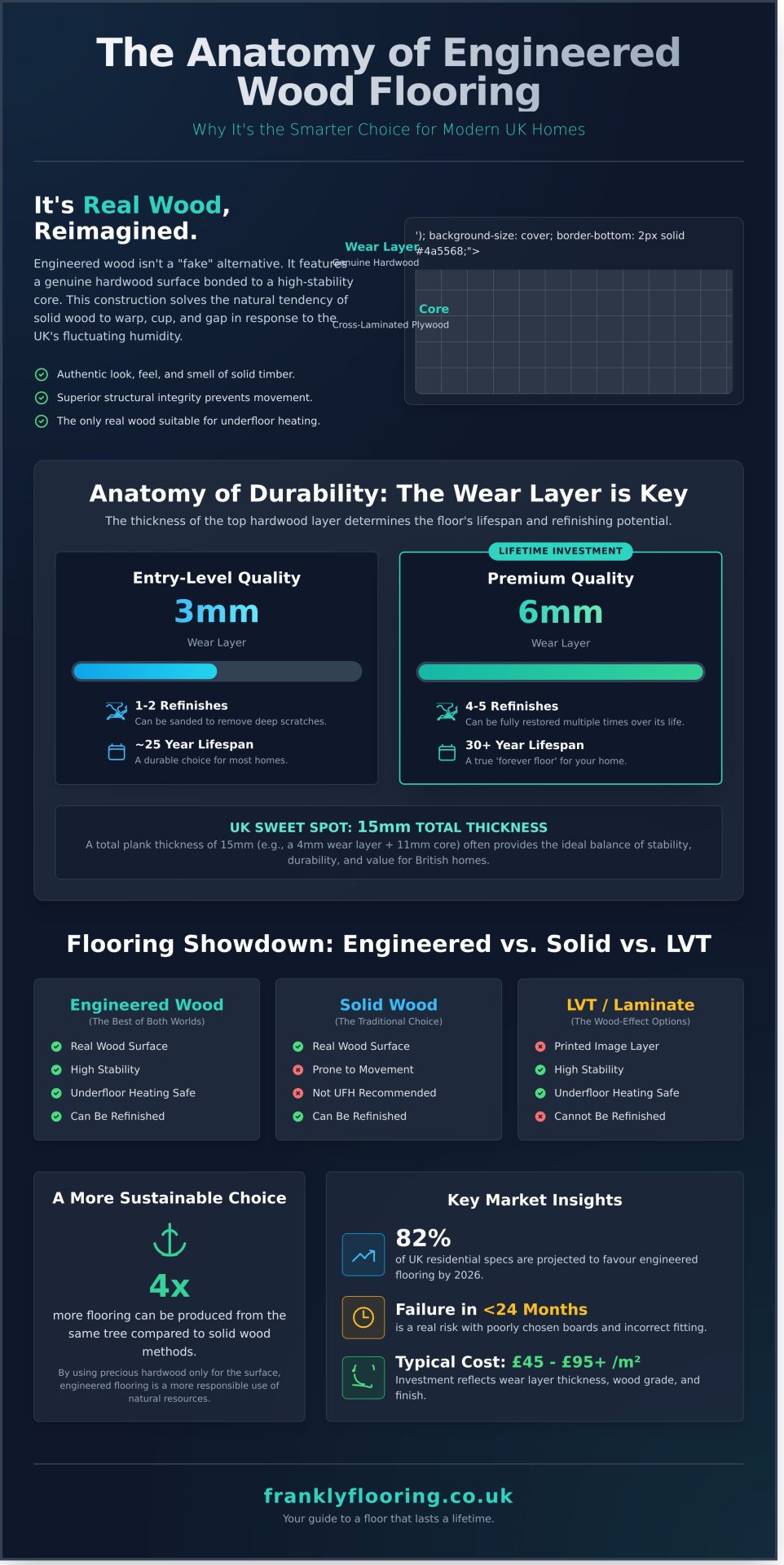
We see customers in our showroom every day who are surprised to learn that this isn’t a budget alternative to solid wood. It is a structural solution to a biological problem. Solid timber is “alive” in the sense that it reacts to its environment. It expands when it’s humid and shrinks when the heating goes on. By 2026, industry data indicates that 82% of UK residential flooring specifications will favour engineered structures over solid alternatives because they simply behave better. Engineered wood flooring has become the gold standard for renovations because it offers the prestige of Oak or Walnut without the heartbreak of gaps and cupping.
Sustainability is another area where we need to be direct. A single Oak tree takes decades to reach maturity. When we manufacture solid wood boards, we use the entire depth of that slow-growing timber for every plank. With engineered boards, we only use the premium hardwood for the visible top layer. This allows manufacturers to produce approximately four times more flooring from the same tree compared to solid timber methods. It is a more responsible way to bring natural beauty into your home without unnecessary waste.
Real Wood vs. “Fake” Wood
It’s vital to distinguish this product from laminate or Luxury Vinyl Tile (LVT). Laminate is essentially a high-resolution photograph of wood printed onto a fibreboard core and finished with a plastic coating. LVT is a high-quality PVC. Neither of them contains a single grain of actual timber. In contrast, the top 2mm to 6mm of an engineered wood flooring plank is 100% natural wood. When you walk on it, you are touching the same knots, grains, and textures found in a solid forest beam. Once it is fitted, even an expert would struggle to tell the difference between an engineered plank and a solid one. It looks, smells, and feels identical because, on the surface, it is identical.
Why British Homes Need Engineered Stability
The UK climate is notoriously difficult for natural materials. We experience significant shifts in humidity, often swinging from 40% to 70% within a single season. When you add modern central heating into the mix, which strips moisture from the air, solid wood boards often struggle to cope. They can warp, twist, or leave unsightly gaps between the skirting boards. The cross-layered construction of an engineered board acts as a counter-balance; when one layer tries to move, the others hold it in place. Engineered wood is a high-performance hybrid of nature and engineering. This stability is why it is the only real wood product we recommend for use with underfloor heating systems, which have become a staple in British home improvements over the last 5 years.
- Structural Integrity: Multiple layers prevent the wood from bowing.
- Versatility: Can be used in kitchens and basements where solid wood would fail.
- Authenticity: Offers the exact same aesthetic appeal as solid timber.
- Longevity: High-quality lamellas can be sanded and refinished multiple times.
Anatomy of a Plank: Understanding Layers and Quality
To understand engineered wood flooring, you have to look past the surface. While a solid wood plank is one piece of timber from top to bottom, an engineered plank is a precision-built sandwich of different materials. This construction isn’t about cutting costs; it’s about engineering out the natural flaws of timber, specifically its tendency to expand and contract when temperatures shift. Frankly, if you choose a plank with a poor internal structure, you’re just waiting for the floor to fail. We believe in being transparent about what’s inside, so you can make a choice that lasts decades rather than years.
The Wear Layer and Refinishing
The top layer of the plank, known as the lamella, is the only part you actually see and walk on. For a floor to be truly durable, this wear layer should sit between 3mm and 6mm. It’s a simple calculation. A 3mm wear layer provides enough depth for one or perhaps two full sandings, which usually extends the floor’s life to roughly 25 years. If you opt for a 6mm wear layer, you are investing in a floor that can be refurbished four or five times, often lasting 50 years or more. You should be wary of layers thinner than 2.5mm; these cannot be sanded safely and are essentially disposable products. However, a thick wear layer is only as good as the core beneath it. If the base is soft, the heavy oak top can actually cause the plank to bow or pull apart.
Core Materials: Plywood vs. Softwood
The core provides the structural backbone. Premium engineered wood flooring typically uses a multi-ply birch plywood core. This involves 9 to 11 layers of birch veneer, glued at right angles to one another. This cross-layered construction is what gives the plank its legendary stability. You can find more technical details on these structures in this Engineered Wood Overview. In contrast, cheaper three-layer floors often use a core of softwood, such as pine or hevea. While these are acceptable for some environments, they lack the density of birch. You can spot a low-quality core by looking for large gaps between the middle slats or a lack of weight in the plank. These “cheap” cores are far more likely to delaminate, where the layers literally peel away from each other over time.
The bottom of the plank features a balancing layer. This final veneer of wood acts as a counterweight to the top wear layer. Without it, the tension from the oak on top would cause the plank to cup or curl. At Frankly Flooring, we also pay close attention to the adhesives used to bond these layers. We prioritise boards that meet the E1 emission standard, ensuring that the VOC levels are kept to an absolute minimum for a healthier home environment. If you want to see the difference in quality for yourself, you can view our range of samples to feel the weight and stability of a high-spec birch core. A quality plank feels solid in the hand; it doesn’t flex or creak when pressure is applied.
- 3mm Wear Layer: Good for 25 years; 1-2 sands possible.
- 6mm Wear Layer: Lifetime product; 4-5 sands possible.
- Birch Plywood Core: The industry standard for high-traffic stability.
- Balancing Layer: Essential for preventing “cupping” in humid conditions.
Engineered vs. Solid Wood vs. LVT: The Honest Comparison
Choosing a floor isn’t just about picking a colour from a sample book. It’s a decision about how your home will function for the next two decades. In high-traffic areas like hallways or living rooms, your floor faces constant pressure. Engineered wood flooring excels here because its cross-layered core prevents the planks from shifting or gapping, even when the British weather swings from a damp autumn to a dry, heated winter. While solid wood might buckle and LVT might feel thin, engineered boards provide a stable, heavy-duty surface that handles the chaos of a busy household without complaint.
Moisture is the one area where we need to be blunt. Bathrooms and wet rooms are absolute “no-go” zones for any timber product. If a pipe leaks or a bath overflows, real wood will soak up that moisture and swell. For these spaces, LVT is the only logical choice. However, for kitchens, engineered boards are perfectly suitable provided you wipe up spills within a reasonable timeframe. It’s about matching the material to the environment rather than forcing a product where it doesn’t belong.
- Acoustics: Real wood absorbs sound, creating a quiet, muffled “thud” underfoot. Synthetics often produce a hollow “clack” that can irritate in open-plan spaces.
- Warmth: Wood is a natural insulator. It retains ambient heat far better than plastic-based LVT, making your home feel cosier during the winter months.
- Longevity: A quality board with a 4mm wear layer can be sanded and refinished up to three times. This gives it a potential lifespan of 30 years or more.
The cost-benefit analysis over a 25-year period tells a clear story. You might pay £70 per square metre for a premium engineered board today, whereas a mid-range LVT costs £35. However, the LVT will likely need replacing after 12 to 15 years as the photographic layer wears thin or scratches become unsightly. The wood floor stays down, gains character, and can be refreshed for a fraction of the cost of a full replacement. It’s a classic case of paying more now to save significantly later.
Engineered Wood vs. Solid Timber
Solid wood is no longer the default for modern UK homes. It’s temperamental. Because solid timber is one single piece of wood, it reacts violently to humidity changes. This makes it a nightmare to fit over concrete subfloors or in modern extensions. Engineered wood flooring wins the Underfloor Heating (UFH) verdict every time. It allows heat to transfer efficiently without the wood drying out and cracking, a common failure seen in 90% of solid wood UFH installations.
Engineered Wood vs. Luxury Vinyl Tile (LVT)
LVT is a fantastic utility product, but it won’t add 3% to 5% to your property’s valuation like real oak does. Buyers in the UK market still value natural materials over high-end plastics. Maintenance is also a different beast. If you deep-scratch an LVT plank, your only real option is to lift and replace it, which is a headache if it’s in the middle of a room. With wood, a bit of colour-matched wax or a light sand can make a scratch disappear, keeping the floor’s integrity intact without a full refit.
The Frank Guide to Choosing Specs: Grades and Finishes
Choosing your floor isn’t just about picking a shade of oak that matches your furniture. It’s a technical decision that affects how your home functions daily. When you invest in engineered wood flooring, you’re choosing a product designed for stability, but the aesthetic and maintenance requirements are dictated by the specific “specs” of the top wear layer.
Decoding Wood Grades
Wood is a natural material, so every tree is different. Manufacturers sort planks into “grades” based on their visual character. Prime grade is the cleanest, most uniform option. You’ll see very few knots, and those that do appear are typically smaller than 15mm. It’s the go-to choice for a sleek, minimalist look. Character and Rustic grades sit at the other end of the spectrum. These celebrate the tree’s history with knots up to 50mm, visible sapwood, and natural colour variations. Frankly, the price difference between grades reflects the rarity of “clean” timber rather than the strength of the board. A rustic plank is just as structurally sound as a prime one; it simply tells a different story.
Choosing the Right Finish for Your Lifestyle
Your choice of finish determines your maintenance routine for the next decade. You have three primary options:
- Lacquered: This acts like a transparent shield over the wood. It’s hard-wearing and smooth, making it the “set and forget” choice for busy households with children or pets. It’s the easiest to mop, though deep scratches can be harder to hide.
- Natural Oil: This is the purist’s choice. The oil soaks into the grain, leaving a deep, matte texture you can actually feel. While it requires a fresh coat of maintenance oil every 12 to 24 months, you can spot-repair small scratches without sanding the whole room.
- UV Oil: This offers a middle ground. The wood is oiled and then cured under UV lights in the factory. This creates a surface that’s tougher than natural oil but retains that organic, low-sheen appearance.
Plank Widths, Bevels, and Textures
The physical dimensions of your planks change how you perceive a room’s size. Standard planks often sit around 150mm wide, but wider boards of 190mm or 240mm are increasingly popular. In a typical 15-square-metre lounge, wider planks create fewer join lines, which makes the space feel less cluttered and more expansive. Textures also play a role in durability. A “brushed” finish involves wire-brushing the surface to remove the softer springwood. This leaves a tactile, harder surface that’s excellent at disguising the minor dents and scratches that occur in high-traffic hallways.
Room Suitability and Underfloor Heating
One of the biggest benefits of engineered wood flooring is its compatibility with modern heating. Its cross-layered construction prevents the timber from warping or cupping when the temperature rises. It’s perfectly safe for use with both water-based and electric underfloor heating (UFH) systems, provided the surface temperature doesn’t exceed 27°C. If you’re fitting wood in a kitchen, we always recommend a lacquered or UV oiled finish. These provide the necessary moisture resistance to handle the occasional spill or steam from a dishwasher. Just ensure your fitter leaves a consistent 10mm expansion gap around the perimeter to allow the floor to breathe as your home’s climate changes.
Ready to see these textures and grades in person? Browse our full range of Woodpecker flooring and accessories to find the perfect match for your project.
Fitting and Maintenance: Keeping Your Floors Perfect
Subfloor preparation is the foundation of a successful project. In fact, subfloor issues cause 90% of post-fitting complaints in the UK. Before you even open a pack of engineered wood flooring, your subfloor must be clean, dry, and level. For concrete, moisture levels must be below 75% relative humidity (RH). If your floor has a deviation of more than 3mm over a 2-metre span, you’ll need a self-levelling compound to prevent future “bounce” or joint failure. Ignoring these tolerances leads to creaks and eventual structural damage.
Acclimatisation is equally critical. You must leave your flooring in the room where it will be fitted for 48 to 72 hours. This period allows the wood to reach equilibrium with the local temperature and humidity. Skipping this step is a gamble that usually ends in the wood expanding or shrinking after it’s been laid, which causes gaps or buckling. It’s a non-negotiable part of the process for any timber product.
Daily care follows our “Frank” rules for longevity. First, never use a soaking wet mop; moisture is the enemy of natural wood. Second, sweep or vacuum with a soft brush daily to remove grit that acts like sandpaper on the finish. These simple habits prevent 95% of common surface wear issues.
The Fitting Process: DIY or Pro?
Choosing between glue-down and floating installation depends on the feel you want underfoot. Glue-down fitting provides the best acoustic performance, as it eliminates the hollow sound often associated with wood. Floating systems are faster and use Click-Lock technology, which is perfect for DIY enthusiasts. You’ll need the right kit to get it right. Check out our guide to DIY flooring accessories to find everything from spacers that maintain the essential 10mm expansion gap to professional-grade pull bars and high-quality underlay.
Long-term Maintenance and Repair
Scratches are a part of a home’s story, but they’re easy to manage. For minor marks, touch-up sticks or a drop of maintenance oil can mask the damage in seconds. Prevention is always more cost-effective than repair, so we recommend fitting high-quality entrance matting at every external door to catch grit before it reaches your boards. You should also apply felt pads to the legs of all furniture; a 50p felt pad can save you a £500 repair bill. To preserve the finish, only use pH-neutral cleaners specifically formulated for wood to avoid stripping the protective oils or lacquers.
The Frankly Flooring Promise
We don’t believe in high-pressure sales or hidden costs. Our advisory approach ensures you select the specific engineered wood flooring that suits your subfloor and lifestyle. We provide direct delivery and no-nonsense pricing across the UK, meaning the price you see is the price you pay. We’re here to guide you from the first measurement to the final sweep-up, ensuring your home looks exactly how you imagined it. Order your free engineered wood samples today and see the quality for yourself.
Step Into a Floor Built to Last
Choosing the right floor shouldn’t feel like a gamble. You now understand that engineered wood flooring offers the best of both worlds: the authentic beauty of a real timber top layer and the structural stability needed for modern British homes. Whether you’ve settled on a 4mm wear layer for maximum durability or a specific UV-oiled finish for a natural look, you’re now equipped to make a decision that adds long-term value to your property. It’s about finding that balance between aesthetic appeal and the practical realities of daily life.
At Frankly Flooring, we’ve spent over 20 years as a family-run business helping homeowners cut through the marketing fluff. We don’t do high-pressure sales or hidden fees; we just provide honest, transparent advice based on two decades of industry experience. With direct UK delivery on all planks and accessories, we ensure your project stays on track from start to finish. We’re here to help you get the job done right. Find your perfect floor at Frankly Flooring and take the first step toward a home you’ll love for years to come.
Frequently Asked Questions
Is engineered wood flooring better than solid wood?
Engineered wood flooring is generally a better choice for modern UK homes because its cross-layered construction makes it 30% more stable than solid planks. This design means the boards are far less likely to warp or gap when humidity levels shift. While solid wood is traditional, engineered boards provide the same genuine oak surface with much better performance over underfloor heating or in damp environments.
Can I use engineered wood flooring in a kitchen?
You can certainly fit this flooring in a kitchen, provided you’re diligent about wiping up spills immediately. Around 25% of our residential projects now involve wood in open-plan cooking areas. To keep the floor in top condition, you must ensure the joints are tight during fitting and any standing water is cleared within 30 minutes to prevent the core from absorbing moisture.
How much does engineered wood flooring cost per square metre in the UK?
In the current UK market, quality engineered wood flooring typically costs between £35 and £90 per square metre for the boards. If you’re opting for a bespoke finish or a thicker 6mm wear layer, prices can reach £120 per square metre. You should also budget an additional £25 to £40 per square metre for professional fitting and subfloor preparation to ensure a long-lasting result.
Do I need underlay for engineered wood flooring?
You’ll need underlay if you’re installing a floating floor rather than glueing the boards directly to the subfloor. A quality 3mm acoustic underlay can reduce impact noise by up to 22 decibels, which makes a noticeable difference in busy households. If you’re fitting over a concrete base, your underlay must include a damp-proof membrane to stop moisture from reaching the wood.
Can engineered wood be installed over underfloor heating?
Yes, it’s the most reliable real wood option for use with underfloor heating systems. The structural layers allow the wood to expand and contract safely as the temperature changes without cracking. To protect the timber, you must ensure the system’s surface temperature never exceeds 27°C. This prevents the natural fibres from drying out and maintains the integrity of the adhesive bonds.
How long should engineered wood acclimatise for?
You should let your boards rest in the room where they’ll be fitted for at least 48 to 72 hours. During this period, keep the room temperature between 18°C and 22°C to allow the wood to reach equilibrium with your home’s atmosphere. This simple step prevents 90% of common post-installation issues like peaking or gapping that occur when wood is fitted too quickly.
What is the difference between oiled and lacquered finishes?
A lacquered finish creates a hard, transparent film on the surface, while oil penetrates deep into the grain for a more matte, natural look. Lacquer is incredibly tough and can last 10 years before it needs a full sand and reseal. Oiled floors require a fresh coat of maintenance oil every 12 to 18 months, but they’re much easier to repair if you get a localized scratch.
Can you mop engineered wood flooring?
You can use a damp microfibre mop, but you should never use a soaking wet one that leaves puddles. Excess water can cause a 5% increase in moisture content, leading to swelling or “crowning” at the edges of the planks. We recommend using a pH-neutral wood cleaner and a spray mop system to control the amount of liquid used during your weekly cleaning routine.