
The traditional belief that solid timber is the only way to achieve a “real” wood floor is actually costing UK homeowners thousands in avoidable repairs. While the prestige of a thick plank is tempting, the debate of solid wood flooring vs engineered often overlooks how wood actually behaves in a British home. You want a floor that looks stunning and stays flat, yet the fear of warping planks or scratching surfaces is enough to make anyone hesitate.
We understand that technical terms like wear layers and multi-ply cores feel like they’re designed to confuse you rather than help. That’s why we’re being Frank. This guide provides a transparent, expert breakdown of engineered wood flooring to help you choose a floor that lasts a lifetime and works perfectly with modern underfloor heating. We’ll show you how to navigate the buying process without the jargon, ensuring your investment increases your home’s value. From understanding structural stability to selecting the right finish, here is everything you need to know for 2026.
Key Takeaways
- Learn why engineered wood is a genuine timber product rather than a synthetic imitation, providing the same warmth and value as traditional planks.
- Understand the structural differences in the solid wood flooring vs engineered debate to choose a stable material that won’t warp in humid UK conditions.
- Discover how to evaluate wear layers and core construction to ensure your new floor can be sanded and refreshed for decades to come.
- Master the nuances of wood grading and species, helping you decide between a clean, modern look and a characterful, rustic finish.
- Identify the critical subfloor preparations needed to avoid common installation pitfalls and ensure your floor stays flat and silent.
What is Engineered Wood Flooring? The Frank Truth
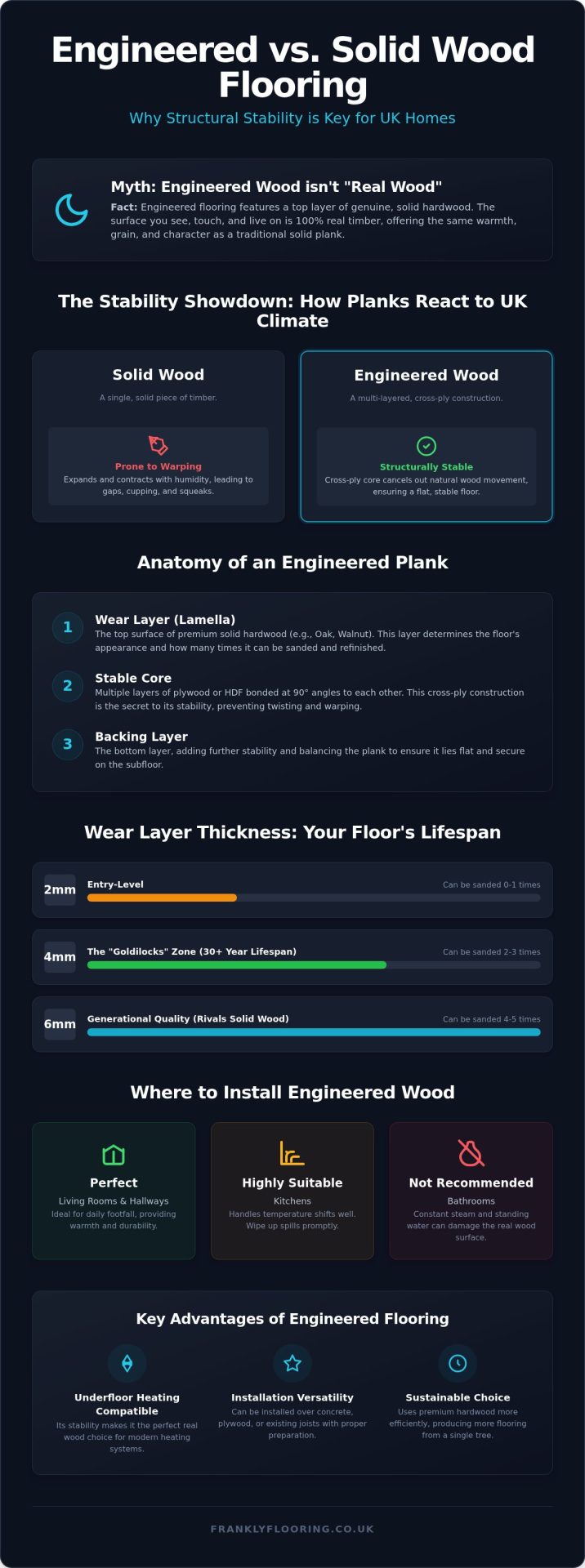
Let’s be clear from the start: engineered wood is real wood. It isn’t a cheap imitation or a plastic substitute. When you look at the surface of an installed plank, you’re seeing the exact same grain, texture, and character as a solid timber board. The difference lies beneath the surface. While solid wood is a single, thick piece of timber, engineered planks are built using a sophisticated layering system. This clever design was specifically created to solve the biggest headache in the flooring industry: wood’s natural tendency to move.
In the debate of solid wood flooring vs engineered, structural integrity is where the latter wins. Solid planks are beautiful, but they’re temperamental. They react to the moisture in the UK air, expanding in the summer and shrinking in the winter. This often leads to gaps, squeaks, or even permanent warping. Engineered wood uses a cross-ply construction where each layer is glued at a 90-degree angle to the one above it. This creates a stable core that resists the urge to twist or cup. You get the premium look of solid oak or walnut, but with a floor that stays flat and functional.
Engineered vs. Solid Wood: Why Structure Matters
The science is simple but effective. Because wood grain naturally expands across its width, stacking layers in opposing directions cancels out that force. This is vital for British homes where central heating and damp weather create a constant cycle of humidity changes. By using engineered wood, you also make a more sustainable choice. A single slow-growing oak tree can produce significantly more flooring when used as a high-quality wear layer rather than being cut into thick, solid planks. It’s a more efficient way to enjoy premium materials without unnecessary waste.
Is it Right for Every Room?
Engineered wood is incredibly versatile, but it isn’t a “fit and forget” solution for every corner of the house. It’s important to match the material to the environment to ensure it lasts a lifetime.
- Living Rooms and Hallways: Perfect. These areas benefit from the durability and warmth of real timber, handling daily footfall with ease.
- Kitchens: Highly suitable, provided you’re quick with the mop if a spill occurs. The structural stability handles temperature shifts from ovens better than almost any other wood product.
- Bathrooms: We’ll be frank; we don’t recommend it. No matter how well engineered a plank is, constant steam and standing water will eventually damage the timber surface. For these rooms, LVT is usually the smarter choice.
Regarding subfloors, this material is a chameleon. It performs brilliantly over concrete screeds, provided they’re dry and level, and can be installed directly over existing floor joists or plywood. It’s the most reliable way to get a high-end finish without the structural risks often found in the solid wood flooring vs engineered comparison. To ensure a perfect result from the ground up, you might explore Flooring Sales and Installation for expert insights into professional fitting standards.
The Anatomy of a Plank: Understanding Quality and Lifespan
To understand why the debate of solid wood flooring vs engineered is so central to modern home renovation, you have to look at what’s happening inside the plank. A high-quality board isn’t a simple piece of timber; it’s a balanced construction of three distinct parts: the wear layer, the core, and the backing. Each component plays a vital role in how the floor looks, feels, and performs over time. When these layers work in harmony, they create a product that is often more durable than its solid counterparts.
The lamella is the top layer of real hardwood that gives the plank its authentic appearance and texture.
The Wear Layer: How Long Will Your Floor Last?
When we talk about the lifespan of your floor, we’re really talking about the thickness of the wear layer. This is the portion of the plank that can be sanded and refinished if it becomes scratched or worn. A 2mm wear layer is an entry-level choice that provides a real wood look for a lower price, but it can usually only be sanded once by a very careful professional. For most British homes, a 4mm wear layer is the “goldilocks” zone. It allows for two or three full refinishes, which typically extends the floor’s life to 30 years or more.
If you want a floor that truly rivals the longevity of solid timber, a 6mm wear layer is the answer. This thickness allows for four or five sandings, meaning the floor can stay in the family for generations. According to technical data in the U.S. Forest Service Wood Handbook, the density and species of this top layer also dictate how well the floor resists impacts and indentations in high-traffic areas. This makes the wear layer the most important factor in your long-term investment.
Core Stability: Multi-ply vs. Three-layer
The core is the engine room of the plank. In the solid wood flooring vs engineered comparison, the core construction is the biggest differentiator for performance. While budget options sometimes use HDF (High-Density Fibreboard), quality engineered wood typically uses a multi-ply or three-layer timber core. Multi-ply construction involves several thin layers of plywood glued with the grain running in opposite directions. This cross-layered approach is what gives engineered wood its famous stability, preventing the expansion and contraction that often plagues solid wood. The bottom backing layer then acts as a final counter-balance to keep the plank perfectly flat against your subfloor.
At Frankly Flooring, we focus on products that offer this level of structural integrity to ensure your investment is protected. You can explore our carefully vetted wood range to find the right balance of thickness and core strength for your project. Choosing the right core ensures your floor remains silent and stable for decades.
Engineered Wood vs. Laminate and LVT: Making the Choice
Choosing a floor isn’t just about the price tag. It’s about how your home feels on a cold Tuesday morning. Engineered wood offers a natural warmth underfoot that laminate simply cannot replicate. While laminate often feels cold and sounds “clicky” when walked on, engineered wood absorbs sound and maintains an ambient temperature. This sensory difference is the first thing you’ll notice. If you’re considering a synthetic alternative for its water resistance, check out our guide on LVT flooring to see how it compares to timber.
There’s also the question of what you’re leaving behind. Timber is a natural, carbon-storing material that is biodegradable at the end of its long life. In contrast, most laminates and vinyls are plastic-based products. In the UK property market, “real wood floors” remains a high-value phrase. Estate agents know that a wood floor isn’t just a covering; it’s a structural asset that adds tangible value to your home. It suggests a level of quality that synthetic materials can’t match.
The Investment Gap: Cost vs. Long-term Value
Upfront, laminate is cheaper. There’s no point pretending otherwise. However, the solid wood flooring vs engineered debate shifts when you look at the cost per year of life. A quality engineered floor lasts 30 to 50 years. A laminate might need replacing in 10 or 15. Over three decades, you’ll likely buy three laminate floors for the price of one engineered wood floor. Investing more now saves you the significant upheaval and cost of a full refit later. It’s the difference between a temporary fix and a permanent foundation.
Durability and Maintenance Reality
Let’s be frank about scratches. If you have a large dog with unclipped claws, wood will patina. It will show the marks of a lived-in home. LVT and high-end laminates are incredibly resistant to surface marks, which makes them tempting for households with high traffic and pets. But here is the catch: when a synthetic floor is deeply scratched, it’s permanent. You can’t fix it. You can only replace the plank or live with the damage.
With engineered wood, you have a “reset” button. As we discussed in the anatomy of the plank, a professional sand and seal can make a twenty-year-old floor look brand new again. This ability to be reborn is why timber remains the gold standard for those who value longevity. If you have large pets, you might choose a more rustic grade or a textured finish that hides marks better, but you’ll always have the option to refinish the surface later.
Selecting Your Style: Species, Grades, and Finishes
Choosing the right aesthetic is where technical specifications meet your personal taste. In the UK, Oak remains the undisputed heavyweight of the flooring world. It’s naturally hardwearing, takes stains beautifully, and offers a timeless grain that suits both Victorian terraces and modern apartments. If you’re looking for something darker and more prestigious, Walnut provides a rich, chocolatey tone, though it’s a softer wood that requires a bit more care. Ash is a fantastic alternative for those wanting a brighter, more contemporary feel, often featuring a more energetic grain pattern than Oak.
Tannins are naturally occurring organic compounds in the wood that react with light and oxygen to gradually deepen or shift the colour of your planks over time.
When deciding on your look, you’ll need to choose a wood grade. This has nothing to do with the structural quality of the solid wood flooring vs engineered planks, but everything to do with the number of knots and colour variations. Prime grade is the cleanest, most uniform look with minimal character marks. Rustic grade, on the other hand, celebrates the natural life of the tree, featuring larger knots and more dramatic grain shifts. Most homeowners find that Rustic grades are more forgiving in busy households because new scratches or dents blend into the existing character of the wood.
Lacquered vs. Oiled: Which Finish is More Practical?
The finish you choose dictates your Sunday morning maintenance routine. A lacquered finish acts like a transparent shield sitting on top of the wood. It’s typically smoother, often has a slight sheen, and is incredibly easy to wipe clean. However, if you manage to scratch through the lacquer, you can’t easily fix a small patch; you’d eventually need to sand the whole room.
An oiled finish soaks into the timber fibres, preserving the natural texture and matte appearance of the wood. While it requires a bit more regular “feeding” with maintenance oils, it’s the most practical choice for high-traffic areas. If you get a deep scratch in an oiled floor, you can simply sand that tiny spot and re-apply a bit of oil. For homes with pets or young children, we frankly recommend an oiled finish for this reason.
The Rise of Herringbone and Parquet
While wide planks are a classic choice that can make a room feel longer, parquet flooring is seeing a massive resurgence in 2026. Patterns like Herringbone and Chevron add a layer of architectural interest that straight planks can’t match. These geometric designs are particularly effective in smaller UK hallways or dining rooms, as the diagonal lines draw the eye outward, making the space feel significantly larger than it actually is.
Installing these patterns is more complex and requires more “wastage” during the cutting process, but the visual payoff is immense. Whether you prefer the clean lines of a Prime Oak Chevron or the rugged charm of a Rustic Herringbone, the right style will define the character of your home for decades. You can browse our full range of engineered wood styles and patterns to see how these different grades and finishes look in person.
Installation and Care: Getting It Right First Time
Your choice of floor is only as good as the surface it sits on. We’ll be Frank: skipping subfloor preparation is the fastest way to ruin a premium investment. Before a single plank is laid, your subfloor must be flat, dry, and clean. Any unevenness greater than 3mm over a two-metre span can cause “bounce” in a floating floor, leading to damaged joints and annoying squeaks. While we don’t offer installation services, we provide the best accessories to ensure your project reaches a professional standard.
You’ll generally choose between two fitting methods. The Click System is perfect for a floating installation, where planks lock together over an underlay without being fixed to the subfloor. It’s fast and DIY-friendly. Tongue and Groove (T&G) planks are usually glued down or secret-nailed. While T&G requires more skill, it results in a floor that feels incredibly solid and quiet underfoot. Regardless of the method, a quality underlay is essential to provide a moisture barrier and reduce impact sound between rooms.
Underfloor Heating (UFH) Compatibility
This is where the solid wood flooring vs engineered debate reaches a definitive conclusion. Engineered wood is the only real timber product we recommend for use with underfloor heating. Its layered construction allows the floor to expand and contract locally without the whole surface warping. Solid wood simply cannot handle the direct heat without shrinking and creating unsightly gaps.
To protect the timber lamella, you must keep the floor surface temperature below 27°C. Rapid temperature changes can stress the wood, so it’s best to increase the heat gradually. Don’t forget the golden rule of acclimatisation. Your wood needs to sit in the room where it will be installed for at least 48 hours. This allows the planks to reach equilibrium with the home’s humidity before they’re locked into place.
Maintenance: How to Keep Your Floor Looking New
Modern finishes make wood easy to live with, but they aren’t invincible. There are two things you should never use on your engineered floor: steam mops and soaking wet cloths. Steam forces moisture deep into the grain, which can cause the layers to delaminate over time. Instead, use a well-wrung damp mop and a pH-neutral wood cleaner.
- Lacquered Floors: These require very little maintenance beyond regular sweeping and occasional mopping. They don’t need polishing or oiling.
- Oiled Floors: These benefit from a “wash and care” solution that replenishes the oil as you clean. Every few years, you might want to apply a fresh coat of maintenance oil to keep the wood looking hydrated.
By following these simple steps, you ensure your floor remains a foundational element of your home’s character for decades. Ready to upgrade? Browse our full engineered wood range today and find the perfect match for your next project.
Step Into a Floor That Lasts a Lifetime
Choosing the right floor is a significant decision for your home. We’ve shown that when weighing up solid wood flooring vs engineered, the modern layered construction offers the best balance of authentic timber aesthetics and structural reliability. By focusing on a substantial wear layer and correct subfloor preparation, you ensure your investment remains beautiful and stable for decades. It’s about finding that perfect match for your lifestyle and your underfloor heating requirements.
At Frankly Flooring, we bring 20 years of family-run expertise to every product we select. We don’t believe in high-pressure sales; we believe in providing authoritative advice that helps you make an informed choice. From technical specs to style selection, we’re here to guide you through the entire process. With our direct-to-door national UK delivery, your new floor is closer than you think. Our team takes pride in helping you build the character of your home from the ground up.
Explore our frank range of premium Engineered Wood Flooring and find the foundation your home deserves. You’re now ready to choose your new floor with total confidence.
Frequently Asked Questions
Can engineered wood flooring be used with underfloor heating?
Yes, engineered wood is the only real timber product suitable for underfloor heating. Its cross-layered construction allows it to expand and contract without the warping often seen in the solid wood flooring vs engineered debate. You should ensure the surface temperature doesn’t exceed 27°C and increase the heat gradually after installation. This stability makes it a far superior choice for modern UK homes equipped with efficient heating systems.
How many times can you sand engineered wood flooring?
You can sand engineered wood between one and five times depending on the thickness of the wear layer. A standard 4mm wear layer typically allows for two or three full refinishes over its lifetime. If you choose a premium 6mm wear layer, you can sand it up to five times, rivaling the longevity of solid planks. We always recommend a professional assessment before sanding to ensure enough real wood remains.
Is engineered wood flooring waterproof?
No, engineered wood flooring is not waterproof. While its structural layers offer better resistance to humidity than solid timber, the top layer is still real wood that will absorb liquid. Spills should be wiped up immediately to prevent staining or swelling. For areas with high moisture levels like bathrooms, we frankly recommend looking at our LVT options instead, which are designed to handle standing water without any risk.
How long should engineered wood floor acclimatise?
You should allow your engineered wood to acclimatise for at least 48 hours in the room where it will be installed. This period allows the timber to reach a balance with the specific humidity and temperature of your home. Keep the planks in their packaging but ensure the room is dry and at a normal living temperature. Skipping this step is a common cause of boards buckling or shrinking after they’ve been fitted.
Is engineered wood flooring better than laminate?
Engineered wood is generally considered superior because it features a genuine hardwood surface rather than a printed plastic layer. It provides better sound absorption, feels warmer underfoot, and adds significant value to your property. While laminate is cheaper upfront, it cannot be sanded or refinished. Choosing engineered wood means you’re investing in a natural material that can be reborn multiple times, offering much better long-term value for your home.
Can I install engineered wood flooring myself?
Yes, you can certainly install it yourself, particularly if you choose a click-system plank. These are designed for a “floating” installation that doesn’t require professional adhesives or specialist nailing tools. However, you must ensure your subfloor is perfectly level and dry before starting. While Frankly Flooring is a supply-only retailer and doesn’t provide installation services, we sell all the essential accessories and tools you’ll need to achieve a high-quality, professional finish.
Does engineered wood flooring scratch easily?
Like any natural timber product, engineered wood can scratch if subjected to heavy impacts or sharp objects. However, its durability depends largely on the finish you choose. Oiled floors hide scratches better and allow for easy spot repairs, whereas lacquered finishes provide a tougher shield but are harder to fix locally. Using felt pads on furniture and keeping pet claws trimmed will help maintain the pristine look of your real wood surface.
What is the best underlay for engineered wood flooring?
The best underlay depends on your subfloor and whether you have underfloor heating. For concrete subfloors, you must use an underlay with a built-in damp proof membrane (DPM) to block moisture. If sound reduction is your priority, look for high-density foam or rubber-based underlays with a high decibel rating. We stock a range of professional-grade accessories specifically designed to support the structural integrity and acoustic performance of your new engineered wood planks.