
The most expensive mistake you can make when renovating isn’t picking a bold colour; it’s assuming that every room needs the exact same plank to look cohesive. While a uniform look is popular, the secret to a successful home design is often knowing when to break the rules. Learning how to choose flooring for your whole house is a balancing act between visual flow and the gritty reality of muddy paws or spilled wine.
We understand the pressure. You’re likely staring at dozens of samples, worrying if the LVT in the kitchen will clash with the carpet on the landing, or if those technical specs like wear layers actually matter for your hallway. It’s a lot to take in, and the fear of a mismatched home is enough to stall any project. You want a space that feels connected but also survives your lifestyle.
This guide provides some much-needed candor. We’ll show you how to master the art of whole-house flooring by zoning your rooms for function while maintaining a seamless aesthetic. From understanding durability for high-traffic areas to planning your delivery, you’ll finish this with a clear, stress-free strategy for your 2026 project.
Key Takeaways
- Master the balance between a unified aesthetic and functional “zoning” to create a home that feels spacious yet remains practical for daily life.
- Get an honest breakdown of LVT, wood, laminate, and carpet to understand how to choose flooring for your whole house based on durability and moisture resistance.
- Identify the specific technical requirements for high-traffic hallways and moisture-prone kitchens to prevent premature wear and tear.
- Learn why the subfloor and underlay you choose are just as important as the surface material for long-term stability and comfort.
- Understand how to accurately measure your rooms and apply the 10% wastage rule to ensure a smooth, cost-effective online ordering process.
The Whole-House Flooring Strategy: Zoning vs. Unifying
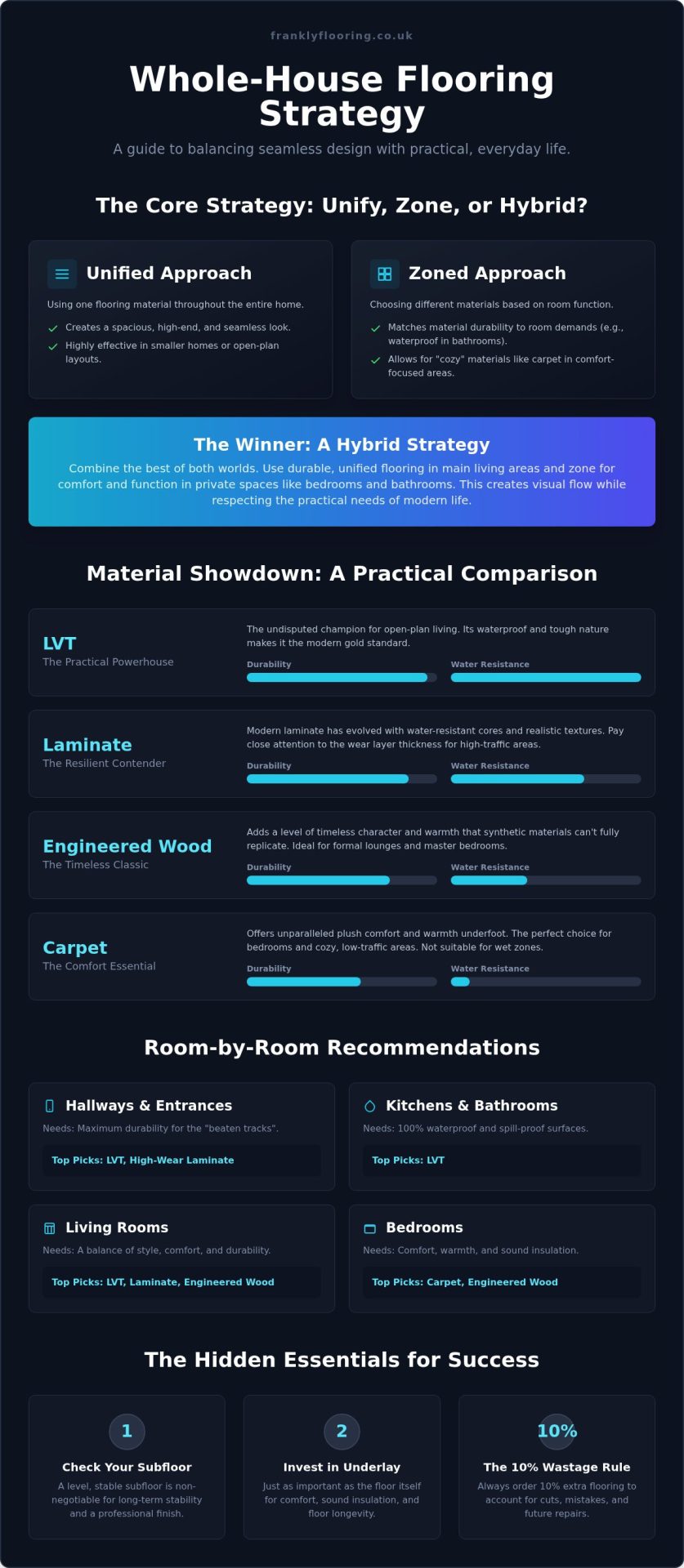
When you’re deciding how to choose flooring for your whole house, you aren’t just picking a surface to walk on; you’re setting the design foundation for every room. A common debate among homeowners is whether to go “Unified” or “Zoned.” The unified approach involves using one material, such as LVT or wood, throughout the entire property. This creates an immediate sense of space and a high-end, seamless look. It’s particularly effective in smaller homes or open-plan layouts where you want to avoid visual “choppiness.”
On the other hand, the zoned approach acknowledges that a bathroom has different needs than a bedroom. You might want the plush comfort of carpet underfoot when you wake up, but you definitely don’t want it near a leaky shower. Our frank advice is that a hybrid strategy is almost always the winner for modern UK homes. It allows you to use durable, waterproof materials in high-traffic zones while keeping the “cosy” factor where it matters most. For a deeper look at the technical specs of these options, you can consult this comprehensive guide to flooring materials to see how different surfaces compare.
Conducting a Lifestyle Audit
Before you commit to a pallet of materials, you need to be honest about how you actually live. Walk through your home and identify the “beaten tracks.” These are the paths from the front door to the kitchen, or the kitchen to the sofa. These areas need maximum durability. If you have pets or young children, scratch resistance and spill-proofing are non-negotiable requirements. Don’t forget about south-facing rooms. Constant sunlight can fade certain materials over time, so UV resistance becomes a priority. Understanding these variables is the first step in learning how to choose flooring for your whole house that actually lasts.
The Visual ‘Flow’ Principle
Maintaining a sense of “flow” doesn’t mean every room has to be identical. You can bridge different materials by using a consistent colour palette. For example, if your LVT has a grey oak finish, look for a carpet with similar cool undertones. Pay attention to “sightlines.” Stand at your front door and look into the house. The flooring you see from this vantage point dictates the primary aesthetic. Finally, consider the role of texture. A slight grain in your laminate or a deep pile in your rug adds character and a premium feel without breaking the visual continuity of your home’s design.
Choosing Your Materials: LVT, Wood, Laminate, or Carpet?
Picking the right material is where your strategy meets reality. In 2026, the market offers four primary contenders, each with distinct strengths for different zones. While you might be tempted by the lowest price tag, the real value lies in how these materials hold up against daily life. Data shows that Luxury Vinyl Plank (LVP) accounted for approximately 52% of US residential flooring sales in 2025, and its popularity is only growing. It’s the current gold standard for a reason. When you’re deciding how to choose flooring for your whole house, you need to look beyond the surface aesthetics and consider the technical performance of each material. This ensures your investment survives the next decade of traffic, spills, and sunlight. Your choice should reflect a balance of durability, comfort, and the long-term character of your property.
LVT and Laminate: The Practical Powerhouses
Modern LVT flooring is the undisputed champion for open-plan living. It’s waterproof and incredibly tough, which explains its massive market share. If you’re looking for a detailed breakdown of durability ratings, this Consumer Reports flooring buying guide offers excellent independent testing results. High-quality laminate flooring has also evolved, now featuring water-resistant cores and realistic textures. When you’re figuring out how to choose flooring for your whole house, pay close attention to the wear layer. For a busy family home, a thicker wear layer is essential to handle heavy foot traffic and the occasional dropped toy without flinching. These materials provide the practical foundation most modern homes require.
Wood and Carpet: The Comfort Essentials
For master bedrooms or formal lounges, engineered wood flooring adds a level of timeless character that synthetic materials struggle to replicate. It’s a smart investment too, as hardwood flooring offers a return on investment of up to 75%. However, wood isn’t always the answer. High-quality carpet remains the best choice for bedrooms and stairs where acoustic benefits are paramount. Large houses can often sound hollow or echoey, especially with hard surfaces everywhere. Carpet dampens that noise effectively while providing a soft landing for bare feet. If you’re ready to start comparing samples, you can view our latest flooring bargains online to see what fits your vision.
Room-by-Room Recommendations: A Practical Guide
Deciding how to choose flooring for your whole house requires a tactical plan for each room. You don’t need the same level of durability in a guest bedroom as you do in your front hallway. The hallway is your home’s “beaten track.” It’s where the most grit, moisture, and foot traffic occur. This is where you should splurge on a high-spec LVT or a premium engineered wood. Conversely, you can save money in bedrooms by opting for a softer carpet with a lower wear rating, provided you pair it with a high-quality underlay for comfort. Living and dining areas are social hubs that need to balance the “cosy” factor with the reality of occasional red wine spills or heavy furniture legs.
Our frank advice on the “save vs. splurge” debate is simple. Invest heavily in the rooms you see and use the most. A cheap floor in a high-traffic kitchen will look worn within eighteen months. However, a mid-range carpet in a bedroom can last a decade. By allocating your budget where the technical demands are highest, you ensure the longevity of your entire project without overspending on low-traffic areas.
The ‘Wet Zone’ Strategy
For kitchens and bathrooms, LVT and vinyl have largely overtaken traditional ceramic tiles in modern UK renovations. Tiles are cold, prone to cracking if the subfloor moves, and a nightmare to replace. LVT offers the same waterproof performance but feels much warmer underfoot. When browsing, check the slip resistance ratings. An R10 rating is the standard for most domestic wet areas, providing a safe balance of grip and ease of cleaning. If you’re installing underfloor heating, LVT and laminate are excellent conductors, allowing heat to permeate the room efficiently without the risk of warping associated with some solid woods.
Stairs and Landings: The Safety First Approach
Stairs are the most dangerous part of any home, and hard flooring here is often a mistake. It’s loud, slippery, and requires expensive stair nosing to finish the edges properly. Carpet is the superior choice for British staircases. It provides essential grip and acts as a massive sound muffler for the rest of the house. To get that professional, tight-to-the-tread look, you’ll need the right accessories. Using high-quality carpet grippers ensures the material stays tensioned and safe, preventing the “baggy” look that leads to trips. While hard flooring on a landing can look sleek, the acoustic echo it creates usually isn’t worth the trade-off in a busy family home.
The ‘Hidden’ Essentials: Underlay, Transitions, and Subfloors
A beautiful floor is only as good as what’s underneath it. When homeowners ask how to choose flooring for your whole house, they often focus on the colour of the planks and forget about the accessories that hold the project together. Skimping on underlay or ignoring a wonky subfloor is the quickest way to ruin a premium investment. You’ll end up with “bouncing” laminate, creaking wood, or carpet that wears unevenly. These hidden elements are the technical foundation of your home. They represent the difference between a floor that lasts twenty years and one that fails in five.
Your choice of underlay depends entirely on your subfloor. Concrete bases require a built-in moisture barrier to prevent damp from rising and warping your materials. Traditional wooden floorboards often need a layer of ply-boarding first to create a stable, flat surface. High-quality underlay isn’t just about comfort; it provides vital thermal insulation and acoustic dampening, especially in multi-storey UK homes where footsteps can echo through the ceiling. Don’t view these as optional extras; they’re essential components of a professional installation.
Mastering Thresholds and Door Bars
Managing transitions between different rooms is the most overlooked part of a whole-house project. If you’ve chosen LVT for the kitchen and carpet for the lounge, you’ll need a way to join them without creating a trip hazard. Choosing door bars that blend with your flooring creates a seamless look that makes the house feel like one cohesive unit. You should familiarise yourself with these three main types:
- T-bars: Used to join two floors of the same height.
- Reducers: Bridge the gap between floors of different thicknesses.
- Z-bars: The standard for transitioning from a hard surface to a carpet.
Even a tiny 1mm height difference can determine whether a standard door bar sits flush or leaves a sharp, dangerous edge that catches your socks. Getting this right from the start prevents frustration during the final stages of your project.
Subfloor Preparation for Success
The subfloor must be clean and level before you even think about laying your first plank. Industry standards generally require a subfloor to be level within 3/16 of an inch over a 10-foot span. If yours is outside these tolerances, your click-lock flooring will eventually separate under the pressure of foot traffic. For concrete floors, moisture testing is vital before laying any wood or LVT, as failure to do so can void your product warranty. Self-levelling compounds are excellent for smoothing out concrete dips, while ply-boarding is the go-to for stabilising old, uneven floorboards. You can browse our full range of professional accessories to find the right grippers, adhesives, and underlays to ensure your subfloor is ready for action.
Buying Whole-House Flooring Online: How to Get it Right
Buying online has transformed how we approach home renovation. It isn’t just about the convenience of scrolling through options from your sofa; it’s about accessing a level of value that traditional showrooms simply can’t match. Industry data suggests that purchasing directly from online retailers can save you between 20% and 40% on material costs. When you’re figuring out how to choose flooring for your whole house, these savings allow you to either stay under budget or upgrade to a higher-spec material like engineered wood. You also get a much broader selection of textures and finishes, ensuring you find the perfect match for your home’s unique character.
However, the success of an online order depends on your preparation. You must order samples before committing to a full pallet. A digital image can’t capture how a specific LVT grain looks under your hallway’s LED lights or how a carpet pile feels against your hand. Samples allow you to test the material in your own environment, away from the artificial lighting of a store. Once you’ve made your choice, coordinating a single delivery for your entire project is the most efficient way to manage the logistics. It ensures all your planks, underlays, and accessories arrive at once, so your project doesn’t stall waiting for a single box of grippers.
The Measuring Masterclass
Accuracy is the antidote to stress. When measuring awkward L-shaped rooms or hallways, break the space down into simple rectangles and add them together. Don’t forget to account for alcoves, bay windows, and the space inside under-stairs cupboards. The most important rule in flooring is the 10% wastage factor. You should never order the exact square meterage you measured. This extra material covers cutting errors, awkward corners, and ensures you have a few matching planks left over for future repairs. It’s a small upfront cost that prevents the nightmare of running out of material mid-installation.
Trusting the Process with Frankly Flooring
At Frankly Flooring, we lean on over 20 years of family-run expertise to make the process transparent. We provide direct, honest advice on every product page because we want you to get it right the first time. Our national UK delivery service is designed to handle large-scale whole-house orders with precision, bringing everything from your LVT to your quality furniture straight to your door. We view flooring as a foundational element of your home’s character, and we’re here to guide you through the final assessment to the successful completion of your project. Knowing how to choose flooring for your whole house is easier when you have a straight-talking expert in your corner.
Start Your Whole-House Transformation Today
Success comes down to balancing a unified visual flow with the specific practical needs of each room. You now have a clear strategy for how to choose flooring for your whole house, from selecting the right LVT for your kitchen to ensuring your bedrooms stay quiet and comfortable with a quality carpet. Don’t forget that the best surface material is only as good as the underlay and subfloor preparation beneath it. Getting those hidden details right ensures your investment lasts for decades rather than just a few years.
At Frankly Flooring, we provide the honest advice and technical expertise you need to get the job done right. As a family-run business with over 20 years of experience, we cut out the middleman to offer direct-to-consumer prices on premium materials. We also keep a full range of installation accessories in stock, so you can order everything you need in one go. Browse our full range of LVT, Wood, and Carpet for your whole-house project and take the first step toward a more cohesive, durable home. You’ve got the plan; now it’s time to see it through.
Frequently Asked Questions
Is it better to have the same flooring throughout the whole house?
Using the same flooring throughout creates a sense of space and visual continuity, which is ideal for smaller homes or open-plan layouts. While this “unified” approach is popular, it isn’t always practical for every room. Most homeowners find that a hybrid strategy works best, using durable hard surfaces in high-traffic areas and softer materials like carpet in bedrooms to balance style with everyday comfort.
What is the most durable flooring for a house with dogs and kids?
Luxury Vinyl Tile (LVT) is the most durable choice for households with pets and children because it is waterproof and highly scratch-resistant. It handles the “beaten tracks” of a busy home far better than traditional wood or cheap laminate. When you are deciding how to choose flooring for your whole house, look for LVT with a thick wear layer to ensure it survives years of muddy paws and heavy play.
Can I install LVT or laminate flooring myself throughout the house?
Yes, modern click-lock systems are designed for DIY installation, but a whole-house project is a significant undertaking. While the laying process is straightforward, the difficulty lies in the preparation. You’ll need to ensure every subfloor is perfectly level and be prepared for complex cuts around door frames and radiators. If you aren’t confident in your technical skills, a professional is a safer bet for a seamless finish.
How do I make different flooring types look good together?
The secret to making different materials look cohesive is matching their colour undertones. If your hallway LVT has a cool, grey oak finish, choose a bedroom carpet with similar cool tones rather than a warm beige. Use high-quality door bars and transitions to bridge the gap between rooms. This creates a professional look that makes the transition between hard and soft surfaces feel intentional rather than accidental.
Which flooring adds the most value to a UK home?
Engineered wood flooring typically adds the most value to a property, often providing a return on investment of up to 75%. It offers the timeless appeal of real timber with better stability for the UK’s changing humidity levels. While it’s a larger upfront investment, its longevity and premium feel are major selling points for potential buyers in the future.
What is the 10% wastage rule when buying flooring?
The 10% wastage rule means you should always order 10% more material than the actual square meterage you measured. This extra amount covers cutting errors, awkward alcoves, and the inevitable “oops” moments during installation. Having a few spare planks is also vital for future repairs, as specific batches and styles can be discontinued over time.
Do I need different underlays for different rooms?
Yes, your underlay choice should be dictated by the subfloor and the room’s specific needs. A concrete kitchen floor requires an underlay with a built-in moisture barrier to prevent damp issues. In contrast, a bedroom with floorboards might benefit from a thicker, acoustic-dampening underlay to reduce noise and increase comfort. Don’t make the mistake of using a “one size fits all” underlay for a whole-house project.
How long should flooring acclimatise before being laid?
Most hard flooring materials, including wood and LVT, should acclimatise in the room where they’ll be laid for at least 48 hours. This allows the planks to adjust to the specific temperature and humidity of your home. Skipping this step is a common cause of flooring failure, as planks that haven’t settled may expand or shrink after they are installed, leading to gaps or buckling.