
Most homeowners believe that expensive engineered oak is the only way to achieve a premium finish; however, by 2026, high-quality laminate flooring has become virtually indistinguishable from real timber at roughly 40% of the cost. It is a bold claim, but modern manufacturing means you no longer have to sacrifice style for a floor that can actually handle the rigours of a busy British household.
We all want a home that looks like a showroom, but we also know the reality of living in one. You shouldn’t have to panic every time a dog bowl overflows or a child drops a heavy toy. Frankly, the industry often makes things harder than they need to be with confusing AC ratings and technical jargon that leaves you second-guessing your choices. This guide is here to change that. We will provide an honest, jargon-free look at how to pick the right thickness, which underlay is actually necessary for your subfloor, and how to ensure your fitting survives the test of time. From initial measurements to the final sweep-up, here is everything you need to know to get a high-end look without the high-end price tag.
Key Takeaways
- Learn why the four-layer construction of modern laminate flooring makes it a durable, practical choice for busy British households.
- Decode AC ratings to ensure you select the right level of durability for every space, from quiet bedrooms to high-traffic hallways.
- Get a frank comparison between laminate, LVT, and engineered wood to find the best balance of cost and performance for your home.
- Discover how to apply the “10% Waste Rule” to your measurements to ensure a seamless fitting process without running short on materials.
- Understand the latest 2026 water-resistant technologies that make it possible to achieve a wood-look finish in moisture-prone rooms.
What is Laminate Flooring? Understanding the 2026 Standards
To understand what is laminate flooring, you have to look past the surface. At its core, it’s a multi-layer synthetic flooring product designed to mimic real wood or stone while offering far greater resilience. These layers are fused together using a high-pressure lamination process, creating a plank that’s tough, stable, and surprisingly realistic. By 2026, the manufacturing standards have reached a point where differentiating between a premium laminate and a solid oak plank requires a very close inspection.
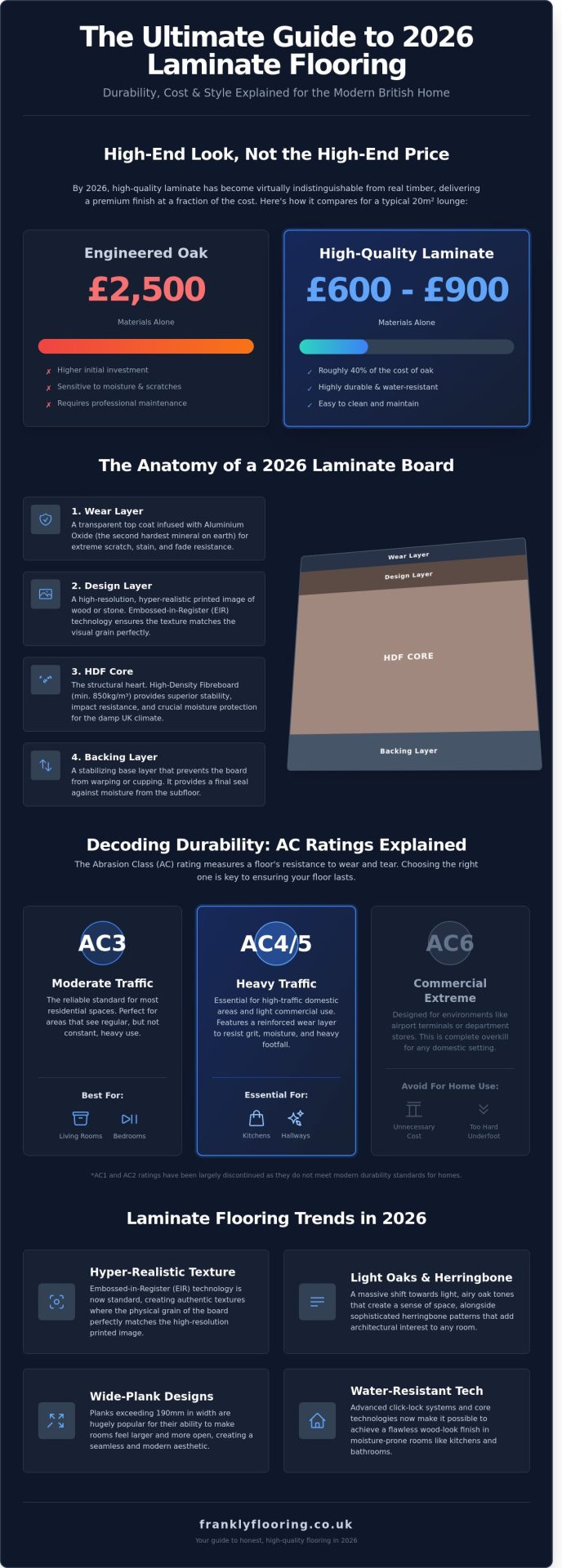
The construction typically involves four distinct components. On top sits the transparent wear layer, followed by a high-resolution design layer. Below that is the structural heart of the board, the High-Density Fibreboard (HDF) core, and finally, a balancing backing layer to prevent warping. This setup is why laminate flooring remains the most practical choice for busy UK households. You get the aesthetic of a natural material without the maintenance headaches of sanding, oiling, or worrying about moisture sensitivity.
Frankly speaking, laminate is the most cost-effective way to transform a room in 2026. While a solid wood floor for a 20-square-metre lounge might set you back £2,500 in materials alone, a high-end laminate provides a similar visual impact for roughly £600 to £900. It’s a straightforward solution for homeowners who value both their time and their budget. We don’t believe in overcomplicating things; if you want a floor that stands up to heavy foot traffic and looks professional, this is usually the right path.
The Anatomy of a Modern Laminate Board
The wear layer in 2026 almost always incorporates Aluminium Oxide (Al2O3). This mineral is the second hardest on earth, providing the scratch resistance necessary for homes with pets or high heels. For the core, we always recommend HDF over the cheaper MDF found in budget retailers. HDF has a density of at least 850kg/m3, which is vital for the damp UK climate as it resists swelling much better than lower-grade alternatives. Modern boards also use advanced click-lock systems like Uniclic or Välinge 5G. These glueless fittings allow for a seamless finish and make the fitting process significantly faster than the old glue-down methods used a decade ago.
Laminate Flooring Trends in 2026
Texture is the big story this year. Embossed-in-register (EIR) technology is now the standard for quality ranges, where the physical grain of the board perfectly matches the printed image. In UK showrooms, we’re seeing a massive shift toward light, airy oaks and sophisticated herringbone patterns that add architectural interest to smaller rooms. Wide-plank designs, often exceeding 190mm in width, are also popular for creating a sense of space. Sustainability is no longer an afterthought; most reputable products now carry PEFC or FSC certification. This ensures the wood fibres used in the HDF core come from responsibly managed forests, which is a non-negotiable for the modern, eco-conscious homeowner.
Decoding Durability: AC Ratings and Thickness Explained
Selecting the right floor involves more than just picking a pretty oak or walnut finish. It requires a hard look at the technical specifications that define how your investment will stand up to daily life in a busy home. The industry uses the Abrasion Class (AC) system to provide a clear, objective measure of durability. An AC rating measures a floor’s resistance to abrasion, impact, and staining through rigorous independent testing. This system is governed by the European standard EN 13329:2000, which provides the framework for categorising every plank of What is Laminate Flooring?
The scale runs from AC1 to AC6. While it is tempting to assume a higher number is always superior, the reality is more nuanced. Choosing the wrong rating can lead to either premature wear or unnecessary spending on a floor that feels too hard for a domestic setting.
Which AC Rating Do You Actually Need?
For most UK households, AC3 is the reliable standard for living rooms and bedrooms. It handles moderate foot traffic and the occasional dropped plate without showing its age. If you are fitting out a hallway, a kitchen, or a home with large dogs, AC4 or AC5 is essential. These ratings offer a reinforced wear layer designed to resist the grit and moisture brought in from the outdoors. AC1 and AC2 have largely disappeared from professional showrooms because they simply do not offer the longevity homeowners expect in 2026.
Frankly, many retailers will try to push you toward AC6 for every room in the house. We don’t believe in that. AC6 is designed for heavy-duty environments like airport terminals or busy department stores. It is complete overkill for a spare bedroom that only sees a guest once a month. You are better off saving that extra £5 per square metre and investing it into a higher-quality underlay that will improve the floor’s thermal properties.
Thickness vs. Quality: Is 12mm Always Better?
Board thickness for laminate flooring typically ranges from 7mm to 12mm. A 7mm or 8mm board is a practical, budget-friendly choice if your subfloor is perfectly level. However, thinner boards lack the structural mass to absorb sound effectively, which can result in a “hollow” or “clicky” noise when walking in heavy shoes or heels. They are often backed by shorter 10 or 15-year warranties compared to their thicker counterparts.
The 12mm advantage is significant for those seeking a premium feel. A thicker board provides superior sound absorption and a structural rigidity that closely mimics solid wood. It is also more forgiving if your subfloor has minor imperfections. When planning your fitting, remember that a 12mm board combined with a 3mm high-density underlay adds 15mm to your floor height. This often requires trimming the bottom of your doors by 2mm or 3mm to ensure clear movement. This is a small but vital detail that prevents long-term damage to the floor’s surface.
If you are unsure which board thickness is right for your specific subfloor conditions, you can request a home consultation to get a professional assessment. We’ll help you find the balance between durability and a seamless finish without the high-pressure sales pitch.
Laminate vs. LVT and Engineered Wood: The Honest Comparison
Choosing the right floor for your home often feels like a balancing act between budget, aesthetics, and how much time you want to spend with a mop in your hand. To be frank, most people find themselves torn between laminate, Luxury Vinyl Tile (LVT), and engineered wood. Each has its place, but laminate flooring has evolved significantly by 2026, closing the gap on its more expensive rivals. While engineered wood offers a 3mm to 6mm real timber top layer, it’s susceptible to scratches and water damage. LVT is entirely waterproof but often requires a more expensive, perfectly levelled subfloor to prevent “telegraphing” imperfections through the tiles.
Laminate is often the easier life choice because it doesn’t require the oiling or sanding that real wood demands. It’s also more DIY-friendly than LVT; the rigid boards click together easily over minor subfloor unevenness. If you’re deciding between the two synthetic options, our guide on LVT vs Laminate Flooring: Which Is Right For You? breaks down the tactile differences. Modern laminate has largely solved the “plastic” feel of the 1990s by using deep embossing that aligns with the wood grain image. When checking durability, look for the AC Ratings for laminate to ensure the product matches your room’s footfall; an AC4 or AC5 rating is standard for busy UK households.
- Lifespan: Quality laminate lasts 15 to 25 years; engineered wood can last 50 if refinished.
- Maintenance: Laminate needs a simple vacuum and damp mop; wood requires specialist soaps.
- DIY Fitting: Laminate is the most accessible for weekend projects due to its click-lock system.
Performance in the British Climate
British homes are notorious for fluctuating humidity levels, which often swing between 20% in winter and 70% in summer. These changes cause engineered wood to expand and contract, potentially leading to gaps. Laminate handles these shifts with more stability because its high-density fibreboard (HDF) core is less reactive to moisture than solid timber. If you’re worried about the “clack” sound associated with older laminates, the solution is simple. Using a high-quality 3mm or 5mm acoustic underlay can dampen impact noise by up to 20 decibels, giving the floor the solid, muffled thud of real oak. Regarding warmth, laminate works exceptionally well with UK underfloor heating systems. It has a high thermal conductivity, allowing heat to permeate the room quickly without the risk of the boards drying out or cracking.
The Cost-to-Value Ratio
In 2026, the price of quality laminate typically ranges from £18 to £35 per square metre. Compare this to engineered wood, which frequently starts at £60 and can exceed £120 for wide-plank oak. For first-time buyers or those renovating rental properties, laminate is the clear winner for return on investment. It provides the high-end look of timber without the financial sting. While some estate agents suggest real wood adds more to a home’s resale value, a well-fitted, premium laminate is often indistinguishable to the average buyer and suggests a home that is easy to maintain. Frankly Flooring believes in transparency; we often tell customers that unless they plan on staying in their “forever home” for thirty years, the extra £3,000 spent on engineered wood for a standard lounge rarely pays for itself in the long run.
Choosing the Right Laminate for Every Room
Choosing the right laminate flooring depends on how you live. A spare bedroom doesn’t need the same spec as a hallway where wet boots and pets are common. In 2026, the standard for a busy UK home is an AC4 rating. This ensures the surface layer resists the 4,000+ abrasive cycles typically found in active households. If you have large dogs or heavy furniture, stepping up to AC5 provides a 30% increase in wear resistance for a relatively small price jump of roughly £3 to £5 per square metre.
Visual tricks matter in smaller British terraced houses. If your room is under 12 square metres, using wider planks of 190mm or more creates fewer visual breaks. This makes the floor look like one continuous surface, tricking the eye into seeing more space. Light oak or soft sand tones reflect 30% more ambient light than dark walnuts; this helps brighten dim, north-facing rooms. Running the planks parallel to the longest wall or towards the main light source also helps elongate the floor plan.
One thing we won’t compromise on is the expansion gap. Wood-based floors move. You need a 10mm gap around the entire perimeter. Hide it with scotias or skirting boards, but never fill it with silicone or caulk. If you skip this, your floor will peak or buckle within 18 months as the humidity changes. It’s a basic rule, but we see it ignored far too often by DIYers and rushed fitters alike.
Laminate in Kitchens and Bathrooms
Modern 2026 boards often carry a 24-hour water protection label. This means the boards have hydrophobic coatings on the bevels to stop water soaking into the HDF core for a full day. It’s great for kitchen spills. However, for full bathrooms with high humidity, we’ll be honest: choose LVT. Even with waterproof underlay and joint sealants, laminate flooring remains 80% wood. Constant steam will eventually cause issues that LVT simply avoids.
High-Traffic Areas: Hallways and Stairs
Your hallway is the hardest working part of your home. Use an AC4 or AC5 rated board here to handle the grit and footfall. For stairs, safety and finish are everything. You’ll need matching nosing to cover the edge of each step securely. Transitions between rooms require proper door bars to allow for independent movement. You can find out how to choose the right door bar for your floor in our detailed guide.
Buying and Fitting: The Frankly Flooring Way
Measuring a room isn’t a complex task, but it requires a bit of focus to avoid the headache of a mid-project shortage. Start by measuring the longest and widest points of your floor. If your room is L-shaped or has deep alcoves, break the space down into smaller rectangles and add their totals together. Frankly, it is better to spend an extra ten minutes with a tape measure now than to find yourself one plank short on a Sunday afternoon when the shops are shut. Always record your measurements in metres to keep things simple when you are ready to order.
We always advise following the 10% waste rule. If your floor area is 20m², you should order 22m². This isn’t a sales tactic to get you to spend more. It is a practical necessity. You will lose material when cutting boards to fit around door frames, radiators, and corners. Having a full spare pack left over is actually a benefit. It provides a safety net for any future repairs if a specific board gets damaged by a heavy drop or a leak. Most manufacturers update their designs every few years, so buying that extra pack now ensures a perfect match later.
Buying laminate flooring online is efficient, but you shouldn’t rely on a laptop screen for colour accuracy. High-resolution photos often struggle to capture the true texture and undertones of a wood grain. Always order physical samples first. Once they arrive, place them in the room where the floor will be fitted. Look at them in both morning light and under your evening lamps. Check the seller’s return policy before you commit. Most UK retailers offer a 14-day return window, but be aware that you will usually have to cover the carriage costs for heavy pallets, which can be expensive.
Preparing Your Subfloor
A level subfloor is the foundation of a quiet, long-lasting floor. If your subfloor is uneven, your laminate will “bounce” when you walk on it, eventually weakening the click-system joints. Use a straight edge to check for dips. If you find a gap larger than 3mm over a 2-metre span, you need to use a self-levelling compound. For concrete subfloors, moisture is the enemy. Use a hygrometer to ensure the moisture level is below 75% relative humidity. If it is higher, you must use a damp-proof membrane (DPM) underlay to prevent the boards from warping.
The Finishing Touches
Choosing between scotia and skirting boards often defines the final look of the room. Skirting boards provide a bespoke, high-end finish because the flooring sits underneath them, but they require more work to fit. Scotia beading is a quicker, cost-effective alternative that covers the expansion gap without removing your existing woodwork. Once your laminate flooring is down, keep it in top condition by ditching the steam mop. Steam forces moisture into the core of the planks, which leads to swelling and “peaking” at the edges. Stick to a well-wrung damp mop and a dedicated floor cleaner.
Before you start the fit, ensure you have this essential checklist ready:
- Underlay: Choose 3mm foam for basic comfort or 5mm fibreboard for better sound reduction and insulation.
- Fitting Kit: You will need spacers to maintain a 10mm expansion gap, a tapping block, and a pull bar for those tight end-of-row joins.
- Cutting Tools: A fine-toothed saw or a dedicated laminate cutter will prevent the decorative surface from chipping.
Ready to start your project? Browse our full range of honest, high-quality laminate flooring and find the perfect match for your home.
Choosing the right floor for your home’s future
Choosing a new floor doesn’t have to be a complicated process filled with industry jargon. By now, you should feel confident identifying the difference between an AC4 and AC5 rating or knowing when a 12mm plank is the right choice for your high-traffic hallway. We’ve spent over 20 years as a family-run business helping UK homeowners navigate these decisions without the usual sales pressure. Our 2026 guide highlights that quality laminate flooring remains one of the most durable and cost-effective ways to upgrade your space, provided you don’t cut corners on the fitting or accessories.
We believe in being upfront about every penny you spend. That’s why we offer transparent pricing with no hidden “fitting” extras that often surprise people at the checkout. Whether you’re in Manchester or London, we provide direct UK delivery on all accessories and flooring to keep your project on schedule. You’re not just buying a product; you’re investing in a foundational part of your home’s character. It’s time to stop second-guessing and start enjoying a floor that’s built to last.
Explore our frankly honest range of Laminate Flooring
Frequently Asked Questions
Is laminate flooring waterproof or just water-resistant?
Most laminate flooring is water-resistant rather than fully waterproof. Standard boards withstand surface spills for 24 to 48 hours before the HDF core begins to swell. However, 2026 technology like AquaStop or Hydroseal allows specific ranges to be 100% waterproof for up to 72 hours. These specialized products are much better suited for bathrooms and kitchens where standing water is a common occurrence.
Can I lay laminate flooring over existing carpet?
You should never lay laminate flooring over an existing carpet. Carpet is far too soft and provides an unstable base that causes the locking joints to snap under pressure. For a professional finish, you must remove the old carpet and underlay to reveal a solid subfloor. This ensures your new floor remains level and doesn’t bounce when you walk on it, protecting your investment for the long term.
How much does it cost to fit laminate flooring in the UK per square metre?
In the UK, professional fitting for laminate flooring typically costs between £12 and £20 per square metre. If your room requires extensive subfloor preparation or intricate beadwork around the skirting, expect to pay towards the higher end of that scale. This price usually excludes the cost of the materials and underlay. A standard 20 square metre lounge would likely cost £240 to £400 in labour alone.
What is the best underlay for laminate flooring on a concrete floor?
The best underlay for a concrete floor is a high-density foam or foil-backed product with an integrated Damp Proof Membrane (DPM). Concrete naturally holds moisture that can rise and damage your boards over time. Using a 3mm or 5mm underlay provides the necessary moisture barrier while also offering sound reduction. It’s a non-negotiable step for any ground-floor installation on a screed base to prevent warping.
How do I clean laminate flooring without damaging the surface?
To clean your floor safely, use a damp microfiber mop and a dedicated laminate cleaning spray. You must avoid using steam mops, as the 100-degree heat can delaminate the surface and weaken the adhesive. Use a mixture of 1 part white vinegar to 3 parts water if you prefer a natural solution. Always dry any standing liquid immediately to prevent the edges of the boards from lifting or peaking.
Does laminate flooring need to acclimate before fitting?
Yes, laminate flooring must acclimate in the room where it’ll be fitted for at least 48 hours. You should store the boxes flat and unopened at a consistent room temperature between 18 and 22 degrees Celsius. This allows the wood fibres to expand or contract to match your home’s environment. Skipping this step often leads to the floor buckling or unsightly gaps appearing within the first 30 days.
Can you use laminate flooring with underfloor heating?
You can use laminate with underfloor heating, provided the system doesn’t exceed a surface temperature of 27 degrees Celsius. Most modern laminates are designed to handle the gradual heat transfer without warping or cracking. It’s vital to choose a low-resistance underlay with a TOG rating below 1.0 to ensure the heat reaches the room efficiently. Check your specific product’s warranty to confirm it’s compatible before you begin the work.
How long should a good quality laminate floor last?
A good quality laminate floor should last between 15 and 25 years in a domestic setting. Its lifespan depends heavily on the AC rating, which measures durability on a scale of 1 to 5. An AC4 rated board is perfect for busy hallways and can easily withstand two decades of heavy foot traffic. Regular maintenance and using felt pads on furniture legs will help you reach the upper end of that estimate.