
Why do most homeowners spend weeks picking a paint colour but only five minutes choosing the surface they actually touch every single day? It is easy to get distracted by a pretty swatch, but a living room floor needs to do more than just look good in a photo. We know the struggle. You want living room carpet ideas that feel plush underfoot while standing up to the chaos of kids, pets, and the occasional spilled glass of wine. It is exhausting trying to decode technical jargon like tog ratings or twist versus loop when all you really want is a cosy, durable space.
At Frankly Flooring, we believe in being direct. We are here to help you find that perfect balance between 2026 style trends and long-term performance. In this guide, we will break down the latest textures and colours that are set to dominate the coming year. We will also give you the frank truth about which materials actually last, how to understand the technical specs without a degree in textiles, and how to buy online with total confidence. By the end, you will have a clear plan for a living room that looks expensive but costs significantly less than the high street showrooms suggest.
Key Takeaways
- Move beyond plain colours by exploring the 2026 “Sensory Home” trend, where tactile textures like loop and cut pile take centre stage.
- Navigate our latest living room carpet ideas to find the perfect “greige” or warm neutral that hides daily wear while keeping your space looking modern.
- Decode the technical jargon to choose between stain-resistant polypropylene for busy families or resilient wool blends for natural insulation.
- Get the measurements right the first time by learning how to account for room dimensions and the critical 10cm wastage needed for a professional fit.
- Save money by bypassing traditional showroom markups and leveraging two decades of family-run flooring expertise through a direct online approach.
Why Living Room Carpet Choice Matters in 2026
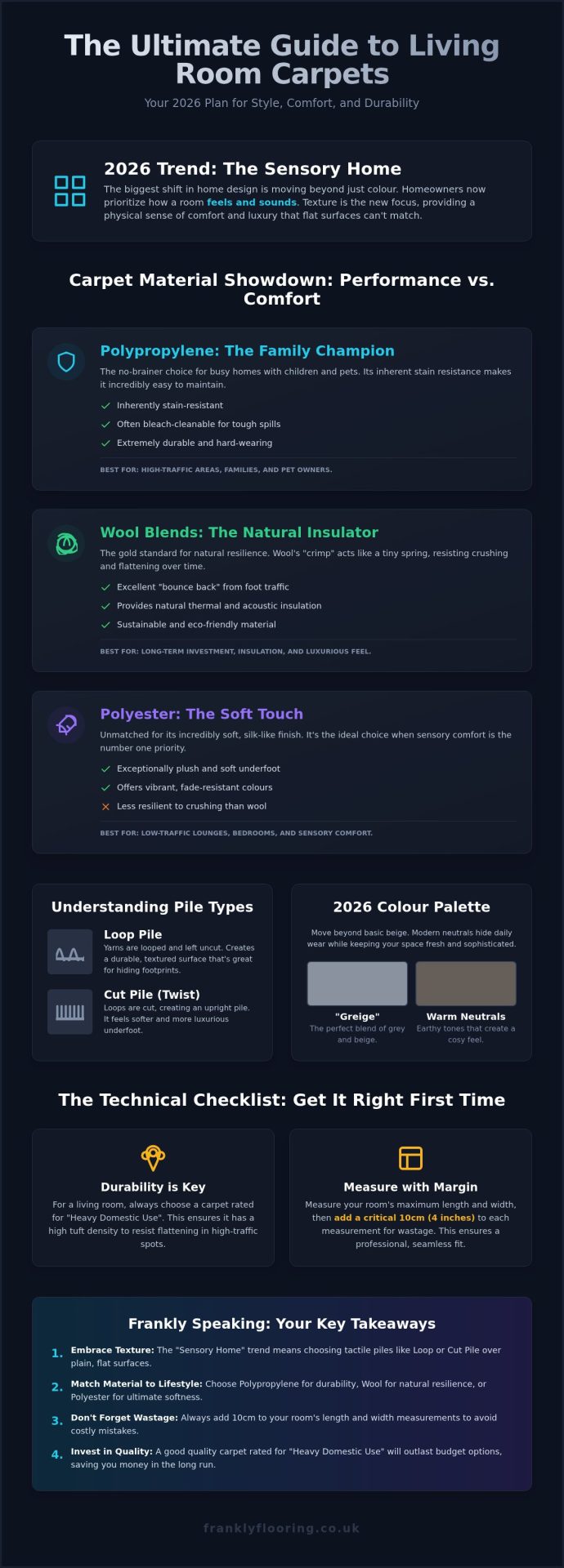
The living room is the undisputed high-traffic heart of the British home. It is the space where the kids play, the dog naps, and you finally sit down after a long shift. In 2026, we are seeing a massive shift in how people view this room. It is no longer just about finding a colour that matches the sofa. The “Sensory Home” trend has taken over, which means homeowners now prioritise how a room feels and sounds just as much as how it looks. Texture is currently outranking plain, flat colours. People want to sink their toes into something substantial that provides a physical sense of comfort.
When you look at the history and construction of carpet, you see that it has always been about more than just aesthetics. It is a functional layer of insulation. From a financial perspective, choosing the right living room carpet ideas is a smart move for property appeal. A high-quality, well-fitted floor suggests a well-maintained home to potential buyers. Frankly speaking, picking the cheapest roll you can find is usually a mistake. Those budget options often flatten within eighteen months, leaving you to pay for new materials and fitting all over again. Investing in quality upfront saves you the headache of a premature replacement.
The Shift Toward Multi-Functional Spaces
Our homes are working harder than ever. Many of us now have open-plan layouts where the lounge bleeds into the dining area or a home office. Carpet is the perfect tool to define these “zones” without needing physical walls. It provides essential acoustic insulation, dampening the sound of video calls or noisy toys. While hard flooring had its moment, 2026 is seeing a return to living room carpet ideas for that undeniable underfoot warmth that laminate simply cannot replicate.
Durability vs Comfort: Finding the Sweet Spot
Finding the balance between a plush feel and rugged durability is the ultimate goal. You need to consider the “bounce back” factor, which is how quickly the pile recovers after you move the coffee table or walk across the room. Living rooms require a significantly higher durability rating than a spare bedroom because they face constant footfall. For 2026 standards, “heavy domestic use” is defined as a carpet specifically engineered with a high tuft density and resilient backing to withstand the daily pressures of a busy family household without losing its structural integrity.
Understanding Carpet Materials: Performance vs Comfort
Choosing the right fibre is where most homeowners get stuck. Frankly, your material choice is the single biggest factor in your carpet’s lifespan and how much time you will spend scrubbing it. While aesthetic living room carpet ideas often focus on the perfect shade, the technical makeup of the yarn determines if it will still look good in three years. You are essentially balancing three main contenders: polypropylene, wool blends, and polyester. Each has a specific job to do in a busy home.
Polypropylene is the undisputed no-brainer for busy families and pet owners. It is inherently stain-resistant because the colour is added during the manufacturing process rather than being dyed afterwards. This makes many ranges bleach-cleanable, which is a genuine lifesaver when the dog brings in mud or a toddler spills juice. According to the Carpet and Rug Institute, performance standards for synthetic fibres have improved drastically, ensuring these carpets don’t just survive but thrive in high-traffic zones. You get the look of a luxury floor with the maintenance requirements of a practical, modern material.
Wool blends remain the gold standard for those who value natural resilience and insulation. Because wool fibres have a natural “crimp”, they act like tiny springs that resist crushing. This makes them ideal for the area in front of your sofa where feet rest most often. Polyester, while less resilient than wool, offers an incredibly soft, silk-like finish that is perfect for a low-traffic lounge where sensory comfort is the priority. It is all about choosing the tool that fits your specific lifestyle. If you want to see how these materials look in real homes, browsing our full carpet range is a great way to compare textures side-by-side.
The Rise of Easy-Clean Polypropylene
Bleach-cleanable carpets are now the first choice for modern UK households, and for good reason. You don’t want to live in fear of your own flooring. Modern manufacturing techniques have evolved so that these synthetic fibres now mimic the matte look and soft handle of natural wool. This means you can achieve sophisticated living room carpet ideas without the anxiety of permanent stains. It is a practical solution that prioritises your sanity over showroom perfection, saving you a fortune on professional cleaning services over the years.
Natural Fibres: Sisal and Berber Styles
If you want a rustic, grounded feel, Berber styles are excellent. These loop-pile carpets are often made from wool or blends and provide a rugged texture that hides footprints and vacuum tracks. Sisal is another popular choice for its unique aesthetic, but it requires much more careful maintenance as it does not handle moisture well. You can read our full Sisal vs Berber comparison to see which natural look fits your home’s traffic levels and your maintenance routine.
Top Living Room Carpet Style and Colour Trends
Style trends for 2026 are moving away from the clinical, cold aesthetics of the past decade. While grey remains a staple in British homes, it is evolving into “Greige”, a warmer blend of grey and beige that feels much more inviting. When searching for living room carpet ideas that will stand the test of time, look for these “new neutrals”. They provide the perfect backdrop for almost any furniture style while adding a layer of visual warmth that pure, cool silvers often lack. We are also seeing a significant rise in nature-inspired palettes, with earthy terracotta and muted sage green becoming popular choices for those who want to bring the outdoors in.
Frankly, your choice of shade should be dictated by your daily reality as much as your Pinterest board. Darker colours are fantastic for hiding the odd bit of dirt or pet hair, making them a practical choice for high-traffic zones. However, if you are working with a compact lounge, lighter tones will make the space feel significantly larger and airier. As we consider the longevity of these style choices, it is worth looking at how the industry is moving toward better sustainability. Programs like the Carpet Stewardship Program highlight the importance of choosing materials that are designed with their full lifecycle in mind, ensuring your flooring is part of a more responsible manufacturing chain.
Modern Grey Carpet Ideas
Understanding undertones is the secret to getting grey right. Pairing grey carpet with your existing decor is much easier when you match the “temperature” of the room. Cool-toned silvers look sharp against crisp whites and blues, but warm-toned charcoals are far more forgiving in a family home. If you want a floor that looks clean for longer, choose a flecked or heathered grey. These multi-tonal yarns are masters at disguising fluff and crumbs between vacuuming sessions.
Pattern and Texture: Beyond the Plain
These living room carpet ideas focus on the “Quiet Luxury” trend, which uses high-low pile heights to create visual interest without the need for loud patterns. By mixing loop and cut piles, manufacturers can create subtle geometric shapes that you feel underfoot rather than just see. If you have a narrow room, consider subtle stripes to elongate the floor space. While plain carpets have dominated for years, bold patterns are making a steady comeback in traditional UK homes, offering a way to anchor a large room and hide signs of wear and tear effectively.
Measuring and Underlay: The Technical Essentials
Most homeowners get excited about living room carpet ideas but ignore the tape measure until the last second. This is a mistake that leads to expensive errors. Getting the technical foundation right is just as important as picking the perfect shade of greige. If your measurements are off or your underlay is cheap, even the most expensive carpet will look poor and wear out quickly. We want your floor to last, which means following a precise, frank process before you hit the checkout button.
Follow these four steps to ensure a professional result:
- Step 1: Measure the widest and longest points of the room. Never assume your walls are perfectly square; older UK homes are notorious for being slightly out of alignment.
- Step 2: Add 10cm of “wastage” to every single side. This extra material gives your fitter enough room to trim the carpet perfectly against the skirting boards for a seamless finish.
- Step 3: Account for door recesses and bay windows. Measure into the back of these areas to ensure the carpet covers the entire floor surface without needing awkward joins.
- Step 4: Match your underlay to your carpet type. A heavy, plush pile requires a different level of support than a flat-weave Berber to prevent the backing from stretching.
Why Underlay is Not an Optional Extra
Underlay is the hidden shock absorber of your living room. It isn’t just a way to make the floor feel softer; a high-quality underlay can actually extend the life of your carpet by up to 50%. It prevents the pile from crushing against the hard subfloor beneath. Foam underlays are popular for their superb insulation, while rubber is the traditional choice for heavy-traffic lounges. Felt underlays are excellent if you want maximum acoustic dampening. Read our Cloud 9 Underlay guide to see why investing in a premium option pays off in the long run.
Essential Accessories for a Professional Finish
The job isn’t finished until the edges are secure. You must use carpet grippers around the perimeter of the room to keep the tension even and prevent ripples from forming over time. You will also need door bars to create a clean transition between your living room and any adjacent hard flooring. For those with older, draughty properties, choosing an underlay and carpet with a high combined tog rating is essential for trapping heat and keeping your toes warm. Once you have your measurements ready, you can browse our full range of carpets and accessories to find everything you need in one place.
Buying Carpet Online: The Frankly Flooring Difference
The traditional showroom model is broken. When you visit a high-street store, you aren’t just paying for the carpet; you are also paying for the heating, the lighting, and the commission of the salesperson following you around. At Frankly Flooring, we cut those unnecessary costs out of the equation. By operating as a direct-to-consumer online retailer, we pass those savings directly to you. It is a more transparent way to shop for living room carpet ideas, allowing you to focus on quality and value rather than navigating high-pressure sales tactics.
We bring over 20 years of industry experience to every order. As a family-run business, our reputation is built on integrity and technical knowledge rather than corporate coldness. We understand that buying flooring is a significant investment for your home. That is why we provide the UK’s best styles with national delivery, ensuring you get a premium product without the hidden showroom markups. You can browse our entire catalogue from the comfort of your own sofa, taking as much time as you need to make a decision that is right for your space.
How to Buy Flooring Online with Confidence
A common concern with buying online is whether the colour will look the same in person. We always recommend ordering samples first. The light in your living room is unique, and a shade that looks perfect on a screen might look different under your specific LED bulbs or natural afternoon sun. Our online guides are designed to help you calculate exactly what you need, reducing the risk of over-ordering. We position ourselves as the expert partner for UK homes, providing the frank advice you need to balance durability with modern style.
Your 2026 Living Room Project Checklist
Before you finalise your order, run through this simple checklist to ensure your project goes smoothly. Taking five minutes now prevents a massive headache on fitting day. We want your living room carpet ideas to come to life exactly as you imagined them.
- Confirm Measurements: Double-check your widest and longest points and ensure you have added that vital 10cm wastage to every side.
- Check Accessories: Ensure you have selected the correct underlay for your carpet type and enough grippers to cover the perimeter.
- Plan the Transition: Check if you need new door bars to match your hallway or dining room flooring.
- Book Your Fitter: Once your delivery date is confirmed, arrange a local professional fitter to handle the installation.
By following this straightforward path, you get a designer-look living room at a fraction of the high-street price. Our team is here to support you from the first sample to the final delivery, ensuring your 2026 home renovation is as stress-free as possible.
Step Into Your 2026 Living Room
Transforming your home’s most important space doesn’t have to be a technical headache or a financial drain. We’ve explored how the 2026 sensory trend prioritises tactile comfort through loop and cut piles, and why matching your material choice to your lifestyle is the secret to a floor that lasts. Whether you opt for the bleach-cleanable resilience of polypropylene or the natural bounce-back of a wool blend, the right decision starts with honest information rather than showroom spin.
By measuring accurately and investing in quality underlay, you ensure your new floor looks professional for years to come. As a family-run business with over 20 years of experience, we are proud to offer national UK delivery and direct-to-consumer pricing that cuts out the middleman. You don’t need to visit a high-street store to find the best living room carpet ideas; you just need a partner who tells it like it is. It’s time to stop overpaying for showroom overheads and start enjoying a cosier, more durable home. Browse our full range of Living Room Carpets today and take the first step toward your project. We look forward to helping you get it right.
Frequently Asked Questions
What is the best carpet for a living room with high traffic?
Polypropylene is the most durable choice for high-traffic lounges because it is inherently stain-resistant and handles heavy footfall without flattening quickly. For the best results, look for a “heavy domestic” rating to ensure the tuft density and backing are engineered for a busy family home. A wool blend is also a fantastic option if you want natural resilience and a pile that bounces back after being walked on.
How much does it cost to carpet a living room in the UK in 2026?
The total cost depends entirely on the square meterage of your room and the specific material you choose for your project. While we don’t provide fixed price estimates, you can save a significant amount by purchasing directly from an online retailer. This approach removes the expensive showroom markups and commission fees that high-street stores usually add to your final invoice.
Is grey carpet going out of style for living rooms?
Grey is not going out of style, but the trend is shifting toward “Greige” and warmer, earthier neutrals. These updated living room carpet ideas move away from the cold, clinical silvers of the past decade in favour of tones that feel more inviting. Choosing a heathered or flecked grey is still one of the most practical ways to hide daily fluff and pet hair.
Can I install a living room carpet myself or do I need a pro?
We always recommend hiring a professional fitter to ensure your carpet is stretched correctly and the joins are invisible. While a DIY approach might seem like a way to save money, a single wrong cut can ruin an entire roll of carpet. Professionals have the specific power stretchers and seaming tools required to prevent ripples and ensure your floor lasts its full lifespan.
What carpet tog rating do I need for a living room?
Most UK living rooms benefit from a combined carpet and underlay tog rating between 1.5 and 2.5 for optimum warmth. If you have underfloor heating, you must be careful not to exceed a combined rating of 2.5, as this will block the heat from rising into the room. For draughty ground floors, a higher tog rating acts as a vital layer of thermal insulation.
How do I get rid of furniture marks on my new carpet?
You can usually lift furniture indentations by placing an ice cube on the flattened area and letting it melt into the fibres. Once the yarn is damp, use a teaspoon or a soft-bristled brush to gently tease the pile back into its upright position. This simple trick works best on wool and resilient synthetic blends that haven’t been permanently crushed by heavy weight.
Are loop pile carpets safe for cats and dogs?
Loop pile carpets are generally not the best choice for homes with pets because claws can easily snag in the loops. This can lead to painful injuries for your cat or dog and unsightly pulled threads across your floor. If you have furry friends, it is much safer to stick with a cut pile or twist carpet that won’t trap their paws.
How long should a living room carpet last?
A quality living room carpet should last between 10 and 15 years if it is fitted with a premium underlay and maintained properly. The lifespan depends heavily on the material; wool blends tend to hold their shape longer than budget synthetics. Regular vacuuming and addressing spills immediately are the two most important factors in keeping your carpet looking fresh for over a decade.