Let’s be frank. Choosing a new floor can feel like navigating a minefield of jargon, hidden costs, and the nagging fear that your investment will end up looking… well, a bit plastic. Between the click-versus-glue-down debate and the worry of what your subfloor might need, it’s easy to feel overwhelmed. You simply want a durable, waterproof floor with a high-end aesthetic-like a classic oak or a sophisticated herringbone-without the stress and inflated showroom prices. This is precisely why we’ve created this comprehensive guide to lvt flooring uk.
Consider this your straightforward, no-nonsense manual for 2026. We’ll pull back the curtain on the technical specifications that actually matter, provide an honest breakdown of costs (including that all-important subfloor preparation), and clarify the fitting process once and for all. Our goal is simple: to give you the quiet confidence to choose the perfect luxury vinyl tile for your home, directly and without the high-street markup. Let’s get started.
Key Takeaways
- Understand the crucial difference between core types and wear layers to ensure you choose a floor that truly lasts.
- Discover the real cost difference between high-street brands and buying direct, potentially saving hundreds on your project.
- Get a frank assessment of the pros and cons to confidently decide if this is the right lvt flooring uk solution for your home.
- Stay ahead of the curve with insights into 2026’s biggest LVT trends, from popular Herringbone patterns to the shift towards warmer, natural palettes.
What is LVT Flooring and Why is it the UK’s Top Choice in 2026?
If you’re renovating or building, you’ve almost certainly encountered the term LVT. Frankly, understanding What is Luxury Vinyl Tile (LVT) is the first step to appreciating why it’s become the go-to flooring for so many British homes. It is a highly engineered, multi-layered flooring solution designed to offer the best of all worlds: the stunning look of natural materials with none of the practical drawbacks. It has steadily overtaken traditional choices like laminate and engineered wood for two straightforward reasons: unmatched durability and complete waterproofing.
This isn’t the thin, curling sheet vinyl of your grandmother’s kitchen. Modern LVT is a robust, premium product. As we look towards 2026, the market for lvt flooring uk is also seeing a significant and welcome shift towards more sustainable, phthalate-free materials, making it a smarter and healthier choice for your home’s environment.
The Layers of a Luxury Vinyl Tile
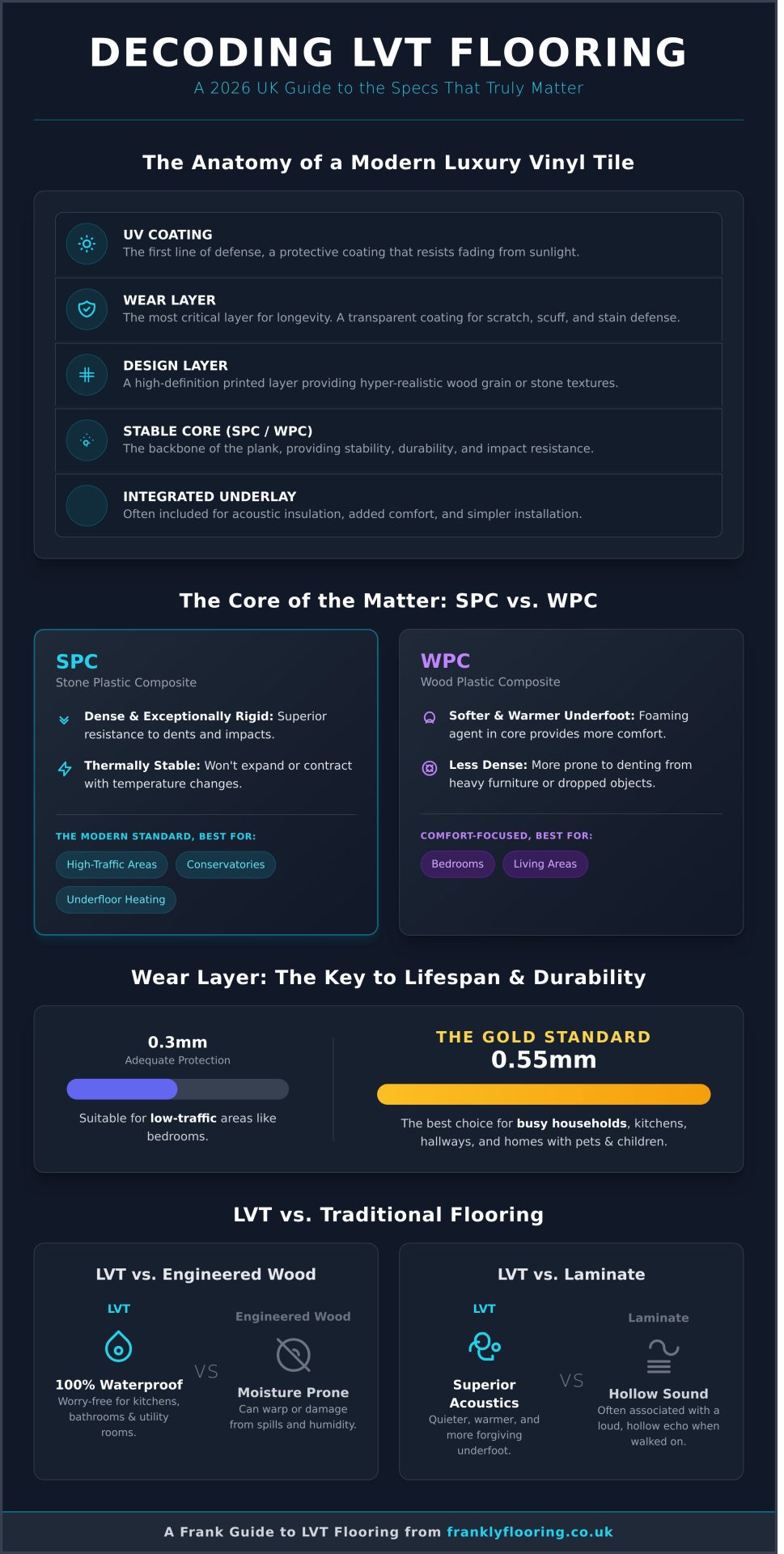
The resilience of LVT comes from its clever layered construction. Each plank or tile consists of a protective UV coating to resist fading, a transparent wear layer for scratch and scuff defence, a high-definition printed design layer, and a stable core. The wear layer is, without question, the most critical factor for longevity. By 2026, advanced digital printing technology allows for hyper-realistic wood grain and stone textures that are almost indistinguishable from the real thing, offering authentic beauty without compromise.
LVT vs. Traditional Flooring: A Quick Look
Choosing the right floor often comes down to a direct comparison. Here’s where LVT truly shines against its main rivals in a typical UK home:
- Compared to Engineered Wood: LVT is 100% waterproof, making it the superior, worry-free choice for kitchens, bathrooms, and utility rooms where moisture and spills are a daily reality.
- Compared to Laminate: LVT offers far better sound insulation, reducing the hollow echo often associated with laminate. It also feels warmer and more forgiving underfoot.
This unique blend of practicality and aesthetic flexibility makes LVT the truly bespoke choice for the demands of modern, open-plan UK living.
Decoding LVT Specs: SPC, WPC, and Wear Layers Explained
When choosing LVT flooring in the UK, it’s easy to get lost in the numbers. But let’s be frank: not all vinyl is created equal. The real performance of a plank lies in its construction, specifically its core and its protective wear layer. A thicker plank doesn’t automatically mean a better floor; the quality is in the composition, not just the depth.
SPC vs. WPC: Which Core is Right for You?
The core is the backbone of your LVT, providing stability and durability. By 2026, two types dominate the market:
- SPC (Stone Plastic Composite): This is the modern standard for a reason. A dense, rigid core made from limestone and stabilisers makes it exceptionally resistant to dents and impacts. Its key advantage for UK homes is its thermal stability. For conservatories or rooms with underfloor heating, SPC is the only sensible choice as it won’t expand or contract with temperature fluctuations.
- WPC (Wood Plastic Composite): WPC incorporates a foaming agent, making it slightly softer and warmer underfoot than SPC. While comfortable, it is less dense and more prone to denting from heavy furniture or dropped objects.
Understanding Wear Layers and Longevity
The wear layer is a transparent top coating that protects the printed design from scratches, scuffs, and stains. Its thickness is the single most important factor for your floor’s lifespan. While a 0.3mm wear layer is adequate for a bedroom, we consider a 0.55mm wear layer the gold standard for busy UK households, especially in hallways, kitchens, or homes with pets and children.
Modern coatings have evolved, with many premium options now featuring ceramic bead technology for enhanced scratch resistance. These surfaces are also engineered for safety; many leading brands now exceed the slip-resistance guidance found within the official UK Building Regulations for flooring. Remember, even the best wear layer needs a perfectly flat base. For guidance on achieving this, see our guide on DIY Flooring Accessories for essential subfloor preparation tools.
Finally, a word on integrated underlay. Most quality rigid core lvt flooring uk products now include a pre-attached underlay. This not only simplifies the fitting process but also provides excellent acoustic insulation, reducing noise transfer-a welcome benefit in any home.
The Frank Comparison: High-Street Brands vs. Buying LVT Online
Let’s be frank. When you start searching for lvt flooring uk, you’ll immediately see big names like Karndean and Amtico. They produce excellent floors, but their high-street prices often reflect massive marketing budgets and costly showroom overheads. You are, in essence, paying for their brand name as much as the product itself.
The reality is that direct-to-consumer online retailers can offer flooring with identical, and sometimes superior, technical specifications for 40-60% less. By cutting out middlemen and physical storefronts—a lean business model often supported by logistics specialists like Gateway Cargo—the savings are passed directly to you. Furthermore, a large, free sample delivered to your door is often a much better gauge of colour and texture than a small, worn-out swatch under the artificial lighting of a showroom.
Is “Cheap” LVT Always a Bad Idea?
The word “cheap” can be misleading. A low price isn’t the problem; low quality is. True “cheap” LVT is defined by its technical shortcomings: a paper-thin wear layer (under 0.5mm for busy homes), a flimsy locking system that will fail under pressure, and a core that lacks rigidity. A recent flooring industry market report highlights how crucial core construction is to long-term performance. To spot a bargain over a costly mistake, look at two key indicators: the warranty (anything less than 15 years for residential use is a red flag) and the click system. A reputable seller will always be transparent about these specs. This is where buying from an accountable, UK-based family business makes all the difference.
The Value of Free Samples
You should never buy flooring without seeing it in your own home first. The cool, natural light of a North-facing room can make a grey floor look completely different than it does in a warm, South-facing lounge. A sample allows you to see the colour and texture at different times of day, alongside your furniture and wall colours. We also recommend a simple “scratch test”: take a coin or a key and run it firmly across the sample’s surface. A quality wear layer will resist scuffing, giving you immediate peace of mind. To see how our floors stand up, we invite you to browse Frankly Flooring’s LVT collection and order your free samples today.
LVT Design Trends & Fitting Realities in the UK
Choosing your new floor is about more than just durability; it’s about finding a style that feels right for your home now and for years to come. Frankly, the world of lvt flooring uk is moving away from the cool, stark greys that dominated the last decade. Homeowners in 2026 are seeking warmth, character, and timeless patterns that add genuine value.
The conversation has shifted from “Cool Grey” to “Greige” (a versatile grey-beige) and rich, natural oak tones. These warmer hues create a more inviting and organic foundation for any room. But beyond colour, the real story is in the patterns and the practicalities of getting them fitted perfectly.
2026 Trend Watch: Herringbone and Stone Effects
The obsession with Herringbone LVT shows no signs of slowing down. It remains the number one request for UK hallways, where its elegant pattern creates a sense of space and a grand entrance. For larger spaces like kitchens and open-plan living areas, large-format stone effect LVT is gaining huge popularity. These tiles offer the sophisticated look of slate or marble without the cold, hard feel underfoot. We’re also seeing a rise in LVT that beautifully mimics intricate Victorian tile patterns, providing timeless character with modern warmth and comfort.
Fitting LVT: Click vs. Glue-Down
Here’s the honest truth about fitting: the method you choose is just as important as the design. The quality of your finish depends entirely on what lies beneath, and in the UK, subfloor preparation is non-negotiable. Uneven floorboards require a layer of plywood, while concrete floors will likely need a self-levelling screed to ensure a flawless, long-lasting result.
- Click LVT: Often marketed as a DIY-friendly option, its interlocking system can be a straightforward weekend project for a competent individual with a perfectly level subfloor. It’s a great choice for reducing fitting costs in a single, simple room.
- Glue-Down LVT: This is the professional’s choice. Each plank or tile is adhered directly to the subfloor, creating an incredibly stable, seamless, and permanent finish that is ideal for complex patterns like Herringbone or for use in high-traffic areas.
For professional fitting in 2026, you should budget between £25 – £45 per square metre, which typically includes basic preparation but not extensive subfloor correction. If the thought of screed and plywood sounds daunting, it’s always best to consult a professional fitter to get it right the first time.
Buying LVT Online with Confidence: The Frankly Flooring Way
Navigating the world of online flooring can feel overwhelming. Frankly, we believe it shouldn’t be. Our direct-to-you approach is designed to save you money and stress by cutting out the high-pressure sales tactics and hidden costs common elsewhere. We focus on one thing: supplying premium LVT that stands the test of time, backed by honest advice. It’s a simpler, more transparent way to buy the floor your home deserves.
Before you commit, accurate measurements are essential. Here’s our straightforward method to avoid over-ordering:
- Measure the Room: Use a tape measure to find the length and width of your room at its widest points.
- Calculate the Area: Multiply the length by the width to get your total square meterage (m²). For example, a room that is 4m by 5m is 20m².
- Add for Wastage: We recommend adding 10% to your total area. This accounts for cuts, angles, and any potential mistakes. For our 20m² room, you would order 22m².
With your measurements ready, run through this final checklist before you press ‘buy’ on your new 2026 LVT floor:
- Have you tested your samples in your room’s natural and artificial light?
- Are your measurements double-checked and does your order include the 10% wastage?
- Is your subfloor clean, dry, and level? This is critical for a perfect finish.
- Have you confirmed the correct underlay for your chosen LVT and subfloor type?
Why Trust a Family-Run Specialist?
With over 20 years of hands-on experience in the UK flooring industry, we provide more than just a product. We offer end-to-end support, even for our online customers. From subfloor queries to fitting advice, our expertise is always available. Our warranties and returns policy are just as straightforward-no confusing small print, just a clear commitment to quality and customer satisfaction. It’s the peace of mind you get from a dedicated specialist.
Next Steps for Your Home Renovation
Ready to see the quality for yourself? The best first step is to order your free samples today and see how they transform your space. Remember to check underlay compatibility to ensure perfect performance and sound insulation. When you invest in high-quality lvt flooring uk, you’re not just buying a floor; you’re laying the foundation for years of style, comfort, and durability in your home.
As you plan your project, remember that flooring is just one part of a successful renovation. Coordinating it with other major elements is key. For example, upgrading to high-quality windows and doors can further enhance your home’s style, security, and energy efficiency. To see what’s possible in that area, you can discover Custom Trade Systems Ltd.
Of course, home renovations are often part of a bigger picture of life milestones. For those also planning a major celebration, capturing the memories is just as important as perfecting the space. The portfolio from Boutique Weddings offers beautiful examples of how special events can be documented with a timeless, high-end aesthetic, much like the one you’re creating in your home.
The Frank Conclusion: Choosing Your Perfect LVT Flooring
As we’ve explored, the rise of LVT in the UK is no accident. Its remarkable blend of aesthetic versatility and practical durability makes it a smart investment for any modern home. By understanding the key specifications-from the rigid stability of SPC cores to the crucial role of the wear layer-you are now equipped to navigate the market with confidence. The choice between inflated high-street prices and the transparent value of buying online has never been clearer.
At Frankly Flooring, we believe finding the right lvt flooring uk homeowners can trust should be a straightforward and honest process. We’re a family-run business, and with over 20 years of hands-on experience, we’ve built our reputation on quality, not on showroom markups. We deliver exceptional flooring direct to you, ensuring you receive the best value without compromising on durability or design. Feel the quality for yourself by ordering free samples, delivered anywhere in the UK.
Browse our full range of honest, high-quality LVT flooring at Frankly Flooring and take the first step towards a floor you’ll love for years to come. Your journey to a beautiful, lasting new floor starts here.
Frequently Asked Questions About LVT Flooring
Is LVT flooring better than laminate for a UK kitchen?
Frankly, yes. When choosing LVT flooring UK homeowners often ask about kitchens, and LVT is the superior choice. Its core is 100% waterproof, so it won’t swell or warp from spills, splashes, or the general humidity common in a kitchen environment. While laminate has improved its water resistance, its wood-based core remains vulnerable to moisture damage over time, making LVT the more reliable and durable option for this part of the home.
Can I install LVT flooring over my existing floor?
While it is sometimes possible, we generally advise against it. The success of any LVT floor depends entirely on a perfectly smooth, flat, and stable subfloor. Laying it over tiles, for instance, can result in the grout lines ‘telegraphing’ through to the surface over time. For a guaranteed seamless and long-lasting finish, the best practice is always to remove the old flooring and prepare the subfloor properly before fitting.
How long does LVT flooring actually last in a busy home?
The longevity of LVT is one of its greatest strengths. A quality LVT, professionally fitted, can easily last between 15 and 25 years, even in a busy family home. The key factor is the thickness of the transparent wear layer on top. For high-traffic areas like hallways and living rooms, we recommend a wear layer of at least 0.55mm to ensure it withstands daily life and maintains its appearance for years to come.
Is LVT flooring compatible with electric underfloor heating?
Yes, the vast majority of LVT products are fully compatible with water-based and electric underfloor heating systems. It’s an excellent conductor of heat, making for a very efficient and comfortable room. However, it is crucial that the surface temperature does not exceed the manufacturer’s stated limit, which is typically 27°C. Always ensure your heating system has a thermostat to regulate this and check the specific flooring guidelines before fitting.
Does LVT flooring scratch easily if I have large dogs?
LVT is highly scratch-resistant, but not entirely scratch-proof. The protective top layer provides excellent defence against everyday wear. For homes with large dogs, we strongly recommend choosing a product with a thick commercial-grade wear layer (0.55mm or more) and a textured or embossed finish. These features not only offer greater durability but also help to disguise any minor surface marks that may occur. Keeping your dog’s nails trimmed is also a simple, effective precaution.
What is the difference between Click LVT and Glue-down LVT?
Click LVT uses a locking mechanism, much like laminate, to connect the planks. It’s laid as a ‘floating floor’ and is generally quicker to fit. Glue-down LVT, as the name suggests, is fully bonded to the subfloor with a specialist adhesive. This method creates an exceptionally stable and robust floor, making it the professional’s choice for large open-plan spaces, conservatories with temperature changes, or very high-traffic commercial areas.
How do I clean and maintain my LVT floor to keep it looking new?
Maintaining LVT is straightforward. Regular sweeping or vacuuming (with a hard floor brush head) removes grit that can cause fine scratches. For cleaning, use a damp mop with a pH-neutral cleaner designed for vinyl flooring; avoid harsh chemicals, bleach, or wax-based polishes. It’s also important never to use a steam mop, as the intense heat can damage the adhesive and the vinyl itself. Placing felt pads under furniture feet will prevent scuffs and scratches.
Do I need underlay for LVT if it already has an integrated backing?
Generally, no. If you have purchased a rigid core LVT product that already features a pre-attached acoustic backing, you should not add another layer of underlay. Doing so can make the click-system joints unstable and may cause them to fail over time, potentially voiding your warranty. The integrated backing is specifically engineered to provide the necessary support, comfort, and sound reduction, so nothing extra is required.