
The most expensive solid oak plank in the showroom might actually be the worst choice for your specific living room. It sounds backwards, but choosing wood flooring is about more than just picking a pretty grain; it’s about matching timber to the unique environment of a British home. You likely already know that a real timber floor is a lifelong investment that can add up to 5% to your property’s market value. However, the fear of boards warping or the confusion between solid and engineered options often leads to expensive mistakes and unnecessary stress.
Frankly, you deserve a straight answer without the high-pressure sales pitch. This guide provides a transparent breakdown of durability, subfloor requirements, and the real costs of fitting to ensure your investment lasts for the next 80 years. We’ll compare the structural integrity of different timber types and explain why the right preparation is the difference between a seamless finish and a costly repair. By the end, you’ll know exactly what you’re paying for and how to achieve a floor that stands the test of time.
Key Takeaways
- Understand the structural differences between solid timber and engineered planks to ensure your floor remains stable in any room environment.
- Learn why Oak is the standard for British homes and how to balance the luxury of Walnut against the practical hardness of the wood.
- Discover the frank truth about subfloor preparation and why skipping the mandatory acclimatisation period is the primary reason most fitting projects fail.
- Identify the specific aesthetic grades and textures that match your interior style while standing up to the demands of everyday life.
- Gain a clear perspective on the long-term ROI of real timber, helping you invest in a surface that adds genuine value to your home.
Understanding Wood Flooring: Why Natural Timber Remains the Ultimate Home Investment
Frankly, we believe there is no substitute for the real thing. Real wood flooring is a natural, renewable surface harvested from slow-growing timber species like oak, walnut, and ash. It isn’t just a decorative layer; it’s a structural element of the home that offers a unique psychological connection to the outdoors. This wood flooring overview details how timber has remained a staple of interior design for centuries because of its inherent resilience and timeless character. Bringing these organic textures inside reduces stress levels and improves air quality by avoiding the volatile organic compounds often found in cheap synthetic glues.
In the UK, the impact of timber on property value is measurable and significant. Data from a 2023 property market analysis suggests that genuine timber floors can increase a home’s resale value by as much as 10% compared to properties with wall-to-wall carpeting. With the average UK house price sitting at approximately £285,000 as of late 2023, choosing a premium natural floor could represent a £28,500 equity boost.
The sustainability profile of timber is equally compelling. While a standard LVT or laminate floor often ends up in a landfill after 15 years, a well-maintained oak floor can easily last for 100 years or more. Timber acts as a carbon sink; it stores carbon dioxide absorbed during the tree’s life, making it a far more responsible choice than plastic-based alternatives that rely on fossil fuel extraction.
The Distinction Between Real Wood and Look-Alikes
Many retailers push “wood effect” laminate or LVT because it’s cheaper to manufacture, but they don’t offer the same experience. Organic timber has a unique cellular structure that retains warmth and absorbs sound naturally. When you walk on real wood, it feels solid and temperate underfoot. Synthetics often feel cold or produce a hollow click sound that can make a room feel cheap. Most importantly, wood is the only floor that gets better with age. You can sand it and refinish it multiple times to erase decades of wear, a feat that is impossible with thin, printed synthetic layers.
Is Wood Right for Your Lifestyle?
Choosing a floor requires an honest look at how you live. If you have three large dogs and young children, your floor will face scratches, spills, and heavy impact. We won’t tell you wood is indestructible; it isn’t. However, many homeowners embrace the patina that develops over time. These small marks and colour shifts tell the story of a home and add a level of soul that a pristine plastic floor lacks.
- High Traffic: Choose harder species like Oak or Hickory for hallways and kitchens.
- Pets and Kids: Opt for a brushed or textured finish to help hide minor surface scratches.
- Maintenance: Be prepared to use specific pH-neutral cleaners rather than harsh supermarket bleaches.
If you prefer a floor that looks exactly the same on day one as it does on day 3,000, a high-end synthetic might be your best bet. But if you value longevity, warmth, and a solid return on investment, wood is the right choice for your next fitting project.
Solid Wood vs. Engineered Wood: The Honest Truth About Construction
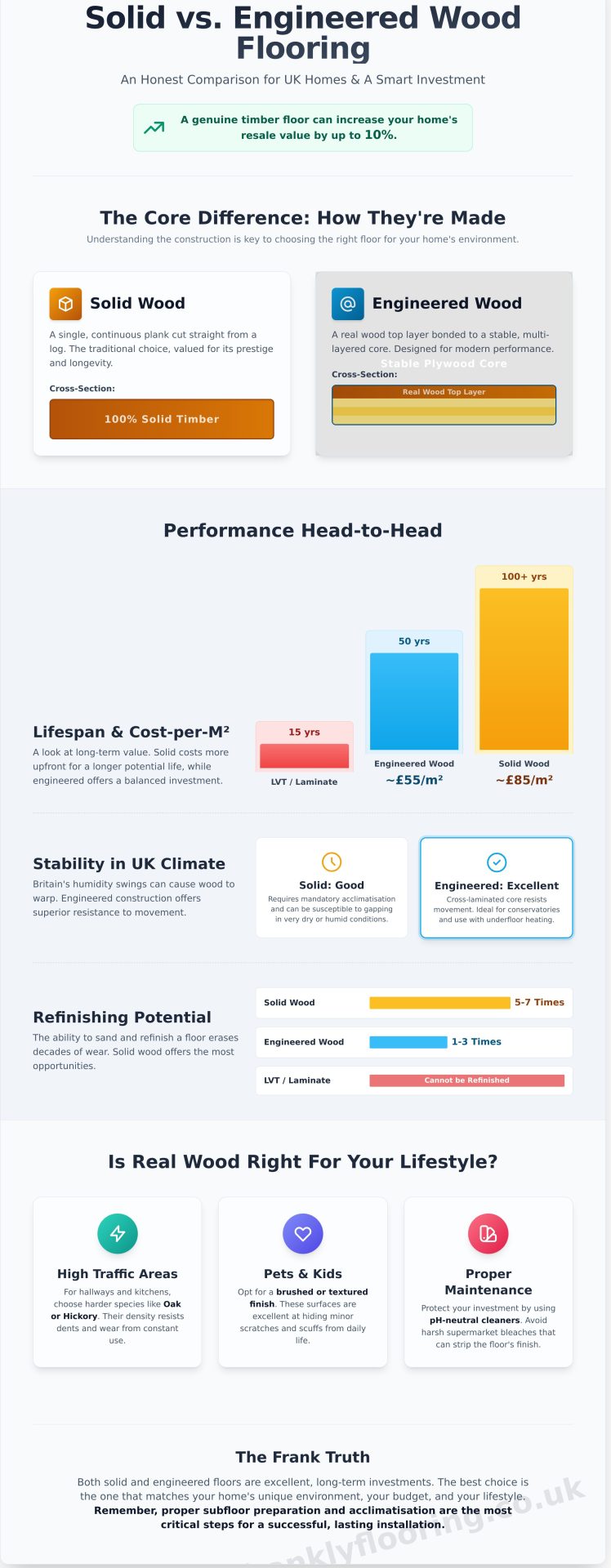
Choosing between solid and engineered wood often feels like a test of your common sense. Solid timber is exactly what it says on the tin; it is a single, continuous plank cut straight from a tree. It is traditional, heavy, and carries a certain prestige. Engineered boards are different. They consist of a high quality top layer of real timber bonded to multiple layers of cross-laminated plywood or birch. Some people claim engineered options aren’t “real,” but that is simply a myth. The surface you walk on is 100% genuine timber. It looks, feels, and smells identical to a solid plank because, on the surface, it is one.
When looking at older properties, the U.S. National Park Service provides excellent guidance on historic wood flooring which highlights how different materials impact a building’s character. In a modern context, the cost-to-longevity ratio is the real deciding factor. A solid oak plank might cost £85 per square metre and last 100 years. A high-end engineered board might cost £55 per square metre and last 50 years. For most homeowners, paying a 40% premium for a floor that outlives them by half a century doesn’t always make financial sense.
Performance in the UK Climate
UK weather is notoriously fickle. Indoor humidity levels typically swing from 35% in the height of winter to 60% during a damp July. Solid timber acts like a natural sponge. It expands and contracts with these shifts, which leads to gaps, cupping, or structural squeaks. Engineered boards are the frank choice for modern British homes because their layered construction restricts this movement by roughly 80%. This stability is an absolute necessity if you have underfloor heating. About 82% of our modern renovation projects now include heated subfloors, and putting solid timber over them is a recipe for expensive failure. Engineered boards allow heat to transfer efficiently without the timber warping or splitting.
The Sanding and Refinishing Debate
The biggest argument for solid timber is its lifespan. You can sand a 20mm solid board down to the tongue and groove roughly 8 times. However, you must consider how often you will actually do this. Most households only refinish their floors every 15 to 20 years. If you choose an engineered board with a 6mm wear layer, you can comfortably sand it 3 or 4 times. This provides a functional life of 60 to 80 years, which covers the residency of most owners twice over.
- 4mm Wear Layer: Suitable for 2 sands; ideal for bedrooms or low-traffic areas.
- 6mm Wear Layer: Suitable for 4 sands; the standard for busy family kitchens and hallways.
- Professional Fitting: DIY sanding often removes 2mm of timber in one go, whereas a professional with a belt sander might only remove 0.5mm.
Refinishing isn’t just about the thickness of the timber; it is about the quality of the original fitting. A poorly fitted floor will develop bounces and dips that make sanding impossible, regardless of how much timber is left. If you want to see how these different wear layers look in person, you can view our range of samples to get a feel for the thickness and quality. We believe in being straight with you: for 90% of UK homes, engineered timber provides better stability and better value without sacrificing the authentic look of a natural floor.
Choosing Your Aesthetic: Wood Species, Grades, and Texture
Oak remains the primary choice for UK homes, accounting for approximately 80% of our wood flooring installations. Its popularity isn’t just about tradition; it’s about sheer resilience. European Oak is a dense, tight-grained timber that handles the foot traffic of a busy hallway without breaking a sweat. Walnut offers a different proposition. It provides a rich, chocolatey tone that screams luxury, but it requires a more careful owner. Walnut is naturally softer than Oak, meaning it’s more susceptible to pressure marks from heavy furniture or high heels.
At Frankly Flooring, we believe in using data to guide your investment. To understand the durability of different hardwood flooring options, you should look at the Janka Hardness Scale. This test measures the force required to embed a small steel ball halfway into the timber. European Oak sits at roughly 1,120 lbf (pounds-force), while American Black Walnut is softer at 1,010 lbf. We generally steer clients away from exotic species like Ipe or Teak. Beyond the ethical concerns of rainforest depletion, these timbers often struggle with the central heating systems found in British homes, leading to gaps and movement.
Understanding Timber Grades
Grading is about visual character, not structural integrity. Prime Grade is the “cleanest” look, featuring minimal knots and a uniform colour. Select Grade offers a middle ground with knots up to 15mm and more natural grain variation. Rustic Grade celebrates the tree’s history. It includes large, filled knots, cracks, and significant colour shifts. Choosing Rustic isn’t just a budget decision; it’s a stylistic choice for those who want a floor with a story.
Finishes: Oil vs. Lacquer
Lacquer acts like a hard-wearing “shield” on the surface. It’s incredibly easy to mop, but if you scratch it, you can’t easily fix a single spot. You’d likely need to sand the entire room. UV Oil is our preferred recommendation for active households. It soaks into the grain rather than sitting on top. If you get a localized scratch, you can simply apply a small amount of maintenance oil to the affected area. It’s a straightforward, honest approach to long-term care.
Surface texture is the final piece of the puzzle. A smooth, sanded finish looks sleek in a minimalist flat, but it’s a magnet for visible dust and micro-scratches. A brushed texture is far more forgiving. By wire-brushing the surface during production, the manufacturer removes the softer grain, leaving a textured finish that camouflages daily wear and tear. In our experience, roughly 70% of homeowners who choose a brushed wood finish report higher satisfaction levels after the first year of use because the floor maintains its “new” appearance for longer.
Preparation and Fitting: What You Need to Know Before the First Plank
Frankly, the biggest mistake homeowners make is rushing the start. You’ve spent thousands on high-quality wood, but if you don’t let it sit in your home for 7 to 14 days, you’re asking for trouble. This process is called acclimatisation. Wood is a living, breathing material that reacts to its environment. It needs time to reach an equilibrium with the specific humidity and temperature of your room. If you skip this, the planks will likely warp or gap once your central heating kicks in during the winter months.
The subfloor is the foundation of your investment, and it’s the frank reason most floors fail. We’ve seen countless projects where the finish looks beautiful, but the floor feels “bouncy” or creaks within weeks. This happens because the subfloor wasn’t level. Your base must be flat within a 3mm tolerance over a 2-metre span. If your floor has dips or peaks beyond this, you must use a self-levelling compound or high-grade plywood to create a true surface before fitting begins.
Moisture is the silent killer of timber. A concrete subfloor might look bone dry on the surface, but it can hold litres of residual water. We never start a job without using a digital hygrometer to check the moisture levels. For a glue-down installation, the relative humidity (RH) of a concrete slab must be below 75%. If it’s higher, you’re essentially laying your floor on a damp sponge. This will lead to cupping, where the edges of the planks rise higher than the centre; a defect that’s incredibly difficult to fix once it starts.
Expansion gaps are another non-negotiable element. You must leave a 10mm to 15mm gap around the entire perimeter of the room, including around radiator pipes and door frames. Wood expands when the air is humid and shrinks when it’s dry. If you fit the planks tight against the walls, the floor has nowhere to go when it expands. It will eventually “tent” or buckle in the middle of the room. We hide these gaps using skirting boards or scotia beads to ensure a seamless look that allows the floor to breathe.
Fitting Methods Explained
Floatation is a popular choice for DIY projects because it’s fast. The planks click together over an underlay without being fixed to the subfloor. Glue-down is the gold standard for a premium feel. We bond the wood directly to the subfloor using a silane-based adhesive; this eliminates the hollow “clack” sound and makes the floor feel incredibly solid. Secret nailing is the traditional British method for timber subfloors, where we drive floor nails at a 45-degree angle through the tongue of the board into the joists below.
The Importance of Quality Underlay
A quality underlay does more than provide a bit of cushion. High-density versions can reduce impact sound by up to 22 decibels, which is a massive difference if you have children running around upstairs. It also acts as a vital moisture barrier. An integrated damp-proof membrane (DPM) is essential for ground floor rooms to stop rising damp from reaching your timber. If you’re unsure which technical specifications suit your home, read our guide on What Underlay Do I Need For Wood Flooring? to make an informed choice.
If you want a floor that stands the test of time without the stress of DIY errors, book a professional fitting consultation with our expert team today.
Finding Your Perfect Floor: Why Quality Wood is Worth the Investment
Choosing the right material for your home isn’t just about picking a colour you like; it’s about matching the physical properties of the timber to the specific demands of your room. We call this the Frank approach. It involves being honest about how you live. If you have a busy household with muddy dogs and heavy foot traffic, we’ll guide you toward harder species like oak that can take the punishment. If you are considering a damp environment, we’ll be the first to tell you if solid wood isn’t the right choice for that specific space.
Investing in real timber offers a long-term return that temporary flooring simply cannot match. A budget laminate might cost £20 per square metre and require replacement within 8 years. In contrast, a high-quality engineered or solid floor can last over 60 years if maintained correctly. This longevity adds roughly 3% to 5% to the total resale value of a UK property, according to recent estate agency data. You aren’t just buying a floor; you’re installing a permanent fixture that matures and improves with age.
Our team sources every plank with a focus on integrity. We’ve spent 24 years building relationships with sawmills that prioritise sustainable harvesting and slow-grown timber. This expert knowledge ensures that the product arriving at your door has the correct moisture content for the British climate, which prevents the warping and gapping often seen in cheaper, mass-produced alternatives.
Before you make a final decision, follow this straightforward checklist to ensure a seamless fitting process:
- Order physical samples: Grain patterns and stains look different under LED bulbs than they do in natural North-facing light.
- Calculate your wastage: Always add 10% to your room measurements to account for cuts and awkward corners.
- Check your subfloor: Ensure your base is level within a 3mm tolerance over a 2-metre area.
- Seek professional advice: Ask about the specific underlay requirements for your heat setup, especially if you have underfloor heating.
Why Frankly Flooring?
We’ve spent more than two decades refining our craft in the UK flooring industry. By operating without expensive high-street showrooms, we cut out the middleman and pass savings of up to 25% directly to our customers. Our business is built on transparency. We provide the kind of direct, expert advice you’d expect from a trusted local tradesman. If a product doesn’t suit your needs, we’ll tell you plainly, even if it means losing a sale today to protect our reputation tomorrow.
Next Steps for Your Home
Seeing a photograph is a good start, but feeling the texture of the grain is essential for making an informed choice. We encourage you to order samples so you can test them against your skirting boards and furniture. Once you have your measurements, our online calculator provides an instant, transparent price without any hidden extras or sudden surcharges at checkout. When you’re ready to upgrade your home, you can browse our full range of real wood flooring to find a surface that will last a lifetime.
Start Your Flooring Journey the Right Way
Choosing a new floor is a significant decision for any homeowner. It’s about more than just a surface; it’s about the foundation of your home’s character. Whether you opt for the traditional depth of solid timber or the structural versatility of an engineered board, getting the fitting right is essential. We’ve spent 20 years perfecting this craft; frankly, we’ve seen how the right wood choice transforms a room from a simple space into a warm, inviting home.
As a family-run British business, we prioritise your long-term satisfaction over a quick sale. We only source FSC certified sustainable timber options, so you know your floor is as responsible as it is beautiful. You deserve a straightforward process without the corporate coldness of larger retailers. From initial subfloor preparation to the final sweep-up after fitting, we’re here to provide an honest, expert service you can trust. Let’s find the perfect planks for your project together.
Order your free wood flooring samples today
We look forward to helping you create a home you’ll love for decades.
Frequently Asked Questions
Is real wood flooring suitable for kitchens and bathrooms?
Frankly, we don’t recommend real wood for bathrooms because humidity levels often exceed 70%, which causes the timber to warp or rot. Kitchens are more manageable if you’re diligent about spills and leaks. Engineered wood is the better choice for these areas as its layered construction provides 30% more stability against moisture than solid planks. If you choose wood for your kitchen, ensure you mop up liquids within 30 minutes to prevent permanent swelling.
How do I clean and maintain a real wood floor?
You should sweep or vacuum your floor daily using a soft brush attachment to remove grit that acts like sandpaper on the finish. For deeper cleaning, use a damp, well-wrung mop with a PH-neutral cleaner specifically designed for timber. Avoid steam mops as they force moisture into the grain, which can cause the boards to peel within 2 to 3 years. Regular maintenance ensures your floor remains a foundational element of your home for decades.
Can I install real wood flooring over underfloor heating?
You can certainly use engineered wood with underfloor heating, but solid wood is a poor choice because it reacts too much to temperature fluctuations. It’s vital to ensure the surface temperature doesn’t exceed 27°C to prevent the timber from drying out and cracking. Most modern systems are compatible with boards up to 18mm thick. This setup provides a seamless, warm feel underfoot while maintaining the structural integrity of your flooring throughout the winter months.
What is the difference between solid and engineered wood?
Solid wood consists of single planks cut from one tree, whereas engineered wood features a real timber top layer bonded to multiple layers of plywood. This construction makes engineered boards more stable in varying UK temperatures and humidity levels. Most engineered planks come with a wear layer between 3mm and 6mm, allowing them to be sanded down 2 or 3 times over their lifespan. It’s an honest, practical alternative that looks identical once the fitting is complete.
Does real wood flooring scratch easily with pets?
All wood flooring can scratch, especially if you have large dogs with untrimmed claws. Choosing a harder species like Oak, which scores 1,360 on the Janka hardness scale, offers better resistance than softer species like Pine. We suggest a brushed and oiled finish because it hides minor marks better than a smooth, high-gloss lacquer. If a scratch does occur, you can often spot-repair oiled floors without needing to sand the entire room.
How long does real wood flooring need to acclimate?
Solid wood requires at least 7 days to acclimate to your home’s humidity, while engineered boards usually need 48 to 72 hours. You must store the planks flat in the room where they’ll be fitted, away from direct heat sources or damp walls. This process allows the moisture content to balance with the local environment, reducing the risk of the floor expanding or shrinking by more than 2% after the fitting is finished.
Can you lay wood flooring over existing tiles?
You can lay wood over tiles if the existing floor is structurally sound and level within a 3mm deviation over a 2-metre span. We often use a high-quality underlay or a levelling compound to ensure the subfloor preparation is perfect before we start. It’s a straightforward way to update your home without the mess of ripping up old ceramics. However, you must check that the added height doesn’t prevent doors from opening properly.
How much value does wood flooring add to a UK house?
Real wood flooring is a sound investment that can increase a UK property’s value by 2% to 10% according to various estate agent surveys. Buyers view it as a premium, long-term feature compared to carpet or laminate. Because it can last for 50 years or more, it’s often cited as a top priority for 30% of house hunters. It isn’t just a commodity; it’s a quality upgrade that makes your home much easier to sell.