
Choosing the right wooden flooring can feel unnecessarily complicated. You’re faced with a barrage of terms like ‘solid’ and ‘engineered’, and legitimate worries about whether your dream floor can handle underfloor heating, the dog’s claws, or a busy family life. Frankly, the sales jargon often adds to the confusion rather than clearing it up. It’s enough to make anyone anxious about making such a significant investment in their home.
This guide is different. We believe in straightforward advice, not sales talk. Here, we will provide a transparent breakdown of the different wood types, explain the real-world costs involved, and discuss quality so you can see past the marketing fluff. Our goal is to give you the confidence to select a beautiful, durable floor that not only adds genuine value to your property but also fits seamlessly into your life, with no unwelcome surprises down the line.
Key Takeaways
- Learn the crucial construction difference between solid and engineered wood to decide which is truly right for your home, beyond just the price tag.
- Understand how to select the right species and grade of wooden flooring, balancing durability with the visual character you want.
- Discover which wood types are compatible with underfloor heating and why your subfloor is the most critical factor for a lasting finish.
- Master the straightforward method for measuring your room and calculating the essential 10% wastage to ensure a smooth, cost-effective fitting.
What is Wooden Flooring and Why Does it Endure?
At its heart, wooden flooring is a timeless and sought-after surface crafted directly from natural timber. Its enduring popularity stems from a combination of authentic beauty, durability, and a unique connection to the natural world. It generally comes in two main constructions: solid wood, milled from a single piece of timber, and engineered wood, which features a real wood top layer bonded to a stable core. While there are many fitting styles, such as classic parquet, these constructions form the basis of most options. For a deeper dive into the specifics, the Wikipedia entry on Wood flooring offers a comprehensive overview.
What truly sets real wood apart is its remarkable longevity. Unlike floors that must be replaced when worn, a quality wood floor can be sanded and refinished multiple times, effectively giving it several lifespans. It is also a ‘living’ material; it subtly expands and contracts with the temperature and humidity in your home, breathing with the seasons. This isn’t a flaw-it’s the authentic hallmark of a natural product that becomes part of the fabric of your home.
The Aesthetic Appeal of Natural Timber
Synthetic floors try hard, but they simply cannot replicate the unique character of real timber. Each plank tells a story through its individual grain, knots, and subtle colour variations, bringing an organic warmth to a room that feels both luxurious and comforting. Over the years, rather than wearing out, a well-maintained wood floor develops a rich patina-a gentle ageing process that adds depth and history. Frankly, it’s also a sound investment; estate agents consistently confirm that quality real wood flooring significantly increases the desirability and value of a UK property.
Sustainability and the Environment
Choosing wood can be a responsible environmental decision, provided it’s sourced correctly. Reputable suppliers ensure their timber carries certifications like FSC or PEFC, which guarantees it comes from sustainably managed forests. In these forests, new trees are planted to replace those harvested, ensuring a continuous cycle. Furthermore, wood acts as a natural carbon store, locking away CO2 for its entire lifespan-a stark contrast to the energy-intensive production of plastic-based alternatives.
Sustainable timber flooring is a lifetime choice, not a 10-year fix.
Solid vs. Engineered Wood: The Straight-Talking Comparison
Before we even touch on laminate, it’s crucial to understand the two main types of real wooden flooring. The choice between solid and engineered wood isn’t simply about cost; it’s about stability, longevity, and suitability for your home. Frankly, the core difference lies in their construction. While both provide an authentic wood surface, how they are made dictates where and how they perform best. The National Wood Flooring Association provides an excellent overview of the different Types of Wooden Flooring, but here’s our straight-talking breakdown.
Solid Wood: The Traditional Choice
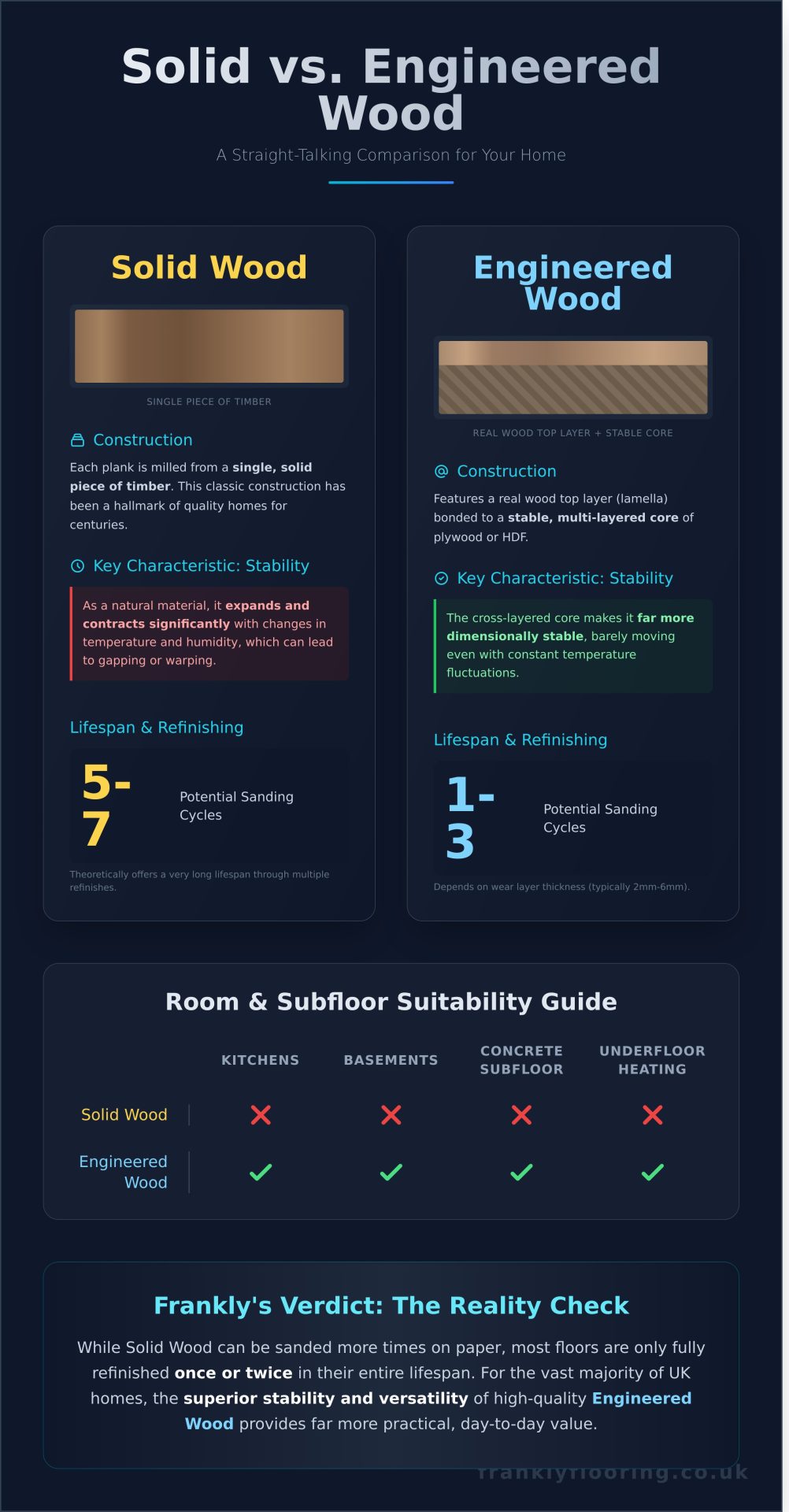
Solid wood flooring is exactly what it sounds like: each plank is milled from a single, solid piece of timber. This gives it a prestigious, timeless appeal that has been the hallmark of quality homes for centuries. However, its classic construction is also its main weakness in a modern home. As a natural material, it expands and contracts significantly with changes in humidity and temperature. In a damp UK kitchen or a bathroom, this movement can lead to unsightly gapping or warping over time. It’s also why we would never recommend fitting solid wood in basements or directly onto a concrete subfloor.
Engineered Wood: The Modern Standard
Engineered wood offers the best of both worlds. It features a multi-layered core of plywood or HDF, with a top layer-the lamella-of real, solid wood. This cross-layered construction makes it far more dimensionally stable, so it barely moves even with the constant fluctuations from central heating. This stability makes it the superior choice for most UK homes, suitable for fitting in almost any room, including over underfloor heating. It’s not a “cheap” alternative; a high-quality engineered board with a thick wear layer can be a significant investment, but one that pays dividends in performance. For a deeper dive, see our Engineered Wood Flooring: The Complete Guide.
So, what about lifespan? This is where honesty matters most.
- Solid Wood: Can typically be sanded and refinished 5-7 times, potentially lasting a lifetime.
- Engineered Wood: Can be sanded 1-3 times, depending on the thickness of its real wood wear layer (usually between 2mm and 6mm).
While solid wood wins on paper, the reality is that most floors are only ever fully sanded once or twice in their entire lifespan. For the vast majority of homeowners, the superior stability of engineered wood provides far more practical, day-to-day value.
Choosing the Right Species, Grade, and Finish
While laminate flooring offers a printed image of wood, engineered wood provides the genuine article. This means your choices go far beyond just colour. The species, grade, and finish of the timber top layer fundamentally define the character, durability, and maintenance of your new floor. Frankly, getting these details right is the key to a floor you’ll love for years.
Species and Durability: More Than Just a Look
When selecting an engineered wooden flooring, the species of the top layer is your first major decision. In the UK, Oak is the perennial favourite, and for good reason. It strikes an excellent balance between aesthetic versatility, durability, and cost. For a touch more luxury, American Black Walnut offers deep, rich tones, but we’ll be honest: it’s a softer timber, making it better suited to a bedroom than a high-traffic hallway. The Janka hardness scale is the industry standard for measuring a wood’s resistance to denting and wear, providing a reliable way to compare different species.
Beyond species, the grade of the wood determines its visual character. It’s not about quality, but aesthetics:
- Prime Grade: Clean, uniform, and almost free of knots for a sleek, contemporary look.
- Rustic Grade: Features natural knots, colour variations, and mineral streaks, delivering a warm, character-rich feel.
Understanding these distinctions is crucial for matching the floor to your home’s style. For a more detailed overview, the NWFA’s wood flooring guide offers excellent, unbiased advice on selecting the right timber.
Finishes: The Practical Difference Between Lacquer and Oil
The finish protects your floor and dictates its upkeep. A lacquered finish sits on top of the wood, creating a sealed, smooth surface that’s very easy to wipe clean. The trade-off is that a deep scratch can break this seal, and repairing it often means sanding a large area. In contrast, a natural oil finish soaks into the wood grain, protecting it from within for a more matte, natural appearance. Its greatest advantage is repairability; minor scuffs and scratches can be spot-treated with a touch-up oil, blending seamlessly without needing to refinish the entire room. For sun-drenched spaces, a UV-oiled finish offers a good middle ground, providing the matte look of an oil with enhanced factory-cured durability.
Finally, don’t overlook the impact of plank size. Wider and longer planks create fewer seams, which can make a room feel more spacious and expansive. Narrower planks, on the other hand, can lend a more traditional, classic feel to a space.
Fitting Realities: Subfloors and Underfloor Heating
Choosing your perfect wooden flooring is the exciting part. But frankly, the long-term success of your investment rests on what you can’t see: the subfloor preparation and fitting method. A beautiful floor laid on a poor subfloor is a problem waiting to happen, which is why we believe in getting the foundations right from the very start.
Preparing Your Subfloor
Your new floor is only as good as the surface it’s laid upon. Before any boards are fitted, a concrete subfloor must be tested for moisture; anything above 75% relative humidity requires a damp-proof membrane. The floor must also be perfectly flat. We work to a strict tolerance of no more than a 3mm deviation over a 2-metre span to prevent bounce, creaks, and gaps. The right underlay is also non-negotiable, providing essential acoustic insulation and moisture protection.
Wood and Underfloor Heating (UFH)
The warmth of underfloor heating paired with wood is a fantastic combination, but only one material is truly up to the task: engineered wood. Its layered construction provides the stability needed to handle temperature fluctuations without warping. To protect the timber, the surface temperature must never exceed 27°C. We also consider the thermal resistance (TOG rating) of the floor and underlay combined to ensure your UFH system runs efficiently.
Finally, your new flooring must be left in the room where it will be laid for at least 48-72 hours to acclimatise. Skipping this vital step is a common cause of floor failure. As for fitting, there are three primary methods:
- Floating: The most common method, where boards click together over an underlay. Ideal for both laminate and engineered wood.
- Gluing: The board is fully bonded to the subfloor for maximum stability. This is our preferred method for engineered wood over UFH.
- Secret Nailing: A traditional technique used to fix boards to wooden joists, which is less common but still effective in certain period properties.
Getting these technical details right is what separates a professional, lasting finish from a DIY disaster. For a frank assessment of your subfloor and fitting requirements, get in touch with our expert team.
Buying Wooden Flooring Online with Frankly Flooring
Once you’ve decided between laminate and engineered wood, the next step is ensuring a smooth purchase and fitting process. Buying your floor online is convenient, but a few practical steps will guarantee success. Before you place an order, accurate measurements are crucial. Simply multiply your room’s length by its width to calculate the square meterage required.
We always recommend adding 10% for wastage. This industry-standard practice accounts for the cuts needed to fit the planks around your room’s specific layout and leaves you with a few spares for any future repairs. It’s a small step that prevents big headaches later on.
- Order Samples First: A computer screen can’t truly replicate how a floor will look and feel in your home. We strongly advise ordering samples to see the true grain and colour in your own natural light, next to your furniture and decor.
- Prepare for Delivery: Your new flooring will arrive securely on a pallet. Because it’s a heavy, bulky item, all deliveries are made kerbside. You will need to arrange to carry the boxes into your property, so it’s a good idea to have an extra pair of hands ready.
The Frankly Flooring Difference
Frankly, not all advice is created equal. As a family-run business with over 20 years of experience in the UK flooring industry, we provide the kind of honest, no-nonsense guidance you won’t find at a big-box retailer. We believe in transparent pricing and clear product descriptions, ensuring you get the perfect floor without the sales pressure. Our expertise allows us to curate a premium selection, including stunning Parquet & Herringbone options for a truly bespoke finish.
Your Next Steps
Ready to move forward? Use our online calculator for an instant quote based on your room’s measurements. If you’re dealing with a tricky installation, an unusual subfloor, or simply want a second opinion on the best wooden flooring for your home, our team is here to help. We pride ourselves on providing practical solutions, not just making a sale.
For a seamless experience from start to finish, browse our full range of wooden flooring today.
Frankly, The Final Word on Your Wooden Floor
Choosing the right wooden flooring comes down to understanding the fundamentals. As we’ve explored, the distinction between solid and engineered wood is crucial, as is selecting a species, grade, and finish that genuinely suits your home and lifestyle. Getting the subfloor preparation right is not just a detail-it is the foundation of a lasting investment.
At Frankly Flooring, we believe in making that choice a straightforward one. With over 20 years of family-run expertise, direct-from-source pricing with no hidden extras, and national UK delivery on all orders, you are in safe, capable hands. We are here to provide honest advice to help you find the perfect floor for your space.
Ready to take the next step with confidence? Shop our curated collection of Engineered and Solid Wood Flooring and begin your home’s transformation today.
Frequently Asked Questions
Is wooden flooring suitable for kitchens or bathrooms?
Frankly, traditional solid wood flooring and high-moisture areas like bathrooms are not a good match, as water can cause warping. However, modern engineered wood offers greater stability and can be a good choice for kitchens, provided spills are cleaned up quickly. For bathrooms, we would almost always recommend a fully waterproof alternative like Luxury Vinyl Tile (LVT) to ensure longevity and prevent any moisture-related issues down the line.
How do I clean and maintain my wooden floor without damaging the finish?
The key is gentle, regular care. Sweep or vacuum with a soft brush head frequently to remove grit that can scratch the surface. For cleaning, use a well-wrung-out mop and a pH-neutral cleaner designed specifically for wood floors. Never use a steam mop, vinegar, or abrasive cleaners, as these can strip the protective finish over time. A little care goes a long way in preserving your floor’s beauty and ensuring it lasts for years.
Can I install wooden flooring myself, or do I need a professional fitter?
While many modern laminate and engineered floors use a click-lock system that makes DIY fitting possible for a competent enthusiast, we always advise careful consideration. A professional fitter guarantees a seamless result, correctly handles subfloor preparation, and navigates tricky areas like doorways with ease. For a finish that’s truly flawless and built to last, professional fitting is a sound investment that prevents costly mistakes.
What is the average cost per square metre for quality wooden flooring in the UK?
Costs can vary significantly based on quality and finish. As a general guide in the UK, you can expect to pay between £20 to £40 per square metre for good quality laminate. For quality engineered wooden flooring, the price typically ranges from £40 to over £90 per square metre, depending on the thickness of the real wood wear layer and the species of timber. Always remember to factor in the cost of underlay, trims, and professional fitting.
How long does wooden flooring need to acclimatise before fitting?
Acclimatisation is a crucial step that shouldn’t be skipped. Both laminate and engineered wood need to adjust to the specific temperature and humidity of the room where they will be fitted. We recommend leaving the unopened boxes laid flat in the room for at least 48 to 72 hours before fitting begins. This simple process prevents the planks from expanding or shrinking after they’ve been laid, ensuring a stable and long-lasting floor.
Will my wooden floor change colour over time due to sunlight?
Yes, it’s a natural characteristic of real wood. Prolonged exposure to direct UV rays can cause the colour of engineered wood to change; some species may lighten while others darken. Laminate flooring, with its printed image layer and protective coating, is generally far more resistant to fading. To minimise colour change on wood floors, consider using blinds or curtains during peak sun hours and rotating rugs periodically.
What is the difference between a “wear layer” and total plank thickness?
These two measurements serve different purposes. The total plank thickness contributes to the floor’s structural stability and feel underfoot. The ‘wear layer,’ found on engineered wood, is the top slice of solid hardwood. Its thickness-typically 2mm to 6mm-determines how many times the floor can be sanded and refinished. A thicker wear layer means a longer potential lifespan, while laminate has a protective top coat that cannot be sanded.
Can I lay wooden flooring directly over old floorboards or tiles?
In many cases, yes, provided the existing surface is structurally sound, clean, and completely level. This is often referred to as a ‘floating floor’ installation. However, any loose tiles or creaky floorboards must be secured first, and you may need a levelling compound to smooth out any imperfections. Proper subfloor preparation is the foundation of a great finish, so it’s a step where cutting corners is never a good idea.