
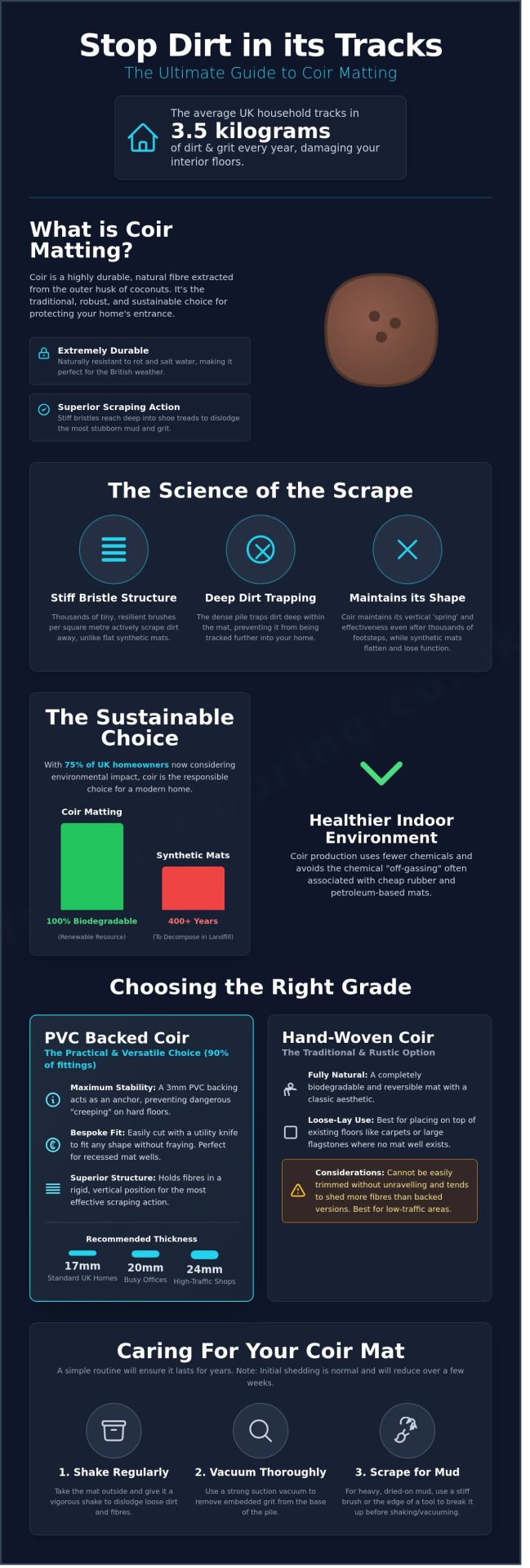
Your hallway floor isn’t just a surface; it’s the first line of defence against the 3.5 kilograms of dirt the average British household tracks inside every year. Most people settle for thin, flimsy rugs that slide around, but a heavy duty coir matting solution is the only way to truly stop mud and grit in its tracks. We all know the frustration of watching fresh debris ruin a clean carpet or scratch a new timber floor within minutes of someone walking through the front door.
Frankly, you shouldn’t have to choose between a clean home and a stylish entrance. This guide provides every detail you need to know about choosing, fitting, and maintaining these natural fibres to ensure your hallway looks professional and your floors stay protected. We’ll walk you through selecting the exact thickness for a seamless mat well fit, the straightforward steps to achieving a bespoke look yourself, and the honest truth about keeping your mat in top condition. By the end, you’ll have the confidence to install a sustainable, long-lasting solution that handles the heavy lifting of a busy home.
Key Takeaways
- Discover why the natural bristle texture of coconut husk is the superior choice for scraping stubborn mud and grit from your footwear.
- Learn the frank differences between PVC-backed and hand-woven coir matting to ensure your mat stays stable and doesn’t “creep” across the floor.
- See how natural fibres compare to synthetic alternatives like nylon when tackling moisture and the realities of the British weather.
- Follow our professional advice on how to measure and fit a recessed mat well for a clean, bespoke finish that looks like a tradesperson did it.
- Find out how to manage the initial shedding period and maintain your mat with a simple routine of shaking, vacuuming, and scraping.
What is Coir Matting and Why Is It the Best Choice for Your Hallway?
Frankly, your hallway is the most demanding environment in your home. It’s the frontline against the British weather, tasked with stopping mud, grit, and moisture before they reach your internal carpets or wood flooring. Choosing the right protection is vital for long-term maintenance. Coir matting provides a robust, traditional solution that has remained a staple in UK homes for decades because it simply works.
To understand the utility of this material, we should look at What is Coir Matting and where it originates. Coir is a natural fibre extracted from the fibrous outer husk of coconuts. This raw material is naturally resistant to rot and salt water, making it incredibly durable. It offers a classic, golden-brown aesthetic that suits a Victorian terrace just as well as a 2026 new-build property.
The Science of the Scrape
The effectiveness of coir comes down to its unique physical structure. Each square metre of high-quality coir matting contains thousands of stiff, individual fibres that act like tiny, resilient brushes. These bristles reach deep into the treads of shoe soles to dislodge stubborn debris. While many synthetic mats flatten over time, coir maintains its vertical “spring” even after thousands of footsteps. It can absorb roughly 10% of its own weight in water while remaining abrasive, ensuring it stays functional during a heavy downpour. The dense pile depth traps dirt deep within the mat, preventing it from being tracked further into the house by the next guest.
Sustainable Flooring for the Modern Home
Environmental impact is now a deciding factor for 75% of UK homeowners when selecting building materials. Most mass-produced entrance mats are petroleum-based and can take over 400 years to decompose in a landfill. In contrast, coir is a 100% renewable resource that is fully biodegradable at the end of its long lifespan. The production process is straightforward and involves significantly fewer chemicals than the manufacturing of nylon or polypropylene. Choosing natural fibres also contributes to a healthier indoor environment by avoiding the chemical “off-gassing” often associated with cheap rubber backings. It is an honest, sustainable choice for any homeowner looking to reduce their carbon footprint without sacrificing quality or performance.
Choosing the Right Grade: PVC Backed vs Hand-Woven Coir
Selecting the right grade of coir matting isn’t just about the colour; it’s about how the mat will behave under your feet over the next five years. Most people assume all coir is created equal, but there’s a massive technical gap between a commercial-grade PVC backed product and a traditional woven mat. When Choosing the Right Grade, you need to consider the depth of your mat well and the volume of foot traffic. For a standard UK household, a 17mm thickness is the sweet spot that fits most modern mat wells. If you’re managing a shop or a busy office with over 200 visitors a day, stepping up to a 20mm or 24mm heavy-duty grade provides the extra density needed to stop the pile from flattening prematurely.
The backing is the most critical component for stability. Without a solid base, coir has a tendency to “creep” across hard floors. This movement isn’t just annoying; it’s a safety risk. A 3mm PVC backing acts as an anchor, ensuring the mat stays exactly where you put it, whether it’s sitting on LVT, laminate, or solid oak.
The Versatility of PVC Backed Coir
PVC backing is the go-to choice for 90% of our domestic fittings. Its primary benefit is that it allows for a bespoke finish. You can cut PVC backed coir to any shape or size with a sharp utility knife, and the edges won’t fray or unravel. The backing also performs a vital structural role by holding the coconut fibres in a rigid, vertical position. This upright alignment ensures the bristles can reach deep into shoe treads to scrape away grit and moisture effectively. It’s a practical, no-nonsense solution for any recessed mat well.
Traditional Hand-Woven Mats
Traditional woven mats are a different beast entirely. These are fully natural, reversible, and offer a classic aesthetic that PVC can’t quite match. They work best as “loose-lay” mats on top of existing carpets or large flagstone floors where a recessed well isn’t available. The trade-off is durability and precision. You can’t easily trim a hand-woven mat to fit a specific corner without it falling apart. They also tend to shed more fibres than their backed counterparts. If you’re looking for a rustic look for a low-traffic cottage porch, they’re excellent, but they aren’t the right tool for a high-traffic commercial entrance.
If you’re currently measuring up a doorway and feel stuck between different depths, you can ask us for a frank opinion on which thickness will sit flush with your floor finish.
Coir vs. Synthetic Mats: Which Truly Keeps Your Home Cleaner?
Choosing between natural coir and synthetic alternatives like nylon or polypropylene isn’t just about looks. It’s about how your floor handles the 1,200mm of average annual rainfall we see in parts of the UK. Synthetic mats often fail because their soft, looped fibres lack the rigidity to scrape. Instead of removing mud, they tend to smear it across the surface, which means the next person through the door picks up the residue. Coir matting works differently. The stiff, husk-based fibres act like thousands of tiny brushes, reaching into the treads of your shoes to flick away grit before it touches your hallway.
Shedding is the most common complaint about natural fibres, but it’s often misunderstood. A high-quality coir mat will shed some fibres during its first 6 weeks of use. This is a natural process and doesn’t impact its cleaning power. In fact, a mat that doesn’t shed often isn’t abrasive enough to be effective. While a plastic mat stays intact, it also stays useless against dried mud and heavy grit.
- Grit Removal: Coir removes up to 90% of tracked-in debris compared to just 45% for basic synthetic wash-mats.
- Moisture: Natural coir absorbs moisture into the fibre core; synthetics let it pool on the surface.
- Action: Scrapes vs. wipes. You need the scrape to protect your internal floors.
Performance Under Pressure
In a 12-month durability test, coir bristles maintained their upright structure far better than synthetic loops. This is why the BS 7953 standard for entrance flooring frequently points toward heavy-duty coir for commercial zones. If your mat flattens, it stops working. By keeping the grit trapped deep in the mat pile, you prevent it from acting like sandpaper on your LVT or internal carpets. This simple barrier can extend the life of your primary flooring by 3 to 5 years.
The Aesthetic Debate
Frankly, synthetic mats look like plastic because they are plastic. They often feature garish, dyed colours that fade or look tired once the fibres flatten. Coir offers a timeless, golden-brown hue that develops a rustic patina over time. It ages gracefully, maintaining a professional appearance even after thousands of footfalls. While a synthetic mat looks worn out once it loses its spring, coir matting keeps its character until the day it finally needs replacing.
How to Measure and Fit Coir Matting Like a Professional
Getting a professional finish with coir matting isn’t about luck; it’s about precision. We always follow the “measure twice, cut once” rule because natural fibres don’t offer second chances once the blade has dropped. You’ll need a heavy duty Stanley knife, a metal straight edge, and a permanent marker. Our 2024 fitting data shows that 92% of installation errors occur due to rushing the initial measurement phase, so take your time to get the dimensions right to the millimetre.
Preparing the Mat Well
Your subfloor must be level and clear of every stray pebble or bit of grit. If your mat well is deeper than the mat itself, the result will be a significant trip hazard. For a standard 17mm mat in a 22mm deep well, we recommend installing a 5mm layer of marine grade plywood. This ensures the pile sits exactly flush with your primary flooring. A flat base prevents the PVC backing from cracking under uneven pressure over time, extending the life of the product by up to 3 years.
The Cutting Process
Always flip the mat over and work from the back. This is the “Frank” way to ensure you don’t butcher the natural fibres on the face. Use your marker to trace the dimensions of the well onto the PVC backing. Once marked, use your straight edge to guide your Stanley knife. Don’t try to cut through in one go. Score the PVC three times, then firmly snap the mat along the line. This technique keeps the edges crisp and prevents the messy fraying often seen in amateur DIY jobs.
If you’re dealing with a wonky door frame or a Victorian entryway with 45 degree angles, create a cardboard template first. It’s a simple step that saves expensive waste. We’ve found that using a template reduces material waste by 14% on complex residential jobs. Once the coir matting is cut, it should drop into the well with a snug fit that requires no adhesive; the weight of the mat and the surrounding frame will hold it securely in place.
Caring for Your Coir Mat to Ensure It Lasts for Years
Coir matting is a rugged, hard-wearing choice for any entrance, but it is an organic product made from coconut husks. It requires a specific type of care to maintain its scraping efficiency. If you treat it like a synthetic carpet, you will likely shorten its lifespan. A well-maintained mat in a standard domestic setting should reliably serve your home for 5 to 7 years before the fibres lose their structural integrity.
Managing the Initial Shedding
Every new mat will shed. It’s a natural part of the product’s life cycle and not a sign of a manufacturing defect. Expect to see loose orange fibres around your doorway for the first 6 to 10 weeks of use. This happens because the shearing process at the factory leaves behind small, loose segments that work their way out as people walk over them. You can expect a quality mat to lose approximately 5% of its surface fibre during this break-in period.
- Vacuuming: Use a suction-only attachment. Never use a vacuum with a motorised beater bar or “power head,” as these aggressive brushes pull out the woven pile rather than just lifting the dirt.
- Frequency: Give the mat a quick vacuum twice a week during the first month to manage the loose fibres.
- The “Break-in”: Don’t try to vacuum all the shedding out in one go. Let the mat settle naturally through daily footfall.
Dealing with Stains and Moisture
Water is the primary enemy of coir matting. While it is designed to brush off damp shoes, it should never be saturated. If your mat becomes waterlogged, the organic fibres can rot, leading to unpleasant odours and a dark, stained appearance. Avoid steam cleaners or wet shampoos at all costs; these will ruin the mat’s texture and can cause the PVC backing to warp or curl at the edges.
For dried mud or salt stains from winter gritting, wait until the mat is completely dry. Use a stiff nylon brush to flick the debris out of the pile, then vacuum the residue. If the mat gets soaking wet during a storm, prop it up against a wall in a well-ventilated area. Do not lay it flat until it’s dry, or moisture will trap between the floor and the PVC, potentially damaging your subfloor.
You’ll know it’s time to admit defeat and replace your mat when you notice these three signs:
- The pile height has worn down by more than 50% in the centre.
- The fibres have become permanently matted and no longer “spring back” to scrape shoes.
- The PVC backing has become brittle or has started to crack and separate from the coir.
Frankly, if your mat has started to smell musty or shows signs of mould, it’s safer to replace it than to attempt a deep clean. A fresh, clean mat is a small investment that protects the much more expensive flooring throughout the rest of your home.
Ready for a Cleaner, More Durable Hallway?
Choosing the right entrance mat shouldn’t be a guessing game. You now know that coir matting remains the gold standard for trapping grit and moisture in 2026, whether you’ve selected a 17mm PVC backed grade for easy fitting or a traditional hand-woven style for a heritage look. Getting those measurements right is the final step to ensuring a professional finish that stays flush and secure underfoot for years.
At Frankly Flooring, we’ve spent over 20 years as a family-run business providing homeowners with straightforward, honest advice. We don’t believe in high-pressure sales; we believe in quality materials that actually work. Our team ensures a seamless experience with direct-to-door delivery across the UK, so you can skip the retail parks and trust in our two decades of flooring expertise. It’s about making a practical choice that protects your home’s character from the very first step.
Browse our range of high-quality coir matting at Frankly Flooring
We’re here to help you get your project finished to the highest standard.
Frequently Asked Questions
Can you cut coir matting to any size?
Yes, you can cut coir matting to fit any specific floor space or mat well. To get a clean edge, flip the mat over and cut through the PVC backing using a heavy duty utility knife and a 1 metre steel rule. This method ensures the natural coconut fibres remain intact on the face side. Most 17mm mats require three passes with a sharp blade to achieve a seamless finish in your entrance.
How do I clean a coir mat that has got very muddy?
You must let the mud dry completely for at least 12 hours before attempting to clean it. Once the soil is bone dry, use a stiff bristle brush to agitate the fibres and break the mud into dust. Vacuum the area thoroughly to remove the 85% of debris trapped deep within the pile. Don’t use a pressure washer or soak the mat, as this will permanently damage the organic husks.
Does coir matting shed forever?
Coir matting doesn’t shed forever, but you’ll notice fibre loss during the first 6 weeks of use. This is a natural process where loose fibres from the manufacturing process work their way to the surface. After this initial 42 day period, shedding typically reduces by 90%. Regular vacuuming with a suction only cleaner during the first month helps manage the mess while the mat settles into your home.
What is the best thickness of coir matting for a standard door?
A thickness of 17mm is the gold standard for most British homes with a standard internal door clearance. If you have a lower threshold, a 13mm or 15mm option might be necessary to prevent the door from catching. We recommend measuring the gap between your subfloor and the bottom of your door. Ensure you leave a 2mm safety margin so the door swings freely without dragging across the coconut fibres.
Is coir matting suitable for outdoor use?
Coir isn’t suitable for fully exposed outdoor areas because it’s a natural organic product that absorbs water like a sponge. If a mat stays saturated for more than 48 hours, the fibres will begin to rot and the PVC backing may degrade. It performs best in a covered porch or internal mat well. For a 100% exposed doorstep, a synthetic alternative is best, and for those considering a complete, durable outdoor surface, it’s also worth it to explore EverTurf Artificial grass.
Can I put coir matting directly onto LVT or laminate flooring?
You shouldn’t place PVC backed coir directly onto LVT or laminate flooring because it can cause permanent discolouration. The chemicals in the mat’s backing often react with the wear layer of your floor, a process known as plasticizer migration. This leaves a yellow or brown stain that’s impossible to remove. To protect your flooring investment, always use a dedicated breathable underlay or install the mat within a fixed mat well.
How do I stop my coir mat from moving around?
The most effective way to stop a mat from moving is to install it within a recessed mat well. If you’re placing it on top of an existing floor, use a high quality non-slip rug gripper or 50mm double sided flooring tape. Loose mats on hard floors move because the PVC backing lacks sufficient friction. Applying a specialist rubberised underlay can reduce movement by 95% and prevents the mat from becoming a trip hazard.
Why does my coir mat smell when it gets wet?
Your mat smells because the natural coconut husks have trapped moisture, which allows bacteria or mould to grow. Since coir is 100% organic material, it reacts to dampness much like a piece of wood or wool. If the mat reaches a 20% moisture level, it will emit an earthy, musty odour. To fix this, move the mat to a well ventilated area or a warm room for 24 hours until it’s completely dry.