
You might think that fitting oversized planks into a modest room is a recipe for a design disaster, but it’s actually the ultimate “cheat code” for making a cramped space feel expansive. Most homeowners understandably worry that wider boards will warp, gap, or simply look out of proportion. We know the feeling of staring at samples and wondering if that beautiful wide plank engineered wood flooring will actually stand the test of time or if it’ll buckle the moment the underfloor heating kicks in.
This guide offers a frank assessment of what makes a quality floor in 2026. We’ll help you navigate the confusion between Rustic and Premier grades while explaining why boards measuring between 5 and 10 inches are dominating modern interiors. You’ll discover the honest truth about structural stability and how to achieve a high-end look without the common pitfalls of poor material selection. From the shift toward warm, natural oak tones to the practicalities of long-term maintenance, we’re providing the clarity you need to choose a floor that serves as a lasting foundation for your home’s character.
Key Takeaways
- Grasp the technical distinction between standard boards and wide plank engineered wood flooring to ensure your floor matches the scale and aesthetic of your living space.
- Discover how cross-layered engineered cores neutralise the natural movement of wood, making wide boards a safe and stable choice for the modern home.
- Use our selection framework to match specific wood grades and finishes to the unique traffic levels and maintenance requirements of your household.
- Learn the practical logistics of a successful project, from calculating the correct 10% “buffer” for wastage to the non-negotiable rules of board acclimatisation.
What Is Wide Plank Engineered Wood Flooring?
Historically, wide planks weren’t a luxury choice; they were a practical necessity. In the grand manor houses of the past, floorboards were cut from massive, old-growth timber, resulting in widths that modern builders can only dream of. Today, wide plank engineered wood flooring recreates that sense of scale and permanence without the structural instability of solid timber. While standard boards often sit around 150mm, the wide plank category truly begins at 180mm and can extend well beyond 300mm.
The term “engineered” is often misunderstood as being synthetic. It’s actually a sophisticated method of Engineered wood flooring construction where a genuine hardwood top layer, or lamella, is bonded to a high-stability core. This design is what allows us to offer such impressive widths. Solid wood boards wider than 150mm are notoriously prone to cupping and gapping as they react to moisture. By 2026, the trend has firmly shifted toward “Extra Wide” formats as homeowners seek to reduce visual clutter and mimic the luxury of bespoke architectural projects.
Width Categories: Medium, Wide, and Extra Wide
Choosing the right width is about balancing the scale of your room with your desired aesthetic. A floor with too many joins can feel “busy” and frantic, while the right width brings a sense of calm. Consider these general thresholds for UK properties:
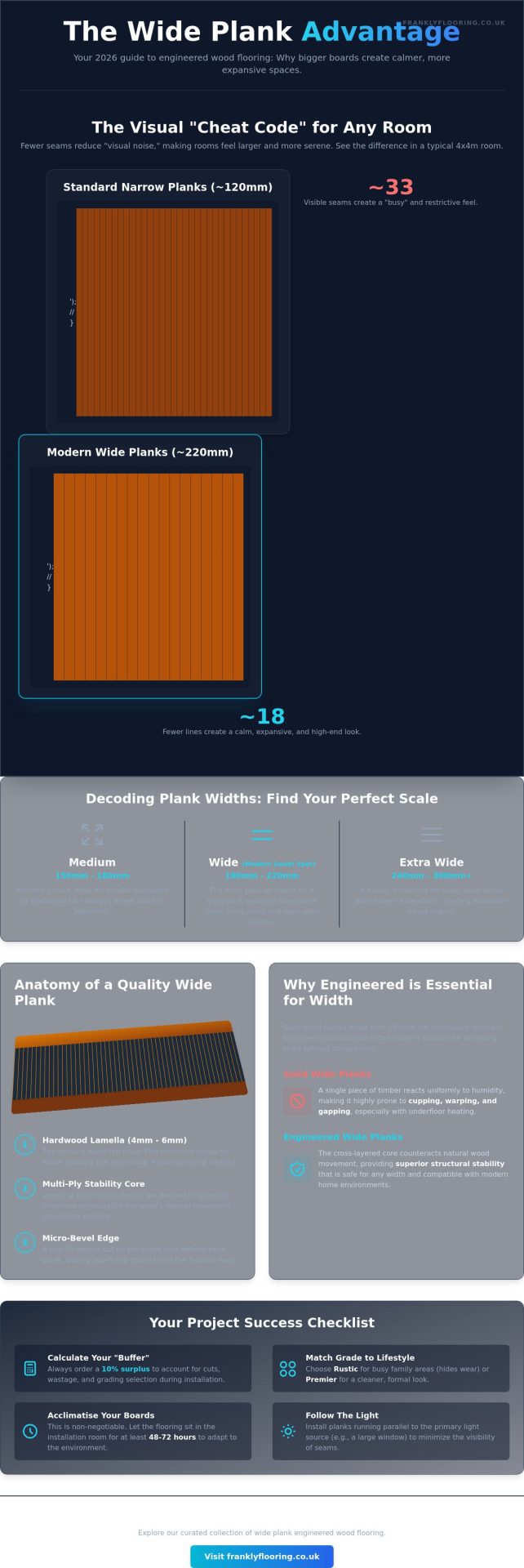
- Medium (150mm to 180mm): These boards are versatile and suit traditional UK cottages or smaller bedrooms where a massive plank might feel overwhelming.
- Wide (190mm to 220mm): This is the modern sweet spot. It provides a significant upgrade from standard “strip” flooring without requiring a massive open-plan space to look right.
- Extra Wide (240mm to 300mm+): These planks are designed for impact. They feature fewer seams across the floor, which creates a calmer, more expansive feel in large living areas or modern new-build extensions.
The Anatomy of a Wide Plank
A quality wide plank is only as good as its internal structure. The wear layer, or lamella, should ideally be between 4mm and 6mm. This thickness provides enough material for future sanding and refinishing while maintaining the stability of the board. Beneath this, you’ll find the core. Multi-ply cores, made from layers of birch or eucalyptus, offer the most reliable performance for UK homes. We also see 3-ply cores, which are excellent for stability but often slightly less rigid than their multi-ply counterparts. Finally, most wide planks feature a micro-bevel on the edges. This small 45-degree cut helps define each individual board, preventing the floor from looking like a flat, characterless sheet of wood.
The Visual Power of Wide Planks: Why Scale Matters
Every join in a floor is a line that the eye must process. In a standard room, choosing a 120mm narrow board creates nearly double the number of seams compared to a 220mm plank. This reduction in “visual noise” is the primary reason wide plank engineered wood flooring feels so much calmer. When you strip away those extra vertical lines, the floor stops looking like a busy grid and starts looking like a cohesive architectural feature. It’s a design “cheat code” that brings a sense of high-end permanence to any space.
Beyond the lack of clutter, wide planks offer a larger canvas for the wood’s natural story. Narrow strips often slice through beautiful grain patterns or cut knots in half, leaving the floor looking fragmented. Wide boards allow for uninterrupted, sweeping grain and large, characterful knots that showcase the tree’s history. This scale is particularly effective when you align the planks with your primary light source. Running the boards toward a window allows natural light to catch the grain and texture, making the seams practically disappear while highlighting the stability and performance of engineered flooring across a broader surface.
Creating the Illusion of Space
There’s a persistent myth that small rooms require small boards. We find the opposite is usually true. In a typical 4x4m UK living room, a 120mm board results in roughly 33 seams across the width. Switch to a 220mm board, and you’re down to about 18. This simple reduction in geometry makes the floor feel less restrictive. However, there’s a limit to this logic. If a board is so wide that you only see three or four planks across the entire room, it can look accidental rather than intentional. The goal is to find a width that allows for enough repetition to establish a pattern without overwhelming the floor with lines.
Aesthetics: Grades and Character
The grade of the wood you choose will drastically change how those wide planks behave visually. Rustic grade is all about “Frank” honesty. It embraces the knots, mineral streaks, and natural colour variations that occur in the forest. On a wide plank, these features have room to breathe, creating a floor with immense personality. If you prefer a more minimalist, contemporary look, Select or Prime grades offer a cleaner surface with fewer distractions. These grades allow the sheer scale of the wide boards to be the focal point. Whether you choose a brushed finish for a tactile, matte feel or a smooth lacquered finish, the wider format ensures the texture is the star of the show. If you’re unsure which look suits your home, browsing a curated selection of wood flooring can help you visualise how these grades translate to a full room.
Stability and Performance: The Frank Truth About Warping
Wood is a living, hygroscopic material. It breathes, expanding when the air is humid and shrinking when it’s dry. When you deal with standard narrow boards, this movement is manageable. However, as boards get wider, the physics change. A solid oak board wider than 150mm is a structural liability in the UK’s fluctuating climate. Without the internal support of an engineered core, these wide planks are prone to cupping, where the edges lift higher than the centre, or gapping, where unsightly spaces open up between boards. Frankly, buying solid wide planks for a UK home is an expensive gamble that rarely pays off.
The success of wide plank engineered wood flooring lies in its ability to neutralise these natural forces. By bonding the hardwood lamella to layers of plywood or softwood positioned at 90 degree angles, the internal stresses are trapped. When the top layer tries to expand, the cross-layered core holds it in place. This dimensional stability is what allows you to enjoy the expansive look of a 240mm or 300mm board without worrying about the floor failing after its first winter. It’s the only way to achieve a high-end, wide format look while maintaining long term structural integrity.
Compatibility with Underfloor Heating (UFH)
Engineered wide planks are the gold standard for homes with underfloor heating. Because they’re so stable, they handle the direct heat better than almost any other wood product. However, you must consider thermal conductivity. A board that’s too thick will act as an insulator, slowing down the time it takes for heat to reach your feet. Most experts recommend a total thickness of 15mm to 18mm for the best balance of stability and warmth. To protect your investment, you must ensure the floor surface temperature never exceeds 27°C. Running your heating too hot can dry out the timber too quickly, leading to structural stress even in engineered boards.
The Importance of Core Quality
Not all cores are created equal. If you’re looking for the best performance, birch plywood is the “Frank” choice for density and screw-holding strength. Eucalyptus is a strong mid-range alternative, while softwood cores are often found in budget-friendly options. While a thicker board might feel more substantial, it’s the density and number of layers in the core that truly determine how the plank will behave over time. A high-quality 15mm board with a birch ply core will often outperform a 20mm board with a cheap, loose-grained softwood centre. Higher core density directly increases the resistance of wide planks to the internal stresses caused by atmospheric humidity changes.
How to Choose Your Wide Plank Floor: A Selection Framework
Choosing your wide plank engineered wood flooring shouldn’t be a decision based solely on a small sample or a pretty social media photo. You need to look at the practicalities of your specific home. A high-traffic hallway in a family home with muddy paws and boots requires a finish that can be maintained easily, whereas a low-traffic guest bedroom might allow for a more delicate aesthetic. Your subfloor also dictates your options. If you’re fitting over concrete, you’ll need a damp proof membrane and potentially a floating installation. If you’re fixing directly to joists, the plank must be structural, usually requiring a thickness of 18mm or 20mm.
Grade selection is where decor meets reality. If your home embraces a traditional farmhouse or “shabby chic” vibe, a Rustic grade is your best friend. It hides the inevitable scuffs of life better than almost any other option. For minimalist, modern interiors, a Select or Prime grade offers the clean, uniform look you’re after, but be aware that every speck of dust or minor scratch will be more visible. It’s a trade-off between visual purity and daily maintenance.
Oil vs Lacquer: The Maintenance Reality
The “Frank” truth about floor finishes is that they all scratch eventually. The difference lies in how you deal with it. A lacquered finish acts like a plastic-tough shield. It’s incredibly easy to clean and resists spills, but once it’s scratched, you can’t easily fix a single spot. You’d likely need to sand and refinish the whole room. In contrast, UV Oiled finishes penetrate the wood grain. They offer excellent sun protection to prevent your wide oak boards from fading, and the best part is the repairability. You can spot-repair a scratch in an oiled floor with a bit of maintenance oil and a rag. It’s a more hands-on approach, but it keeps the floor looking “newly laid” for longer without a full restoration.
Specifying the Right Thickness
When you’re browsing, you’ll see boards ranging from 14mm to 20mm. Don’t assume thicker is always better. A 14mm or 15mm board is perfectly adequate for most domestic settings, especially when fitted over a solid subfloor like concrete or plywood. The real number to watch is the wear layer, or lamella. This hardwood top layer usually ranges from 3mm to 6mm. A thicker wear layer means the floor can be sanded down more times over its lifespan. If you want a deeper dive into the technical specs of different board types, our broader guide on engineered wood flooring covers these nuances in detail. Generally, you only need the 20mm structural planks if you are fitting directly across floor joists where the board itself provides the strength of the floor.
Ready to find your perfect match? You can shop our full range of wood flooring to see how these different finishes and thicknesses look in person.
Installation and Practical Considerations for UK Homes
Installing wide plank engineered wood flooring requires a higher level of precision than standard strip flooring. You can’t just slap it down and hope for the best. The first rule is the 10% wastage buffer. While 5% might suffice for narrow boards, wide planks are different. If you make one wrong cut on a 220mm board, you’ve lost a significant chunk of square meterage. Ordering that extra 10% ensures you aren’t left short at the end of the project because of a few tricky corner cuts.
Acclimatisation is another non-negotiable step. Your boards need to sit in the room where they’ll be fitted for at least 48 to 72 hours. This allows the timber to reach an equilibrium with the local humidity and temperature of your home. Skipping this step is the fastest way to invite structural stress. Similarly, your subfloor must be perfectly level. Because wide planks have a larger surface area, they’re less “forgiving” than small boards. Any hump or dip in the subfloor will cause the plank to bridge the gap, leading to an annoying “hollow” sound or physical bounce when you walk on it.
Floating vs Glue-Down Installation
We’re often asked which method is better. For wide formats, we almost always recommend a glue-down installation. Bonding the planks directly to the subfloor eliminates that “springy” feeling and makes the floor feel as solid as a traditional hardwood installation. If you choose a floating system, you’ll need a high-quality, high-density underlay to support the weight and width of the boards. If your new wood floor meets a carpeted room, check out our guide on carpet grippers to ensure a professional, flush transition between the different materials.
The Cost of Wide Planks
There’s no hiding the fact that wider boards carry a price premium. It’s a matter of raw material supply. To get a clean, wide plank, you need larger, older logs, which are rarer and more expensive to source and process. However, this isn’t just an expense; it’s an investment in your property’s value. Wide planks are a hallmark of high-end design and are frequently cited by estate agents as a feature that boosts resale appeal. Wide plank engineered floors offer superior long-term value over laminate because their thick wear layers allow for multiple refinishing cycles, effectively resetting the floor’s lifespan every decade. It’s a foundational element that’s built to last for generations, not just a few seasons.
Build a Lasting Foundation for Your Home
Selecting your floor is a decision that shapes the character of your property for decades. You now understand that wide plank engineered wood flooring isn’t just a visual “cheat code” for making rooms look larger. It’s a technically superior choice that offers the stability needed for the UK’s fluctuating climate, provided you prioritise core quality and proper acclimatisation. By choosing the right grade and finish for your lifestyle, you’re investing in a floor that will age gracefully alongside your home.
As a family-run business with over 20 years of experience, we value transparency and technical craftsmanship over high-pressure sales tactics. We offer direct-to-consumer prices and the “Frank” advice you need to get the job done right. If you’re ready to start your project, we provide free delivery on all orders over £499 to help keep your budget on track.
Browse our full range of Wide Plank Engineered Wood Flooring and find the perfect match for your next renovation. We look forward to helping you create a space you’ll be proud of for years to come.
Frequently Asked Questions
Are wide planks more expensive than narrow planks?
Yes, wide planks generally carry a higher price per square metre than narrow ones. Producing wide boards requires larger, older trees, which are rarer and more expensive to harvest. The manufacturing process also generates more timber waste to achieve a clean, wide finish. While the initial material cost is higher, the reduced number of joins can sometimes lead to a slightly faster installation process.
Do wide planks make a small room look smaller?
No, wide planks actually create the illusion of a larger space by reducing visual clutter. Fewer joins mean fewer vertical lines for the eye to process, which makes the floor look like one continuous, expansive surface. In a small UK bedroom or hallway, a wide plank can prevent the room from feeling busy or boxed in by a grid of smaller boards.
Can I use wide plank engineered wood with underfloor heating?
Yes, wide plank engineered wood flooring is specifically designed to handle the thermal changes of underfloor heating. The cross-layered core prevents the wood from warping or gapping as it heats and cools. You should ensure the floor surface temperature stays below 27°C and choose a board thickness, typically 15mm to 18mm, that allows for efficient heat transfer.
How much wastage should I allow for wide plank flooring?
You should allow for a 10% wastage buffer when ordering wide planks. Because each board covers more surface area, a single mistake or a complex cut around a door frame results in a larger loss of material than with narrow strips. Having this extra stock on hand ensures you don’t run out during the final stages of fitting or end up with awkward, mismatched joins.
Is engineered wood better than solid wood for wide planks?
Yes, engineered construction is the only reliable way to produce wide planks for the UK climate. Solid wood boards wider than 150mm are notoriously unstable and will likely cup or gap as humidity levels change. The multi-ply or 3-ply core of an engineered board traps the natural movement of the wood, providing the structural integrity needed for widths up to 300mm.
How do I clean and maintain wide plank engineered wood?
Maintenance is straightforward but requires the right tools. Use a soft-bristled vacuum or a dry microfibre mop for daily dust removal to prevent scratches. For deeper cleans, use a well-wrung damp mop with a pH-neutral wood floor cleaner. Avoid steam mops or excessive water, as these can penetrate the joins and cause the timber to swell or the finish to peel.
What is the widest engineered wood plank available?
While specialty architectural boards can reach widths of 400mm or more, most high-quality residential ranges peak at around 300mm. The most common “extra wide” boards found in modern UK homes typically measure between 220mm and 260mm. These widths offer a dramatic, high-end aesthetic while remaining practical for standard room sizes and subfloor conditions.
Do wide planks need to be glued down?
While you can fit them as a floating floor, we strongly recommend a full glue-down installation for wide planks. This method provides a much firmer feel underfoot and eliminates the “hollow” sound or slight bounce often associated with floating systems. Glueing the boards directly to the subfloor also enhances the floor’s stability, which is vital for boards with a large surface area.