The era of “safe” sterile grey is officially over, and frankly, it’s about time. Choosing a new floor often feels like a gamble, especially when you’re caught between a budget $1.00 per square foot polyester and a luxury $20.00 wool. You want a home that feels current, yet you’re rightly worried that today’s “must-have” colour will look like a mistake in two years. It’s easy to feel overwhelmed by technical jargon while just trying to find something that survives the kids and the dog.
We believe in being straightforward about what actually works. This guide explores the defining modern carpet trends 2026, moving away from flat synthetics toward “Tactile Authenticity” and organic warmth. You’ll learn why the “New Earth” palette is replacing cold tones and how upcoming regulations, such as the December 31, 2026 ban on PFAS chemicals, are shifting the focus toward safer, sustainable materials. We’ll break down the honest differences between wool and nylon so you can invest with confidence, ensuring your home feels both stylish and timeless.
Key Takeaways
- Understand the shift from cold, blue-based greys to the “Glow” trend of warm neutrals and organic Japandi styles.
- Learn why natural fibres are essential for 2026, offering superior breathability and a smaller environmental footprint.
- Discover how to use biophilic patterns and earthy palettes like moss green and terracotta to create a calming, nature-inspired space.
- Get an honest assessment of how to apply modern carpet trends 2026 to your specific lifestyle, ensuring durability in busy family homes.
- Master the straightforward method for measuring your room and buying carpet online to ensure a seamless fit without the stress.
The Evolution of Modern Carpet Trends: From Grey to Glow
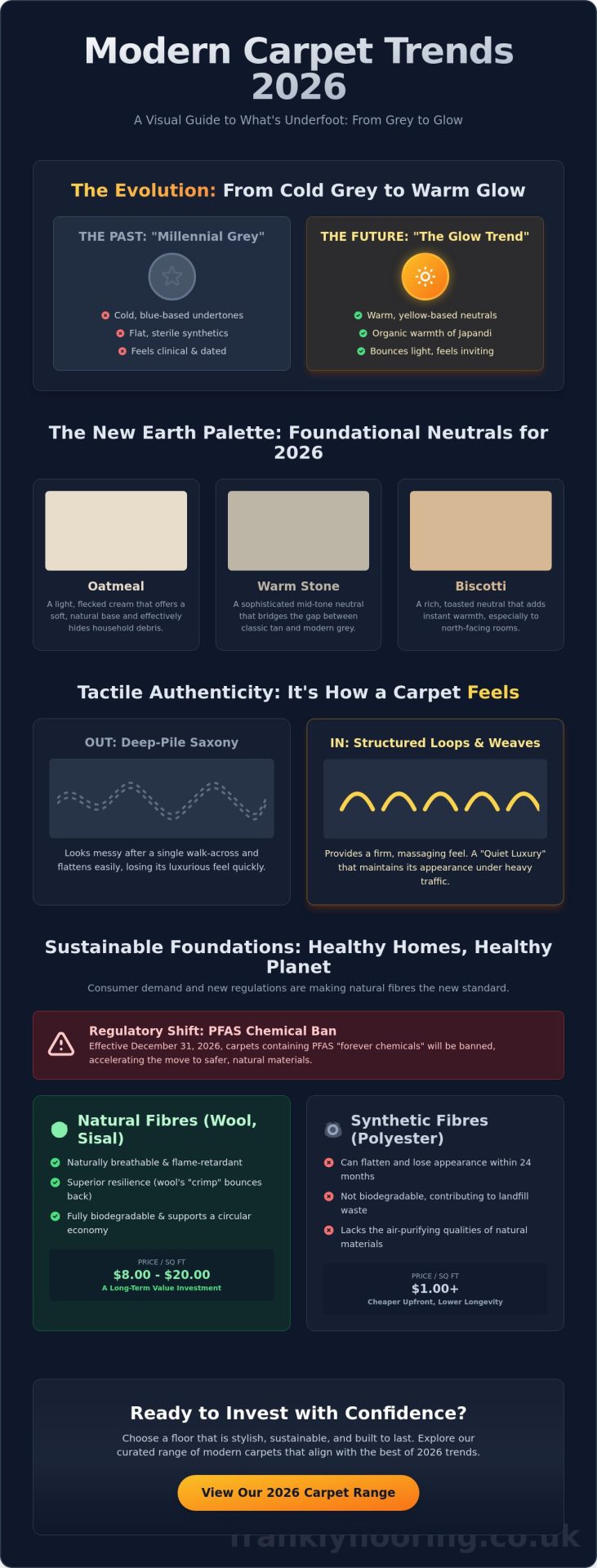
For years, homeowners defaulted to cool, steely greys. It was a safe choice, but by May 2026, those blue-undertones started feeling cold and clinical. The modern carpet trends 2026 represent a significant pivot toward what we call the “Glow” trend. Instead of absorbing light into a flat, grey surface, these new styles use warm, yellow-based neutrals to bounce light around a room. This shift marks the evolution of Hygge and Scandi-minimalism into “Japandi”, a style that blends Japanese functionality with organic warmth. We’re seeing a move away from uniform, flat textures toward heavy-gauge loops and visible weaves that celebrate the raw material. The 2026 aesthetic is defined by “Tactile Authenticity”, a design philosophy that prioritises sensory comfort and the honest expression of materials over mere visual uniformity.
Moving Beyond the “Millennial Grey” Era
Cool greys are struggling to stay relevant in 2026. They often clash with the natural wood and stone textures currently dominating home design. In their place, “Greige” and “Mushroom” have emerged as the new foundational neutrals. These shades offer the versatility of grey but with a toasted, earthy undertone that feels much more inviting. If you’re looking to transition an existing grey room without a full overhaul, swapping a cool-toned carpet for a warmer mushroom shade can instantly soften the space. It’s a straightforward way to modernise without losing that neutral base. Popular 2026 neutrals include:
- Oatmeal: A light, flecked cream that hides household debris effectively.
- Warm Stone: A mid-tone neutral that bridges the gap between tan and grey.
- Biscotti: A rich, yellowish neutral that adds warmth to north-facing rooms.
The Rise of Tactile Comfort underfoot
Modern interior design is no longer just about how a room looks; it’s about how it feels when you walk through it at the end of a long day. This focus on sensory experience is why deep-pile saxonies, which often look messy after one walk-across, are being replaced by structured loops. These loops provide a firm, massaging feel that aligns with the “quiet luxury” movement. Understanding the history and materials of carpet helps explain why this shift matters. While synthetic fibres dominated the past decade, the modern carpet trends 2026 favour natural, structured weaves that offer longevity and a sophisticated finish. These carpets don’t just sit in a room; they provide a foundational character that feels intentional and grounded. By choosing a heavy-gauge loop, you’re investing in a floor that maintains its appearance under heavy foot traffic while providing a distinct, high-end texture that flat carpets simply can’t match.
Sustainable Foundations: Why Natural Fibres Dominate in 2026
In 2026, sustainability is no longer a luxury choice; it’s a fundamental requirement. Homeowners are increasingly prioritising materials that are healthy for their families and the planet. This shift is partly driven by new regulations, such as the ban on PFAS chemicals in carpets effective December 31, 2026. Natural fibres like wool, sisal, and seagrass are at the heart of modern carpet trends 2026 because they offer inherent benefits that synthetics struggle to match. These materials are naturally breathable, flame-retardant, and fully biodegradable. Choosing an environmentally preferable carpet ensures your home remains free from “forever chemicals” while supporting a circular economy.
The “Frank” truth is that while high-end wool can cost between $8.00 and $20.00 per square foot, the long-term value often outweighs the initial price tag. Synthetic options like polyester are cheaper upfront, but they don’t offer the same resilience or air-purifying qualities. If you’re carpeting a high-traffic hallway, a natural weave is usually the smarter investment for longevity. You can view our latest carpet range to see how these sustainable materials look in a real home setting.
The Return of 100% British Wool
British wool is seeing a massive resurgence within modern carpet trends 2026. It’s a superb natural insulator. By trapping air within its fibres, a wool carpet can significantly reduce heat loss through the floor, helping you manage rising energy bills. Unlike synthetic fibres that can flatten after just 24 months, wool has a natural “crimp” that allows it to bounce back. This “farm-to-floor” movement isn’t just about aesthetics; it’s about supporting local farmers and ensuring a transparent supply chain. A well-maintained wool carpet can easily last 15 years, making it a sustainable choice for both your wallet and the environment.
Sisal, Seagrass, and Plant-Based Fibres
For those who want a distinct, architectural look, plant-based fibres are the go-to choice. We often get asked about sisal vs berber when customers are planning hallway updates. Sisal is incredibly tough, making it perfect for stairs and entrances where boots and paws do their worst. However, it’s worth being honest: sisal is coarse. It’s not the material you want for a bedroom where you’ll be walking barefoot. Seagrass offers a slightly smoother finish but lacks the dye versatility of wool. To achieve a high-end look, pair these raw textures with soft furniture to balance the ruggedness of the weave.
Patterns and Palettes: What’s Underfoot This Year
The visual shift in modern carpet trends 2026 is about more than just a fresh coat of paint for your floor. It’s a move toward “Biophilic Design,” where patterns mimic natural landscapes like forest floors, rippled sand, or weathered stone textures. This isn’t just about looking pretty; it’s about psychological comfort and creating a sanctuary at home. According to the 2026 carpet industry forecast, we’re seeing a renewed interest in soft surfaces that provide visual depth without overwhelming the senses. It’s a sophisticated way to bring the outdoors in without the maintenance of actual greenery. These patterns are often created using varying pile heights or different yarn weights, giving the floor a three-dimensional quality that feels bespoke.
The “New Earth” Colour Story
The palette for 2026 is anchored in Clays, Terracotta, and Moss Green. These aren’t the bright, loud versions of these colours, but muted, dusty iterations that feel grounded and permanent. In British homes, where natural light can be grey and fickle for much of the year, these warm tones are essential. They provide a “glow” that cool-toned carpets lack, making a room feel inhabited rather than just decorated. When choosing a colour, consider how it interacts with your existing furniture. A terracotta base works brilliantly with mid-century teak or modern oak. It’s a choice that won’t feel dated by 2028 because it’s based on natural pigments. These modern carpet trends 2026 prioritise longevity over fleeting fashion fads, ensuring your investment stands the test of time.
Maximalist Patterns in Minimalist Spaces
While bedrooms are often kept calm and neutral, the “Statement Hallway” is making a huge comeback. Bold stripes and geometric weaves like herringbone are perfect for these transition spaces. In smaller UK homes, a vertical stripe can actually make a narrow hallway feel longer and more spacious. Don’t be afraid of small-scale patterns; they often act as a neutral from a distance while hiding the inevitable marks of daily life better than a plain pile. The trick to balancing a patterned floor is keeping your walls simple. Let the carpet do the heavy lifting in the room. Geometric prints like honeycomb or subtle chevrons add a layer of architectural interest that flat piles simply can’t match.
If a full patterned carpet feels like too much of a commitment, layering is your best friend. Many people are choosing to keep their foundational carpet neutral and then using rugs to introduce texture and colour. This approach gives you the flexibility to change the room’s look without the cost of a new fitting or moving every piece of furniture. It’s a straightforward way to stay current while protecting your main investment. By layering a high-pile rug over a low-profile loop carpet, you create a sense of depth and luxury that feels both modern and timeless.
The Frank Reality Check: Matching Trends to Your Lifestyle
Social media feeds are often full of beautiful, impractical floors that wouldn’t last a week in a standard British household. While modern carpet trends 2026 offer exciting new aesthetics, we need to be honest about what works when real life happens. An all-white, deep-pile carpet looks stunning in a showroom, but for a busy family with a Golden Retriever, it’s a recipe for stress. Most homeowners expect their flooring to last between 10 and 15 years. Achieving that longevity requires looking past the colour and focusing on technical specifications like pile weight and density. A 40oz or 50oz wool blend provides the resilience needed for a lounge, whereas a lighter weight might suffice for a guest bedroom. Success comes down to choosing the right carpet based on the actual foot traffic in each specific room.
When assessing a carpet’s durability, don’t just feel the top. Check the backing and the density of the tufts. A denser carpet with shorter piles will generally outperform a loose, shaggy texture over a decade of use. If you’re planning a large project, remember that the average cost to carpet a 1,000-square-foot area with mid-range materials sits between $5,500 and $9,000. It’s a significant investment, so it pays to be realistic about maintenance before you commit to a specific style. You can browse our full carpet collection to compare different weights and textures side-by-side.
Pet-Friendly and Family-Proof Trends
The rise of “cleanable luxury” is a game-changer for 2026. We’re seeing advanced synthetic fibres that mimic the matte look of wool but are entirely bleach-cleanable. This is perfect for those who want the “Glow” trend without the fear of permanent stains. However, if you have cats, be careful with the popular heavy-gauge loop trends. Those beautiful loops are essentially scratching posts that can snag and pull, ruining the look of your landing in months. For pet owners, a high-quality twist pile is often the more straightforward, honest choice. The “New Earth” palette is also a practical win here; moss greens and warm stones are far more forgiving than flat greys when it comes to hiding everyday dust and pet hair.
High-Traffic Areas vs. Sanctuary Spaces
Your stairs and landings are the motorways of your home. They require a different approach than a master bedroom. For these high-traffic zones, durability is king. A wool-rich blend (typically 80% wool and 20% nylon) remains the industry gold standard for stairs because it retains its shape under pressure. In contrast, bedrooms are the place to embrace the “cloud-like” trend. Here, you can prioritise softness and a higher pile height for that luxury feel underfoot. Regardless of the room, never skimp on the foundation. A high-quality underlay is essential for trend longevity. It can extend the life of your carpet by up to 40% by absorbing the impact of footsteps and providing better thermal insulation.
Navigating 2026 Carpet Trends Online: A Straightforward Buying Guide
The shift toward digital shopping hasn’t missed the flooring industry. While some traditionalists still insist you must visit a physical showroom, the reality of 2026 is that you can buy carpet online in the UK with total certainty. It’s about having a clear, honest process. We don’t believe in high-pressure sales; we believe in providing the right information so you can make an informed choice from your own sofa. To stay ahead of modern carpet trends 2026, you need a retailer that prioritises transparency over glossy marketing speak. Our “Frank” method for measuring involves adding a 10cm safety margin to your room’s widest and longest points. This simple step helps you avoid the common pitfall of being short on material during the fitting, while also ensuring you don’t overspend on unnecessary waste.
Ordering samples is a non-negotiable part of the process. In 2026, where the “Glow” trend relies heavily on how warm neutrals react to light, you need to see the material in your own space. A sample that looks beige in a bright warehouse might look like a warm mushroom in your north-facing lounge. Once you’ve made your choice, we handle the logistics of getting your new carpet from our warehouse to your front door. We provide clear delivery windows so you aren’t left waiting around, allowing you to coordinate with your local fitter for a seamless transition from old floor to new.
Judging Texture and Colour from a Screen
Screens can be deceptive, but they are getting better. To get the best sense of a 2026 trend, look for customer photos and videos that show the carpet in real-world settings. These “unfiltered” views often reveal more about the pile height and how the light catches a structured loop than a professional studio shot ever could. When your samples arrive, check them at different times of the day. A moss green might feel vibrant in the morning sun but transform into a moody, sophisticated forest green by evening. We provide honest, technical descriptions of every product, from the exact millimetre height of the pile to the density of the weave, so there are no surprises when the roll is uncurled.
The Frankly Flooring Approach to Modern Style
Our commitment is to quality that outlasts fleeting fads. We don’t just sell what’s trendy; we sell what’s reliable. Every item in our collection is vetted for its ability to stand up to the rigours of a real home. As you finalise your order, don’t forget the essentials that keep a high-end trend looking sharp. A final checklist should always include quality underlay to protect your investment and the right carpet grippers to ensure a taut, professional finish. We also provide matching door bars to create a clean transition between rooms. By handling the end-to-end supply process with honesty and precision, we ensure your journey into modern carpet trends 2026 is straightforward, stress-free, and successful.
Ready to Step Into the 2026 Aesthetic?
The shift toward “Glow” tones and sustainable natural fibres isn’t just a fleeting change; it’s a fundamental move toward healthier, more comfortable homes. By choosing warm neutrals and resilient materials like British wool, you’re investing in a space that remains stylish long after the calendar turns. We’ve explored how modern carpet trends 2026 prioritise tactile authenticity and practical durability over cold, sterile minimalism. It’s about creating a sanctuary that stands up to the rigours of daily life while reflecting a more organic, grounded style.
As a family-run business with over 20 years of expertise, we pride ourselves on a straightforward approach. We offer direct national delivery across the UK and maintain transparent, honest pricing with no hidden fitting costs. You won’t find high-pressure sales tactics here; we provide expert advice to help you get the job done right. Browse our 2026 Carpet Collection and order your free samples today to see the quality for yourself. Choosing a new floor is a big decision, but with the right information and honest materials, it’s one you can make with total confidence. Your home is the foundation of your character; let’s make sure it starts on the right footing.
Frequently Asked Questions
What is the most popular carpet colour for 2026?
Warm, earthy tones like Mushroom, Terracotta, and Moss Green are the leading choices for 2026. These colours form the “New Earth” palette, replacing the clinical whites and cool greys of previous years. They provide a natural “glow” that makes British rooms feel inhabited and comfortable. By choosing these pigments, you’re opting for a look that feels grounded and won’t clash with the wood and stone textures currently dominating home design.
Are grey carpets going out of style in 2026?
Cool, blue-based greys are definitely feeling dated in 2026, but the colour hasn’t vanished entirely. Instead, it has evolved into “Greige” and “Warm Stone” shades that incorporate yellow or brown undertones. These warmer variations are much more versatile and inviting. They bridge the gap between traditional neutrals and modern minimalism, making them a safe but current choice for anyone wary of bold colour shifts.
Which carpet material is most sustainable for UK homes?
British wool is the most sustainable option for UK homes because it is renewable, biodegradable, and locally sourced. Unlike synthetic fibres that can take centuries to break down, wool is a natural protein that returns to the soil. It also acts as a superb insulator. This helps reduce energy consumption by trapping heat within its fibres, which is a significant practical benefit in our colder climate.
Can I use patterned carpet in a small room without it feeling cluttered?
You can absolutely use patterned carpet in a small room by choosing small-scale motifs or vertical stripes. A vertical stripe can actually make a narrow hallway feel longer and more spacious by drawing the eye forward. The key is to keep the walls neutral. Let the modern carpet trends 2026 do the architectural work on the floor while keeping the rest of the space simple and uncluttered.
What is the best carpet trend for homes with pets and children?
The best trend for active households is “cleanable luxury,” which uses advanced, bleach-cleanable synthetic fibres that mimic the matte look of wool. These carpets handle spills and muddy paws without permanent damage. If you prefer natural materials, a high-density 80/20 wool-rich twist is the honest choice. It offers excellent resilience and hides household debris much better than a flat, light-coloured pile.
How do I know if a carpet is high quality when buying online?
Focus on technical specifications like pile weight and density rather than just the photo. A high-quality carpet will typically have a pile weight of 40oz per square yard or higher. Check the backing material too; a secondary jute or action back suggests better stability. Reliable retailers will always provide these numbers upfront so you can compare products accurately without needing a showroom visit.
Is wool carpet worth the extra investment in 2026?
Wool is definitely worth the investment in 2026 because it outlasts budget synthetics by several years. While a mid-range nylon might last 10 years, a well-maintained wool carpet can easily reach 15 years or more. It retains its appearance better because the fibres have a natural “crimp” that prevents flattening. This longevity makes it the most cost-effective and straightforward choice for long-term homeowners.
What underlay should I use with modern loop-pile carpets?
You should use a high-density firm underlay with modern loop-pile carpets to prevent the loops from stretching or distorting. A 9mm or 11mm high-density foam underlay provides the necessary support while adding a significant layer of comfort. This foundation is essential for maintaining the crisp, structured look of the weave. Skimping on underlay is a common mistake that can shorten the lifespan of your new flooring by up to 40%.