
Would you buy a luxury sports car just to drive it through a muddy field every single day? Choosing a saxony carpet for your home requires a similar bit of honest logic. It is the undisputed gold standard for comfort, offering that plush, velvet-like finish that defines a high-end bedroom or a formal lounge. However, many homeowners dive into this investment without fully understanding the “footprint” reality. You likely want that deep, indulgent pile, but you are probably worried about those tell-tale tracking marks or the carpet losing its bounce after just a few months of use.
We believe in being frank about flooring. In this guide, we’ll help you decide if a saxony pile is a dream come true or a maintenance headache for your specific space. We will break down the differences between polypropylene and polyester, explain why your choice of underlay is just as important as the carpet itself, and show you exactly which rooms benefit most from this luxurious style. By the end, you will have the confidence to choose a floor that stays looking brilliant for years to come.
Key Takeaways
- Identify the specific construction of a saxony carpet to understand why its dense, cut-pile fibres offer a level of luxury that other styles cannot match.
- Differentiate between straight and textured finishes to manage your expectations regarding “shading” and footprint marks in different rooms.
- Get honest advice on where to lay this plush pile, including why bedrooms are the perfect fit and why high-traffic areas might be a step too far.
- Learn why the right underlay and accessories are non-negotiable for preserving the height and soft feel of your new investment.
- Compare Saxony against Twist and Berber alternatives to ensure you are picking the right material, such as polypropylene or polyester, for your household needs.
What Is Saxony Carpet? The Frank Truth About Luxury Pile
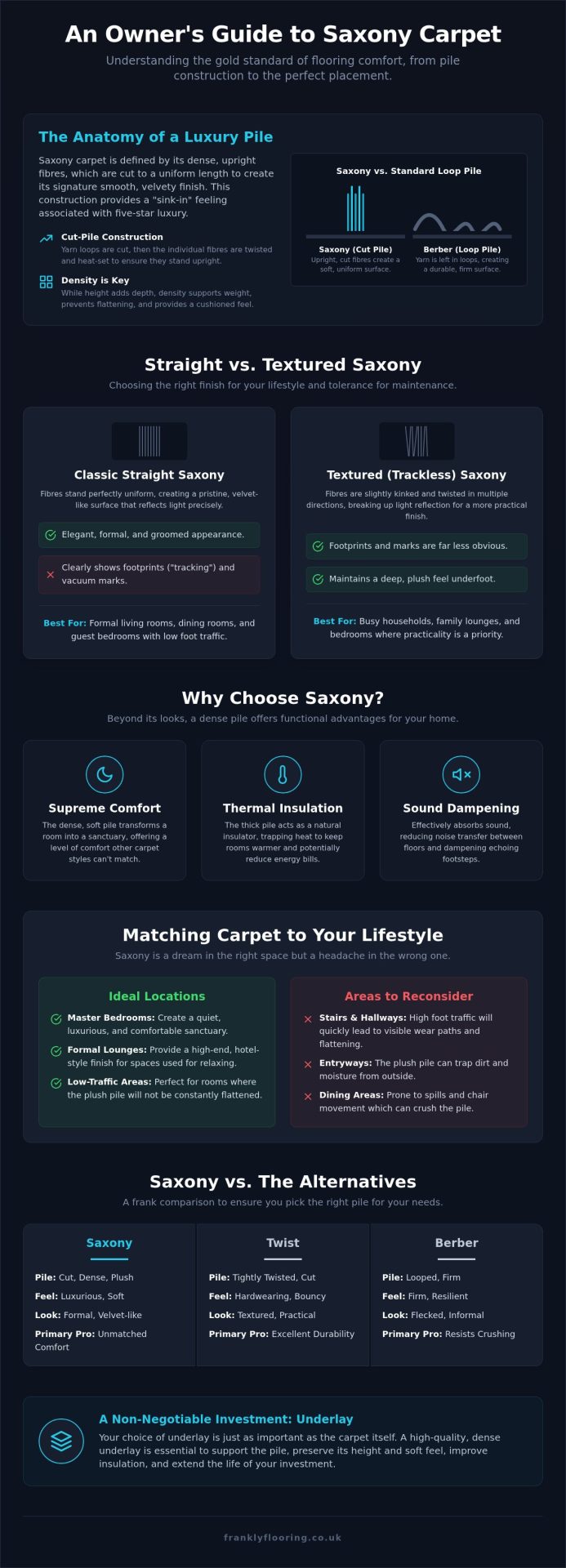
Saxony carpet is a cut-pile floor covering with a uniform, level surface and a typically higher-than-average pile height. Think of it as the flooring industry’s version of a high-thread-count duvet. It’s pure luxury, but it needs care. A Carpet like this is defined by its upright fibres, which are cut to the same length to create a smooth, velvety finish. When you walk on a saxony carpet, the density of the pile provides that signature “sink-in” feeling that people often associate with five-star hotels.
The Anatomy of a Saxony Pile
To understand why this style feels so different, you have to look at the construction. Most carpets are made by pulling loops through a backing, but in a Saxony, those loops are cut. The yarn is then twisted and “heat-set.” This technical process is vital because it ensures the individual fibres have enough strength to stand upright rather than flopping over.
We often discuss pile height and pile density with our customers. While height gives you that visual depth, density is what actually supports your weight and prevents the carpet from looking flat. A high-quality pile balances both. This balance is why it feels significantly thicker and softer than a standard twist carpet, providing a cushion-like effect that’s hard to beat.
Why British Homeowners Choose Saxony in 2026
Why is this style still a top choice for UK homes? It mostly comes down to the atmosphere it creates. A deep saxony carpet transforms a master bedroom into a sanctuary. It offers a hotel-style finish that looks intentional and expensive. For those seeking to complete their high-end aesthetic, luxury retailers like HANKI offer inspiration for furniture and décor that pairs beautifully with such premium flooring. However, the benefits aren’t just about looks.
Because the pile is so dense, it acts as a natural thermal insulator. It helps trap heat in the room, which is a welcome feature during a damp British winter. It is also a fantastic sound dampener. If you are tired of hearing footsteps echoing from the floor above, a thick pile can significantly reduce noise transfer between levels. It is a functional choice for comfort as much as it is a stylistic one for your home.
Not all saxony carpet is created equal. The choice between a straight or textured finish will dictate how much time you spend obsessing over your vacuum cleaner. Straight Saxony is the classic choice. It offers a smooth, uniform surface where every fibre stands in exactly the same direction. It looks incredible when freshly laid, but there’s a catch. If you hate seeing every single footprint, our frank advice is to steer clear of the straight stuff and opt for something more forgiving.
The Classic Straight Saxony Look
If you want that elegant, groomed appearance, straight Saxony is the way to go. However, because the fibres are so uniform, they reflect light with precision. When you walk across it or push a vacuum over it, the fibres bend. This creates “tracking” (visible footprints) and “shading” (darker or lighter patches). In the flooring trade, we sometimes call this watermarking. It isn’t a defect in the carpet; it’s just a result of light hitting the pile at different angles. The Carpet and Rug Institute highlights that this refined surface is highly suitable for traditional living and dining rooms. It’s for those who value a formal, velvet-like aesthetic over everyday practicality.
Textured Saxony: The Practical Alternative
Textured Saxony, often marketed as “trackless,” is the sensible answer for busy households. Instead of all the fibres standing perfectly upright, they are slightly kinked or twisted in different directions during manufacturing. This clever bit of engineering breaks up the light reflection. You still get the deep, plush feel underfoot, but footprints and vacuum marks are far less obvious. It’s a brilliant compromise for a home that actually gets lived in.
Choosing between the two depends entirely on your tolerance for maintenance. A straight pile is perfect for a guest bedroom that stays pristine. A textured pile is better for a lounge where you want luxury without the constant need to “brush” the carpet back to a uniform look. If you’re ready to find a style that balances beauty with your daily routine, you can view our range of carpet options to see how these different piles perform in a real home environment.
Saxony vs. Twist and Berber: A Frank Comparison
Choosing a new floor often feels like a balancing act between style and survival. While a saxony carpet is the undisputed king of comfort, it isn’t always the right tool for the job. To make a smart investment, you need to understand how it stacks up against the “all-rounders” of the flooring world: Twist and Berber. We won’t pull any punches here; some carpets are built for the chaos of a hallway, while others are designed strictly for the sanctuary of a bedroom.
| Carpet Style | Durability | Softness | Maintenance |
|---|---|---|---|
| Saxony | Moderate | Excellent | High |
| Twist | High | Moderate | Low |
| Berber | High | Low | Moderate |
Durability and Pile Resilience
Twist carpets are the workhorses of British homes. Their fibres are tightly twisted together, allowing them to “bounce back” after being stepped on. In contrast, the deep, upright fibres of a saxony carpet are more prone to flattening over time if they are placed in high-traffic zones like stairs or landings. If you choose a cheaper, low-density Saxony for a busy living room, you’ll likely see “traffic lanes” appearing within a year. Understanding these carpet characteristics is vital for long-term value. For areas where people are constantly on the move, the resilience of a twist is hard to beat.
Maintenance and Cleaning Realities
Berber carpets, made from loops rather than cut fibres, offer a rugged look but come with a specific warning: pets. A cat or dog can easily snag a loop, causing a permanent pull that ruins the aesthetic. Saxony doesn’t have this snagging issue, but its depth creates a different challenge. Dirt can sink deep into the pile, making it harder to reach with a standard vacuum. You’ll need a vacuum with adjustable height settings to ensure you’re actually cleaning the base of the fibres without getting the machine “stuck” in the plushness. Berber is also notoriously difficult to deep-clean because the loops trap moisture and grit more effectively than cut-pile styles.
The Frank verdict is simple. Use a durable twist for the hall, stairs, and landing where resilience is the priority. Save the saxony carpet for the bedroom or a formal lounge where you can enjoy the luxury without worrying about the heavy footfall of daily life.
Where to Lay Saxony: Matching Carpet to Your Lifestyle
Some retailers will tell you that a saxony carpet is suitable for every room in the house. We disagree. While it is arguably the most comfortable pile available, its height and density make it a specialist choice rather than a general-purpose one. If you put it in the wrong place, you’ll be replacing it long before you should. For instance, putting Saxony on stairs is a mistake you will likely regret. The thick pile can mask the edge of the step, creating a trip hazard, and the fibres will flatten quickly under the pressure of climbing feet. This leaves you with a worn-out, crushed look in just a few months.
You also need to think about your household dynamic. If you have large pets or young children, a very deep pile can become a magnet for crumbs and pet hair that a standard vacuum might struggle to reach. It isn’t that you can’t have luxury with a family; you just need to be honest about how much time you want to spend maintaining it.
The Bedroom Sanctuary
Bedrooms are the natural home for this style. It is the one place where foot traffic is low and you are most likely to be barefoot. That signature “barefoot feel” is the primary reason people fall in love with a saxony carpet. To get the most out of your investment, we always recommend pairing it with a high-quality underlay. A good underlay doesn’t just add to the luxury; it protects the pile from the hard subfloor, ensuring it stays plush for much longer. During a cold British winter, the density of this carpet also provides a noticeable layer of insulation, keeping your sanctuary warm the moment you step out of bed. To further enhance this comfort, you can visit King of Cotton to find premium bedding options that pair perfectly with a luxurious bedroom floor.
The Living Room Debate
Can you use it in a lounge? Yes, but you need to be strategic. If your living room is the heart of a busy home, a deep, straight Saxony might be a struggle to keep pristine. However, a shorter, denser textured version can work brilliantly. You must consider heavy furniture indents. Because the fibres stand so high, a heavy sofa will leave permanent “crushing” marks. We always advise using furniture cups to spread the weight and prevent the pile from being flattened forever. For lounges, look for a stain-resistant polypropylene Saxony. It gives you that soft feel but allows you to clean up the inevitable spills of daily life. If you’re ready to upgrade your space with a pile that suits your routine, you can browse our full carpet collection to find the right balance of pile and practicality.
Buying Saxony Carpet Online: A Stress-Free Approach
Buying a saxony carpet online shouldn’t be a gamble. Many homeowners believe they need a high-street showroom to judge quality, but those physical stores have massive overheads that inevitably inflate your final bill. By choosing a specialist, you get better value for the exact same luxury. You just need to be precise with your preparation. Measuring your room accurately is the first step to avoiding expensive mistakes. Always measure the longest and widest points, including any door recesses or bay windows. We recommend adding 10cm to each dimension as a safety margin. It’s far cheaper to trim away a bit of excess than to end up with a gap in the corner of your bedroom.
Logistics for large carpet rolls in the UK can be tricky because of their weight and length. We’ve spent 20 years refining our delivery process to ensure these bulky items arrive safely at your front door without the stress. This direct-to-consumer approach means you aren’t paying for a salesperson’s commission, just the quality of the pile itself.
The Essential Accessories
If you are investing in a deep pile, don’t kill the comfort by using cheap or old underlay. A saxony carpet is heavy and requires a high-density underlay to support that weight. Without it, the fibres will “bottom out” against the hard subfloor, and you’ll lose that sink-in feeling within months. Think of the underlay as the shock absorber for your floor. You also need to ensure you have fresh carpet gripper installed. Deep piles exert significant tension on the edges, and quality grippers are essential to keep the surface taut and wrinkle-free. If your room transitions to a hard surface like laminate flooring, choose a sturdy door bar that accounts for the height difference. A standard bar might sit too low, creating a trip hazard where the plush pile meets the flat laminate.
Why Choose Frankly Flooring?
We’ve spent two decades as a family-run business, and we know that trust is built on honesty rather than high-pressure sales tactics. We don’t hide costs in “free” fitting deals that actually inflate the price of the carpet. Instead, we offer straight-talking advice and national UK delivery. Our curated selection focuses on saxony carpets that balance that “wow” factor with real-world durability. You aren’t just buying a roll of fabric; you’re buying a foundational element of your home’s character. We take pride in helping you get it right the first time, from the initial measurement to the final delivery.
Ready to Transform Your Home With the Right Pile?
Choosing a new floor is about balancing that indulgent “sink-in” feeling with the reality of your daily life. You now know that while a saxony carpet offers unmatched luxury for a bedroom sanctuary, it requires the support of high-density underlay and some honest logic regarding room placement to stay looking its best. By deciding between a straight or textured finish and avoiding high-traffic zones like stairs, you can enjoy a premium finish without the maintenance headaches.
At Frankly Flooring, we are a family-run UK business with over 20 years of experience. We prioritize transparent pricing and direct, helpful advice over high-pressure sales tactics. We want you to feel confident that your investment is protected by the right accessories and a pile that truly fits your lifestyle. If you are ready to find your perfect match, you can browse our range of luxury Saxony carpets at Frankly Flooring today. Your journey to a more comfortable, stylish home is just a few clicks away.
Frequently Asked Questions
Do Saxony carpets show footprints and vacuum marks?
Yes, straight saxony carpet is prone to showing footprints and vacuum tracks due to its uniform, upright fibres. Light reflects differently when the pile is disturbed, creating “shading” or “watermarking” effects. If this bothers you, choose a textured Saxony instead. These have multi-directional fibres that break up light reflection, making tracks far less visible. It is a practical choice for living rooms where people walk frequently but still want a plush feel.
Is Saxony carpet good for high-traffic areas like hallways?
No, we don’t recommend Saxony for hallways or stairs. The long, cut-pile fibres are designed for comfort rather than resilience against heavy footfall. In high-traffic zones, the pile will likely flatten and “crush” within a few months, leaving visible traffic lanes that are hard to revive. For these areas, a durable twist carpet is a much smarter investment that will maintain its appearance for years longer than a deep pile.
What is the best underlay for a Saxony carpet?
The best choice is a high-density PU foam underlay, ideally between 9mm and 11mm thick. Because Saxony is a heavy, deep-pile carpet, it needs a firm foundation to prevent the fibres from bottoming out against the subfloor. A quality underlay acts as a shock absorber, preserving the “sink-in” feeling and extending the life of the carpet. Don’t skimp here; a cheap, low-density underlay will make even expensive carpet feel thin.
Can I use a vacuum with a beater bar on a Saxony carpet?
You can use a beater bar, but it must have an adjustable height setting. If the vacuum is set too low, the beater bar can pull and fuzz the long fibres, damaging the uniform finish of your saxony carpet over time. Set the vacuum to a higher position so the brushes gently agitate the pile without digging in too deep. This ensures you remove hidden grit without causing premature wear to the luxury surface.
What is the difference between Saxony and shag pile carpet?
The main difference lies in the length and density of the fibres. Shag carpets have very long, loose piles that create a messy, “shaggy” look. Saxony is more refined, featuring a dense, level surface where the fibres are cut to a uniform height and heat-set to stand upright. While both are soft, Saxony provides a formal, velvet-like appearance, whereas shag is much more casual and often significantly harder to deep-clean.
Is polypropylene or wool better for a Saxony carpet?
Polypropylene is the most popular choice for Saxony because it is inherently stain-resistant and bleach-cleanable, which is vital for deep piles. It offers great value and stays soft. Wool is a premium alternative that provides better natural resilience and bounce-back, but it is more expensive and harder to clean if spills occur. For most busy UK households, a high-quality polypropylene Saxony strikes the best balance between luxury and daily practicality.
How do I stop my Saxony carpet from flattening under furniture?
You should always use furniture cups under the legs of heavy sofas or wardrobes. These cups spread the weight across a larger area, preventing the concentrated pressure that causes permanent pile crushing. If indents do occur, you can often revive the fibres by gently dampening the area and using a coin or a steam iron held an inch above the pile to lift the flattened fibres back into their upright position.
Is Saxony carpet suitable for homes with pets?
It is a mixed bag for pet owners. On the plus side, Saxony is a cut-pile carpet, meaning there are no loops for claws to snag, unlike Berber styles. However, the deep pile can trap pet hair and dander more easily than shorter carpets. If you have pets, we suggest a stain-resistant polypropylene version and a vacuum with strong suction to ensure you are pulling hair from the base of the fibres.