
Most conservatory floors are essentially ticking time bombs, waiting for the first heatwave of July or the deep frost of January to reveal their hidden flaws. You likely invested in those glass walls to enjoy the light, only to find your floor lifting at the joints or fading into a patchy mess where the sun hits it hardest. It is incredibly frustrating to have a beautiful room that feels like a greenhouse in summer yet leaves you with freezing feet all winter. Finding the right flooring for conservatories that get hot and cold shouldn’t feel like a gamble with your hard-earned money.
We are going to be Frank about what works and what doesn’t. You will discover which materials actually survive extreme temperature swings without warping, buckling, or losing their vibrant colour. We will look at the latest 2026 UV-resistance standards and explain why modern Rigid Core LVT and specific Engineered Wood options are the only stable choices for this high-stress environment. By the end of this guide, you will know how to create a stylish, comfortable space that stays flat and feels like a real room all year round.
Key Takeaways
- Understand why the ‘greenhouse effect’ destroys standard floors and how to spot the signs of thermal expansion before your joints peak.
- Learn why Rigid Core SPC is the 2026 gold standard for flooring for conservatories that get hot and cold, thanks to its limestone-based stability.
- Compare the resilience of cross-layered engineered wood against premium laminate to find the right balance of style and temperature resistance.
- Discover the non-negotiable rules for installation, including the 48-hour acclimatisation period and why high-temperature adhesive is essential for LVT.
- Get a direct, “Frank” comparison of materials to help you decide between immediate budget savings and long-term lifetime value.
Why Conservatories Are ‘Flooring Killers’: The Science of Temperature Swings
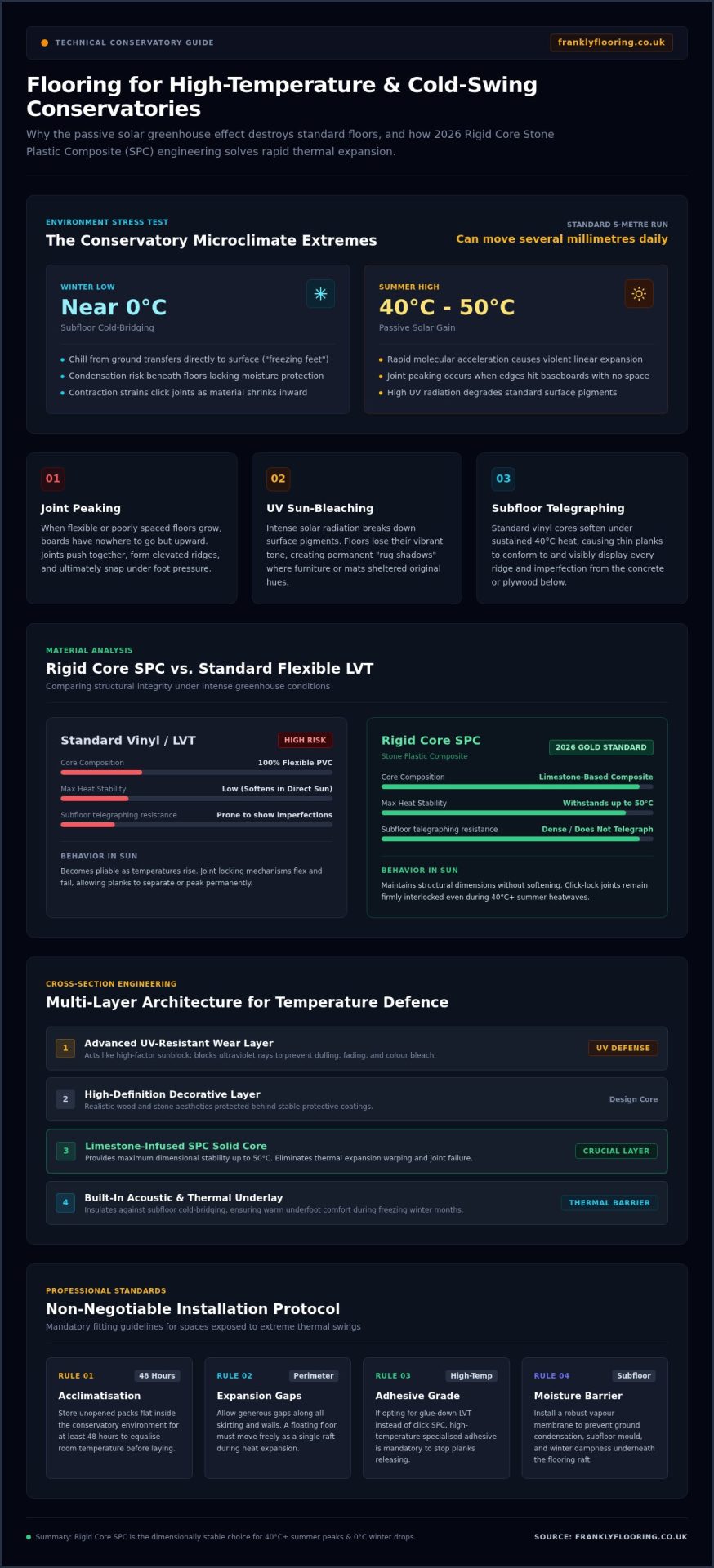
Conservatories are beautiful spaces, but they’re brutal on floors. The glass structure creates a high-intensity environment that most standard materials simply weren’t built to survive. This is essentially passive solar building design in action. While the light is great for your plants, the solar gain can push surface temperatures well beyond 40 degrees in the summer, only to drop to near zero on a January night. This rapid swing is what we call a “flooring killer.”
Most flooring for conservatories that get hot and cold has to deal with two conflicting forces: expansion and contraction. When the sun hits the floor, the molecules in the material move faster and take up more space. If you’ve chosen a cheap vinyl or poorly installed laminate, that floor will grow. Without enough room at the edges, it has nowhere to go but up. This creates “peaking,” where the joints push against each other and lift off the subfloor, creating unsightly ridges that eventually snap.
It isn’t just the physical movement you have to worry about. Direct sunlight carries high levels of UV radiation. Over time, this breaks down the pigments in your floor. We’ve seen plenty of “nice” floors that end up with a permanent shadow where a rug once sat, simply because the rest of the room has faded into a dull, sun-bleached version of its former self.
Understanding Expansion and Contraction
On a standard 5-metre run, a floor can move by several millimetres in a single day. Heat-related movement is different from moisture-related movement; it happens much faster and more aggressively. Floating floors are usually the better choice for these environments. Because they aren’t fixed to the subfloor, the entire “raft” of flooring can move as one unit. You just need to ensure the expansion gaps around the perimeter are wide enough to accommodate that growth without the floor hitting the skirting boards.
The Impact of Humidity and Cold
Winter brings its own set of problems. Cold-bridging occurs when the chill from the ground transfers through the subfloor, making the surface feel like ice. Condensation is also a risk in the UK climate. Moisture can trap itself under the floor, leading to mould or subfloor rot if you haven’t used a proper moisture barrier. Choosing the right flooring for conservatories that get hot and cold means looking for materials with high thermal resistance and built-in stability, ensuring the room remains usable when the temperature drops.
Rigid Core LVT: The Best Flooring for Conservatories That Get Hot and Cold
If you want a floor that won’t give up when the British weather turns erratic, Rigid Core LVT is the 2026 gold standard. Unlike standard vinyl, which is flexible and prone to softening in the sun, Rigid Core uses SPC technology. SPC stands for Stone Plastic Composite. It features a core made primarily of limestone, which gives the planks incredible dimensional stability. This means when your conservatory hits 40 degrees, the floor stays put instead of expanding into the walls. If you are new to this material, start with our article on What Is LVT Flooring? A Frank Guide for UK Homes to understand the basics.
Choosing the right flooring for conservatories that get hot and cold involves more than just picking a pretty pattern. You need a surface that can handle intense UV exposure. Modern SPC products come with advanced UV-resistant wear layers that act like a high-factor sunblock for your floor. This prevents the fading and discolouration that usually ruins standard vinyl within a few years. Most of our Rigid Core options also feature built-in underlay. This adds a layer of thermal insulation that helps keep the room warmer in winter, effectively tackling that “freezing feet” problem we mentioned earlier.
SPC vs. Standard LVT: The Stability Test
Standard LVT is often too soft for a sun-drenched room. Once the temperature climbs, the PVC core becomes pliable, leading to joint failure. SPC is different. It can handle temperatures up to 50°C without losing its structural integrity. Because the core is so dense, it doesn’t “telegraph” minor imperfections from the subfloor, which is a common issue with thinner, glue-down alternatives. The click-lock systems on these rigid planks are also significantly stronger, ensuring the floor remains a solid, flat surface even in high-traffic zones. While traditional Wood Flooring Installation Guidelines require very strict humidity controls, SPC offers a much wider margin for error in a conservatory environment.
Design and Comfort Benefits
You don’t have to sacrifice style for durability. SPC allows you to achieve the high-end look of real stone or oak without the practical drawbacks. Real stone is notoriously difficult to heat in a UK winter, but LVT remains comfortable underfoot year-round. It is also completely waterproof. If you are frequently moving between the garden and the house, you won’t have to worry about muddy boots or wet paws damaging the surface. It is a low-maintenance, high-performance solution that genuinely transforms a conservatory into a functional room. You can browse our stable SPC collections to find a style that fits your home.
Engineered Wood and Laminate: Can They Handle the Heat?
While Rigid Core LVT is our top recommendation, many homeowners still crave the authentic warmth of real timber under their feet. If that’s you, engineered wood is the only viable path forward. Let’s be Frank: solid wood has no business being in a glass room. Because solid timber is a single piece of organic material, it reacts aggressively to the UK’s fluctuating humidity and heat. It will cup, gap, and eventually fail. Engineered wood, however, is a different beast entirely. You can read our Engineered Wood Flooring: The Frank 2026 Guide to Quality & Value to see why this material is a smarter investment for your home.
Selecting the right flooring for extreme temperatures requires looking at how a product is built, not just how it looks in a sample. Engineered wood uses cross-layered construction, where each layer of plywood or HDF is laid at a 90-degree angle to the one above. This structure physically restrains the wood, preventing the dramatic warping you would see in solid planks. It’s a clever bit of engineering that makes it a strong contender for flooring for conservatories that get hot and cold.
Why Engineered Wood Wins Over Solid Timber
The stability of engineered wood comes from its multi-ply base. When the real oak top layer tries to expand in the summer sun, the layers underneath pull it back. For a conservatory, we suggest a wear layer of at least 3mm to 4mm. This gives you the longevity of a real wood floor without the instability. Regarding finishes, UV-cured lacquers are often better for sunrooms as they provide a harder barrier against fading. Natural oils are beautiful, but they require more frequent maintenance to stop the sun from drying out the timber fibres.
High-Spec Laminate: The Budget Alternative
If you’re looking for a cost-effective solution, laminate is a solid choice, provided you don’t cut corners on quality. You must look for an AC4 or AC5 rating. This indicates the floor can handle the high-traffic and abrasive dust often found in garden-facing rooms. The core matters too. A High-Density Fibreboard (HDF) core is essential for stability. You can find more details in our Laminate Flooring UK: The Frank 2026 Buying & Installation Guide. Laminate is generally less prone to UV fading than real wood, making it a great middle-ground for flooring for conservatories that get hot and cold when LVT isn’t the right fit for your budget.
Critical Installation Rules for High-Temperature Areas
Selecting the right flooring for conservatories that get hot and cold is only half the battle. If you don’t follow strict installation protocols, even the highest quality SPC LVT will fail. The most common mistake we see is rushing the process. Acclimatisation is not a suggestion; it’s a requirement. You must leave your flooring in the conservatory for at least 48 hours before fitting. This allows the planks to reach the room’s ambient temperature. If you fit planks straight from a cold delivery van into a sun-drenched room, they’ll expand immediately and buckle against your walls.
Let’s be Frank about adhesives. If you’ve chosen a glue-down LVT, standard acrylic adhesives are a waste of money. They soften when the sun hits the glass, causing the tiles to slide or lift. You must use a dedicated “High-Temperature” (HT) adhesive. It’s designed to maintain a rock-solid bond even when surface temperatures climb towards 50°C. Similarly, subfloor preparation is vital. Any slight unevenness in the floor creates stress points on the click-lock joints. When the material tries to move due to heat, those joints will snap if the floor isn’t perfectly level.
Expansion gaps also need a rethink. While a 10mm gap is standard for most rooms, a south-facing conservatory often requires 12mm or even 15mm. You’re dealing with extreme movement here. If the floor hits the skirting board, the pressure has nowhere to go but up, resulting in that dreaded peaking at the joints. You can shop our high-performance LVT collection to find products specifically engineered for these high-stress environments.
Choosing the Right Underlay
Underlay choice is vital for stability and comfort. Soft, foam-based underlays are fantastic for carpets, but they’re often too squishy for rigid floors in hot rooms. You need a high-density underlay that won’t compress under heat. Look at the TOG rating if you’re worried about winter chill; a higher rating provides better thermal resistance to stop the cold ground from sucking the heat out of the room. Just ensure the underlay is compatible with your specific flooring type to avoid voiding your warranty.
Managing Large Glass Expanses
Large conservatories often require transition bars, especially in doorways or where the floor length exceeds 8 to 10 metres. These bars allow different sections of the floor to move independently, reducing the overall stress on the system. You can hide those large expansion gaps using scotias or by fitting new skirting boards over the floor. If you’re transitioning from your conservatory to a carpeted living room, you might find our guide on Carpet Gripper: The Frank Guide to Choosing and Fitting Like a Pro useful for getting that professional finish at the threshold.
Frankly Speaking: Which Conservatory Floor Should You Buy?
We have covered the science of solar gain and the technical necessity of high-temperature adhesives. Now, it is time for the “Frank” verdict. Choosing flooring for conservatories that get hot and cold doesn’t have to be a gamble if you prioritise material stability over the lowest possible price tag. In our 20 years of experience, we’ve seen that the most expensive floor is the one you have to replace after two years because the joints have snapped in the summer heat.
If you are looking for the best lifetime value, SPC LVT is the clear winner. It is virtually bulletproof in the face of UK temperature swings and handles the transition from garden to home without moisture damage. For those who want a premium, high-end room feel, engineered wood is a beautiful choice, provided you are willing to manage the humidity levels. Premium laminate serves as a solid middle ground for those on a budget, as long as you don’t compromise on the AC rating or core density.
The Conservatory Decision Matrix
When we weigh up heat resistance, moisture protection, and foot feel, Frankly Flooring recommends SPC LVT for roughly 90% of UK conservatory projects. It simply removes the stress of worrying about the weather. While wood feels slightly warmer naturally, a high-quality SPC with a built-in cork or IXPE underlay offers a similar level of comfort without the risk of warping. You should only invest in engineered wood if the conservatory is well-insulated and you specifically want to match the flooring in the rest of a premium property.
Ordering Samples and Planning
You shouldn’t ever buy a floor for a glass room based on a digital screen. The way light hits a plank at midday in July is vastly different from how it looks at sunset in December. We always tell our customers to place their samples in the conservatory and watch them throughout the day. This helps you spot if a particular grain looks too busy under direct sun or if a colour turns too grey in low light. Before you commit, run through this final checklist:
- Have you accounted for a 12mm to 15mm expansion gap?
- Is your subfloor level to within 3mm over a 2-metre run?
- If you are using adhesive, is it specifically rated for high temperatures?
- Have you planned for transition bars in large open-plan spaces?
Taking these steps ensures your floor stays flat and beautiful for years. You can explore our full range of LVT and Engineered Wood today to find the perfect match for your home.
Building a Conservatory Floor That Lasts
Your conservatory shouldn’t be a room you avoid for half the year. By choosing materials with a limestone-based rigid core or high-stability engineered layers, you can stop worrying about buckling joints and sun-faded patches. Selecting the right flooring for conservatories that get hot and cold is ultimately about managing thermal expansion through quality materials and strict installation protocols, such as using high-temperature adhesives and allowing for generous expansion gaps.
We’ve spent 20 years helping UK homeowners find reliable solutions that survive the unique greenhouse environment of a glass room. We specialise in SPC LVT that stays flat when the sun is at its peak and remains comfortable underfoot during a frost. With our national UK delivery, you can get professional-grade materials delivered straight to your door, backed by two decades of family-run expertise. It’s time to turn that glass box into a functional, stylish extension of your home.
Browse our stable, conservatory-ready flooring collections at Frankly Flooring and start your project with confidence today.
Frequently Asked Questions
Can I put LVT in a conservatory that gets very hot?
Yes, but you must choose Rigid Core (SPC) LVT rather than standard flexible vinyl. Standard LVT becomes pliable when surface temperatures rise, leading to joint failure. SPC uses a limestone core that remains stable even when your conservatory hits 50°C. It is the most reliable flooring for conservatories that get hot and cold. Always ensure you allow for the correct expansion gaps to handle the inevitable movement caused by the UK’s shifting weather.
Does laminate flooring warp in the sun?
Laminate is generally more resistant to UV fading than natural wood, but it can still warp if the installation is poor. The main issue isn’t the sun itself, but the heat it generates. If you don’t leave a large enough expansion gap at the perimeter, the floor will hit the walls and buckle. You should always look for a high-density fibreboard (HDF) core to ensure the planks remain structurally sound during summer.
What is the best flooring for a cold conservatory in winter?
SPC LVT with a built-in IXPE or cork underlay is an excellent choice for winter warmth. Unlike stone or ceramic tiles, which stay cold and draw heat away from your feet, LVT has much higher thermal resistance. Engineered wood is another warm alternative, provided you use a high-density underlay with a good TOG rating. This helps insulate the room against the cold subfloor, making the space feel like a real extension of your home.
Do I need special glue for conservatory flooring?
If you are opting for a glue-down installation, a high-temperature (HT) adhesive is non-negotiable. Standard acrylic glues will soften and lose their bond when solar gain heats the floor surface. This causes tiles to shift or lift at the edges. Using a dedicated HT adhesive ensures the floor stays firmly in place even during the hottest months of July and August. For click-lock systems, no glue is required, which simplifies the process.
How big should the expansion gap be in a conservatory?
While a 10mm gap is standard for most internal rooms, a conservatory requires more breathing room. We suggest a gap of 12mm to 15mm around the entire perimeter. This accounts for the aggressive expansion that occurs when the sun hits the glass. You can easily hide these larger gaps using a matching scotia or by fitting new skirting boards over the top of the flooring once the installation is complete.
Can I use carpet in a conservatory?
You can use carpet, but we rarely recommend it for this environment. The intense UV exposure in a glass room will cause the colours to fade unevenly and quite rapidly. Additionally, conservatories are often the primary transition point between the garden and the house. For those extending their living space out onto the patio with garden pieces from rengard.co.uk, having a durable hard floor inside makes keeping the threshold clean far simpler. Carpet traps mud, pollen, and moisture much more easily than LVT or laminate, making it harder to maintain and prone to developing a musty smell over time.
Is engineered wood better than solid wood for a conservatory?
Engineered wood is significantly better than solid timber for a conservatory. Solid wood is a single piece of organic material that expands and contracts heavily with humidity and temperature changes. This leads to cupping and gapping. Engineered wood uses cross-layered plywood or HDF to counteract this natural movement. It provides the authentic look of oak while offering the structural stability needed for flooring for conservatories that get hot and cold.
Will my conservatory floor fade in direct sunlight?
All materials will experience some degree of UV degradation over many years, but modern LVT and premium laminates are designed to resist it. You should look for products with a high-spec UV-resistant wear layer. This acts as a barrier against the sun’s rays, keeping the colours vibrant for much longer than traditional vinyl. Moving your furniture or rugs occasionally can also help ensure the floor ages evenly across the entire room.