
The quickest way to forfeit your tenancy deposit isn’t an accidental wall scuff; it’s trusting sticky peel-and-stick tiles on a landlord’s floor. Staring at worn carpets or dated linoleum every day is exhausting, yet the thought of stubborn adhesive residues costing you hundreds at checkout keeps most tenants stuck. Frankly, finding reliable temporary flooring solutions for renters doesn’t require risky glues or structural alterations. The real secret comes down to floating mechanics and protective barrier underlays that shield the surface underneath.
You can easily transform tired rental spaces without putting your security deposit on the line. This practical guide breaks down realistic, removable options tailored specifically for rented flats and houses across the UK. We will compare loose-lay vinyl, click-lock planks, and textile coverings so you know exactly which materials can safely float over your existing subfloor, giving you the practical know-how to install and lift them with total confidence.
Key Takeaways
- Explore why floating, adhesive-free systems ensure your full deposit return under UK Tenancy Deposit Scheme rules.
- Compare the best temporary flooring solutions for renters, from click LVT and loose-lay vinyl to laminate and oversized area rugs.
- Assess your existing rental subfloor accurately to identify which coverings succeed over ceramic tiles or firm low-pile carpets.
- Master a simple five-step installation and removal technique using non-destructive perimeter methods that leave zero trace at checkout.
- Source straightforward, high-performance flooring delivered direct to your door nationwide without paying inflated showroom markups.
The Renter Flooring Dilemma: Protecting Your Deposit While Upgrading Your Space
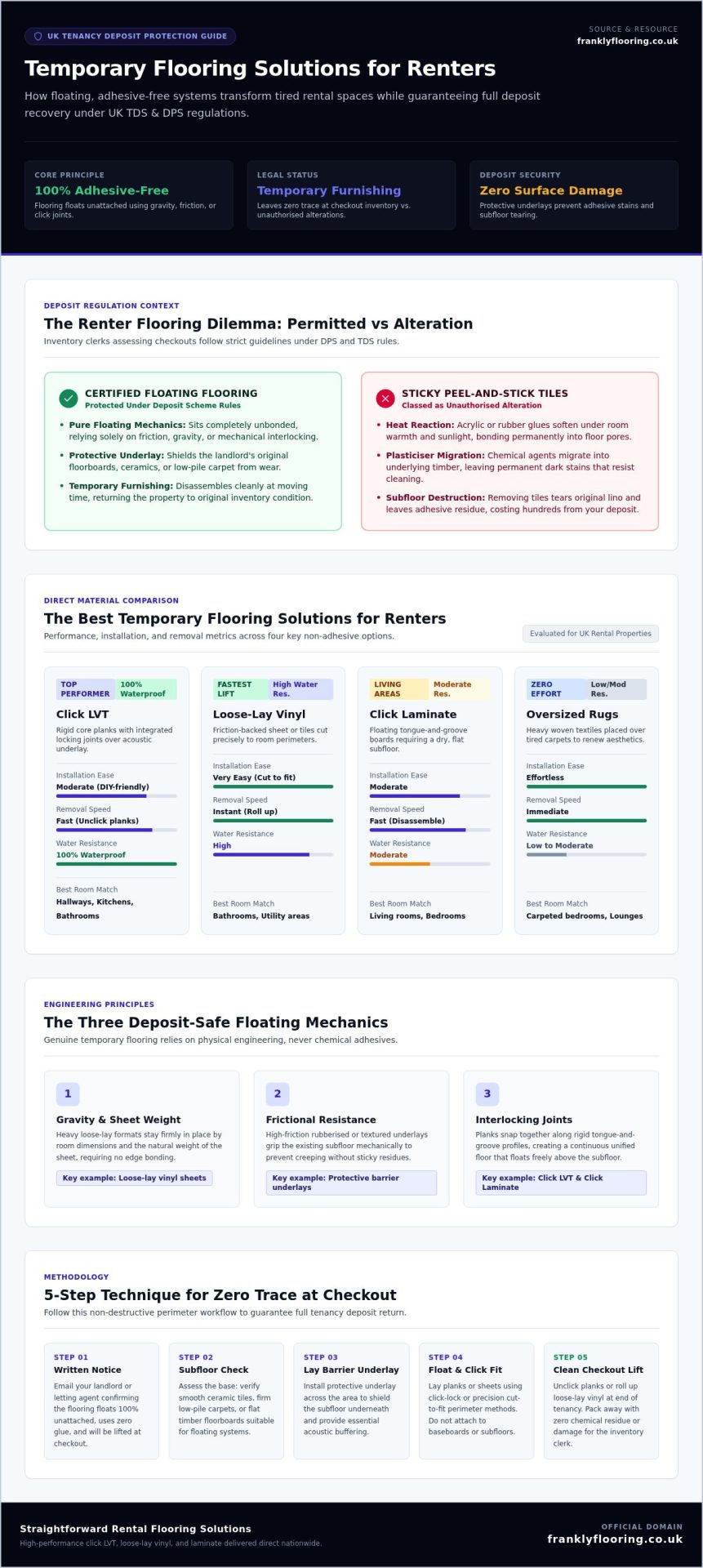
Temporary flooring is defined as an entirely non-adhesive, floating covering engineered for quick, clean removal without altering the existing structure underneath. True temporary flooring relies on clever engineering rather than wet glues or permanent fixings. When assessing genuine temporary flooring solutions for renters, the rule is straightforward: your upgrade must depend on gravity, friction, or interlocking joints. If a product requires chemical bonding to stay in place, it belongs in an owner-occupied renovation, not a rented property.
Understanding Tenancy Deposit Regulations and Floor Alterations
Checkout inventory clerks follow strict guidelines set by government-approved schemes like the Deposit Protection Service (DPS) and the Tenancy Deposit Scheme (TDS). They compare your moving-out state against the original inventory, looking for changes rather than general fair wear and tear. A classic mistake is assuming an aesthetic “improvement” is welcomed by landlords. Under standard UK assured shorthold tenancy agreements, any permanent alteration made without prior written permission is classed as property damage. Opting for a certified floating floor installation keeps your project firmly within the category of temporary furnishings, ensuring your deposit remains protected.
- Fair wear and tear: Gradual, unavoidable deterioration like minor carpet thinning along high-traffic hallways.
- Unauthorised alteration: Replacing or permanently bonding materials over original fixtures, giving landlords legal grounds to deduct full replacement costs from your deposit.
- Written consent: Always email your landlord or letting agent outlining that your temporary flooring solutions for renters require zero adhesive, float entirely unattached, and will be lifted cleanly at checkout.
Why Traditional Adhesives and Peel-and-Stick Tiles Fail in Rentals
Budget peel-and-stick tiles look tempting on social media, but they carry hidden risks for rental properties. The acrylic or rubber-based adhesives attached to cheap vinyl react heavily to ambient room heat and sunlight. Over several months, warmth softens the glue, pressing it deep into the pores of underlying floorboards, ceramic tiles, or vintage lino. When you attempt to lift them at moving time, the glue separates. You are left with broken tiles, torn subfloors, and stubborn adhesive residue that resists domestic solvents. Furthermore, plasticisers in low-grade adhesive films frequently migrate into underlying timber, leaving permanent dark stains that professional cleaning cannot lift.
The Best Temporary Flooring Solutions for Renters Compared
Choosing between temporary flooring solutions for renters comes down to matching your existing subfloor with how you actually live in the property. Rigorous housing studies, including long-term research on renter trends, show that tenants are staying in rented accommodation longer than in previous decades. This shift makes livable, comfortable interior spaces essential. Hallways demand hard-wearing resilience against constant foot traffic, while living rooms benefit from warmer textures underfoot.
| Flooring Type | Installation Ease | Removal Speed | Water Resistance | Best Room Match |
|---|---|---|---|---|
| Click LVT | Moderate (DIY-friendly) | Fast (unclick planks) | 100% Waterproof | Hallways, kitchens, bathrooms |
| Loose-Lay Vinyl | Very Easy (cut to fit) | Instant (roll up) | High | Bathrooms, utility areas |
| Click Laminate | Moderate | Fast (disassemble) | Moderate | Living rooms, bedrooms |
| Oversized Rugs | Effortless | Immediate | Low to Moderate | Carpeted bedrooms, lounges |
Click-Lock Luxury Vinyl Tile (LVT) and Floating Laminate
Rigid core click LVT features integrated locking joints that snap together securely across an acoustic underlay. The planks sit completely free of the floor underneath. If you want a deep dive into core compositions and wear layers, check our guide explaining what is LVT flooring. For dry living areas with a flat base, floating laminate flooring provides exceptional resistance against furniture scuffs while delivering an authentic timber finish without permanent fixings.
Cushioned Loose-Lay Sheet Vinyl
Modern sheet vinyl has come a long way. Heavy textile-backed variants use their own weight and structural stability to lie perfectly flat without messy perimeter glues. You simply roll out the sheet, trim the perimeter with a sharp utility knife, and let gravity do the work. It is an affordable way to refresh tired rental kitchens, and rolling it up to take to your next home takes minutes.
Large Area Rugs and Modular Carpet Solutions
If you face stained, threadbare carpets that your landlord refuses to replace, oversized rugs offer immediate relief. Read our advice on choosing the right carpet textures to understand which weaves handle furniture weight best. Alternatively, modular carpet tiles joined at the corners with adhesive friction tabs create a room-sized carpet that never touches the subfloor. If you are weighing up your options, you can explore the direct-to-consumer collections at franklyflooring.co.uk to find DIY-ready materials built for clean removal.
Evaluating Your Existing Rental Subfloor Before Laying Temporary Floors
Before unrolling underlay or assembling planks, inspect what lies beneath your feet. A floating floor mimics the contours of whatever supports it. If your subfloor dips by more than 3mm over a two-metre span, rigid locking mechanisms experience continuous strain. Check your surface levels using a standard spirit level or straight edge. For suspected moisture across ground-floor concrete, tape a small square of clear plastic flat to the floor for 24 hours; condensation beneath the film signals damp that will ruin materials without a vapour barrier. Picking viable temporary flooring solutions for renters always starts with this honest diagnostic.
Laying Temporary Flooring Over Existing Hard Floors
Laying planks over ceramic tiles presents a specific hazard: grout line telegraphing. Deep grout lines allow thin, flexible floor coverings to sag into the voids under everyday foot traffic. Pair your floating planks with a firm, high-density acoustic underlay that bridges recessed grout lines while dampening hollow footstep sounds. If you are covering landlord hardwood, ensure your protective barrier is breathable to stop moisture from becoming trapped and discolouring the original timber beneath.
Covering Worn or Stained Rental Carpets
Installing rigid click-lock planks directly over thick carpet is a guaranteed recipe for cracked joints. Carpets possess too much vertical bounce. When walked on, that downward deflection stresses the delicate interlocking joints until they snap. While laying hardboard sheets can create a temporary bridge over very firm, low-pile cord carpet, plush carpets simply offer too much give. In those spaces, oversized textured rugs remain the safer, far more practical choice.
Managing Internal Door Clearances and Thresholds
Always verify vertical door clearance before introducing new floor layers. Planing down internal doors counts as an unauthorised alteration under standard tenancy agreements, which invariably leads to deposit deductions. Measure the gap between your door base and the existing floor. Slim 2mm to 4mm luxury vinyl profiles slide beneath tight clearances with ease. For room transitions, bypass screw-down metal trims in favour of tension-grip threshold profiles that clamp down neatly without puncturing the landlord’s subfloor. As practical publications detailing Temporary flooring options for renters confirm, accounting for clearances beforehand guarantees that your deposit remains completely secure.
How to Install and Remove Temporary Flooring Without Leaving a Trace
Fitting removable floors requires methodical preparation rather than complex trade machinery. Equipping yourself with a sharp utility knife, a rubber tapping block, expansion spacers, and a steel straight edge gives you everything needed to fit click or loose-lay systems cleanly. Adopting dependable temporary flooring solutions for renters means keeping original surfaces completely untouched. Every step focuses on reversible joinery and perimeter care so your move-out day stays entirely stress-free.
Acclimatisation and Room Preparation
Lay your boxed planks flat in the designated room for 24 to 48 hours prior to installation. This crucial step balances the material with indoor humidity, preventing warping after fitting. Deep clean the existing floor thoroughly, removing grit that could grind into surfaces under foot pressure. Place 5mm to 8mm expansion spacers around the perimeter against the skirting boards. This gap permits natural thermal movement without pinning materials down.
Step-by-Step Installation of Floating Click and Loose-Lay Materials
Rolling out an approved underlay barrier forms your protective foundation across the room. Follow this proven sequence:
- Lay the barrier: Roll out high-density underlay, taping sheet seams with low-tack tape without letting adhesive touch the landlord’s subfloor.
- Set your first row: Lay planks from the longest straight wall, placing spacers against baseboards to maintain the expansion channel.
- Stagger joints: Offset end joints by at least 20cm between adjacent rows to ensure optimal structural integrity across the floating deck.
- Scribe tricky edges: For loose-lay vinyl, push the sheet into baseboard angles using a straight edge, scoring relief cuts around architraves with a fresh utility blade.
- Anchor doorways: Secure free edges at room thresholds using residue-free, heavy-duty removable carpet tape beneath the plank underside.
End-of-Tenancy Removal and Floor Restoration
Dismantling is straightforward. Lift the perimeter row gently at an angle to unclick planks without snapping tongue-and-groove profiles, boxing them up for your next property. Remove temporary perimeter tape using warm soapy water and a microfibre cloth; avoid mineral spirits that risk stripping original floor varnishes. Finish with a standard vacuum and mop to return the space in pristine condition for your checkout inventory inspection. Ready to start your room upgrade? Explore our collection of DIY-friendly floating finishes and underlays at franklyflooring.co.uk to find the ideal match for your rental flat.
Choosing the Right Temporary Flooring from Frankly Flooring
Frankly Flooring cuts through trade jargon with honest, straightforward advice tailored to UK tenants. Backed by over 20 years of family-run industry experience, we supply reliable materials without high-pressure sales tactics. Finding practical temporary flooring solutions for renters shouldn’t involve paying inflated showroom markups. Our direct-to-consumer online model delivers click LVT, laminate, vinyl rolls, carpets, rugs, and installation accessories straight to your door across the UK, keeping project costs manageable and totally transparent.
Why a Frank, Direct Approach Suits Renters
Tenants face unique challenges that traditional high-street flooring retailers rarely understand. Most shops focus exclusively on permanent domestic fittings, pushing costly adhesives and invasive subfloor preparations that forfeit deposits. We focus on non-destructive options, detailing exact wear layers, plank thicknesses, and joint ratings so you know precisely what is going into your home. Bypassing middleman markups means you secure durable, trade-quality surfaces that withstand active daily use without stretching your rental improvement budget.
Selecting Your Materials and Planning Your Project
Accurate planning ensures you order the right volume of material while safeguarding the subfloor underneath. Keep these core planning rules in mind before placing your order:
- Calculate square meterage with buffer: Measure the maximum length and width of the room, multiplying them to find your total area. Always add a 10% wastage allowance to accommodate edge cuts, alcoves, and awkward doorways.
- Prioritise protective underlays: Select high-density underlay barriers to isolate floating planks from the subfloor. This stops friction grit from abrading landlord tiles or floorboards over time.
- Treat flooring as portable equity: Quality click LVT and floating laminate aren’t sunk costs. You can unclick them cleanly when moving out, repacking the planks to install in your next rental property.
Investing in your everyday living space shouldn’t put your security deposit at risk. Take a look at our extensive online flooring catalogue to find deposit-safe floating floors, durable room-filling rugs, and essential DIY accessories suited to your flat.
Transform Your Rental Space with Complete Deposit Peace of Mind
Upgrading a rented property shouldn’t mean gambling with your checkout inventory. Selecting genuine temporary flooring solutions for renters comes down to two foundational principles: choosing floating mechanics over sticky adhesives, and shielding the existing surface with an appropriate high-density barrier. Whether you snap rigid click LVT over tired kitchen ceramics or roll out cushioned sheet vinyl to mask worn hallway boards, you now hold the practical blueprint to modernise your home without leaving a trace.
Living in rented accommodation shouldn’t stop you from creating an interior you genuinely love. Backed by over 20 years of hands-on trade experience, Frankly Flooring is an independent, family-run specialist delivering click LVT, laminate, vinyl, rugs, and protective underlays directly across mainland UK. Skip the inflated showroom markups and make your next home improvement completely stress-free. Explore our full range of deposit-safe floating floors at Frankly Flooring, order your samples, and start enjoying a fresher, more comfortable living space today.
Frequently Asked Questions
Can I put temporary flooring over an existing carpet in a rented property?
Yes, but only over very firm, low-pile cord carpets. Thick, plush carpets have too much vertical give, which flexes and snaps floating click-lock joints under regular foot traffic. If your carpet is deep or heavily cushioned, avoid rigid planks entirely. Instead, roll out oversized woven area rugs, or lay interlocking hardboard panels over low-pile carpet first to establish a stable, flat base before laying floating planks.
Will peel-and-stick vinyl tiles damage the floor underneath when removed?
Yes, peel-and-stick tiles frequently damage rental subfloors and jeopardise your tenancy deposit. Ambient room heat softens their chemical adhesives over time, bonding the glue firmly into original tiles, floorboards, or linoleum. When peeled up at checkout, the backing tears and leaves sticky residue or strips existing varnish. For genuine temporary flooring solutions for renters, stick exclusively to floating click planks or loose-lay sheet vinyl requiring zero glues.
Do I need my landlord’s permission to install floating temporary flooring?
Strictly speaking, non-permanent floating floors requiring no adhesives, nails, or permanent fixings do not constitute structural alterations. However, securing written confirmation via email is always the safest path. Clarify to your landlord or letting agent that your covering floats entirely on a protective underlay and will be removed at checkout. Having this written record prevents inventory misunderstandings and avoids deposit disputes when moving out.
How thick should temporary flooring be to avoid catching on internal doors?
Aim for a total floor profile between 4mm and 6mm, including your protective underlay. Shaving down landlord doors is an unauthorised alteration that invariably triggers deposit deductions. Rigid click LVT planks generally sit between 4mm and 5mm thick with integrated underlay, slipping cleanly under tight door clearances. If clearance is exceptionally limited, cushioned loose-lay sheet vinyl delivers a refreshed look at a slender 2mm to 3mm thickness.
Can I reuse click LVT or laminate planks when I move to my next rental home?
Yes, high-quality click LVT and laminate planks can be disassembled and reinstalled in your next home. Gently lift each plank row by row at an angle to release the locking joints without snapping the click profiles. Pack them flat in original boxes for transit. Remember that room dimensions will differ, so keep an extra pack handy to accommodate newly trimmed perimeter cuts in your next flat.
What is the most cost-effective temporary flooring for large rental rooms?
Cushioned loose-lay sheet vinyl and room-filling area rugs are the most economical options for covering large square meterage. Heavy textile-backed sheet vinyl rolls out smoothly without locking joints or perimeter adhesives, masking tired subfloors affordably. When comparing practical temporary flooring solutions for renters on a modest budget, loose-lay vinyl provides immediate, seamless coverage and rolls up in minutes when your tenancy ends.
What underlay should I use to protect my landlord’s hardwood floors from scratches?
Use a dense, breathable closed-cell foam underlay or a specialised felt barrier. Never install cheap non-breathable plastic films or rubber mats directly over natural wood, as trapped condensation causes timber to warp and discolour over time. A firm, high-density acoustic underlay prevents stray grit from rubbing into the original varnish while dampening footfall, keeping the landlord’s original floor in spotless checkout condition.