
A floor that shrugs off a spill may not be the one that lasts longest overall. That’s the key to engineered wood vs lvt durability: LVT is generally more resistant to moisture and surface scratches, while some engineered wood floors may have a longer useful life if their surface can be refinished.
It’s understandable to want one clear winner, especially when pets, furniture and busy footfall put a floor to the test. But durability depends on the type of wear you’re concerned about, the room’s conditions and the maintenance you’re comfortable with. Product specifications matter too, and they don’t always make for easy comparisons.
This guide explains how engineered wood and LVT respond to scratches, spills and everyday traffic, and what repair or refinishing could mean over time. You’ll also learn which details to compare, including an LVT’s wear layer and an engineered wood floor’s real-wood surface, so you can narrow down the right option for each room and household.
Key Takeaways
- Durability has several measures, from surface wear to how a floor can be repaired over time.
- For engineered wood vs lvt durability, compare the exact board construction and product specifications rather than relying on material labels alone.
- Match your choice to the room’s conditions and the demands of your household.
- Read the care instructions and consider what repairs may be possible before deciding which floor suits your routine.
- Use the side-by-side comparison and checklist to narrow down the most practical option for each space.
Engineered Wood vs LVT Durability: What Does ‘Durable’ Really Mean?
Neither engineered wood nor LVT is automatically more durable in every home. The better choice depends on what the floor needs to withstand: scratches, dents from dropped objects, moisture, daily footfall or wear that builds over time. Repairability matters too. A floor that shows damage may be repairable in a different way from one that resists that type of damage in the first place.
For a useful engineered wood vs lvt durability comparison, identify the likely sources of wear in each room rather than relying on a general claim that a material is “hard-wearing”. This table offers a broad guide. The product’s construction, instructions and care can all affect how it performs.
| Durability factor | What to consider |
|---|---|
| Scratches and scuffs | Surface protection and finish affect how visible everyday marks become. |
| Dents and chips | Heavy furniture or a dropped object can damage a floor differently from light surface abrasion. |
| Moisture | Occasional spills differ from repeated exposure or water reaching joints and edges. |
| Repairability | Find out whether surface damage can be addressed, and what care the product requires. |
Which kinds of everyday damage should you compare?
Scuffs and fine scratches affect the visible surface; dents press into it, while chips or structural damage can reach deeper layers. Grit tracked in from outside can act like an abrasive under shoes. Chair legs and furniture moved without protection may leave marks, while pets’ claws and dropped toys create other everyday risks. The impact depends on the product and the force involved.
Moisture deserves separate consideration. A spill cleaned promptly isn’t the same as repeated wetting, standing water or dampness around joints. Engineered wood has real timber at the surface, so moisture and humidity can affect it. LVT is generally more water-resistant, but product construction and fitting details still matter.
Why does durability vary between flooring products?
Both categories include products with different constructions and finishes. Engineered wood has a real-wood wear layer over a supporting core. The timber surface and its finish influence how marks show and what surface care or repair may be possible. The core is a separate part of the board, not the visible wood layer.
LVT is also layered, and its wear layer is one part of its surface protection, not a complete durability verdict. Compare the full specification, care instructions and intended use. Correct fitting matters too: a suitable, well-prepared subfloor and following the product’s fitting guidance can help prevent problems that material choice alone won’t avoid.
Engineered Wood Durability: Wear, Refinishing and Moisture
Engineered wood has a real-wood surface bonded to a layered supporting construction. Unlike solid timber, its structure combines layers, but the visible surface is still wood, so scratches, dents and finish wear remain part of its durability story. The depth of the real-wood layer and the board’s finish vary by product. One engineered floor is not a reliable guide to every other product.
Some engineered boards may be sanded and refinished, potentially extending their useful life. Refinishing removes material, however, so whether it’s possible depends on the thickness of the usable wood layer and the manufacturer’s instructions. A mark in the finish may be easier to address than a deep dent or damage that reaches the core. Check the guidance for the exact product before assuming the floor can be restored.
How do finish and wear-layer thickness affect engineered wood?
A lacquered finish creates a surface coating, while an oiled finish tends to retain a more natural-looking feel. Their appearance, upkeep and approach to localised repairs differ, so follow the guidance for the specific product. The thickness of the real-wood layer matters too: a thinner surface may leave less scope for sanding than a thicker one. For more on construction and product selection, read this engineered wood flooring guide.
In the wider engineered wood vs lvt durability comparison, engineered wood’s potential for refinishing is a different advantage from the surface protection associated with resilient flooring. The Resilient Floor Covering Institute explains LVT construction and characteristics, providing useful context for comparing the materials without assuming either is damage-proof.
How does engineered wood cope with spills and busy rooms?
Moisture is a risk to manage, not a reason to label engineered wood waterproof. Wipe up spills promptly and follow the floor’s specific care instructions. Repeated wetting, standing water or damp conditions present a different challenge from a small spill cleaned straight away.
Busy-room wear also comes from everyday habits. Grit can abrade the finish underfoot, and unprotected furniture legs may scratch or dent boards. Unsuitable cleaning products or excess water can affect the surface too. Follow care guidance that matches the finish rather than relying on a general wood-floor routine. A kitchen or bathroom isn’t automatically suitable or unsuitable: consider the product’s instructions, moisture exposure and how the room is used.
Before choosing, compare the surface finish, real-wood layer and care guidance for the specific boards. You can also browse engineered wood flooring alongside other flooring options and assess the product details that matter for your home.
LVT Durability: Wear Layers, Water and Surface Damage
LVT is a category of layered resilient flooring, but its construction and performance vary by product. A protective wear layer sits above the decorative design and helps guard the surface against everyday scuffs and scratches. It’s a useful specification to compare, but it can’t tell you everything about how a floor will perform. The overall build, fitting requirements, care instructions and intended use matter as well.
That distinction is central to engineered wood vs lvt durability. LVT is often chosen for rooms where spills are more likely, but water resistance isn’t a guarantee against every moisture problem. Water reaching joints or edges, prolonged exposure or moisture beneath the floor may still cause issues, depending on the product and how it’s fitted. The Resilient Floor Covering Institute explains LVT construction and its general characteristics, including water resistance.
What does an LVT wear layer tell you about durability?
The wear layer is the transparent protective surface over the printed design. Its specification can help you compare products, particularly if you expect regular footfall, but thickness alone doesn’t establish a universal durability ranking. Compare like with like, and read each product’s full specification and care guidance instead of relying on a broad rule for all LVT. This LVT wear-layer comparison explains what to look at when reviewing wear-layer details.
How does LVT handle moisture, pets and daily cleaning?
LVT is commonly considered for moisture-prone spaces, subject to the manufacturer’s instructions and the conditions in the room. Follow the product guidance for cleaning and spills. Don’t assume a water-resistant surface makes every joint, edge or subfloor immune to moisture.
Routine care helps limit avoidable surface wear. Remove grit before it gets ground under shoes, and use cleaning products suited to the specific floor. LVT can still be cut or gouged by sharp objects, while pet claws or heavy furniture dragged across it may leave marks. Heat exposure can also damage some products, so follow the stated care and use instructions.
Damage to an individual plank or tile may be addressed differently depending on the product’s construction and fitting method. Don’t assume replacement will be straightforward or that a repair will blend in perfectly. Keep the details of your chosen floor for future reference and follow the product information. To compare options, browse LVT flooring and review the specifications against your room’s needs.
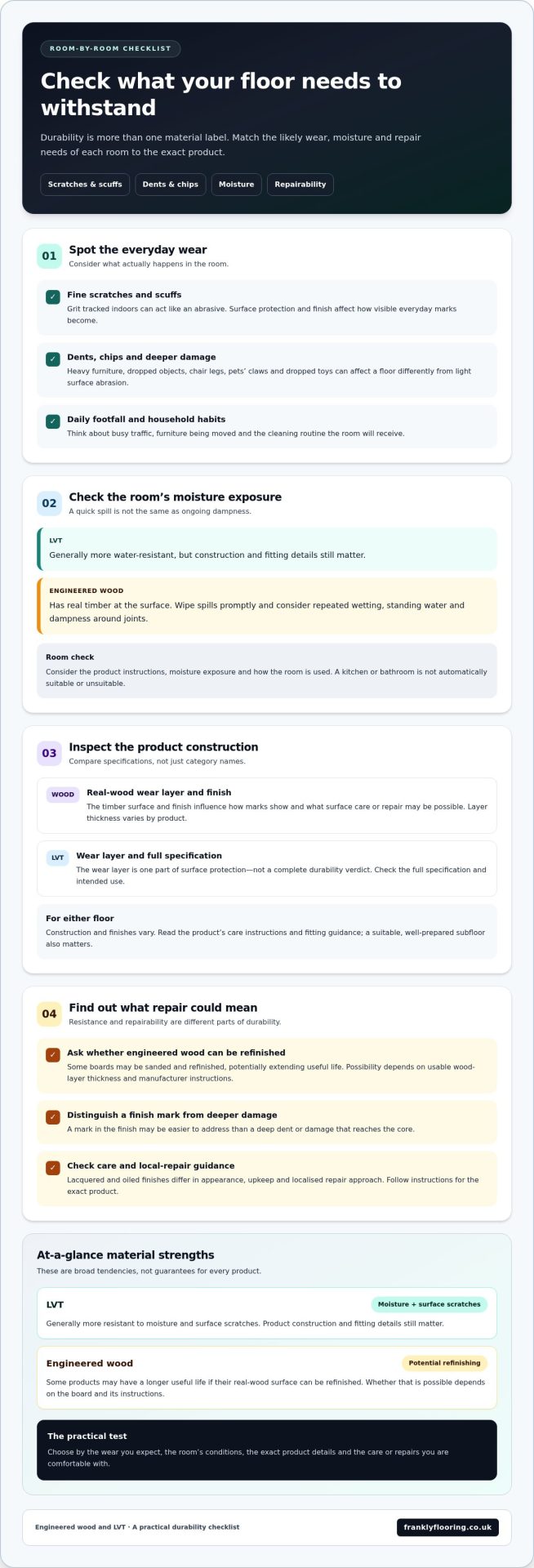
Engineered Wood vs LVT: Which Is More Durable in Your Room?
There isn’t one material that wins in every room. For engineered wood vs lvt durability, weigh the type of wear a space sees against the care you’re willing to give it. LVT may suit a busy area where spills and frequent cleaning are likely. Engineered wood may suit a quieter space where its real-wood appearance matters and its care requirements fit your household.
| Consideration | Engineered wood | LVT |
|---|---|---|
| Moisture | Manage spills promptly and follow the product’s room guidance. | Often considered for moisture-prone areas, but check instructions and fitting conditions. |
| Surface wear | Wood and its finish can show scratches, dents or wear. | The wear layer helps protect the surface, but cuts and gouges remain possible. |
| Repair options | Some products may be refinished, depending on the real-wood layer and guidance. | Repair or replacement options depend on the product and fitting method. |
| Upkeep | Care requirements depend on the finish and manufacturer’s instructions. | Remove grit and use cleaning products recommended for the floor. |
| Appearance | Has a real-wood surface with natural variation. | Offers a decorative surface in a layered resilient construction. |
Which flooring is more practical for kitchens, hallways and family spaces?
Start with how the room is used. A hallway where grit gets tracked in, or a kitchen where spills and regular cleaning are part of daily life, may make LVT a practical option. In a family room, consider whether children’s play, pets and moved furniture are likely to cause marks, and how much upkeep fits your routine.
Engineered wood can suit a living space where the look of a real-wood surface is a priority and the household is prepared to follow its care guidance. These are starting points, not fixed rules. Product instructions, moisture conditions and the state of the subfloor all affect suitability. Even a durable material needs to be fitted appropriately.
Is LVT always more durable than real wood?
No. LVT and engineered wood resist different kinds of wear. LVT’s protective surface can help with everyday scuffs, while some engineered wood products may be refinished if their usable wood layer allows it. Neither feature guarantees a floor will avoid damage or remain easy to repair. For a straightforward explanation of LVT construction, read this LVT flooring guide.
Use the comparison as a room-by-room decision, then weigh the exact product details against your household’s routines. Explore LVT and engineered wood flooring to compare the options and their specifications.
Choose the More Durable Floor for Your Home: A Practical Checklist
Use this checklist to compare specific products against the demands of your home. The best choice in the engineered wood vs lvt durability debate is the one whose strengths and care requirements suit the room, not simply the material with the toughest-sounding claim.
- Start with the room. Note likely moisture, footfall, cleaning frequency and any conditions such as underfloor heating. A hallway, for example, may need to cope with grit from outside, while a quieter living space may place more emphasis on appearance.
- Factor in household routines. Consider pets, children, furniture movement and how quickly spills are usually cleaned. Be realistic about the maintenance you’re comfortable doing.
- Compare the product specifications. For engineered wood, look at the real-wood wear layer, finish and care guidance. For LVT, review wear-layer details, construction and product-specific moisture instructions. Compare full specifications rather than relying on one figure or a broad category claim.
- Check fitting and repair guidance. Make sure the product’s fitting requirements suit the room and subfloor. If you have underfloor heating, check compatibility and any related instructions. Look into possible repairs too, including whether engineered wood can be refinished or an LVT plank or tile can be replaced.
- Consider the appearance in context. Check samples or product imagery against your room’s lighting and furnishings. Colour, texture and finish can look different across screens and settings, so take time to assess the visual details before deciding.
What should you check on an engineered wood or LVT specification?
Read the product information alongside its care instructions. For engineered wood, focus on the surface layer, finish and any stated limits on sanding or refinishing. For LVT, review the wear layer and construction, as well as guidance on moisture and cleaning. In both cases, confirm fitting requirements and suitability for underfloor heating where relevant. These details make general durability claims more useful for comparing specific products.
How can Frankly Flooring help you compare flooring options?
Frankly Flooring is a family-run online retailer offering both LVT and wood flooring, with more than 20 years of experience in the flooring industry. Browse the product information for each option and compare the details against your room, routines and priorities. There’s no universal winner: choose the material whose trade-offs make sense for your home.
Browse flooring options at Frankly Flooring
Choose a Floor That Fits the Way You Live
The clearest lesson from the engineered wood vs lvt durability comparison is that each material has different strengths. LVT may suit rooms where moisture and regular cleaning are concerns, while engineered wood offers a real-wood surface and, for some products, the possibility of refinishing. Neither is immune to damage, and performance depends on the specific product, fitting and care.
Before choosing, consider the room and your household routines, then compare product specifications, maintenance instructions and repair options. Look beyond broad claims: details such as the wear layer, finish and construction can help you judge what a particular floor is suited to.
Frankly Flooring is a family-run online retailer with more than 20 years of flooring-industry experience, offering both LVT and wood flooring. Compare the options and their product details against your priorities. Browse LVT and engineered wood flooring at Frankly Flooring.
With a floor that fits your home and habits, you can make a considered choice for the years ahead.
Frequently Asked Questions
Is engineered wood or LVT more durable?
Neither is more durable in every home; each handles different types of wear. LVT is generally more resistant to surface scratches and moisture, while some engineered wood products can be refinished if their real-wood layer allows it. The right choice in the engineered wood vs lvt durability comparison depends on the room, product construction, fitting and care. Compare exact specifications rather than relying on a material label alone.
Can engineered wood flooring be refinished if it gets scratched?
Sometimes, but it depends on how deep the damage is and how much usable real wood sits above the board’s supporting core. A surface mark may affect only the finish, while a deep scratch or dent can be harder to address. Follow the manufacturer’s guidance before sanding or refinishing, as removing too much material can damage the floor. Don’t assume every engineered board can be refinished.
Is LVT more scratch-resistant than engineered wood?
LVT is generally more resistant to surface scratches because its protective wear layer helps shield the decorative design. That doesn’t make it scratch-proof: grit, sharp objects, pet claws and dragged furniture can still mark the surface. Engineered wood can also scratch or dent, and its finish affects how wear appears. Compare the specific products’ construction and care instructions, not just the flooring category.
Can you use LVT and engineered wood in kitchens?
LVT is commonly considered for kitchens because it’s generally more resistant to water than wood flooring. Engineered wood may also suit some kitchens, but it isn’t waterproof and requires prompt spill clean-up and care suited to its finish. For either material, read the product’s room suitability, moisture and fitting instructions. Consider how often spills occur and whether the room’s conditions match the product guidance.
How long does engineered wood or LVT flooring last?
There’s no single lifespan for either material. Published estimates vary, with engineered wood often cited at around 30-50+ years and LVT estimates ranging from 10-30 years, depending on product quality. Treat these as broad estimates, not promises for a particular floor. The product specification, footfall, moisture exposure, fitting and maintenance all affect how long the floor remains serviceable.
What is the most important durability specification to compare?
There isn’t one specification that settles the comparison. For LVT, review the wear-layer details alongside the full construction and product care guidance. For engineered wood, look at the real-wood layer, surface finish and any refinishing instructions. Also check fitting requirements, moisture guidance and underfloor-heating compatibility where relevant. The most useful details are those that match the room and your household’s routines.