
The thicker LVT plank isn’t automatically the one that lasts longer. If you’re wondering “is thicker lvt better”, the answer is: not by itself. Total thickness and wear-layer thickness measure different things, and confusing them can make a product specification look more reassuring than it is.
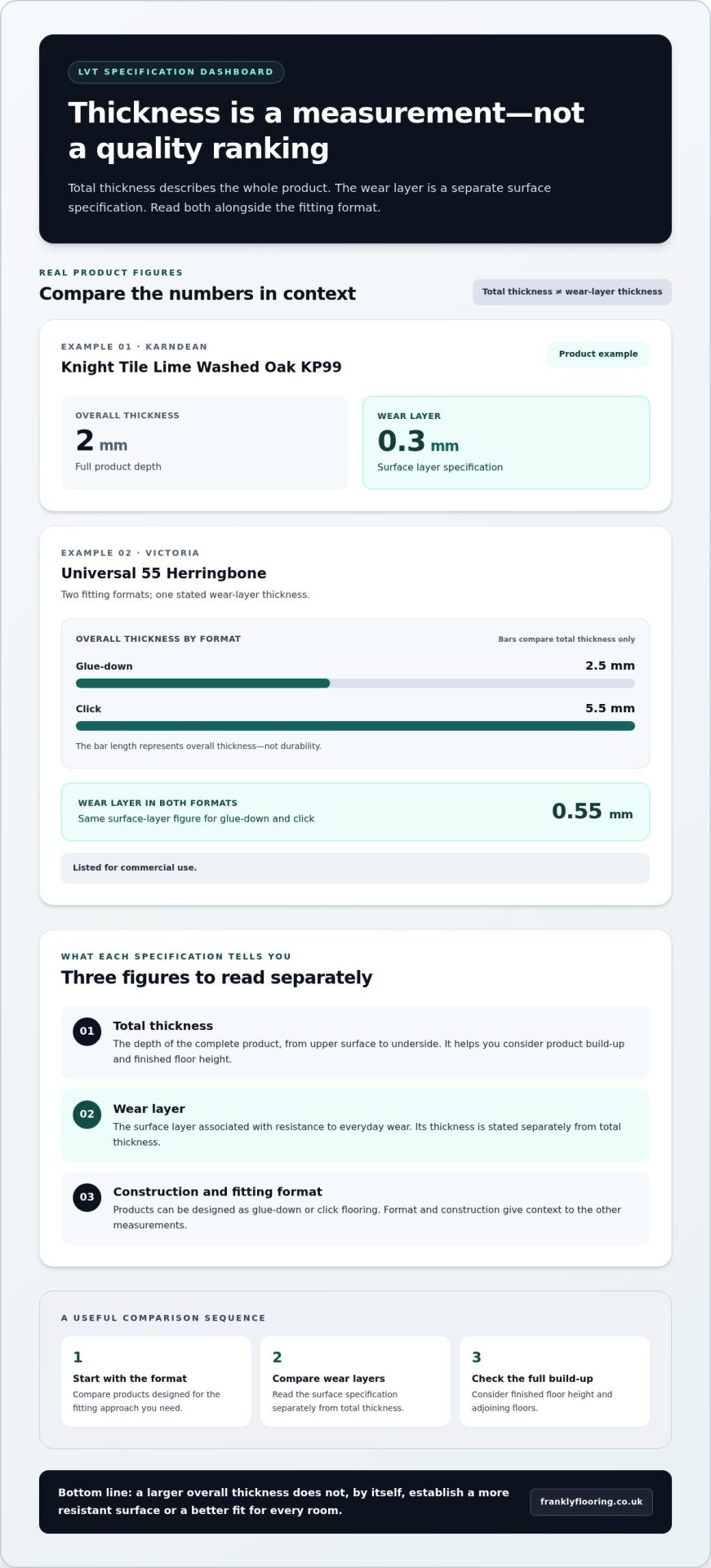
It’s easy to assume a bigger thickness figure is the safer choice. But total thickness can also reflect the fitting format. Karndean Knight Tile Lime Washed Oak KP99 is 2mm thick overall with a 0.3mm wear layer, while Victoria Universal 55 Herringbone is available in 2.5mm glue-down or 5.5mm click, with a 0.55mm wear layer in both formats. Read the figures together to make a useful comparison.
This guide explains what total thickness can and can’t tell you, how the wear layer helps you compare products, and why glue-down and click formats have different requirements. You’ll learn how to weigh those specifications against your room, floor levels and priorities, so you can compare LVT by its overall suitability rather than choosing by thickness alone.
Key Takeaways
- Is thicker LVT better? Not necessarily: total thickness describes the whole product, while the wear layer is a separate specification.
- Compare the wear layer and construction alongside total thickness to judge which flooring suits your room’s everyday use.
- Glue-down and click LVT are different fitting formats, so compare products in the context of how they’re designed to be fitted.
- Choose a format for the room, compare wear layers, then consider product guidance and the height of adjoining floors.
- Use the full specification to narrow your options, rather than treating one thickness figure as a quality ranking.
Is thicker LVT better? What total thickness actually tells you
Thicker LVT isn’t automatically better. Suitability depends on the full specification, including the wear layer, product construction and fitting format. A larger millimetre figure tells you that the product is thicker overall, but it doesn’t show on its own how well the surface will stand up to everyday use or whether the format suits your floor.
Total thickness still matters. It contributes to the finished floor height, which can affect how the flooring meets adjoining surfaces, thresholds and doorways. It also reflects how a product is built. For a general overview of the material and its uses, see Luxury vinyl tile (LVT). Read each measurement for what it describes instead of treating one number as a complete quality score.
What does an LVT thickness figure measure?
The stated thickness in millimetres describes the product’s overall thickness, from its upper surface to its underside. The wear layer is only one part of that measurement. It sits at the top of the flooring, protecting the decorative design beneath it. Other layers and the core contribute to the product’s construction, and their arrangement can vary between products and formats.
- Top: wear layer, the clear surface layer associated with resistance to everyday wear.
- Below: decorative design layer.
- Lower layers: the product’s core and backing, where included in its construction.
- Full measurement: total thickness, from the top surface to the underside.
This is a simple guide, not a claim that every LVT product has identical layers. Compare specifications in context: different constructions and fitting formats mean two total-thickness figures may not describe like-for-like products.
Why doesn’t thicker automatically mean better?
Thickness and wear resistance answer different questions. Total thickness tells you how deep the whole product is; the wear-layer specification describes the protective surface. A thicker product may have a different construction or be designed for another fitting format, but its overall measurement alone can’t establish how resistant its surface is to scratches, scuffs or general use.
That distinction matters when comparing options. A thinner product can suit one fitting approach, while a thicker product may be designed for another. Neither is automatically the better choice for every home. Check the wear-layer figure and fitting guidance alongside total thickness instead of assuming extra millimetres mean extra durability.
Use thickness as a practical measurement, especially when considering finished floor height. Use the rest of the specification to understand what the product is designed to do. This gives you a fairer comparison than ranking LVT by overall depth alone.
Total thickness, wear layer, and construction: which LVT specification matters?
To compare LVT fairly, separate three things: the thickness of the whole product, the thickness of its surface wear layer, and how the product is constructed. Each answers a different question. Total thickness helps you understand the product’s overall build-up; the wear-layer figure describes the protective surface; and construction and format explain why products with different measurements may not be direct alternatives.
Total thickness: The overall depth of the flooring, measured from top to underside. Useful for comparing product build-up and considering finished floor height.
Wear layer: The surface layer associated with resistance to everyday wear. Its thickness is stated separately from the product’s total thickness.
Construction and format: How the product is built and whether it is designed as glue-down or click flooring. This gives context to the other figures and helps distinguish products with different fitting systems.
Two products with different total thicknesses can’t be ranked by thickness alone, because their wear layers, construction and fitting formats may differ.
How is the wear layer different from total thickness?
The wear layer is part of the flooring’s surface, not another name for its full thickness. Its measurement helps you compare the protective layer between products, while total thickness describes the depth of the complete product. Neither figure gives the whole picture on its own: read the surface specification alongside construction and fitting format. For more on comparing this surface layer, see our guide to LVT wear layers and their thicknesses.
What do real product specifications show?
Frankly Flooring’s product examples show why these measurements should be read together. Karndean Knight Tile Lime Washed Oak KP99 is 2mm thick overall and has a 0.3mm wear layer. Those figures describe its build and surface specification; they aren’t, by themselves, a verdict on whether it suits a particular room.
Victoria Universal 55 Herringbone makes the role of format especially clear. Its glue-down version is 2.5mm thick, while the click version is 5.5mm thick. Both have a 0.55mm wear layer, and the product is listed for commercial use. The difference in overall thickness doesn’t mean one version has a thicker wear layer than the other. Compare each option with its fitting format and intended use in mind.
That’s the practical answer to is thicker lvt better: the right choice depends on how the specifications work together. Start with the format you need, then compare wear-layer figures and total build-up. If you’re weighing up finishes as well as measurements, compare LVT samples and specifications before settling on an option.
How LVT thickness compares across glue-down and click flooring
Glue-down and click LVT are different fitting formats, not rungs on a simple ladder from thinner and inferior to thicker and superior. Their construction and fitting systems differ, so thickness comparisons are most useful when you know which format each figure describes. A broad thickness range can provide context, but it isn’t a universal UK buying rule or a verdict on product quality.
Why can click LVT be thicker than glue-down LVT?
Victoria Universal 55 Herringbone illustrates the difference: the glue-down version is 2.5mm thick, while the click version is 5.5mm thick. These are format-specific specifications for the same named product. The figures show that overall thickness can vary with fitting format; they don’t explain every detail of the product’s construction or prove that one option is better.
In broad terms, glue-down flooring is secured with adhesive, while click flooring joins through a connecting edge system. That distinction helps explain why the options shouldn’t be compared as though they were identical products with one simply made thicker. For a wider look at how fitting formats differ, our guide to loose lay versus click LVT explores another format comparison.
How should you compare thickness across fitting formats?
Start by comparing products designed for the same fitting format. Then read each specification as a set: format, overall thickness, stated wear layer and the manufacturer’s fitting guidance. Victoria Universal 55 Herringbone has a 0.55mm wear layer in both its 2.5mm glue-down and 5.5mm click versions, so the thicker option doesn’t mean a thicker wear layer.
Before choosing, consider how the stated thickness relates to the finished floor height in your room. The level where LVT meets another floor or a doorway can matter, especially when comparing options with noticeably different overall measurements. Think about the complete floor build-up required by the selected product, and follow its instructions rather than assuming every format can be fitted in the same way.
- Match the format: Compare glue-down with glue-down, or click with click, where possible.
- Separate the figures: Read total thickness and wear-layer thickness as different measurements.
- Check the guidance: Follow the instructions for the exact product and fitting format.
- Consider floor height: Account for adjoining surfaces and the finished level, not just the plank measurement.
So, is thicker LVT better? Not as a rule. The right format depends on the product specification and the room’s fitting requirements, not on a thickness chart alone. Compare LVT formats and product specifications with those practical details in mind before deciding.
How to choose the right LVT thickness for your room
Choose a product for the room and fitting conditions, not to meet an arbitrary thickness target. The same thickness won’t suit every project: the room’s intended use, the format you want and the manufacturer’s requirements all affect the decision. Use this four-step check to compare products in a practical order.
What should you check before choosing a thickness?
Start with how the room will be used, then look for the product’s stated room suitability. Next, compare fitting format and wear layer as separate details. Finally, consider finished floor height: measure how the proposed flooring will meet adjoining surfaces and check transitions, thresholds and door clearance.
- Identify the room and its use. Note how the space is used and what the product is stated to suit. Don’t choose a thickness based on a broad label such as “kitchen” or “hallway” alone.
- Choose the fitting format. Decide whether glue-down or click is appropriate for the project, then compare products within that format where possible. Each product has its own fitting instructions.
- Compare the wear layer. Read its stated thickness separately from the overall product measurement. Use the specification to understand the surface layer, rather than treating total thickness as a measure of surface durability.
- Check the fitting guidance and floor build-up. Review the exact product’s requirements and account for how its finished height will meet other floors, doorways and transitions.
Room first, format second, wear layer third, fitting guidance and finished floor height last: that’s the order for comparing LVT specifications.
When do subfloor and underfloor heating affect the decision?
The subfloor is part of the product decision because the chosen LVT must be fitted in line with its manufacturer’s requirements. Those instructions apply to the specific product and format, so don’t rely on a general thickness guide as a substitute. A thicker option won’t necessarily accommodate an existing floor condition.
If the room has underfloor heating, check the exact product’s compatibility information and fitting instructions before choosing. Requirements can be product-specific, so avoid applying a blanket rule about which LVT thickness or format will work. The same principle applies to the full floor build-up: use the stated guidance for the product you’re considering.
As you compare suitable options, keep your measurements and the product specifications together. This makes it easier to see whether a product’s overall thickness fits the planned floor level without losing sight of its format and room suitability. Browse LVT flooring and product specifications to compare options.
Choose LVT by the full specification, not thickness alone
The useful question isn’t simply “is thicker lvt better?” It’s whether a product’s format, stated room suitability, wear layer and total floor build-up fit your project. Check those details together, then consider the look and finish. That gives you a more reliable basis for choosing than treating the largest thickness figure as the obvious winner.
What to compare on an LVT product page
Read the specification as a whole. Start with the product name and fitting format so you’re comparing the correct version. Then note the overall thickness and wear-layer figure separately. Check the stated room suitability and product-specific fitting information too. These details help you understand what the product is intended for and what its fitting involves.
- Product and format: Confirm the exact product and whether the option is glue-down or click.
- Measurements: Record total thickness and wear-layer thickness as separate figures.
- Suitability and guidance: Read the stated room suitability and instructions for that product.
- Floor build-up: Consider the finished level alongside adjoining floors, thresholds and door clearance.
- Appearance: Compare a sample with the room’s light and furnishings, as well as the written specification.
Frankly Flooring’s examples show why this approach matters. Karndean Knight Tile Lime Washed Oak KP99 measures 2mm overall and has a 0.3mm wear layer. Victoria Universal 55 Herringbone has a 0.55mm wear layer in both its 2.5mm glue-down and 5.5mm click formats, and is listed for commercial use. These examples illustrate different specifications and formats, not a universal ranking. The figures alone don’t establish which product is right for your room.
A sample can help you judge the colour and finish in your own space before ordering. It won’t replace the specification, but it adds a useful real-world check: see how the flooring looks in the room, then return to the product details to make sure the format and measurements suit your plan.
How to take the next step with Frankly Flooring
Frankly Flooring’s online LVT range gives you product specifications to compare across glue-down and click options. Free samples offer a practical way to assess the look and finish, and delivery is available across the UK. Keep the product details close as you weigh up your options, especially if you’re comparing formats or planning around adjoining floor heights.
There’s no need to chase a thickness target. Match the format and room use, compare the wear layer, then check fitting guidance and the finished floor build-up. Browse LVT flooring at Frankly Flooring and explore LVT flooring while comparing specifications and samples.
Make your next LVT choice with confidence
Before settling on a floor, take your shortlist back to the room itself. Check how each option will work with the space, the existing floor level and the finish you want to live with every day. The question “is thicker lvt better” is a useful starting point, but your decision should come from how well the complete product specification fits your plans.
A sample can help you judge the colour and surface in your home, where lighting and nearby finishes influence how a floor looks. Frankly Flooring offers free samples and delivery across the UK, so you can explore options online and consider them in context before ordering.
Take your time with the final comparison. A clear choice is one that suits your room and fitting requirements, not simply the one with the biggest number on its product page. Browse LVT flooring at Frankly Flooring and find an option that feels right for your home.
Frequently Asked Questions
Is thicker LVT more durable?
No. Greater overall thickness doesn’t, by itself, show how long an LVT surface will resist wear. The wear-layer figure describes the surface layer, while construction can vary between products. For a busy entrance, compare the specific product’s wear-layer specification and stated room suitability, then read its fitting and care guidance. So, is thicker LVT better? It depends on the full product details and intended use, not millimetres alone.
Can thicker LVT be fitted over an uneven floor?
Don’t assume extra thickness will hide an uneven subfloor. A thicker plank isn’t a substitute for meeting the selected product’s subfloor requirements, and the fitting method may affect what preparation is needed. Before planning the floor build-up, read the manufacturer’s instructions for the exact LVT option. If the surface has dips or raised areas, factor its condition into the project rather than expecting the flooring thickness to compensate.
Does thicker LVT make a room quieter?
Not necessarily. Overall thickness alone can’t predict how much sound you’ll hear in a room, since product construction, fitting format and the floor beneath it can all affect the result. If footfall noise is a concern, look for acoustic information stated for the exact product and installation arrangement. Don’t use thickness as a substitute for that information or assume a particular sound reduction without product-specific evidence.
Will thicker LVT affect doors and floor transitions?
It can affect the finished floor level, so include door clearances and adjoining surfaces in your measurements. Compare the complete planned floor build-up, including any components specified for the chosen product, rather than looking only at the LVT figure. Check how the proposed level meets thresholds and nearby flooring. A height difference doesn’t automatically mean a door or threshold needs alteration, but it’s sensible to assess these details before ordering.
Can you use thicker LVT with underfloor heating?
Possibly, but thickness alone can’t establish compatibility. Underfloor heating suitability depends on the exact LVT product and its manufacturer’s instructions, including the stated fitting guidance. Check those details for the option you’re considering before making a selection, rather than applying a general rule to all thicker flooring. Product specifications can differ, so don’t assume compatibility or performance information for one LVT option applies to another.
What happens if you choose LVT that is too thick for your project?
The finished floor height may not work neatly with a doorway, threshold or adjoining floor, so the planned transitions could need reconsideration. That’s a question of whether the product fits the project, not evidence that thicker LVT is inherently poor. Before ordering, compare the complete floor build-up with existing levels and read the product’s fitting guidance. This helps you spot potential height conflicts early without assuming a specific problem will occur.