
A polished product page alone doesn’t prove a retailer is reliable. To judge how to trust an online flooring retailer, look beyond the products: check that contact and returns information is clear, how the retailer responds to complaints, and whether reviews are recent. These practical checks give you a better basis for deciding than a star rating alone.
It’s sensible to want clear answers before ordering flooring online, especially when it needs to suit a particular room and project. Assess complaint replies, find the contact and returns information, and consider whether reviews reflect recent customer experiences. Look for recurring themes across reviews rather than relying on one striking comment, so you can make a considered choice without rushing.
Key Takeaways
- Judge complaint replies by whether they address the issue clearly and explain a practical next step, not just by their tone.
- Look for accessible contact details and returns information that explains the process in plain, specific terms.
- Use review dates to distinguish current experiences from older feedback that may no longer reflect how a retailer operates.
- Compare recurring themes across reviews and ratings, rather than letting one glowing or critical account decide for you.
Assessing company replies to complaints
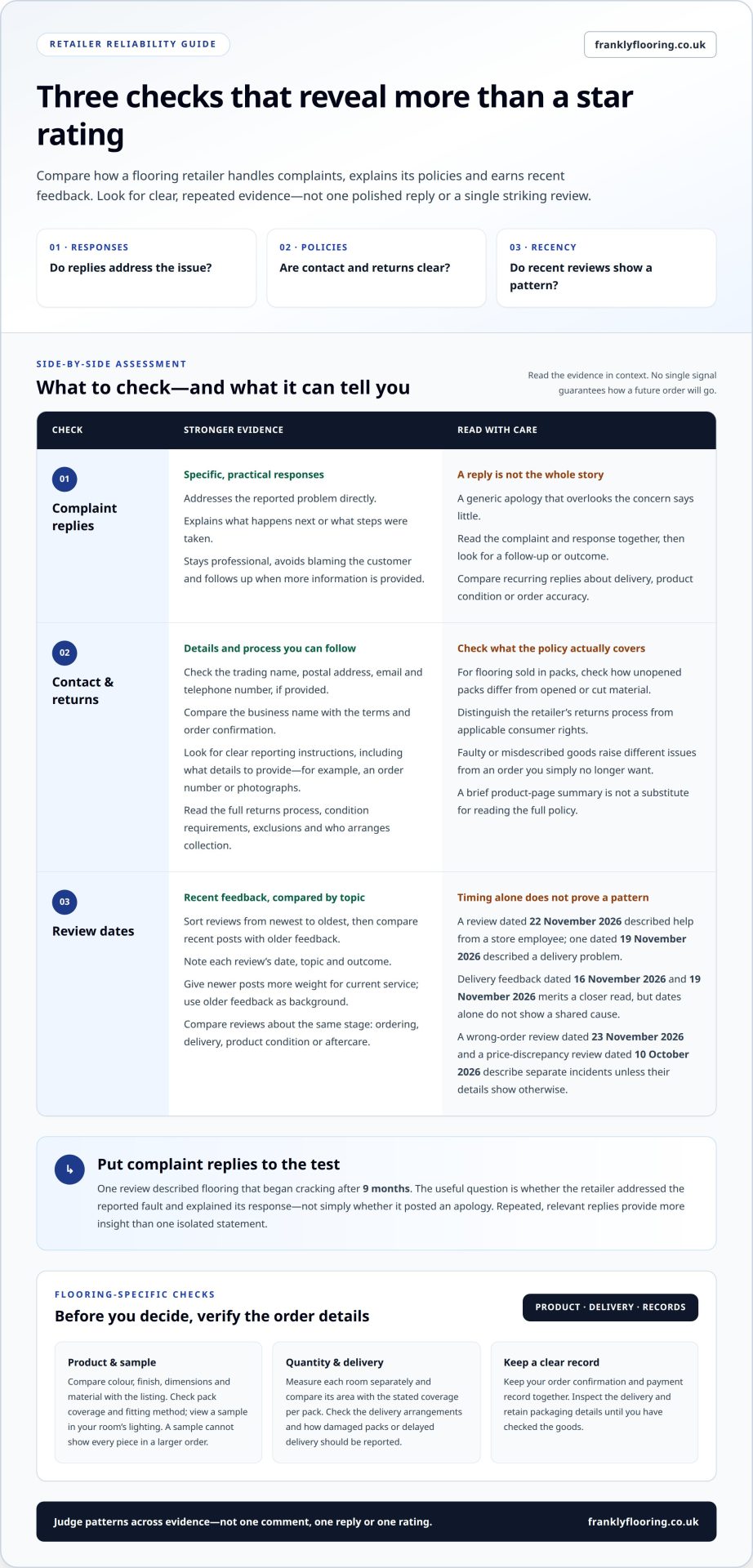
A retailer’s reply to a complaint shows how it responds when something goes wrong after checkout. Look for a direct response to the issue, a clear explanation of what happens next, and a practical route to resolution. A generic apology that overlooks the customer’s concern tells you little. A reply that acknowledges the reported problem and explains the steps taken is more useful, even if the reviewer wasn’t satisfied with the outcome.
Read the complaint and reply together. For example, a review described flooring that began cracking after 9 months. The useful question is whether the company addressed the reported fault and explained its response, rather than simply posting a standard message. These examples show why replies should address the detail, not just express regret.
To compare online flooring prices, delivery fees and fitting costs in the UK, list them separately and compare equivalent product specifications, pack coverage, delivery arrangements and fitting work. For a herringbone layout, check that fitting comparisons include the same pattern and preparation. Card payment terms should explain how to raise a payment dispute. Keep your order confirmation and payment record together.
Check whether the reply is professional, avoids blaming the customer and gives a specific next step. Note whether the company follows up when the reviewer provides more information. A helpful reply can’t prove that every future issue will be handled well, but repeated, relevant responses provide more insight than a single polished statement.
Use a simple process: identify the complaint, read the full company response, then look for a follow-up or outcome. Compare it with other complaints about delivery, product condition or order accuracy. If several replies address the issue and explain actions clearly, that pattern is more meaningful than one isolated response. If replies repeatedly sidestep concerns, examine the retailer’s contact and returns information closely.
Checking retailer contact and returns information
Knowing how to trust an online flooring retailer starts with clear business and contact details. Read the contact page and note the trading name, postal address, email and telephone number, if provided. Compare the business name with the terms and order confirmation. A clear way to report a delayed delivery or damaged pack helps you understand what to do. Check whether the retailer explains what information to provide, such as your order number and photographs.
Read the full returns policy before ordering, not just a brief product-page summary. Look for the return process, condition requirements, exclusions and who arranges collection. Flooring is often sold in packs, so check how the policy treats unopened packs compared with opened or cut material. A step-by-step explanation is more useful than a general statement that returns are accepted.
For UK online purchases, distinguish the retailer’s returns policy from your consumer rights. The reason for returning matters: faulty goods or goods that differ from their description raise different issues from an order you simply no longer want. Read the policy for the process, while remembering that its terms don’t replace applicable legal rights.
Before ordering a sample or full product, compare its colour, finish, dimensions and material with the listing. Check the pack coverage and stated fitting method, then view the sample in your room’s lighting. A sample helps you judge appearance, but won’t show every piece in a larger order. For one continuous floor, check how the retailer addresses batch consistency and visible shade variation.
A practical part of deciding how to trust an online flooring retailer is understanding what could go wrong and what the policy says to do. Delivery may be delayed, packs may be damaged in transit, or the quantity may not suit your measurements. Measure each room separately and compare its area with the stated coverage per pack. Keep your order confirmation, inspect the delivery and retain packaging details until you’ve checked the goods.
Checking when reviews were posted
A review’s date helps show whether it reflects a retailer’s current service. A comment from three or four years ago may no longer describe how the business handles orders today. Sort reviews from newest to oldest, then compare recent feedback with older comments. Look for recurring issues across different periods rather than treating an old complaint as proof of current performance or a recent positive review as the whole picture.
Dates make individual experiences easier to place in context. For example, a review describing help from a store employee was dated 22 November 2026, while a separate review about a delivery problem was dated 19 November 2026. These posts sit close together, but describe different parts of the customer journey. Check whether the review concerns ordering, delivery, product condition or aftercare, then compare it with other dated accounts covering the same stage.
Look at clusters of reviews, too. A set posted within a short period may relate to the same busy season, delivery disruption or change in service. Compare those comments with reviews from other months before deciding whether a problem appears persistent. For instance, delivery feedback dated 16 November 2026 and 19 November 2026 deserves attention, but dates alone don’t show whether both customers experienced the same cause. Read the details and any company response together.
Recent reviews can also reveal whether a retailer is responding to issues raised earlier. One review about a wrong flooring order was dated 23 November 2026; another describing a price discrepancy and customer service was dated 10 October 2026. Use those dates to distinguish separate incidents, then assess what each review actually says. Don’t infer a pattern from timing alone. Check whether comments describe similar outcomes, and whether later reviews suggest the issue continued or was addressed.
For a balanced assessment, note the date, topic and outcome of several reviews. Give newer posts more weight when judging current service, while treating older feedback as background. A dated review is a clue, not a verdict: its value depends on its detail and how it fits with other customer experiences.
How to verify a flooring retailer’s reviews and ratings in the UK?
Start with the retailer’s Google Business Listing and Trustpilot profile. A Google Business Listing can display customer reviews about a company, while Trustpilot offers another place to read customer feedback. Check that each profile refers to the same business and flooring retailer. Read the review, not just the star score, and note whether it covers ordering, delivery, product quality or aftercare. These details help you compare feedback about similar parts of the buying experience.
A rating is easier to interpret alongside its review count. For example, a 4.4-star rating based on over two thousand reviews gives a broader sample than a perfect five-star rating based on twelve reviews. Neither figure proves how your own order will go. Instead, consider how the number of reviews affects the weight you give the average, then read individual accounts to understand what customers praised or criticised.
Look for recurring themes across a substantial sample, rather than letting one unusually positive or negative post shape your decision. Reading fifty comments can help show whether concerns recur, such as delivery coordination, order accuracy or communication. Separate comments by stage of the purchase, then see whether similar experiences appear in more than one account. A repeated, specific issue deserves closer attention than a vague remark mentioned only once.
Use a simple cross-check: compare the business name across platforms, read a mix of high and low ratings, and note recurring topics. Then compare those themes with the retailer’s replies to complaints and its published contact and returns information. If Google and Trustpilot present different overall impressions, examine the dates and detail behind the comments before drawing a conclusion. For a further step, explore flooring options while weighing the product information against the review patterns you’ve found.
Frankly Flooring
Once you’ve assessed a retailer’s reviews, contact details and returns information, browse Frankly Flooring’s carpet options if you’re considering flooring for your home. Compare products with the room’s intended use, appearance and product details. Furniture is also available if you’re planning how the room will come together.
Take the same considered approach to any purchase: read the product information, check the ordering and returns details, and order only when the terms suit your needs. There’s no need to rush. Understanding the product and the retailer helps you make an informed decision.
If you’d like to take the next step, contact Frankly Flooring.
Make your next flooring choice with confidence
Knowing how to trust an online flooring retailer is ultimately about choosing what suits your home, not chasing a perfect-looking rating. Consider how the room is used, what finish suits it and which product details matter most to you. That gives you a practical basis for choosing rather than relying on one impression.
Frankly Flooring offers LVT, wood and carpet, with options to consider for different rooms and preferences. Compare the product information with your plans and take the time you need to decide what suits your space. Free samples are available and delivered to your home, so you can assess colour and texture in the room before ordering.
Ready to discuss your flooring options? Contact Frankly Flooring and take the next step at your own pace.
Frequently Asked Questions
How to check whether a UK online flooring retailer is a legitimate company?
For a limited company, search its exact legal name on Companies House and compare the registered details with the retailer’s terms and order documents. Check that the trading name is explained if it differs, and that the payment recipient matches the business you’re ordering from. A Companies House record confirms company registration, not the quality of its products or service, so consider it alongside clear order and business information.
What should a UK flooring retailer’s delivery, returns and refund policies include?
Look for separate, plain-language details about delivery, reporting damaged or missing goods, returns and refunds. The policy should explain how to start each process, what condition flooring must be in, whether collection is arranged and how refunds are handled. Check how it treats unopened and opened packs, and made-to-measure items if relevant. Keep the policy and order confirmation so you can refer to the terms that applied when you bought.
What consumer rights apply when buying flooring online in the UK?
Faulty flooring or goods that differ from their description raise different consumer-rights issues from an order you simply no longer want. The retailer’s returns policy explains its process, but doesn’t replace applicable legal rights.