Last Tuesday, a homeowner visited our showroom and explained how her previous £1,200 carpet had flattened into a thin, shiny mess on the stairs in just 14 months. It’s a frustratingly common story. You likely want your home to feel inviting, but it’s difficult to feel proud of your decor when you’re constantly spotting vacuum tracks or stubborn stains in those busy transition zones between rooms.
Frankly, we believe you shouldn’t have to replace your flooring every few years. We’re here to help you find the best carpet for stairs and landing that combines genuine durability with a style that won’t date. You can achieve a look that remains resilient for 10 years or more by choosing the right materials from the start. This guide explains exactly which fibres resist crushing, how to maintain a cohesive look across different levels, and why the right fitting and underlay are just as important as the pile itself.
Key Takeaways
- Understand the “nosing” effect and why choosing the best carpet for stairs and landing requires a specific “Extra Heavy Domestic” rating to withstand multi-directional footfall.
- Compare the durability of wool versus polypropylene and see why the industry-standard 80/20 wool blend remains the frank choice for shape retention.
- Learn why reusing old underlay is a false economy and how selecting the correct 9mm or 11mm density provides the essential foundation for a professional fitting.
- Get a straightforward guide to measuring your staircase accurately to ensure your online quote is honest, transparent, and free from hidden surprises.
- Discover what to look for when your samples arrive to ensure the pile and texture can handle the pressure of a busy family home.
Why Stairs and Landings Are the Ultimate Test for Any Carpet
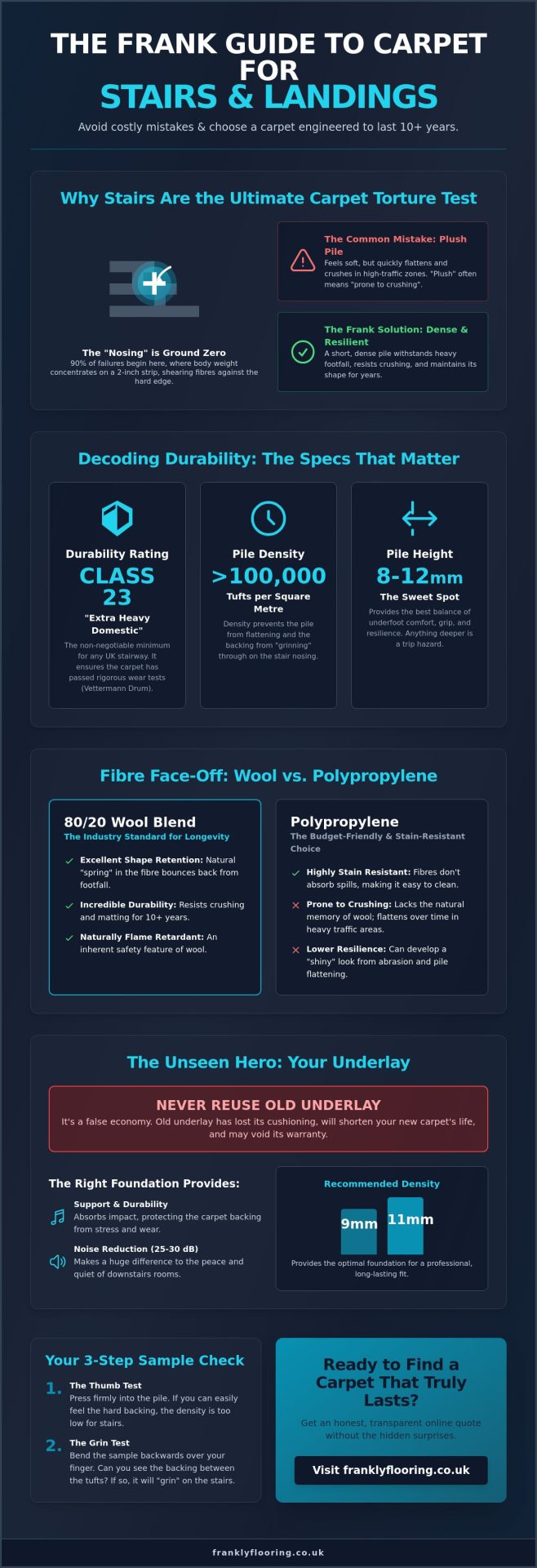
Choosing the best carpet for stairs and landing isn’t just about finding a colour that matches your walls. It’s an engineering decision. Most carpets fail in these areas because stairs aren’t flat, static surfaces; they’re high-impact zones. The “nosing” is the front edge of each step, and it’s where 90% of stair carpet failures begin. Every time you walk down, your full body weight concentrates onto a tiny two inch strip of fibre. This pressure shears the pile against the hard timber edge underneath, leading to premature balding if the material isn’t up to the task.
Many homeowners make the mistake of choosing a deep, plush pile for their stairs because it feels soft underfoot. The frank truth is that “plush” usually means “prone to crushing” in high-traffic zones. Within six months, a thick bedroom-grade carpet will look matted and flattened on the treads. It won’t spring back, no matter how much you vacuum it. You need a dense, resilient pile that can withstand the heavy-duty grind of a family home without losing its shape.
The Physics of Footfall on a Staircase
Descent is far more damaging than ascent. When you go down the stairs, your heel strikes the carpet with a force that significantly exceeds your standing weight. On landings, the problem shifts to “pivoting.” You don’t just walk in a straight line; you turn, twist, and stop to enter bedrooms or bathrooms. This twisting motion grinds the fibres together, causing pile shading and wear. Density is your primary defence here. A higher number of tufts per square inch prevents the pile from flattening under pressure. Understanding carpet construction and materials helps you see why a short, tight twist or a high-quality loop pile is the standard for longevity.
The Landing: The Hub of the Home
The landing is the busiest square metre in your property. It’s the central hub where traffic from every room converges, creating specific “doorway wear” patterns where people pivot. You must ensure your best carpet for stairs and landing choice carries a heavy domestic or commercial durability rating across both areas to maintain a cohesive look. If you compromise on the landing quality to save a few pounds, it will look aged and tired long before the stairs do.
Sound insulation is another critical factor often overlooked. Landings act as a drum, echoing footsteps into the rooms below. A high-quality, dense carpet paired with a premium underlay can reduce impact noise by 25 to 30 decibels. This makes a massive difference to the peace and quiet of your downstairs living spaces while the rest of the house is in motion.
Technical Specs: The Ratings That Actually Matter for Stairs
The Heavy Domestic (Class 23) Standard
If a carpet is rated Class 22, it’s intended for general domestic use in rooms like bedrooms. It’ll likely fail on your stairs within 24 months as the fibres flatten and the backing begins to show. Class 23 is the non-negotiable minimum requirement for any UK stairway that sees daily use. For busy family homes, we always suggest looking for an “Extra Heavy Domestic” label. This ensures the carpet meets higher standards for safety and longevity, including meeting federal flammability standards and abrasion resistance. A Class 23 rating is the only way to ensure your investment doesn’t look worn out before the rest of your decor.
Density vs. Depth: The 2026 Quality Test
Don’t let a high pile weight fool you. A carpet can have a 60oz weight but still be poorly constructed if those fibres are spaced too far apart. Density is what prevents the carpet from “grinning”. That’s the industry term for when you see the carpet backing as the material bends over the edge of the stair nosing. It’s a sign of a poor-quality fitting or a sub-par product.
- The Thumb Test: Press your thumb firmly into the pile of a sample. If you can easily feel the hard carpet backing, the density is too low for stairs.
- Tuft Count: A high-quality stair carpet usually features upwards of 100,000 tufts per square metre.
- Pile Height: Keep it short. A pile height between 8mm and 12mm provides the best balance of comfort and grip.
Deep shags are a trip hazard on steps. They hide the edge of the tread and compress unevenly over time. A tight, dense twist or a high-quality wool loop will always outperform a thick, fluffy alternative. When you’re ready to see these specs in person, come and have a frank conversation at our showroom about which materials will actually stand up to your household’s routine. Always look for the “stair rating” icon on the back of the sample. It looks like a small staircase and confirms the manufacturer has tested the product for the unique stresses of vertical installation.
Fibre and Pile Types: The Frank Comparison
Choosing the right material is where most homeowners get it wrong. It isn’t just about the colour or the softness underfoot; it’s about how the yarn handles the pressure of a human heel thousands of times a week. On a staircase, the carpet is stretched over the tread and bent over the nosing, which puts immense stress on the backing and the fibre itself.
Natural Wool and the 80/20 Blend
Wool remains the benchmark for performance. Its natural protein structure acts like a coiled spring, allowing the fibre to bounce back after being crushed by footfall. For the best carpet for stairs and landing, we almost always recommend an 80/20 blend. This ratio mixes 80% wool with 20% synthetic nylon to increase tensile strength. Academic studies on carpet fiber and yarn construction confirm that adding nylon significantly boosts abrasion resistance, which prevents the carpet from “balding” on the edges of the steps. While wool requires professional cleaning and more care than plastic alternatives, it maintains its appearance for 10 to 15 years in a typical UK home.
Modern Synthetics: Polypropylene and Polyester
Many families choose polypropylene for the “bleach cleanable” factor. It’s a practical, honest choice if you have young children or high spill risks. By 2026, stain-resistant coatings on these fibres have improved significantly, with new polymer treatments offering better oil resistance than versions from just five years ago. However, you must be wary of cheap polyester. While it feels incredibly soft in the showroom, it lacks the structural integrity of wool. Lower-grade synthetics often flatten permanently on stair nosings within 24 months. If you go synthetic, ensure it’s a high-density “life-style” yarn designed for heavy domestic use.
Which Pile Type Wins for Safety?
The structure of the pile affects both safety and maintenance. We suggest sticking to these rules:
- Twist Piles: These are the safest option. The cut ends of the yarn provide better friction for socks and slippers, which helps prevent slips. They also hide “shading” and footprints better than most other styles.
- Loop Piles (Berbers): While they look modern and textured, they can be slippery. More importantly, we give a frank warning to pet owners: avoid loops. Cat and dog claws easily snag in the loops, especially on the tensioned edges of stairs. Once a loop is pulled, it can run like a ladder in a pair of tights, ruining the entire flight.
For a busy household, a high-quality twist pile in an 80/20 blend is the most reliable path to a long-lasting, safe, and attractive staircase. It’s a straightforward investment that avoids the “crushing” issues seen in cheaper alternatives.
The Essentials: Underlay, Grippers, and Tog Ratings
To be frank, the best carpet for stairs and landing is only as good as what’s underneath it. Many homeowners try to save a few pounds by reusing old underlay, but this is a mistake that costs more in the long run. Underlay on stairs takes a localized beating. Even if it looks acceptable, the internal structure of the foam or rubber has likely collapsed in the high-traffic “tread” areas. Placing a brand-new carpet over exhausted underlay leads to visible “tracking” and premature wear within 12 to 18 months. Always start with a fresh base to ensure your investment lasts.
Selecting a High-Performance Underlay
Firmness beats thickness every time on a staircase. While a thick 11mm PU foam underlay feels luxurious in a bedroom, it’s often too “pillowy” for stairs. This extra movement allows the carpet backing to stretch and shift, which eventually causes the carpet to come loose from the fixings. A high-density 9mm underlay is the professional choice. It provides a stable foundation that prevents the carpet from “rolling” over the stair nosing. For the ultimate durability, crumb rubber underlay, made from recycled car tyres, is the gold standard. It withstands the “stair pound” better than PU foam, effectively doubling the lifespan of your carpet by absorbing the impact that would otherwise snap the carpet fibres.
Tog Ratings and Heat Efficiency
If your home features under-carpet heating, you must pay attention to the 2.5 Tog rule. This is the maximum combined thermal resistance allowed for both your carpet and underlay. If you exceed this limit, your carpet acts as an insulator, trapping heat beneath the floor and forcing your boiler to work 15% harder to reach the desired temperature. For modern UK homes with underfloor heating, look for low-tog carpets and specialized perforated underlays. This ensures a steady heat flow of approximately 0.10 to 0.15 m²K/W, keeping your hallway warm without wasting energy or damaging the heating system.
A professional finish also relies heavily on the quality of your carpet grippers. On stairs, we use “short pin” grippers to ensure the sharp points don’t poke through the carpet pile, which is a common hazard with cheaper, standard-depth alternatives. These grippers hold the carpet under tension, creating that crisp, bolstered look where the carpet meets the riser. Without high-quality grippers, the carpet will eventually sag, creating a trip hazard on the landing.
Choosing the right accessories is just as vital as the fabric itself. If you want a floor that stands the test of time, book a professional measurement and consultation with our team to get the technical details right from the start.
Buying Your Stair Carpet Online: How to Get it Right
Buying flooring online used to be a gamble. Today, it’s the smartest way to secure a high-end finish without the high-street markup. At Frankly Flooring, we’ve stripped away the overheads of traditional showrooms to offer the best carpet for stairs and landing at a price that reflects its actual value. It requires a bit of preparation on your end, but the process is straightforward when you follow a few frank rules.
The Frank Guide to Measuring Stairs
You don’t need a degree in engineering to measure a flight of stairs. Use the “Tread and Riser” formula: measure the depth of the step (tread) and the height of the step (riser). Add these two figures together, then multiply by the total number of steps. This simple sum gives you the total length required for the straight run.
Landings require a different approach. Always add a waste margin of 5% to 10% to your final calculations. This extra material is vital for pattern matching and ensuring the pile direction remains consistent across the entire floor. If you have a winding staircase, measure the widest point of every “kite” or turning step. This ensures you aren’t left short when the fitter arrives to cut the material to shape. It’s better to have a small offcut than a gap on your top step.
Trusting the Online Process
We curate a specific “Stair-Ready” collection because not every carpet can handle the heavy footfall of a busy British home. Our selection focuses on high-density piles and resilient fibres that won’t flatten within six months of use. When your samples arrive in the post, don’t just look at the colour. Press your thumb into the pile to check the density and hold it against your existing skirting boards in natural daylight. This helps you see how the tones shift as the sun moves throughout the day.
Choosing to buy online offers better value because you aren’t paying for a physical shop’s electricity bills or commission-based sales staff. We work directly with reputable suppliers to ensure the quality remains high while the costs stay low. Once your carpet arrives, your final step is finding a local pro to handle the installation. We recommend using platforms with verified reviews to find a qualified fitter in your area. A professional fitting usually takes half a day for a standard flight, ensuring your investment looks perfect for years to come.
Step Into a More Durable Home
Choosing the best carpet for stairs and landing doesn’t have to be a gamble. You’ve now seen that these high-traffic areas require a heavy domestic rating and a dense pile to withstand thousands of footfalls over the next decade. Whether you opt for a resilient 80/20 wool blend or a stain-resistant polypropylene, the secret to longevity often lies in the technical details like high-quality underlay and appropriate tog ratings. These specifications ensure your investment doesn’t flatten out after just a few months of use.
We’ve spent over 20 years as a family-run business helping UK homeowners avoid expensive mistakes. Because we’ve cut out the high street showroom overheads, we can offer direct-to-consumer prices that make premium quality more accessible. You’ll find frank, honest advice on every product page because we believe in getting the job done right the first time. Take a look at our curated range to find a style that stands up to the daily demands of a busy household.
Explore our Heavy-Duty Stair & Landing Carpets
Your stairs are the backbone of your home, so give them the finish they deserve.
Frequently Asked Questions
What is the most hard-wearing carpet for stairs?
An 80% wool and 20% nylon blend is the most hard-wearing choice for your home. This specific ratio has been the British industry standard for decades because it combines the natural resilience of wool with the strength of synthetic fibres. It is widely considered the best carpet for stairs and landing because it resists crushing and maintains its appearance for 10 to 15 years in a typical household.
Can I use loop pile carpet on my stairs if I have a cat?
You should avoid loop pile carpets if you have cats. Their claws easily snag on the loops, leading to pulled threads that are difficult to repair. A single snag can unravel a significant section of the pile and ruin the look of the flight. Instead, choose a high-quality twist or velvet cut pile. These styles don’t have loops for claws to catch on, making them a much more durable option for pet owners.
Is wool or synthetic carpet better for high-traffic landings?
Wool is generally better for high-traffic landings due to its natural elasticity and ability to spring back after being stepped on. Synthetic fibres like polypropylene are excellent for stain resistance but can flatten permanently under heavy use. For the best carpet for stairs and landing, a wool-rich blend offers the most balance. It stays looking fresh for over 3,000 days of heavy footfall if maintained correctly with regular vacuuming.
Do I need a special type of underlay for a staircase?
You need a high-density underlay specifically designed for stairs rather than a thick, soft one. A 9mm or 11mm crumb rubber or a very firm polyurethane foam is ideal. Using an underlay that’s too soft allows the carpet to move too much against the wooden tread. This friction causes the backing to break down 30% faster than it would with a stable, high-density support that holds the carpet in place.
How do I stop my stair carpet from flattening on the edges?
To stop a carpet from flattening on the stair nosing, you must invest in a high pile weight, such as a 50oz or 60oz twist. Flattening usually happens when the pile is too sparse or the underlay is too thin. Ensure your fitter uses a bullnose technique that wraps the carpet tightly around the edge. Quality wool blends are 40% more likely to retain their shape on edges compared to entry-level polyester options.
What is the best colour for hiding dirt on stairs and landings?
Mid-toned heathered colours or carpets with a flecked appearance are the best for hiding dirt and lint. Solid dark colours like navy show every speck of dust, while very light creams highlight mud and footprints. Showroom data from 2024 indicates that greige and taupe tones are the most popular choices for busy UK families. These shades mask debris effectively between your weekly cleaning sessions.
How much extra carpet should I order for a winding staircase?
You should typically allow for 15% extra material when ordering for a winding staircase. Unlike straight flights, winders require each step to be cut from a larger piece of carpet to ensure the pile direction remains consistent. This ensures a seamless look and better wear over time. If your staircase has multiple turns or a half-landing, your fitter will need this additional meterage to align the grain correctly across every tread.
What tog rating is best for carpet with underfloor heating?
The combined tog rating of your carpet and underlay shouldn’t exceed 2.5 if you have underfloor heating. If the total rating is higher, it acts as an insulator and prevents the heat from rising into the room effectively. Most wool carpets have a rating of 1.5 to 2.0 tog. You’ll need to pair this with a specialized low-tog underlay, often around 0.5 tog, to stay within the safe 2.5 limit recommended by heating manufacturers.