
A respected brand name can be a useful starting point, but it won’t tell you how a particular floor will perform in your home. So, is quick-step laminate good quality? It can be, but the answer depends on the exact product, the room and how the flooring will be used.
It’s reasonable to want a durable floor without paying for features you don’t need. Wear classification, thickness and the joint system can help you understand what you’re buying. Compare products with similar intended uses, then check each detail against your household’s needs instead of relying on brand claims alone.
This guide explains how to assess Quick-Step laminate, compare it fairly with Balterio and identify the details that matter for different rooms and household demands. You’ll also find out when laminate may suit your plans and when another flooring option could be a better fit. The aim is simple: help you choose based on the product, not reputation alone.
Key Takeaways
- To answer “is quick-step laminate good quality”, assess the specific floor’s documented performance and suitability, not the brand name alone.
- Read an AC rating as an indication of abrasion resistance, not a complete score of overall quality.
- Compare Quick-Step and Balterio products with similar intended uses, including thickness, finish, joint system and warranty terms.
- Match the floor to the room’s conditions, household activity and care requirements before deciding which features matter.
- Use the exact product documents to check fitting requirements and avoid paying for specifications your home doesn’t need.
Is Quick-Step laminate good quality? Start with what quality means
Quick-Step can be a good-quality choice, but judge quality by the exact product’s specifications and how well they suit the room. A familiar name is a starting point, not proof that every range offers the same performance. If you’re asking “is quick-step laminate good quality”, look beyond the logo and consider wear resistance, joint design, surface finish, care requirements and intended use.
Laminate is a layered flooring material. This overview of what laminate flooring is explains its general construction and background. In practical terms, laminate quality is how well a floor’s documented wear resistance, core, joints, finish and care requirements meet the demands of its intended room.
What makes a laminate floor good quality?
Each feature answers a different question. The wear classification and surface finish give you information about abrasion performance and appearance. A consistent core supports the plank, while well-made joints help boards fit together securely. These features don’t make up for poor preparation or fitting, so follow the instructions for the exact product.
Keep the measures separate:
- Durability: Check the stated wear classification and any performance limits.
- Joint integrity: Review the joining system and fitting requirements.
- Appearance: Consider the décor, texture and finish in the room’s lighting.
- Comfort and care: Think about underfoot feel, cleaning instructions and the level of upkeep that suits your household.
A floor may have a strong wear rating and still be unsuitable if its moisture guidance doesn’t match the room. Likewise, a realistic finish doesn’t tell you how much care the floor requires.
Does every Quick-Step laminate range offer the same performance?
No. Specifications and recommended uses can differ between ranges and individual products. Don’t apply a claim about one floor to the whole brand. Thickness, wear classification, moisture guidance, warranty conditions and fitting instructions are product-specific details, not a universal quality score.
Before deciding, compare the current manufacturer datasheet and installation guidance for the exact Quick-Step product you’re considering. Check what each feature covers and read the warranty terms alongside the conditions for them to apply. This gives you a fair basis for comparison with Balterio or another laminate brand: match products with similar intended uses, then weigh the differences against your room and household needs.
Which Quick-Step laminate specifications reveal how well it may perform?
A product datasheet is more useful than a brand-wide claim. Find the exact product name, then check its wear classification, thickness, core description, joint system, moisture guidance, warranty conditions and fitting instructions. These details help you decide whether the floor is suitable for a bedroom, busy hallway or another room, rather than simply whether the figures look impressive.
If you’re asking “is quick-step laminate good quality”, use the specifications as evidence, not as a single pass-or-fail score. Compare similar products and read each figure in the context of what it measures.
What does an AC rating tell you about Quick-Step laminate?
An AC rating indicates a laminate floor’s resistance to abrasion, assessed through a standardised wear test. The World Floor Covering Association describes the AC system as an industry standard for gauging durability. The rating can help you compare products by wear performance, but it doesn’t tell you everything about how a floor will cope in your home.
AC ratings help compare abrasion performance, but they don’t guarantee identical performance in every room or situation. An AC rating isn’t a promise of resistance to spills, impact damage or problems caused by unsuitable fitting. Nor should you assume a Quick-Step floor has a particular rating from its brand name. Confirm the rating for the exact product in its current manufacturer documentation.
How do thickness, core, and click joints affect quality?
Thickness can affect how substantial a plank feels underfoot, but a thicker board isn’t automatically more durable. Check the stated core construction and how the product’s joints are designed to fit together. A consistent core and accurately made joints can support a stable fit, though the finished result also depends on following the fitting instructions.
Check the product guidance before choosing underlay or preparing the subfloor. Requirements can vary, and an incompatible underlay or unsuitable base may affect the floor’s performance or warranty. Don’t assume a joint system, thickness or installation requirement applies across every range.
For a useful comparison, note the exact product details side by side:
- Wear: Record the stated AC rating and what it measures.
- Construction: Compare thickness and the documented core material.
- Fitting: Check joint details, subfloor guidance and underlay compatibility.
- Room suitability: Read moisture instructions and warranty conditions alongside the technical figures.
Once you know which specifications matter for your room, you can explore laminate flooring options and compare finishes against those practical requirements.
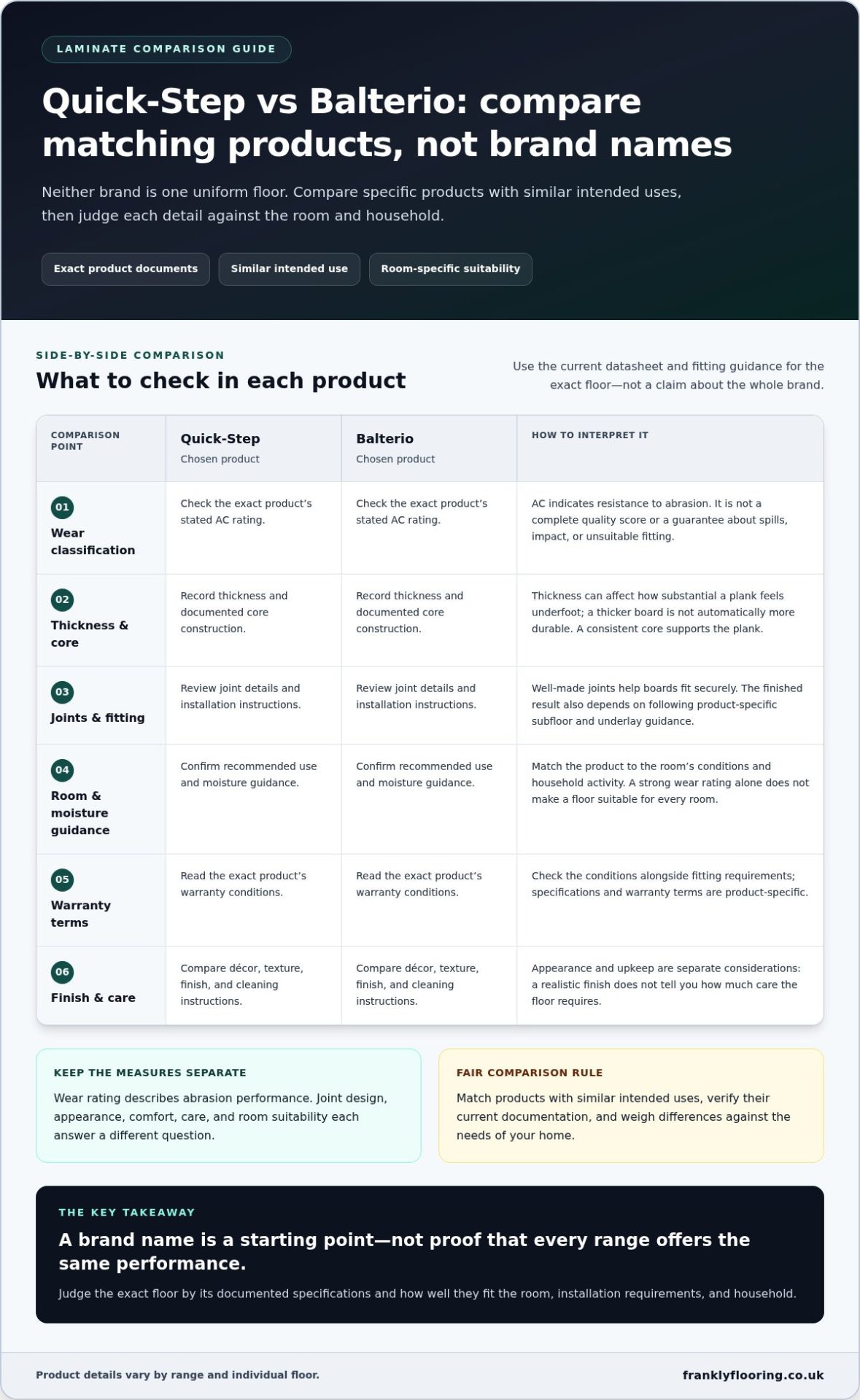
Quick-Step vs Balterio laminate: compare like with like
Quick-Step and Balterio shouldn’t be ranked as if each brand makes one uniform floor. A fair comparison matches two specific products with similar intended uses, then checks their documented performance and design. Without exact product references, there’s no sound basis for declaring one the winner or assuming ratings from brand reputation.
Use the table as a comparison template. Fill in details from the current manufacturer documents for the exact products, and note the publication or revision date shown on each document. If a detail isn’t provided, mark it “not stated” rather than treating it as a match.
| Specification | Quick-Step | Balterio | How to compare |
|---|---|---|---|
| Wear rating | Check exact product datasheet | Check exact product datasheet | Match the stated classification and intended use. |
| Thickness and core | Check exact product datasheet | Check exact product datasheet | Compare thickness and core details separately. |
| Finish | Check product description or technical document | Check product description or technical document | Compare surface appearance and texture in person or through reliable samples where possible. |
| Joint system | Check fitting instructions | Check fitting instructions | Compare the joining method and any stated fitting requirements. |
| Warranty | Check exact product warranty | Check exact product warranty | Read the conditions, exclusions and coverage period, not just the headline. |
Which specifications should you compare between Quick-Step and Balterio?
Start with equivalent intended uses, then compare construction, finish, joint details and warranty terms. Keep verified facts separate from your interpretation: thickness is measurable, while whether a plank feels better underfoot is a matter of preference. Industry references such as the North American Laminate Flooring Association can provide context on laminate performance, but your product decision should still be based on each floor’s documentation and suitability for your home.
Is a better-known laminate brand worth prioritising?
Brand familiarity may make a range easier to recognise, and design choice can be an important part of the decision. But familiarity alone doesn’t show whether a specific floor suits your room, household or fitting conditions. If the documents show comparable performance, appearance, care needs and warranty conditions may help settle the choice. If moisture exposure is a particular concern, compare laminate with alternatives such as LVT. Our LVT flooring guide explains the material.
So, is quick-step laminate good quality? Judge the exact product against the same criteria you’d apply to Balterio. Room suitability and documented details matter more than a brand-wide verdict.
Is Quick-Step laminate right for your room and household?
The right choice depends on where the floor will go and what it will face day to day. Use this sequence: room conditions → household use → care expectations → exact product specifications. Work through each point before deciding whether a particular Quick-Step laminate is suitable. Neither a familiar brand nor a high wear rating makes every laminate appropriate for every room.
What should you consider for busy living areas and hallways?
Think about foot traffic, grit brought in on shoes, pets’ claws, children’s play and furniture being moved. Then compare those demands with the exact product’s stated classification and recommended use. Consider your cleaning routine too: remove loose grit and follow the manufacturer’s care guidance to help limit everyday surface wear.
Simple precautions can help reduce avoidable damage. Mats at entrances can catch some grit, while suitable protectors beneath movable furniture can help guard against scuffs. These steps don’t replace choosing a floor that matches the room, but they can help preserve its appearance over time.
Can Quick-Step laminate work in kitchens or other moisture-prone rooms?
Check the exact product’s water-resistance claim, the limits of that claim, and its maintenance and fitting instructions. Resistance to occasional surface spills isn’t automatically the same as suitability for persistent damp, standing water or moisture entering through joints. Follow the manufacturer’s guidance on how quickly spills must be dealt with and which areas are covered by any stated protection.
Don’t assume every laminate product is waterproof or suitable for bathrooms. Consider the room’s conditions, including the likelihood of splashes, leaks and water remaining on the floor. If the product documents don’t support those conditions, consider whether a different flooring material would be a better fit.
Use this quick sequence before choosing:
- Identify the room: Note likely spills, dampness and traffic.
- Consider daily use: Account for people, pets, grit and furniture movement.
- Be honest about upkeep: Choose care requirements that fit your routine.
- Check the product documents: Match the stated use, moisture limits and fitting instructions to the room.
For more help weighing product selection and fitting considerations, read the laminate buying and installation guide. The practical answer to “is quick-step laminate good quality” still comes down to whether the specific product suits your room and household. Explore laminate flooring options as you compare the details.
How to make a confident Quick-Step laminate decision
A confident choice comes from matching the exact floor to your home, not relying on a brand-wide promise. Before making a shortlist, use this checklist:
- Room use: Note foot traffic, likely spills and other conditions the floor will face.
- Verified specification: Check the product’s current datasheet for its stated use and performance details.
- Care needs: Make sure the maintenance advice fits the routine you can realistically follow.
- Fitting requirements: Review subfloor preparation, underlay compatibility and the specified fitting method.
- Appearance: Consider how the finish and colour will look alongside your room’s lighting and existing surfaces.
Read the product instructions and warranty conditions together. A headline feature only helps if it applies to the room and the floor is prepared, fitted and maintained as instructed. If you’re comparing Quick-Step with Balterio, use documents for the exact products instead of assuming a claim for one range applies to every product from that brand.
What should you verify before choosing a laminate floor?
Confirm the stated use, maintenance guidance and any limits on performance in the product’s current documentation. Check the fitting instructions for subfloor conditions, underlay and joining method. These details can affect whether the product suits your plans. For appearance, compare product imagery or samples where available with the room’s lighting and surrounding finishes. A colour that looks right on a screen may appear different in your home.
When should you consider laminate alternatives?
Laminate may suit a household looking for a hard-wearing floor with a particular decorative finish, but no material is right for every room or priority. If moisture exposure, care preferences or the desired look make you uncertain, compare laminate with LVT by considering the materials and their suitability for your room. Check the guidance for each exact product rather than assuming one category is always superior.
So, is quick-step laminate good quality? It may be suitable when its documented specifications, fitting requirements and care guidance match your room and expectations. Frankly Flooring is a UK-wide online retailer with laminate and LVT flooring options, so you can compare different flooring types as well as finishes. Explore flooring at Frankly Flooring.
Choose your laminate with confidence
So, is quick-step laminate good quality? It can be, but judge the exact product rather than relying on the brand name alone. Check its documented wear rating, construction, joint details, care guidance and warranty conditions, then compare those with your room’s needs. Quick-Step and Balterio are best compared product against product, with moisture exposure, fitting requirements and appearance all part of the decision.
A floor that suits a busy hallway may not be the right choice for a room with different conditions. Matching specifications to your household helps you focus on the features that matter without paying for performance you don’t need.
Frankly Flooring is a family-run, UK-wide online flooring retailer with laminate among its flooring options and more than 20 years of flooring-industry experience. Explore the range of flooring choices and take your next step at Frankly Flooring. Compare the options and choose a floor that fits your home.
Frequently Asked Questions
Is Quick-Step laminate good quality?
Quick-Step laminate can be good quality, but judge the exact product rather than relying on the brand name alone. Check its wear classification, construction, joint system, care guidance and intended use against the demands of your room. A high rating doesn’t measure every aspect of performance, and fitting conditions matter too. Compare current manufacturer documents before deciding whether a particular floor offers the features your home needs.
Is Quick-Step laminate better than Balterio?
There isn’t a universal winner. The fair comparison is between specific Quick-Step and Balterio floors with similar intended uses. Compare their documented wear ratings, thickness, core details, finish, joints, fitting instructions and warranty terms. Design preference may also influence your choice. If a specification is missing from either product’s documents, treat it as unstated rather than assuming the products are equivalent.
How long does Quick-Step laminate last?
There isn’t one lifespan that applies to every Quick-Step laminate product or household. How long a floor remains in good condition depends on its specification, traffic, care, room conditions and whether it’s fitted according to the manufacturer’s instructions. Read the exact product’s warranty terms, but don’t treat a warranty period as a guaranteed lifespan. Regular cleaning and limiting grit and avoidable damage can help preserve its appearance.
Is Quick-Step laminate waterproof?
Some Quick-Step laminate products are marketed with water-resistance or waterproof features, but don’t assume the same claim and conditions apply to every product sold in the UK. Check the exact product’s current documentation for coverage, spill limits, maintenance guidance and fitting requirements. Protection against surface spills doesn’t necessarily mean suitability for persistent moisture or standing water. Follow the manufacturer’s stated limitations, particularly in kitchens and bathrooms.
What should I check when buying Quick-Step laminate?
Start with the exact product datasheet and installation instructions. Check the intended use, wear classification, thickness, core, joint system, moisture guidance, maintenance advice and warranty conditions. Confirm subfloor preparation, underlay compatibility and fitting requirements before choosing. Then consider whether the finish suits your room’s lighting and surrounding surfaces. These checks help you compare specific products fairly and avoid paying for features that don’t match your household’s needs.
Does thicker laminate mean better quality?
No. Thickness can affect how substantial a plank feels, but it doesn’t independently prove durability or overall quality. A thinner product may still suit a room if its other specifications meet the demands of that space. Compare thickness alongside wear classification, core construction, joint details and fitting requirements. Choose based on the product’s documented performance and your priorities, rather than treating a single measurement as a complete quality score.