
Choosing the cheapest quote for your new floor is often the most expensive mistake you’ll ever make. It’s frustrating when a bargain price per square metre doubles once you factor in the essentials like subfloor prep and underlay. You’re likely here because you want a straight answer about the lvt flooring cost per m2 uk without the typical high-pressure sales fluff. We understand that confusion; between budget vinyl and genuine luxury tiles, the price gap can feel like a minefield of technical jargon and hidden fees that only appear once you’ve reached the checkout.
This guide provides a transparent breakdown of Luxury Vinyl Tile pricing for 2026, moving past the surface numbers to explain what you’re actually paying for. We’ll help you understand why a thicker wear layer justifies its price and how to distinguish a long-term investment from a temporary fix. By the end, you’ll have the confidence to select the right tier for your home and a realistic budget that covers the full project lifecycle, from the first pack of planks to the necessary adhesives and finishing trims.
Key Takeaways
- Learn why the lowest entry price often leads to early replacement cycles and how to identify a floor that offers genuine long-term durability.
- Understand how technical specifications like wear layer thickness and core technology (SPC vs. WPC) directly dictate the price and performance of your tiles.
- Get a realistic view of the total lvt flooring cost per m2 uk by factoring in essential extras like subfloor preparation, underlay, and matching accessories.
- Discover how the upfront investment in LVT compares to laminate or engineered wood through a cost-per-year lens that prioritizes moisture resistance and lifespan.
- Practical tips on accurate measuring and why ordering physical samples is the only way to avoid costly mistakes before you commit to a full order.
Breaking Down LVT Flooring Cost Per m2: The Supply-Only Spectrum
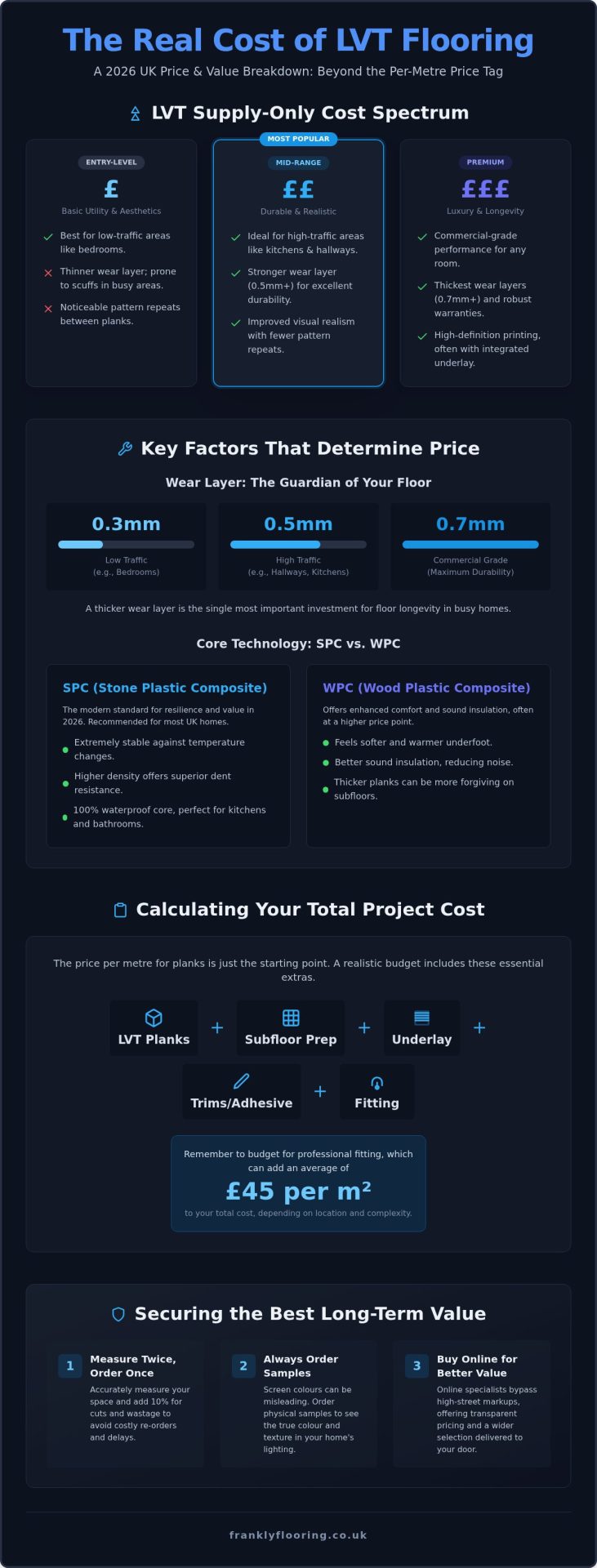
Understanding the lvt flooring cost per m2 uk requires looking at the total project, not just the box of planks. While the material itself ranges across budget, mid-range, and premium tiers, the final figure on your invoice includes several variables. Modern LVT is a far cry from its ancestor, the Vinyl composition tile; it’s a multi-layered product engineered for longevity. You’ll find that entry-level products focus on basic utility, while premium collections invest in high-definition aesthetics and superior core stability. It’s vital to distinguish between supply-only pricing and fully fitted estimates. While we provide the materials directly to your door, professional fitting can add an average of £45 per m2 to your total budget, depending on your location and the complexity of the room.
Choosing a “cheap” LVT might seem like a win for your bank balance today, but it often leads to a higher cost-per-year. Lower-tier products typically feature thinner wear layers that scuff easily in high-traffic areas like hallways or kitchens. This leads to a shorter replacement cycle, meaning you could end up paying for a second floor and a second round of installation within a few years. Investing in a higher-quality tier from the start ensures the floor stays functional and attractive for decades, effectively lowering your long-term expenditure.
Entry-Level vs. Premium: What Changes?
The most immediate difference is visual realism. Budget floors often have a high pattern repeat frequency, where you’ll notice the same wood knot or stone vein appearing every few planks. Premium collections use advanced printing technology to ensure almost every board looks unique. Beyond aesthetics, premium options often come with integrated underlay, saving you the step of buying it separately. You’ll also find that higher-tier products carry more robust residential warranties and commercial-grade durability ratings, reflecting their ability to withstand heavy daily use without fading or peeling.
Why Online Pricing Offers Better Value
Buying your flooring online directly from a specialist allows you to bypass the traditional retail markups found in physical showrooms. We don’t have the massive overheads of a high-street shop, such as expensive floor space or large sales teams, so we can focus on providing transparent, honest pricing. This direct-to-consumer model also gives you access to a much broader range of stock. Instead of being limited to what a local shop can fit on its shelves, you can browse a comprehensive national inventory. With efficient national delivery, you get the exact technical specifications you need delivered straight to your project site without the logistics headache.
The Technical Factors That Determine Your Price Per Metre
The lvt flooring cost per m2 uk isn’t just a reflection of the pattern on top. It’s dictated by the engineering inside the plank. Choices like core density and wear layer thickness determine how long your floor will last before it shows signs of age. When you’re comparing products, you’re essentially paying for the durability and stability of the materials used. Understanding these specs helps you avoid overpaying for features you don’t need or under-investing in high-traffic areas.
Understanding the Wear Layer
The wear layer is the clear, protective top coating measured in millimetres that guards against scratches, scuffs, and stains. A 0.3mm layer is perfectly adequate for low-traffic areas like bedrooms where you’re often in slippers or socks. However, for busy hallways, kitchens, or homes with pets, you’ll need a 0.5mm to 0.7mm layer to ensure the design doesn’t wear away. This jump in specification moves the product from residential to commercial grade. It significantly impacts the price per metre, but it’s a necessary investment to avoid a worn-out floor in five years.
SPC vs. WPC Cores
Rigid core LVT, known as SPC (Stone Plastic Composite), is particularly well-suited for UK homes where temperatures can fluctuate. Its limestone-based core makes it incredibly stable and resistant to expansion. In contrast, WPC (Wood Plastic Composite) cores are thicker and feel slightly softer underfoot, providing better sound insulation. For 2026, SPC offers the best “bang for your buck” because it provides high durability and waterproof performance at a competitive price point. While WPC feels more luxurious, the sheer resilience of SPC makes it the practical choice for most modern households.
Total plank thickness also plays a role in your budget. Thicker planks are more “forgiving” of minor subfloor imperfections, which can save you money on extensive preparation. You also need to choose between click-lock and glue-down systems. Click-lock planks are generally more expensive per square metre but are much easier for DIY enthusiasts to handle. Glue-down options are cheaper to buy, but they require a perfectly level subfloor and professional adhesive. If you’re unsure which technical spec fits your room, you can browse our LVT range to see how these factors influence the final price. Adhering to UK building regulations for flooring ensures your technical choices meet safety and performance standards for your specific property type.
Calculating the Total Project Cost: Beyond the Planks
Most homeowners focus solely on the lvt flooring cost per m2 uk displayed on the product page. However, the planks are only one part of the equation. To build a realistic budget, you must account for the “invisible” elements that ensure your floor stays flat, dry, and professional looking for years. Skipping these or underestimating their volume is the quickest way to stall a project or end up with a finish that fails prematurely. We’ve seen many projects go over budget simply because the subfloor wasn’t ready for the new material.
Your total expenditure will also include essential accessories like underlay, door bars, and scotia or skirting. If you’re choosing glue down LVT, the quality of your adhesive is non-negotiable. Using a cheap alternative can lead to planks shifting or lifting, especially in areas with significant temperature changes. Buying your flooring and accessories from a single source doesn’t just simplify the logistics; it ensures that every component is technically compatible, which is vital for maintaining your warranty.
The Hidden Costs of Subfloor Prep
LVT is a relatively thin material, which means it’s unforgiving of imperfections. Any bump in a concrete slab or gap between floorboards will eventually “telegraph” through to the surface, ruining the aesthetic. To prevent this, you’ll likely need smoothing compounds or 6mm plywood sheets to create a perfectly level base. For ground floor installations, a Damp Proof Membrane (DPM) is often essential to block moisture from rising. Adhering to NHBC flooring standards for subfloor preparation is the best way to ensure your investment lasts its full intended lifespan. Depending on the current state of your floor, these preparation materials can sometimes match the cost of the flooring itself.
Waste and Room Complexity
You can’t simply order the exact square meterage of your room. Every project requires a “waste factor” to account for cuts, corners, and the occasional mistake. For a standard rectangular room with straight-lay planks, a 10% waste margin is the industry benchmark. However, if you’re planning a more intricate layout, you’ll need to increase this. Intricate patterns require more precision and result in more offcuts. You can find pattern inspiration in our guide on What Is LVT Flooring? A Frank Guide for UK Homes. For herringbone designs, we recommend ordering 15% extra. Small, awkward spaces like bathrooms often have higher waste percentages too, as the ratio of cuts to floor area is much higher than in a large, open-plan kitchen.
LVT vs. Other Flooring: A Long-Term Value Comparison
Evaluating the lvt flooring cost per m2 uk only makes sense if you compare it against the alternatives you’re likely considering. While some materials have a lower entry price, they often carry higher maintenance requirements or shorter lifespans. We believe in looking at the “cost-per-year” rather than just the initial outlay. LVT often sits in the middle ground of pricing but leads the pack for practical longevity and ease of care. It’s the choice for those who want a floor that looks high-end but doesn’t require high-end effort to maintain.
LVT vs. Laminate
Laminate has traditionally been the go-to for budget-conscious renovations. However, the gap is closing. Most modern LVT is fully waterproof, making it suitable for bathrooms and kitchens where standard laminate might fail. While some high-end laminates are now water-resistant, they still rely on a wood-based core that can swell if moisture finds its way into the joints. LVT also offers superior sound dampening. It doesn’t have that hollow “click” sound often associated with cheaper floating floors. It feels warmer underfoot, too. If you’re weighing up these two options, check out our Laminate Flooring UK: The Frank 2026 Buying & Installation Guide for a deeper look at that specific material.
LVT vs. Real Wood
Engineered wood and solid timber are the gold standards for aesthetics; however, they come with a high price tag and significant maintenance duties. LVT allows you to achieve that premium look for less, without the stress of seasonal expansion or scratches from pets. In a busy family home, wood requires periodic sanding and refinishing to stay looking its best. LVT is a “set and forget” choice. It only needs a simple mop to maintain its appearance. It won’t stain if a drink is spilled, and it won’t warp if the kids track in mud from the garden.
When you look at lifecycle value, a high-quality LVT can easily last 20 to 25 years. This durability often makes the lvt flooring cost per m2 uk more economical over two decades than a cheaper floor you have to replace twice. You’re buying peace of mind alongside a beautiful finish. Explore our collection today to find a floor that balances style with long-term value.
How to Secure the Best LVT Value for Your UK Home
Securing the best lvt flooring cost per m2 uk isn’t just about hunting for the lowest sticker price. Genuine value comes from precision and making a choice that fits your specific room’s demands. We see many homeowners rush into a purchase based on a digital thumbnail, only to find the colour or texture doesn’t match their expectations once it’s on the floor. To get the most for your money, you need to be strategic about how you shop and how you measure. If you’re working with a strict budget, keep an eye on our “Bargains” section for high-quality stock at reduced rates. Value is found in buying the right product once, rather than the cheap product twice.
The Importance of Physical Samples
You can’t trust a smartphone or laptop screen to accurately represent the subtle undertones of a wood-effect plank or a stone-look tile. Digital displays vary wildly in colour calibration. The lighting in your home, whether it’s cool morning sunlight or warm evening lamps, will drastically change how the material looks in situ. Ordering physical samples is the only way to be certain. It also allows you to perform a “scratch test” with a coin or key to see how the wear layer holds up under pressure. Feeling the weight and texture of different tiers side-by-side gives you the confidence that you’re paying for actual quality, not just a brand name.
Smart Measuring and Ordering
Accuracy during the planning stage prevents costly mistakes later. Our “Frank” tip for measuring is to always measure into the deepest part of doorways, alcoves, and bay windows. If you only measure the main rectangle of a room, you’ll almost certainly run short. We always recommend buying your entire floor in one single batch. Flooring is manufactured in runs, and while modern quality control is excellent, there can be tiny variations in shade between different batches. Getting everything at once ensures perfect colour consistency across your project. It also means you only pay for delivery once, which keeps your logistics costs down.
The Frank approach is about transparency; we’d rather you ask a technical question now than face a problem during the fitting process. Check if you have enough adhesive or the correct underlay for your specific core type before checking out. Timing can also play a role; while we keep our prices fair year-round, seasonal clearances are a great time to pick up premium ranges for a mid-range price. By combining accurate measurements with a physical sample check, you ensure that every pound of your lvt flooring cost per m2 uk is an investment in a floor that will last for decades. Browse our LVT collections and order your samples today to get your project started properly.
Ready to Budget for Your New Floor?
Calculating the true lvt flooring cost per m2 uk is about looking beyond the initial price tag and focusing on the technical specs that drive long-term durability. By prioritizing a robust wear layer and accounting for essential accessories like underlay and subfloor prep early on, you avoid the hidden costs that often derail home renovations. LVT isn’t just a material; it’s a foundational element of your home’s character that balances high-end aesthetics with practical moisture resistance.
At Frankly Flooring, we lean on over 20 years of family-run expertise to provide transparent, no-nonsense advice that helps you buy with confidence. We focus on providing the technical depth you need without the corporate fluff, ensuring you get the best value for your specific project. From our direct-to-consumer pricing to our efficient national UK delivery, we’ve designed every step of the process to be stress-free and reliable.
Explore our direct-to-consumer LVT range for the best UK value and start your transformation with a floor built to last. Your home deserves a finish that stands up to daily life without compromising on style.
Frequently Asked Questions
Is LVT flooring more expensive than laminate per m2?
LVT typically carries a higher initial price tag than standard laminate. This is because LVT is fully waterproof and constructed from more resilient materials. While laminate is often the entry-level choice for budget renovations, the long-term lvt flooring cost per m2 uk is frequently lower. You won’t need to replace it as often due to moisture damage or surface wear; this makes it a more stable investment for busy family homes.
How much does it cost to fit LVT flooring in the UK?
Professional installation is a separate expense that you should budget for alongside your material purchase. In the UK, professional fitters usually charge between £15 and £30 per square metre for labour. Some specialists prefer a daily rate, which can range from £150 to £350 depending on the complexity of the room. Always ensure your subfloor is prepared correctly before the fitter arrives to avoid additional daily charges or project delays.
Do I always need underlay with LVT flooring?
You don’t always need to purchase separate underlay. Many modern, high-specification LVT planks come with an integrated underlay already attached to the base. If your chosen product doesn’t have this feature, a dedicated LVT underlay is essential for sound reduction and underfoot comfort. Using the correct accessories ensures your floor performs as intended and helps maintain your product warranty. We provide a full range of compatible underlays to suit different core types.
What is the cheapest way to install LVT?
The most cost-effective installation method is a DIY approach using a “click” LVT system. By fitting the floor yourself, you can save the average £45 per m2 typically charged for professional labour. Click systems are designed for straightforward assembly without the need for specialist adhesives. If you’re confident with a tape measure and a utility knife, you can significantly reduce your total project spend while still achieving a professional-looking finish.
Does herringbone LVT cost more per square metre?
Herringbone patterns generally cost more than straight-lay planks. The manufacturing process for smaller, specialized blocks is often more expensive, and the intricate installation requires more time and precision. You’ll also need to account for a higher waste percentage, usually 15% instead of the standard 10%. While the initial lvt flooring cost per m2 uk for herringbone is higher, it adds a distinct premium aesthetic that can increase the character of your property.
How much extra LVT should I order for waste?
We recommend ordering 10% extra for standard rooms with a straight-lay pattern. This covers the offcuts needed for corners and doorways. If your room has many alcoves or you’ve chosen a herringbone layout, you should increase this to 15%. Ordering everything in a single batch ensures colour consistency across your floor. It’s always better to have a few spare planks kept in the loft for any future repairs rather than running short mid-project.
Is expensive LVT really worth the extra money?
Investing in premium LVT is worth it for high-traffic areas like hallways and kitchens. Higher-priced options usually feature a thicker wear layer, often 0.5mm or 0.7mm, which provides superior resistance to scratches and scuffs. You’ll also benefit from more realistic textures and less frequent pattern repeats across the floor. In the long run, a durable, high-quality product prevents the need for early replacement, offering better value over its 20 to 25 year lifespan.