
The price tag on a pack of planks is often the most misleading number in your entire renovation budget. It’s easy to feel overwhelmed by the massive price gaps between solid oak and engineered alternatives, especially when trying to calculate the total wood flooring cost uk projects require. You deserve to know exactly what you’re paying for before you commit your hard earned money to a project that should last a lifetime.
We believe in being frank about the numbers. This guide provides a transparent, no-nonsense breakdown of 2026 pricing, from base material costs to the essential subfloor prep and accessories that often get missed in initial quotes. You’ll learn how to distinguish between genuine quality and clever marketing, ensuring you invest in a floor that adds character to your home. We will walk you through a clear budget framework, helping you decide where to save and where it’s vital to splurge for long term durability. This is about more than just a surface; it is about building a foundation for your home that offers real value for decades to come.
Key Takeaways
- Learn why engineered wood often provides superior stability and better long-term value than solid wood in the unpredictable British climate.
- Identify the “invisible” expenses, such as subfloor preparation and quality underlay, that can unexpectedly shift your total wood flooring cost uk budget.
- Understand how wood species and visual grades—from Rustic to Prime—impact both the character of your home and the final price on the box.
- Get a frank breakdown of 2026 labour rates to help you determine if a professional installation is worth the investment over a DIY approach.
- Explore high-value alternatives like LVT and modern laminate that deliver a premium wood aesthetic without the premium price tag.
The Frank Truth: Solid Wood vs. Engineered Wood Costs
Choosing between solid and engineered planks isn’t just a matter of tradition; it’s a strategic financial decision. While both fall under the umbrella of Solid and engineered wood flooring, their long-term impact on your wallet differs significantly. Solid wood is often seen as the gold standard, but in the modern UK home, it isn’t always the most cost-effective path forward. Understanding how these materials behave helps you calculate a realistic wood flooring cost uk homeowners can actually stick to.
Solid Hardwood: The Premium Investment
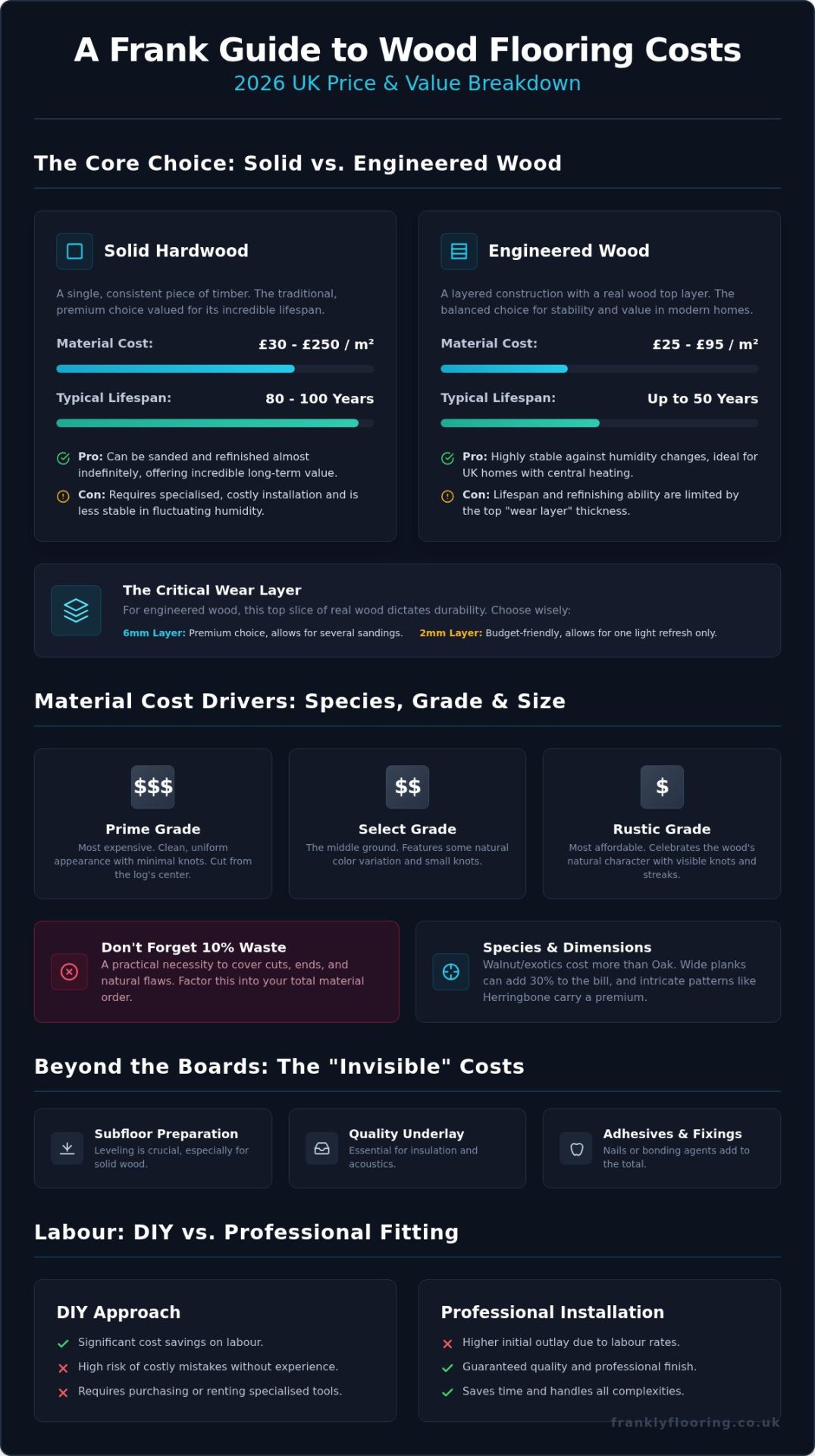
Solid wood is exactly what it says on the tin: a single, consistent piece of timber from top to bottom. Industry benchmarks for 2026 show that solid oak usually starts around £30 per m², while walnut or exotic species can easily reach £250 per m². However, the material price is only one part of the bill. Fitting solid wood is a specialised task. It usually requires a perfectly level subfloor and professional nailing or bonding, which adds a premium to the installation stage. The real value lies in the 80 to 100-year lifespan. You can sand and refinish solid timber almost indefinitely, making the “cost per year” remarkably low if you plan to stay in your property for decades.
Engineered Wood: The Balanced Choice
Engineered wood is our “Frank” favourite for contemporary living. It’s built in layers, which makes it much more stable in centrally heated British homes where humidity levels often fluctuate. Material prices for quality engineered boards generally sit between £25 and £95 per m². You’ll find two main types: multi-ply and three-ply. Multi-ply uses more layers and is typically the more expensive, stable option. Our Engineered Wood Flooring Guide breaks down these technical nuances so you can see exactly where your money goes.
The price of engineered wood is heavily dictated by the thickness of the wear layer. This is the top slice of real wood that you actually see and walk on. A 6mm wear layer is a premium choice that allows for several sandings over 50 years. A 2mm layer is a budget-friendly entry point, but it won’t survive more than one light refresh. By matching the wear layer to your lifestyle, you can control your wood flooring cost uk without sacrificing the authentic look of real timber. It’s about finding that sweet spot between initial outlay and the longevity your home requires.
Calculating Material Costs by Wood Species and Grade
The species of wood you choose is the primary driver of your budget. Oak remains the most popular choice across the country because it is abundant, durable, and versatile. If you move toward Walnut or exotic timbers, expect to pay a significant premium. These species are harder to source and slower to grow, which directly impacts the final price. Beyond the species, you must account for a 10% waste factor. This isn’t a sales tactic; it is a practical necessity to cover cuts, ends, and the occasional board with a natural flaw you would rather not see in the middle of your hall. This extra buffer is a vital part of the wood flooring cost uk homeowners need to factor in from day one.
Understanding Wood Grades and Pricing
Wood grading is often the most confusing part of the calculation. It has nothing to do with the structural integrity of the plank. Instead, it is about aesthetics. The British Wood Flooring Association provides standards for these grades to help consumers understand exactly what they are buying. Prime grade is the most expensive because it is cut from the centre of the log, resulting in a clean, uniform look with minimal knots. Select grade offers a middle ground, featuring some natural variation without being overwhelming. If you want to save money, Rustic grade is the way to go. It celebrates the natural character of the tree with visible knots and colour streaks, often costing significantly less than Prime alternatives.
Width and Pattern Premiums
The physical dimensions of your planks also dictate the bill. Wide-plank flooring is currently in high demand, but because it requires larger, older trees to produce, it can increase your material costs by up to 30%. Standard narrow strips are more economical and easier to source. If you are looking for a specific aesthetic, our Parquet & Herringbone Guide explains why these intricate patterns carry a higher price. They involve more complex manufacturing and result in more waste during installation. If you are unsure which grade fits your vision, you can browse our wood collections to see the visual differences for yourself. Balancing your desire for a specific width or pattern against your budget is the best way to manage the total wood flooring cost uk for your project.
Beyond the Boards: The “Invisible” Costs of Installation
The price on the box is rarely the final figure on your bank statement. If you only budget for the planks themselves, you’ll likely face a frustrating wake-up call halfway through the project. Calculating the total wood flooring cost uk projects incur requires looking at the site as a whole. A significant portion of your investment goes into things you will never see once the floor is down, but these “invisible” elements are what determine whether your floor lasts five years or fifty.
Subfloor Preparation: The Hidden Budget Killer
Your subfloor is the biggest wildcard in your budget. If your existing floor is uneven, damp, or structurally unsound, your new wood flooring will fail. It is that simple. Professional fitters will often insist on a self-levelling screed for concrete or ply-lining for timber joists to create a flat surface. Skipping this to save money is a false economy. An uneven base causes planks to bounce and creak, eventually damaging the joints beyond repair.
Moisture testing is another non-negotiable step. Wood is a natural material that reacts to its environment. If there is residual dampness in your subfloor, the wood will swell and buckle. Applying a Damp Proof Membrane (DPM) is a standard requirement for most ground-floor installations. While it adds to the initial bill, it acts as an insurance policy for your investment. When researching the latest wood flooring installation costs, you’ll notice that professional quotes often include these preparation stages because they are essential for a long-lasting finish.
Accessories and Finishing
Accessories are the finishing touches that turn a construction site into a home. Underlay isn’t just about comfort; it provides vital heat insulation and sound reduction. Depending on your needs, you might choose an acoustic underlay to dampen footsteps or a thermal version for colder rooms. These typically range from £6 to £12 per m² and are a vital component of the wood flooring cost uk homeowners must anticipate.
Don’t forget the perimeter. Wood needs an expansion gap around the edges of the room to breathe. This gap is hidden by skirting boards or scotia beading. You also need to budget for door bars and thresholds to manage the transition between different rooms. Our Carpet Gripper & Accessories Guide offers deeper insights into how these small components provide a professional finish. These extras might seem small, but they ensure your floor looks intentional rather than unfinished.
Labour Rates and the DIY vs. Professional Fitting Debate
The labour bill is often the part of a renovation that catches homeowners off guard. In 2026, standard plank installation rates in the UK generally range from £25 to £70 per m². This wide bracket exists because no two rooms are the same. A perfectly square bedroom is a straightforward job, but a hallway with five doorways, three alcoves, and a radiator pipe to cut around requires significantly more time and precision. When you are calculating your total wood flooring cost uk, you must look beyond the floor area and consider the physical obstacles in the space.
Professional Fitting Costs
Most fitters will quote either a price per square metre or a day rate. Current day rates for a skilled floor fitter sit between £250 and £350. For smaller rooms, a day rate might apply even if the square footage is low, simply because the setup and finishing time remain the same. Method matters, too. A floating floor that “clicks” together is the fastest to install. Conversely, a glue-down installation requires more technical skill and expensive adhesives, naturally pushing the labour cost toward the higher end of the scale.
Don’t forget the “hidden” labour tasks that aren’t always in the initial headline price. If your new floor is thicker than your old one, your doors will likely need trimming to clear the new surface. This typically costs between £30 and £50 per door. Additionally, if you need the fitter to uplift and dispose of your old flooring, expect to add £5 to £10 per m² to the bill. These small extras are essential components of a realistic wood flooring cost uk budget.
Can You Save Money with DIY?
We believe in being frank: DIY is a great way to save money, but only if you choose the right product. If you’ve purchased a click-system engineered floor, a confident DIYer can achieve a professional-looking finish with a bit of patience. However, solid wood and intricate patterns like herringbone are different beasts entirely. Parquet requires an expert eye to ensure the pattern stays square across the entire room. One small misalignment at the start will result in massive, unsightly gaps by the time you reach the far wall.
The true cost of DIY also includes tool hire and the risk of wasted materials. If you miscut a premium walnut plank, that is a significant loss. If you want the peace of mind that comes with a perfectly flat, creak-free finish, hiring a pro is often the smarter long-term investment. Ready to find the right material for your project? Browse our wood flooring collections to see our full range of DIY-friendly and professional-grade planks.
How to Get the Wood Look for Less: Smart Alternatives
We understand that real timber isn’t always the right fit for every room or every budget. If your heart is set on the warmth of oak but your wood flooring cost uk calculations are looking a bit steep, you don’t have to settle for a cold, characterless floor. Modern manufacturing has closed the gap between natural materials and high-quality synthetic alternatives. Choosing a smart alternative often allows you to allocate more of your budget to other areas of your renovation without sacrificing the aesthetic you’ve planned.
The Case for LVT Flooring
Luxury Vinyl Tile, or LVT, is currently the ultimate budget hack for those who want the visual appeal of wood with none of its temperamental nature. While real wood is sensitive to humidity and spills, LVT is completely waterproof. This makes it a superior choice for kitchens, bathrooms, and utility rooms where real planks might buckle or stain. Our guide on What is LVT Flooring? explores why this material is so resilient. Beyond the material price, you’ll also save on installation. LVT is thinner and easier to cut than engineered wood, which often results in lower labour quotes from fitters.
Modern Laminate: A Frank Re-evaluation
If you haven’t looked at laminate since the early 2000s, you’re in for a surprise. In 2026, high-end laminate technology uses “embossed-in-register” textures. This means the physical grain you feel on the surface perfectly matches the wood pattern you see. It no longer looks like a plastic photograph of wood; it looks and feels like the real thing. When you compare high-quality laminate against entry-level engineered wood, the laminate often wins on durability. It is significantly more scratch-resistant, making it a “Frank” favourite for busy households with pets or young children. You can find more details on choosing the right grade in our Laminate Flooring UK Guide.
Spotting a genuine bargain requires looking at the total lifecycle cost. A “cheap” floor that needs replacing in three years is the most expensive floor you can buy. When browsing alternatives, pay close attention to the wear layer and the locking system. A sturdy click-system ensures your floor stays tightly joined for years, preventing the gaps that plague low-quality products. By choosing a high-spec LVT or laminate, you can manage your wood flooring cost uk while still achieving a finish that looks expensive, feels durable, and stays beautiful for the long term.
Building Your Foundation with Confidence
Calculating a realistic wood flooring cost uk project requires looking past the price on the box. You now understand that the true value of your floor lies in the preparation of your subfloor and the quality of the accessories you choose to support it. Whether you opt for the timeless longevity of solid oak, the modern stability of engineered planks, or the budget-friendly resilience of high-end LVT, the key is matching the material to your specific lifestyle and room requirements. Honest budgeting at the start prevents unwanted surprises later.
At Frankly Flooring, we believe in providing the candid advice you need to make an informed decision. As a family-run UK business with over 20 years of flooring expertise, we prioritise integrity over high-pressure sales tactics. We offer national delivery on all orders to ensure your renovation stays on track from the first plank to the final threshold. If you’re ready to transform your space with a floor that stands the test of time, browse our range of quality wood flooring and get a frank price today. Your home deserves a foundation built with care and precision.
Frequently Asked Questions
How much does it cost to install wood flooring per square metre in the UK?
Professional installation rates for standard planks generally range from £25 to £70 per square metre. This price varies based on the complexity of the room and the fitting method you choose. If you select a complex pattern like herringbone, expect the labour rate to rise toward the higher end of that scale. These rates cover the fitter’s time but don’t include materials or the necessary subfloor preparation required for a flat finish.
Is engineered wood cheaper than solid wood in 2026?
Engineered wood is often more affordable than solid wood, with material prices typically starting around £25 per m² compared to £30 per m² for solid oak. The real saving comes from its stability in centrally heated homes. Engineered planks are less likely to warp in the British climate, which reduces the risk of expensive long term repairs. While premium engineered boards exist, they generally offer better value for modern properties.
What are the hidden costs of wood flooring installation?
Common hidden expenses include subfloor levelling, moisture testing, and the disposal of your old flooring. You should also account for accessories like underlay, which can cost between £6 and £12 per m², and matching door bars or scotia beading. These extras are essential for a professional finish and can significantly impact the total wood flooring cost uk if they aren’t factored into your initial project budget from the start.
Can I install wood flooring over underfloor heating?
Engineered wood is the only recommended option for use with underfloor heating systems. Its layered construction allows it to expand and contract safely as temperatures change without buckling. Solid wood is too reactive and will likely gap or warp if placed directly over a heat source. Always check the manufacturer’s maximum temperature limit and ensure you use a compatible underlay to maintain the efficiency and safety of your heating system.
How much extra should I budget for flooring waste?
You should always add a 10% waste factor to your total measurements to cover cuts and natural variations in the timber. If you are installing a complex pattern like chevron or herringbone, we recommend increasing this buffer to 15%. This ensures you have enough material to finish the job without the delay of ordering more packs, which might come from a different batch and show slight colour differences.
Does wood flooring add value to my UK home?
High quality wood flooring is a sought after feature that can increase the resale value of a property. Estate agents often highlight real wood floors as a premium selling point because of their longevity and timeless appeal. Unlike carpet, which may need replacing every few years, a well maintained wood floor can last for many decades. This durability makes it a sound investment that pays off when you eventually sell.
Is it cheaper to buy wood flooring online or in-store?
Buying wood flooring online is usually more cost effective because digital retailers don’t have the high overheads of running physical showrooms. This allows businesses like ours to pass those savings directly to you through more competitive pricing. You also benefit from a wider selection of species and grades that a local shop might not stock. We provide national delivery across the UK, making it easy to get premium materials delivered.
How much does it cost to sand and refinish a wood floor?
Professional sanding and refinishing typically costs between £25 and £35 per square metre. This price usually includes the sanding process and the application of several coats of lacquer or oil. While it requires an initial outlay, refinishing a floor is much cheaper than replacing it entirely. It’s a great way to restore the character of your home and manage the long term wood flooring cost uk homeowners expect over a project’s lifecycle.