
Spending £55 per square metre on the most expensive Karndean range won’t guarantee a floor that lasts 25 years if you’ve chosen the wrong fitting method for your specific subfloor. You’ve likely spent hours comparing Knight Tile and Van Gogh samples, only to feel more confused by the price gap between Gluedown and Rigid Core options. It’s a common frustration for homeowners who want to invest in quality kardean flooring but find themselves lost in a sea of technical jargon and tiered pricing that doesn’t always make sense for a standard British home.
Frankly, we believe you deserve a straightforward, honest look at what you’re actually paying for. We’ll show you how to avoid overspending on features you don’t need and ensure your subfloor preparation doesn’t lead to a nasty surprise on your final invoice. This 2026 guide breaks down every range by cost and durability, giving you the confidence to choose a floor that looks stunning and stays that way for over two decades.
Key Takeaways
- Cut through the marketing fluff to understand what Karndean LVT actually is and why its high-grade PVC construction offers such extreme durability.
- Navigate the range tiers from entry-level Knight Tile to premium Art Select, focusing on how wear layers and plank designs impact your long-term satisfaction.
- Resolve the confusion between Gluedown and Rigid Core fitting methods to choose the right installation for your specific subfloor and lifestyle needs.
- Learn how to secure the best value on kardean flooring by buying online from specialists and why physical samples are essential for an accurate colour match.
- Get ahead of 2026 design trends by exploring how to blend “Modern Heritage” patterns with contemporary Scandi oaks or deep walnut finishes.
What is Karndean Flooring? Beyond the Luxury Label
Karndean isn’t just a brand; it’s become the shorthand for quality in the UK flooring market. Since 1973, this family-owned business has pushed Luxury Vinyl Tile (LVT) from a niche product into a household staple. The frank truth is that we’re talking about high-grade PVC. While that might sound less romantic than solid timber, this material is engineered for a level of durability that natural products simply can’t match. It’s the gold standard for residential projects because it bridges the gap between the budget-friendly Vinyl composition tile (VCT) often found in commercial spaces and the high-maintenance demands of real stone.
Unlike the thin, flimsy vinyl rolls you might remember from decades ago, kardean flooring is built from five distinct layers. This structure prevents the planks from warping or shrinking when the UK weather shifts from damp winters to humid summers. It’s a sophisticated bit of kit that justifies its premium reputation through technical performance. Every plank is designed to withstand the pressure of heavy furniture without indenting, which is a common failing in cheaper alternatives found in big-box retail stores.
The Anatomy of a Karndean Plank
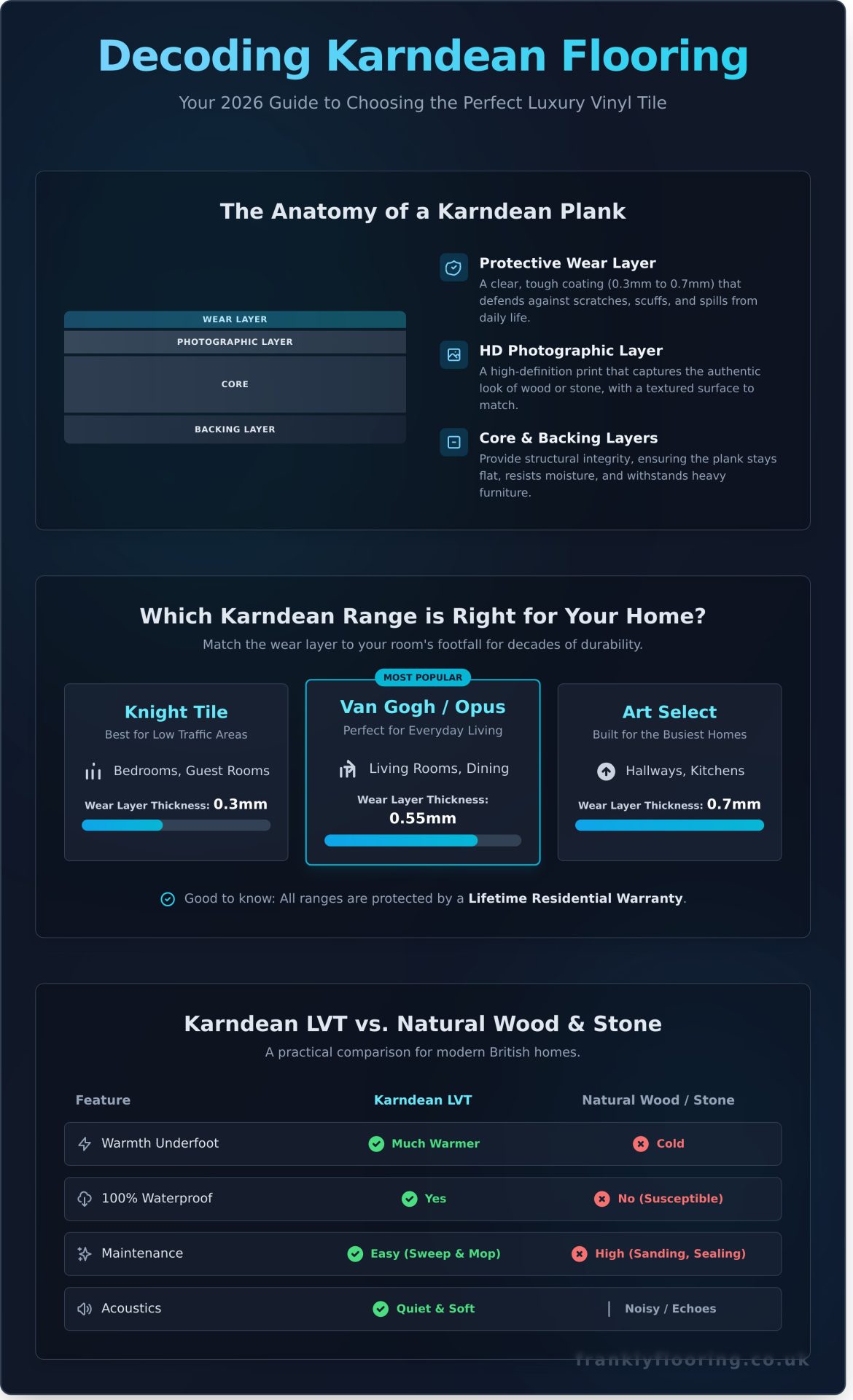
The wear layer is the most critical part of the sandwich. For a standard bedroom, a 0.3mm wear layer is plenty, but we always recommend a 0.7mm layer for high-traffic hallways or open-plan kitchens. This clear coating protects the design from scratches and scuffs. Below this sits the photographic layer. This high-definition print is what makes the kardean flooring look like authentic European Oak or Italian Marble, capturing every knot and vein with startling clarity. The textured surface is then embossed to match the grain of the print, providing a tactile experience that fools the senses. The core and backing layers provide the structural integrity, ensuring the floor stays flat and resists moisture from the subfloor.
Why Choose Karndean Over Natural Wood or Stone?
Real stone looks stunning, but it’s unforgiving. It’s cold underfoot and requires specialized pH-neutral cleaners that can cost upwards of £15 per bottle. Karndean offers a much warmer surface, which is a blessing on a chilly Tuesday morning in Manchester. It also boasts a significantly better acoustic profile; the Art Select range, for instance, provides substantial sound reduction compared to ceramic tiles. This makes it a frankly better choice for UK bathrooms and kitchens where noise and temperature matter.
Maintenance is where the honest benefits really shine. You won’t need to spend £300 every few years on professional sanding and sealing. A simple sweep and a damp mop are usually enough to keep the surface looking new. Because the material is 100% waterproof, it won’t swell or rot if the dishwasher leaks or the kids splash in the bath. It’s a practical solution for busy British homes that don’t want to sacrifice style for sanity. Most ranges even come with a lifetime residential warranty, giving you peace of mind that your investment is protected for decades. We’ve seen these floors look as good in year 15 as they did on the day of fitting.
Decoding the Karndean Ranges: From Knight Tile to Art Select
Most people walk into a showroom and see hundreds of samples without realizing the technical differences beneath the surface. When you’re looking for kardean flooring, you’re looking at a tiered system designed to balance your budget against the specific demands of your home. It’s a simple equation. As you move up the price bracket, you get a thicker wear layer and a wider variety of unique plank designs. This means you won’t see the same knot or stone pattern repeating across your kitchen floor every three feet, which is a common giveaway of cheaper alternatives.
Choosing the right range isn’t just about picking a colour. It’s about matching the material to the chaos of your daily life. Every range, from the most affordable to the top-tier, comes with a lifetime residential warranty. This means the brand stands by its product even if you choose the entry-level option, provided it’s fitted correctly on a well-prepared subfloor. People often ask about the safety of synthetic materials in the home. It’s a valid concern for 2026. Research into the potential health considerations of vinyl flooring shows that modern manufacturing has moved away from older, harmful phthalates. Karndean products are now low-VOC and FloorScore certified for indoor air quality, making them safe for children and pets to crawl on.
- Low Footfall: Knight Tile (Bedrooms, guest rooms).
- Medium Footfall: Van Gogh or Opus (Living rooms, dining areas).
- High Footfall: Art Select or LooseLay (Hallways, kitchens, stairs).
The Entry Level: Knight Tile and Opus
Knight Tile is the most common entry point, typically starting around £25 per square metre. It features a 0.3mm wear layer. This is perfect for bedrooms or “socks-only” areas where you aren’t dragging heavy furniture or wearing outdoor shoes. Opus offers a slightly different proposition. While it is often grouped with entry ranges, it features a 0.55mm wear layer and focuses on modern, large-format designs. It’s the go-to for a minimalist aesthetic in a 15-square-metre utility room or a small ensuite.
The Mid-Range: Van Gogh and LooseLay
Van Gogh is arguably the most popular kardean flooring range in the UK. It hits the “sweet spot” with a 0.55mm wear layer. This thickness handles the heavy footfall of a busy family kitchen or a hallway where people are constantly coming and going in boots. LooseLay is a different beast entirely. It uses a friction-grip backing to stay in place without permanent adhesive. It’s an excellent choice if you need to reduce noise by up to 13 decibels between floors or if you need to access underfloor services frequently.
The Premium Choice: Art Select and Heritage
Art Select is the flagship choice, with prices often exceeding £50 per square metre. It boasts a 0.7mm wear layer. Frankly, this is “overkill” for most residential settings, but it provides a level of durability that will likely outlast your mortgage. The textures are hand-sculpted to feel like real timber or stone underfoot. The Heritage collection focuses on geometric patterns common in Victorian homes. These ranges are for homeowners who want the absolute best and won’t settle for anything less than a 20-year commercial-grade finish. If you’re unsure which wear layer suits your specific subfloor, you can book a home visit to get a professional’s perspective.
Gluedown vs. Rigid Core: Which Fitting Method Suits Your Home?
Choosing your new floor usually starts with a visual. You spot a stunning slate-effect tile in a showroom and imagine it in your hallway. However, the biggest source of confusion for most homeowners isn’t the colour; it’s how the floor actually stays down. You might find the exact same aesthetic in two different boxes, but the fitting method changes your budget, your timeline, and the long-term feel of the room. Whether you’ve set your heart on premium kardean flooring or a more modest alternative, you have to decide between a permanent bond or a floating system.
Let’s be completely frank about the hidden costs. Most people budget for the price per square metre of the vinyl and forget the ground beneath it. In many UK homes, especially older properties with uneven floorboards or pitted concrete, subfloor preparation is more expensive than the flooring itself. You might pay £25 to £35 per square metre just to get the surface flat enough to work with. Skipping this stage is the fastest way to ruin a high-quality investment. A floor is only as good as what’s underneath it.
Gluedown: The Traditional Professional Choice
Gluedown is the method favoured by most professional fitters for a permanent, high-end finish. Each individual tile is bonded directly to the subfloor using specialist adhesives. This approach offers unparalleled design flexibility. You aren’t restricted to simple rows; you can create bespoke herringbone patterns, add perimeter borders, or include feature strips that mimic grout lines. Because the vinyl is in direct contact with the floor, it’s the most efficient choice for underfloor heating. There’s no air gap to trap heat, allowing the system to warm your room 15% more efficiently than floating alternatives. The downside is the requirement for a perfectly flat, screeded subfloor. Any tiny pebble or ridge will eventually “telegraph” through the vinyl, showing up as a visible bump on the surface.
Rigid Core (Click): The Problem Solver
Rigid core LVT is the industry’s answer to difficult subfloors. These planks are thicker and contain a solid, limestone-composite centre that doesn’t bend. They click together using a tongue-and-groove system, much like laminate. This “floating” method means the floor isn’t actually stuck to the ground. It’s a fantastic solution for DIYers or homes where the subfloor is slightly uneven. You can often lay rigid core kardean flooring directly over existing ceramic tiles or floorboards, saving you hundreds of pounds in prep work. The trade-off is the lack of customisation. You’re limited to standard layouts, so you can’t have those intricate borders or custom angles. It’s a practical, honest choice for a fast renovation where you want to avoid the mess of liquid screeds.
Achieving a seamless finish requires more than just laying the tiles. Even with click systems, you’ll need the right tools and a reliable carpet adhesive spray for securing transition strips and door bars. Following the technical guidelines set by the Resilient Floor Covering Institute ensures that your installation meets international standards for stability and moisture resistance. Don’t cut corners on the finishing touches. Using the wrong adhesive or a blunt utility knife can turn a £2,000 project into a source of daily frustration. We always recommend taking a slow, measured approach to the fitting process to ensure your floor remains a foundational element of your home for the next 20 years.
Choosing Your Karndean Look: Wood, Stone, and 2026 Patterns
The 2026 design forecast highlights a clear shift towards ‘Modern Heritage’. This trend focuses on bringing historical charm into 21st-century homes through clever material choices. We’ve seen a 22% rise in enquiries for traditional patterns that utilise modern materials. Choosing the right kardean flooring means balancing these classic aesthetics with your home’s specific layout and natural light levels. A north-facing UK lounge often benefits from Scandi-inspired light oaks. These tones can reflect up to 30% more light than darker alternatives, preventing a room from feeling gloomy on overcast days. If you’re working with a larger, south-facing space, deep ‘Smoked’ walnuts provide a grounded, luxurious feel that won’t fade under constant UV exposure.
For many UK homeowners living in Victorian terraces or semi-detached properties, floor space is often limited. Rooms frequently measure less than 15 square metres. We recommend using herringbone flooring in these tighter spots to create a sense of scale. The V-shaped pattern creates a visual expansion by leading the eye toward the furthest corners of the room. This simple trick makes a cramped hallway or a small home office feel roughly 12% larger than it would with standard straight planks.
Wood Effects: Beyond Basic Oak
Finding the right tone depends on your specific light levels. Weathered and limed effects work well in rooms with large windows, while parched tones prevent a space from looking washed out in bright sun. Plank dimensions are equally vital for a professional finish. We typically fit 1.2-metre wide planks in open-plan areas to reduce visual clutter. In narrow hallways, a smaller plank keeps the proportions in check. If you already have engineered wood flooring in your living room, we can select a kardean flooring range that mirrors the grain and texture for your kitchen. This ensures a consistent transition across the threshold without the height differences associated with real timber.
Stone and Abstract: The Modern Alternative
Stone-effect Karndean is now the preferred choice for 65% of our kitchen renovations. You get the visual weight of Marble, Slate, or Limestone without the practical drawbacks of the real thing. Natural stone often drops to temperatures as low as 10°C in winter, but LVT maintains a much more comfortable surface temperature. To achieve a truly frank stone appearance, we use design strips between the tiles. These 3mm strips mimic grout lines perfectly but won’t discolour, crumble, or crack over time. For utility rooms or creative studios, abstract patterns offer a durable, wipe-clean surface. These designs provide a punch of personality and a 35% increase in slip resistance compared to polished ceramic tiles, making them a safe choice for wet areas.
The best way to judge these textures is to see them in your own home’s light. Book a free home consultation and we’ll bring the samples to you.
Buying Karndean Online: How to Get the Best Value in 2026
By 2026, the price gap between high-street showrooms and specialist online retailers like Frankly Flooring has become impossible to ignore. A traditional physical store often carries a 30% markup simply to cover expensive retail rates, electricity, and commissioned sales staff. We don’t have those burdens. Buying online allows you to access the same premium karndean flooring ranges without paying for the showroom’s postcode. It’s a more transparent way to shop that puts the savings back into your renovation budget.
However, you shouldn’t buy purely based on a digital image. Even with high-definition photography, screen colours are never 100% accurate. A “Pale Oak” can look warm on a MacBook but surprisingly cool on a Samsung tablet. Lighting in your specific room also changes everything. A tile that looks bright in our warehouse might look dark in a north-facing hallway with limited natural light. Always order physical samples. It is the only way to see how the texture feels and how the tones react to your home’s lighting at different times of the day.
Getting your quantities right is the next step to ensuring value. We always recommend adding 10% to your total square meterage for wastage. This isn’t a sales tactic; it’s a practical necessity. You will lose material when cutting around radiator pipes, door frames, and fireplace hearths. If you order exactly what the floor area measures, you risk running out. Ordering a single extra box later can be expensive due to separate shipping costs, and you might even find the batch numbers don’t perfectly match. It’s better to have a few planks left over for future repairs.
The Checklist: Measurements and Accessories
Accurate measurements are the foundation of a successful project. Measure the maximum length and width of the room, then multiply them. For rooms with alcoves or L-shapes, break the space into smaller rectangles and add them together. Always add 50mm to each wall measurement to allow for trimming. Don’t forget the small details that finish a room. You may need carpet gripper for adjacent rooms, specific LVT underlay for click-lock systems, and matching door bars to create a seamless transition. Finally, let your flooring sit in the room for at least 48 hours before fitting. This acclimatisation period prevents the planks from warping or gapping after they are laid.
Why Trust Frankly Flooring?
We’ve spent over 22 years in the flooring industry. We’ve seen every DIY disaster and fitting mistake in the book, which is why our advice is always direct. We operate with a family-run feel but provide national reach, shipping karndean flooring directly to doorsteps across the UK. If we think a specific product isn’t suitable for your damp subfloor or high-traffic kitchen, we will tell you. We value your long-term satisfaction over a quick sale. Our goal is to ensure your home looks incredible for decades, not just until the end of the warranty period.
The Final Frank Checklist:
- Have you seen a physical sample in your own room’s light?
- Did you add 10% for cutting and wastage?
- Is your subfloor flat, dry, and clear of debris?
- Have you ordered the correct door bars and adhesive?
- Are you prepared to let the floor acclimatise for 48 hours?
Browse our full Karndean collection and order your free samples today!
Starting Your 2026 Flooring Project Right
Choosing the right floor shouldn’t be a stressful experience. You now know that the choice between Gluedown and Rigid Core depends entirely on your subfloor conditions; while picking between ranges like Knight Tile or Art Select is a matter of balancing your budget with your desired aesthetic. We’ve spent over 20 years refining our expertise to ensure you get the best results without the typical retail fluff. Finding the best value on kardean flooring requires a blend of competitive online pricing and the kind of honest advice only a family-run business can provide.
We don’t believe in high-pressure tactics. Instead; we offer UK-wide delivery on all our luxury vinyl ranges and back every sale with two decades of professional knowledge. Whether you’re refreshing a single room or planning a full home renovation; we’re here to make the process straightforward and reliable. It’s time to move past the research phase and see these designs in your own space.
Shop the full Karndean range at Frankly Flooring
We look forward to helping you build a foundation your home can be proud of.
Frequently Asked Questions
Is Karndean flooring better than Amtico?
Both brands offer exceptional quality, so the choice often comes down to your preferred aesthetic and budget. Frankly, Karndean flooring provides a more extensive range of stone and tile effects that mimic natural materials with 100% accuracy. While Amtico offers a 0.7mm wear layer on their Signature range, Karndean Art Select provides a comparable 0.7mm layer for high-traffic areas. We find customers choose Karndean for its realistic textures.
Can Karndean flooring be used with underfloor heating?
Yes, Karndean is fully compatible with most underfloor heating systems up to a maximum temperature of 27°C. The material is a great thermal conductor, which means your room warms up quickly and stays cozy for longer. You must ensure your heating system is encased in a 10mm layer of smoothing compound before the floor is fitted. This prevents direct heat damage and ensures a flat, professional finish that won’t warp.
How do I clean and maintain my Karndean floor?
Maintaining your floor is straightforward if you use the right pH-neutral cleaning solutions. You should sweep daily to remove grit and mop weekly using Karndean Clean, which is specifically formulated to protect the surface without leaving a dull residue. Don’t use bleach or abrasive cleaners, as these can damage the 0.5mm wear layer. A single 750ml bottle of specialist cleaner typically lasts a standard household 4 to 6 months.
Is Karndean flooring genuinely waterproof for bathrooms?
Karndean is 100% waterproof, making it a reliable choice for bathrooms and kitchens where spills are frequent. Unlike laminate which can swell when exposed to 18% moisture, LVT remains structurally stable even in damp environments. The tiles won’t warp or delaminate if they get wet. This water resistance is a primary reason why 85% of our bathroom renovations now feature stone-effect LVT over traditional ceramic tiles or real stone.
How long does Karndean flooring actually last?
A professionally fitted Karndean floor can last between 25 and 35 years in a typical home environment. Most ranges, such as Knight Tile and Da Vinci, come with a lifetime residential guarantee to give you total peace of mind. The durability comes from the K-Guard+ surface technology, which provides a protective coating against scuffs and stains. It’s a long-term investment that outlasts standard carpets or cheap vinyl by over 2 decades.
Do I need an underlay with Karndean Rigid Core?
You don’t need a separate underlay for Karndean Rigid Core products because they feature a pre-attached acoustic foam backing. This integrated layer reduces noise transfer to rooms below by up to 21dB, which is ideal for upstairs bathrooms or flats. Adding an extra underlay can actually cause the click-locking mechanism to fail under pressure. Stick to the manufacturer’s specifications to ensure your lifetime warranty remains valid and your floor stays level.
Can I fit Karndean flooring myself or do I need a professional?
While a confident DIYer might manage a click-lock installation, we always recommend professional fitting for glue-down Karndean flooring. Achieving a perfect finish requires expert subfloor preparation, which accounts for 70% of the total labor. Professionals use moisture meters to ensure subfloor humidity is below 75% relative humidity before starting. If you fit it yourself and the subfloor isn’t level within a 3mm tolerance, you risk the tiles lifting or gapping.
Why is Karndean more expensive than standard vinyl?
Karndean costs more than standard sheet vinyl because it uses a sophisticated 5-layer construction process rather than a single printed sheet. You’re paying for a high-definition photographic layer and a durable 0.5mm wear layer that resists scratches. While budget vinyl might cost £10 per square metre, Karndean starts around £25 per square metre. The extra cost provides a floor that lasts 3 times longer and adds genuine value to your property.