
The wrong shade of grey carpet is the fastest way to turn a cosy British home into a sterile, 1990s call centre. It is a common frustration for the 65% of homeowners who now choose grey as their primary floor colour, yet struggle to tell the difference between a warm “greige” and a cold blue-grey on a smartphone screen. You want a sophisticated look that lasts, but the technical confusion between Saxony and Twist piles often leads to expensive mistakes. It is understandable to feel hesitant when you are looking for a finish that needs to survive a decade of family life without losing its charm.
Frankly, you shouldn’t have to gamble with your home’s character or your budget. We have put together this guide to help you match the right materials and tones to your specific room requirements so your carpet stays plush for 10 years or more. We will provide a straightforward look at how to navigate undertones and pile durability to ensure your buying process is entirely seamless from the first sample to the final fitting.
Key Takeaways
- Navigate the 2026 trends to see why grey remains a British favourite and how to choose a timeless shade that transcends passing fads.
- Compare the durability of wool blends against bleach-cleanable materials to ensure your grey carpet stands up to the demands of a busy family home.
- Identify the best pile types for every room, from hard-wearing textures for high-traffic lounges to plush, insulating options for the bedroom.
- Learn how to use samples effectively to judge colour in changing light and how to measure your space accurately to keep your project on budget.
- Discover the benefits of a “Frank” pricing model that eliminates hidden extras, ensuring a seamless and honest fitting experience from start to finish.
The Frank Truth About the Grey Carpet Trend in 2026
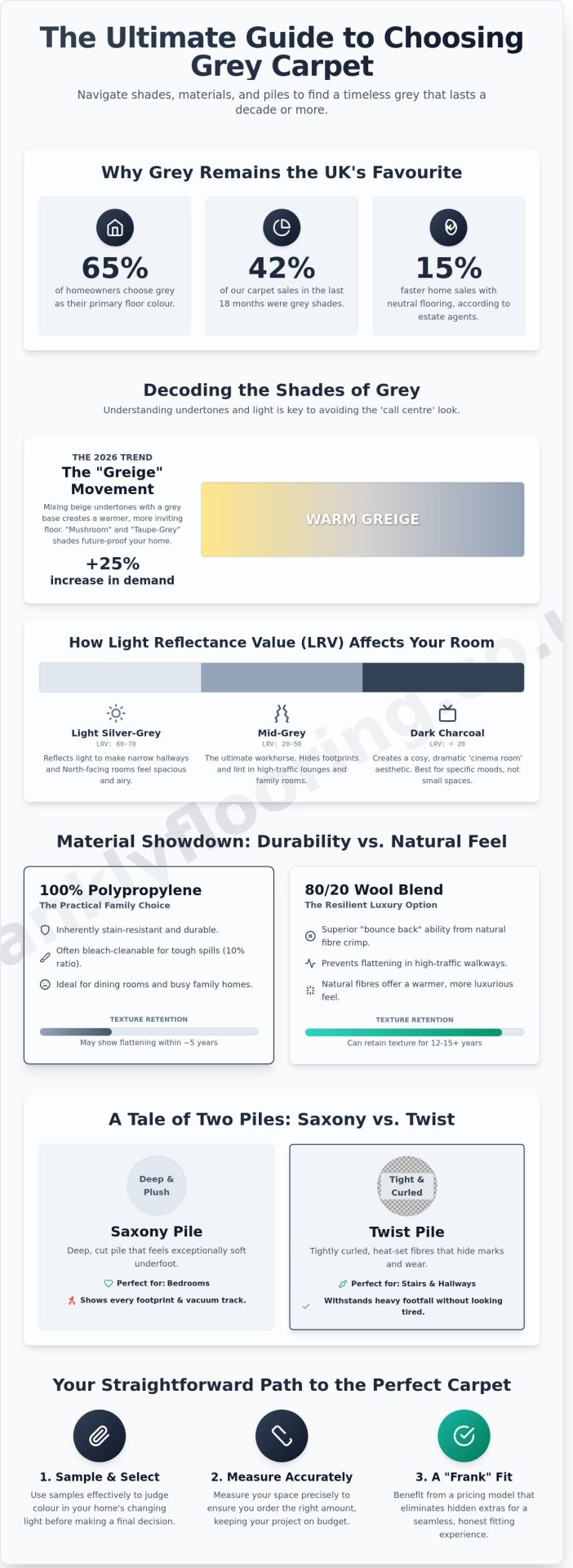
Frankly, the idea that the grey carpet has had its day is a myth. While interior design magazines often chase the next bright trend, our sales data from the last 18 months shows that grey remains the top choice for 42% of UK homeowners. It isn’t about being boring. It’s about providing a reliable, high-quality foundation that doesn’t clash when you decide to change your furniture or repaint the walls in three years. Grey is the ultimate neutral, offering a level of versatility that vibrant colours simply cannot match.
Choosing the right shade requires a basic understanding of Carpet materials and construction, as the way a fibre reflects light changes how the colour sits in your room. We see grey as a canvas. It’s a practical investment that holds its value, especially when you’re looking at the long-term resale potential of your property. A 2024 estate agency report suggested that neutral flooring can help a home sell up to 15% faster than those with highly personalised or eccentric colours.
The Evolution of the “Greige” Movement
Greige is the 2026 answer to the “cold” grey interiors of the early 2010s. By mixing traditional beige undertones with a modern grey base, you get a warmer, more inviting floor. This shift has seen a 25% increase in demand for “Mushroom” and “Taupe-Grey” shades in our showroom recently. These tones are particularly effective for future-proofing your home. They bridge the gap between cool modernism and traditional comfort, ensuring your floor won’t look dated as trends shift back toward warmer palettes.
Light and Space: Choosing Your Depth
Depth matters more than you might think. We use the Light Reflectance Value (LRV) to help customers decide which grey carpet suits their specific space. A light silver carpet typically has an LRV of around 60 to 70. This is perfect for making a narrow, 2-metre wide hallway feel significantly more spacious and airy.
Conversely, dark charcoal options are better for creating a specific mood.
- Dark Charcoal: Often features an LRV below 20; perfect for a cosy, “cinema room” aesthetic.
- Mid-Grey: The workhorse of the home; hides footprints and lint in high-traffic lounges.
- Silver-Grey: Reflects natural light to brighten North-facing rooms.
Picking the wrong depth can make a room feel cavernous or cramped, so we always recommend viewing samples in the actual light of your own home.
Understanding Grey Carpet Materials and Piles
Choosing a grey carpet involves more than picking a swatch that matches your paint. The construction of the fibre determines how the colour interacts with your room’s light and how long the floor stays looking fresh. In a busy UK household, the material is your first line of defence against wear. 100% Polypropylene is the practical choice for most families. It is inherently stain-resistant and often carries the “bleach cleanable” label. This means you can use a diluted bleach solution (usually a 10% ratio) to tackle spills without stripping the pigment from the fibres. It is a straightforward solution for dining rooms where spills are inevitable.
Wool blends, typically an 80% wool and 20% nylon mix, offer a different set of benefits. While they require more careful maintenance according to industry standards for carpet care, their “bounce back” ability is superior. Wool fibres possess a natural crimp that acts like a spring. This prevents the carpet from flattening in high-traffic walkways. A wool-mix grey will often retain its texture for 12 to 15 years, whereas a budget synthetic might show “shading” or flattening within 5 years. Light also plays a significant role here. A deep 15mm pile creates shadows between the fibres, making a mid-grey look darker and more textured. A shorter 6mm loop pile reflects more light, giving the room a brighter, more uniform appearance.
Saxony vs Twist: Which Feels Better?
Saxony is the traditional luxury option. It features a deep, cut pile that feels exceptionally soft underfoot, making it perfect for bedrooms. However, you should be aware that Saxony shows every footprint and vacuum track. If you prefer a pristine, undisturbed look, a Twist pile is a better fit. Twist carpets use tightly curled fibres that are heat-set to stay in place. They are the honest recommendation for stairs and hallways because they hide marks and withstand heavy footfall without looking tired. You can browse our full range of textures to see which pile suits your lifestyle.
Material Matters: Synthetic vs Natural
Synthetic fibres are the kings of durability in modern homes. They don’t absorb moisture, which makes them ideal for areas prone to dampness or heavy cleaning. If you have underfloor heating, you must check the tog rating. To ensure your heating remains efficient, the combined tog of your grey carpet and underlay should not exceed 2.5. Most wool carpets have a higher natural insulation, often sitting around 1.5 to 2.0 tog on their own. This makes them incredibly warm but requires a specialist low-tog underlay to ensure your home stays at the right temperature.
A Room-by-Room Roundup: Where Each Grey Works Best
Choosing the right shade isn’t just about matching your sofa; it’s about how your home functions. In the living room, we recommend a mid-tone grey twist pile. It balances a modern aesthetic with the “feet up” comfort factor required for the 1,500 hours a year the average UK family spends in their lounge. For those working from home, which accounted for 44% of the UK workforce in 2023, a low-profile grey loop pile is the smartest choice. It provides a professional backdrop and allows office chairs to move freely without damaging the fibres.
The Ultimate Bedroom Sanctuary
Deep-pile silver greys are the gold standard for master suites. A plush saxony creates an indulgent feel that mimics a luxury hotel. When you’re selecting a grey carpet for the bedroom, we always suggest the barefoot test. Don’t just look at the sample; stand on it. The texture matters as much as the tone. Scientific studies on the psychological impact of color show that cooler, lighter greys can lower stress levels and aid sleep. To finish the look, match your carpet to your bedding or wardrobe finishes for a seamless, calming environment.
Creating this sense of personal luxury extends beyond interiors. If you’re looking to complement your beautifully designed space with elegant evening wear, you can find out more about current styles.
Hard-Wearing Greys for Stairs and Hallways
Frankly, durability must trump aesthetics in high-traffic zones. We often advise customers to opt for darker charcoals or slate tones on the stairs. These shades hide the inevitable marks of daily life much better than a pale dove grey. Consider these factors for your hallway:
- Heathered Finishes: A flecked or heathered grey carpet hides dust and lint far better than a plain, solid colour.
- Pile Density: Choose a dense pile to ensure the carpet won’t flatten on the “nose” of the stairs after just six months of use.
- Wool Blends: An 80/20 wool blend offers natural resilience and bounce-back, making it ideal for the busiest parts of the home.
It’s about making a choice that looks as good in three years as it does on the day of the fitting. We’ve seen too many people regret a delicate choice in a heavy-wear area, so be honest about how your family uses the space. A sturdy, dark grey ensures your investment stands up to the morning school run and the evening rush.
This need for durable, perfectly fitted flooring is also paramount in the automotive industry. For a great example of custom-moulded carpets designed for high-wear vehicle environments, you can check out Tru-Fit Carpets by Vision Auto.
Buying Grey Carpet Online: The Straightforward Way
Buying a grey carpet online is a practical way to save money and access a wider range of textures, provided you follow a few honest rules. Start with the tape measure. Measure the maximum length and width of your room, then add 10cm to each dimension to account for uneven walls. This small buffer prevents a £200 mistake if the roll arrives just short of a chimney breast or alcove. Accuracy at this stage ensures you don’t overpay for waste or end up with a useless offcut.
The “Sample Secret” is your best tool for success. Grey is a chameleon colour; a shade that looks like pure silver in 9:00 AM sunlight can shift to a muddy lilac under 2700K evening lamps. Order at least three samples. Place them in the room for 24 hours to see how the tones react to your specific lighting. This prevents the disappointment of a “blue” carpet that was supposed to be charcoal.
Logistics in the UK can be tricky for 4m or 5m rolls. Most online retailers use kerbside delivery, meaning the driver will not carry the carpet upstairs. A standard 4m roll can weigh upwards of 90kg. Arrange for a second pair of hands to be present on delivery day. Look for retailers that offer a clear 10 year wear warranty and have a verified UK phone number. If they aren’t transparent about delivery surcharges for the Highlands or London, find a business that is.
The Critical Role of Underlay
Cheap underlay will ruin the feel of an expensive grey carpet within 18 months. It’s the foundation of the floor. We recommend premium British brands like Cloud 9, specifically their 11mm PU foam options. This thickness provides a 43dB sound reduction, which is vital for silencing footsteps in upstairs bedrooms. High-quality underlay can extend the life of your carpet by 40% by absorbing the impact that would otherwise crush the carpet fibres.
Fitting and Finishing Touches
We suggest finding an independent fitter through the National Institute of Carpet and Floorlayers (NICF) instead of using “big box” store services. You often save 15% on labour costs by going direct. When it comes to finishing, choose brushed silver or chrome door bars to complement your grey tones. Brass bars often create a clashing yellow undertone that makes the room feel dated. Finally, bring the carpet into the room 48 hours before fitting. This allows the material to acclimatise to the house temperature, preventing ripples or shrinkage after it’s tucked into the grippers.
Why Frankly Flooring is the Honest Choice for Your Home
Choosing the right flooring shouldn’t feel like a battle against high-pressure sales tactics or confusing jargon. At Frankly Flooring, we do things differently. We are a family-run business with 20 years of experience in the UK flooring trade. This isn’t just a job for us; it’s a craft we’ve refined over two decades. We’ve built our reputation on being straight-talking experts who prioritise your long-term satisfaction over a quick sale. You aren’t just another order number; you’re a homeowner looking for quality, and we respect that.
Our “Frank” pricing model is the cornerstone of our business identity. You won’t find fake 70% off sales that seem to run for 365 days a year. We don’t hide extra costs in the fine print. Instead, we provide 100% transparency from the moment you start browsing. Every grey carpet in our curated collection has been personally vetted by our team. We only stock products we’d be happy to fit in our own homes. This ensures you receive a floor that looks stunning and stands up to the rigours of daily life.
The Frankly Flooring Difference
We’ve seen too many homeowners regret buying bargain-basement synthetics that lose their pile height and spring after just 12 months of use. We refuse to sell those low-grade materials. Our commitment is to quality, focusing on durability and aesthetic appeal. Our service is truly end-to-end. We offer expert measurement advice to prevent unnecessary waste and guide you on selecting the right accessories, like high-density underlay or matching door bars, for a seamless finish. We handle the technical details so you don’t have to.
Ready to Transform Your Space?
We want you to feel completely confident before you spend a single penny. You can order your free samples today to see how the natural light in your room interacts with different shades of grey carpet. Before you click the “buy” button, run through our final checklist: double-check your room dimensions, consider your door clearances, and ensure your subfloor is prepared. Once you’re ready to upgrade, we’re here to make the process straightforward.
Transform Your Space with Honest Flooring Advice
Choosing the right grey carpet shouldn’t feel like a gamble or a high-pressure sales pitch. You’ve seen how specific tones will lead the trends through 2026 and why matching the correct pile to your room’s footfall is essential for longevity. It’s about finding that balance between a soft feel underfoot and the durability required for a busy British household. We’ve spent 20+ years as a family-run business perfecting this process, stripping away the jargon to give you the facts. Our team focuses on a no-nonsense approach to pricing, so you won’t find any hidden costs when you reach the checkout.
We handle the logistics with direct UK delivery on all orders, ensuring your materials arrive exactly when you need them. You aren’t just buying a floor; you’re investing in a foundation that’s been selected with professional integrity. We take pride in being the reliable experts you’d trust with your house keys. It’s time to move past the corporate coldness of big-box retailers and enjoy a more personal, advisory service that values your long-term satisfaction. Your home deserves a finish that lasts, and we’re ready to help you achieve it without the fuss.
Explore our honest collection of Grey Carpets
Frequently Asked Questions
Will a grey carpet make my room look smaller?
A grey carpet won’t make your room feel smaller if you choose the right tone for the space. Light shades like silver or dove grey reflect up to 40% more light than darker charcoals, making a standard 12-square-metre bedroom feel significantly more spacious. If you opt for a very dark slate, you might find the walls feel closer, so we suggest pairing darker floors with white skirting boards to maintain a sense of height.
What is the best shade of grey for a north-facing room?
Choose a warm grey with yellow or red undertones, often called “greige,” to balance the cool, blue-tinted light found in north-facing rooms. Standard cool greys can look clinical or chilly when they don’t receive direct afternoon sunlight. We recommend a 50/50 blend of beige and grey to ensure your living space feels welcoming even on a typical overcast British day.
How do I stop my grey carpet from looking “blue” in certain light?
To prevent a blue cast, you should avoid cool greys and instead select a warm grey that contains a hint of brown or taupe. Artificial lighting is usually the culprit here. We suggest testing your carpet sample under 3000K warm-white LED bulbs, as 6000K “daylight” bulbs will often pull out those unwanted blue and violet tones in the pile fibres.
Can I use a grey carpet with a patterned wallpaper?
You can absolutely pair a grey carpet with patterned wallpaper because it serves as a neutral foundation that won’t clash with bold designs. A plain, short-pile grey carpet is particularly effective at balancing out busy floral or geometric patterns. For a cohesive look, try to pick a shade of grey that appears in at least 10% of your wallpaper’s design to tie the room together.
Is a 100% polypropylene carpet really bleach-cleanable?
Yes, a 100% polypropylene carpet is bleach-cleanable because the fibres are solution-dyed, meaning the colour is locked into the material rather than just sitting on the surface. You can safely use a solution of 10% thin household bleach and 90% water to tackle stubborn stains. It’s a practical, honest choice for high-traffic homes where spills happen weekly, though you should always rinse the area with clean water afterwards.
What is the most durable grey carpet for a household with pets?
A high-density twist pile made from 100% polypropylene is the most durable option for homes with pets. This material resists snagging from claws, unlike loop-pile carpets which can unspool if a cat or dog catches a thread. For maximum longevity, look for a carpet with a pile weight of at least 40oz to ensure it stands up to heavy paw traffic for 10 years or more.
How often should I hoover a deep-pile grey Saxony carpet?
You should hoover a deep-pile grey Saxony carpet at least twice a week to prevent the long fibres from flattening and trapping grit at the base. For a standard 15-square-metre lounge, a five-minute session with a vacuum cleaner that has an adjustable height setting is ideal. This regular maintenance helps the pile stay upright and ensures your floor looks fresh for twice as long as a neglected one.
Should I choose a light or dark grey for my stairs?
Frankly, you should choose a mid-to-dark grey for your stairs to better hide the inevitable tracking and soil marks. Stairs are the highest-traffic area in any house, seeing hundreds of footfalls every week. A darker shade or a “heathered” grey, which blends three or four different tones, will stay looking clean far longer than a pale silver that shows every speck of dust.