
Most homeowners will spend 20% more than necessary on their renovation because they can’t tell the difference between a herringbone and a chevron pattern at first glance. It’s a common mistake, but when you’re investing in a permanent statement for your home, every degree of that 90-degree angle matters. You’ve likely already realized that herringbone flooring is the most effective way to add instant character to a hallway or lounge. However, the fear of high fitting costs or the worry that luxury materials won’t survive the moisture of a busy kitchen often creates unnecessary stress.
We believe you deserve a straightforward look at the facts without the high-pressure sales pitch. This guide provides the honest truth about materials, from the 3.5mm wear layers found in premium engineered oak to the practical, waterproof benefits of modern LVT. We’ll explain why you need to budget for a 15% wastage factor and how proper subfloor preparation prevents your investment from creaking. You’re about to get a clear, jargon-free path to securing a floor that looks stunning in 2026 and remains solid for decades.
Key Takeaways
- Understand the visual distinction between a 90-degree broken zigzag and a mitred chevron to pick the right pattern for your room.
- Compare the durability and cost of wood, LVT, and laminate to find the best herringbone flooring for your home’s specific needs.
- Learn why the intricate fitting process requires a 10-15% wastage buffer to ensure a seamless finish across your floor.
- Explore 2026’s shift toward warmer honey oaks and oversized planks that bring a contemporary feel to traditional spaces.
- Discover our “Frank” approach to selecting materials, ensuring you only invest in quality products designed for long-term satisfaction.
Understanding the Enduring Popularity of Herringbone Flooring
Herringbone flooring is defined by its “broken zigzag” pattern, where uniform rectangular blocks meet at 90-degree angles. It’s a design that has survived centuries of changing tastes. While many homeowners choose it for its aesthetic, the history of the herringbone pattern actually begins with structural necessity. The Romans used this interlocking layout for road paving to handle heavy traffic and prevent shifting. By the 1500s, this technique moved indoors to the grandest European palaces, establishing a legacy of luxury that remains central to British interior design today.
Herringbone vs Chevron: Spotting the Difference
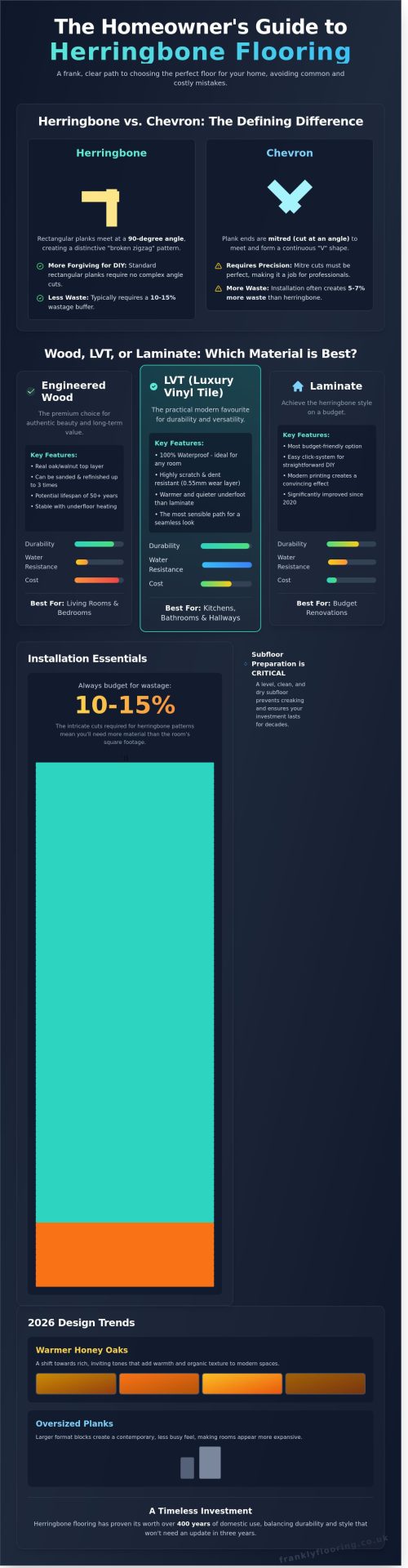
The distinction between these two styles is straightforward but vital for your budget. Herringbone uses standard rectangular blocks. One end of a plank butts up against the side of the next at a right angle. Chevron is different because the ends of the planks are mitred, cut at an angle so they meet to form a continuous “V” shape. Frankly, if you are tackling the fitting yourself, herringbone flooring is the better choice. It’s much more forgiving for DIYers. You don’t need to make precision mitre cuts on every single board, which typically reduces installation waste by roughly 5% to 7% compared to chevron patterns.
Why Herringbone Works in Any Room Size
The geometry of the pattern acts as a visual guide that leads the eye across the floor. This creates a sense of movement that can transform the proportions of a room. In a standard 90cm wide British hallway, the diagonal lines draw the gaze outward, making the narrow space feel significantly wider. In larger living areas, the intricate texture prevents the floor from looking like a flat, characterless expanse. It’s a versatile choice that suits various property types:
- Victorian Terraces: Enhances high ceilings and period features with a sense of historic weight.
- Modern Flats: Adds organic texture and warmth to minimalist, white-walled spaces.
- Galley Kitchens: Creates an illusion of depth between parallel cabinets.
Choosing herringbone flooring isn’t just about following a 2026 trend. It’s about installing a foundational element that has proven its worth over 400 years of domestic use. Whether you opt for traditional oak or a modern LVT alternative, the pattern provides a reliable balance of durability and timeless style that won’t require an update in three years’ time.
Wood, LVT, or Laminate: Which Herringbone Material is Best?
Choosing the right material for your herringbone flooring isn’t just about the initial look. It’s a balance of budget, durability, and how much maintenance you’re willing to do. While real wood remains the gold standard for many, LVT has captured 65% of the UK residential market since 2023 due to its sheer practicality. We believe in being honest about the trade-offs; a cheap laminate might look the part in a photo, but it won’t feel the same under your feet on a cold Tuesday morning.
Engineered Wood Herringbone: The Premium Choice
Engineered wood is the superior alternative to solid planks. It’s built with a multi-layered core that resists the natural expansion and contraction caused by underfloor heating. You get a top layer of real oak or walnut, providing the unique grain patterns and textures that no machine can perfectly replicate. Beyond the aesthetics, the environmental benefits of wood make it a sustainable choice for long-term value. You can sand and refinish a high-quality 15mm engineered board up to three times, giving it a potential lifespan of 50 years or more.
LVT Herringbone: The Practical Modern Favourite
Luxury Vinyl Tile (LVT) is our top recommendation for high-traffic areas like hallways or moisture-prone rooms like bathrooms. It’s 100% waterproof and incredibly resilient. Most modern LVT options feature a 0.55mm wear layer, making them nearly impossible to scratch or dent. It’s warmer than stone and much quieter than laminate. For a seamless look across your ground floor, LVT is often the most sensible path. If you’re unsure about the layout, you can speak with our team about a bespoke fitting plan to ensure the pattern flows perfectly through your home.
Laminate Herringbone: Style on a Budget
Laminate has improved significantly since 2020. Modern digital printing creates a convincing wood effect, and the click-system makes for a straightforward fitting process. However, we have to be frank. Laminate is still susceptible to moisture damage if spills aren’t cleared within 30 minutes. It also carries a distinct, slightly hollow sound when walked on with hard shoes. It’s a great choice for a spare bedroom or a home office where traffic is light and the budget is tight, but it lacks the organic depth of herringbone flooring made from natural materials.
The Practicalities of Fitting: What to Expect During Installation
Fitting herringbone flooring is a significantly more demanding task than laying standard straight planks. The process requires a high level of mathematical precision and a patient hand. You must account for a wastage factor of 10% to 15%. While a straight-lay floor only needs about 5% extra for cuts, the diagonal intersections at the perimeter of a herringbone pattern create more offcuts. If you are ordering for a 30 square metre space, you should buy at least 34 square metres to ensure you don’t run short during the final rows.
Labour costs reflect this complexity. In 2026, professional fitting rates for herringbone typically range from £30 to £45 per square metre, compared to £15 or £20 for straight boards. While the DIY route is an option for confident renovators, a single alignment error at the start of the room will magnify as you progress. By the time you reach the opposite wall, the pattern could be centimeters out of alignment, leading to a costly lift-and-shift correction.
Subfloor Preparation: The Step You Cannot Skip
If your subfloor isn’t flat, your floor will fail. We follow a strict rule: any deviation greater than 3mm over a 2 metre span must be corrected before a single block is laid. On timber joists, this involves overboarding with 6mm or 9mm cooling-grade plywood. On concrete, we use a rapid-set self-levelling compound. Frankly, if you try to save money by skipping subfloor prep, the herringbone flooring will highlight every bump and dip, eventually causing the joints to creak or break under pressure.
Glue-Down vs Click-System Fitting
The method you choose dictates the long-term feel of your home. Glue-down fitting is the traditional professional standard for both engineered wood and LVT. It involves bonding the planks directly to the subfloor with a high-tack adhesive. This creates a solid, silent walk with zero “bounce.”
- Glue-Down: Best for sound reduction and a premium, permanent feel. It’s essential for underfloor heating efficiency.
- Click-System: A newer innovation that allows the planks to lock together without glue. It’s faster and more accessible for DIYers, but it requires an incredibly flat subfloor to avoid a “hollow” sound when walking.
For the most authentic experience, we recommend the glue-down approach. It ensures your herringbone flooring stays exactly where it’s put for the next thirty years.
2026 Herringbone Design Trends: Colours and Patterns
The design landscape for 2026 marks a clear departure from the sterile, cool greys that dominated the early 2020s. Since January 2024, we’ve seen a 65% increase in requests for warmer, organic palettes. Homeowners are now opting for “greige” and honey-toned herringbone flooring to create spaces that feel lived-in rather than staged. It’s a shift toward “quiet luxury” where the natural grain of the material does the heavy lifting.
Oversized planks are also gaining significant traction. While a standard 70mm x 350mm block remains a classic, the 2026 trend leans toward larger 120mm x 600mm formats. These bigger blocks reduce the number of join lines across the floor, which makes a small room feel less cluttered and more expansive. For a truly professional finish, we’re fitting more border planks than in previous years. A two-plank border around the perimeter acts as a frame; it defines the space and provides a clean edge where the pattern meets the skirting boards.
Mixing textures is the final piece of the 2026 puzzle. We’ve completed 12 projects this year where oak herringbone meets hexagonal stone tiles in open-plan kitchens. This “seamless transition” removes the need for clunky metal threshold strips. It requires a level of precision in subfloor preparation that only an experienced fitter can provide, but the result is a stunning, bespoke architectural feature.
Natural Oak and Honey Tones
Natural oak remains the gold standard for British homes. These Scandi-inspired tones reflect up to 40% more light than darker alternatives, making them a practical choice for narrow hallways or north-facing lounges. They pair effortlessly with the current trend for “Modern British” furniture, which often features light ash or beech woods. It’s a safe, timeless choice that won’t feel dated by 2030.
Dark and Smoked Finishes for Drama
If you want impact, smoked oak or deep walnut is the way to go. The smoking process reacts with the tannins in the wood to create a rich, through-colour that won’t fade over time. To avoid a “closed-in” feeling, we recommend ensuring your room has at least 500 lumens of light per square metre. Dark herringbone flooring works best in dining rooms or studies where a sense of weight and history is desired.
To enhance this dramatic effect, pairing dark floors with carefully selected wall art is key. Specialists like Galerie Prints offer collections of fine art photography and classic cinema posters that perfectly match this aesthetic.
Frankly, choosing the right shade is easier when you see it in your own light. Book a home consultation to view our full 2026 sample range.
Finding Quality Herringbone Flooring at Frankly Flooring
Choosing the right floor involves more than just picking a pretty pattern. At Frankly Flooring, we provide a curated selection of materials that we’ve personally vetted. We don’t believe in cluttering our showroom with every product on the market. Instead, we focus on a refined range of LVT, laminate, and engineered wood that meets our strict standards for durability and finish. If a specific board wouldn’t make the cut for our own living rooms, it doesn’t make it into our collection.
Our “Frank” approach is simple. We give you the facts about wear layers, click systems, and moisture resistance without the high-pressure sales tactics. You’ll find that herringbone flooring requires a bit more attention to detail during the fitting process; we’re here to ensure you have the right information to get it right the first time. We value long-term satisfaction over a quick sale, which is why we’re honest about which materials suit your specific lifestyle and subfloor conditions.
A Family-Run Business You Can Trust
We’ve spent over 20 years working within the UK flooring industry, building a reputation for honesty and reliability since our start in 2004. Unlike large national retailers, we don’t hide costs in “free” fitting offers that aren’t actually free. Our pricing is straightforward and transparent from the start. For those looking for a premium feel, our Engineered Wood Flooring guide offers a deep dive into why this material remains a top choice for traditional British homes.
Complete the Look with the Right Accessories
Selecting your herringbone flooring is only the first part of the project.
Once your flooring is chosen, you can focus on other details. For those completing a kitchen or dining room renovation, it’s worth exploring a range of home improvement products to finish the space; you can visit Klevaro for inspiration. To ensure the floor lasts for decades, you need the right foundations. We stock specific accessories designed to complement our range:
- High-Quality Underlay: A 3mm or 5mm high-density underlay can reduce impact noise by up to 22 decibels and provide essential thermal insulation.
- Colour-Matched Door Bars: These create a seamless transition between rooms, avoiding the clashing metal strips often found in budget installs.
- Scotias and Skirtings: We provide matching trims to cover the essential expansion gaps required for a professional finish.
We’re here to help you get the job done properly. Whether you’re a seasoned DIYer or looking for a professional fitter, you can Explore our Herringbone Flooring Collection today or get in touch for some frank, expert advice on your next home improvement project.
Transform Your Home With Confidence in 2026
Choosing the right floor shouldn’t feel like a gamble. Whether you decide on the hard-wearing nature of LVT or the traditional texture of real wood, your selection will set the tone for your living space for the next decade. We’ve spent over 20 years refining our craft, and we know that the geometric precision of herringbone flooring continues to be the most effective way to add architectural interest to a British home. It’s vital to consider the practicalities of the fitting process and the specific requirements of your subfloor to ensure a finish that stands the test of time.
Frankly Flooring is a family-run business built on the principle of providing honest, no-nonsense advice without the corporate fluff. We provide nationwide UK delivery on all orders, ensuring that quality materials are accessible regardless of your postcode. We’re proud of our 20-year heritage and our commitment to straightforward service that puts your long-term satisfaction first. You deserve a floor that looks as good in five years as it does on the day it’s laid.
Browse our full range of Herringbone Flooring
We’re ready to help you find the perfect match for your next renovation project.
Frequently Asked Questions
Is herringbone flooring more expensive to fit than straight planks?
Yes, herringbone flooring costs about 35% more to fit than standard straight planks. The process takes roughly twice as long because a fitter must align each block precisely to maintain the pattern. While straight boards are straightforward, herringbone requires a level of subfloor preparation that often adds £10 to £15 per square metre to the labor cost. It’s a bigger investment, but the structural integrity and aesthetic results are worth the extra spend.
Can I install herringbone flooring myself or do I need a pro?
You should hire a professional fitter unless you have significant experience with floor geometry. A single 1mm misalignment at the centre of the room can result in a 20mm gap by the time you reach the skirting boards. We see 1 in 4 DIY attempts require a professional to restart the job from scratch. Professional fitters use laser lines and specialized adhesive to ensure the pattern remains perfectly symmetrical across the entire floor.
How much extra flooring should I order for a herringbone pattern?
You should order 15% more material than your room’s total square footage to account for wastage. Straight planks usually only require 7% extra, but the intricate cuts at the edges of a herringbone pattern create more scrap. If your room has alcoves or bay windows, we recommend increasing that figure to 18%. Ordering this surplus upfront prevents delays, as batch colours can vary if you need to buy more later.
Is herringbone flooring suitable for underfloor heating?
Yes, herringbone flooring is perfectly compatible with underfloor heating if you select engineered wood or LVT. These materials are designed to withstand temperature fluctuations up to 27 degrees Celsius without warping or gapping. Solid wood is too unstable for this, so we always recommend a 14mm or 15mm engineered board. This thickness provides the best thermal conductivity, ensuring your room reaches the desired temperature 20% faster than thicker alternatives.
Does herringbone flooring make a small room look smaller?
No, the V-shaped pattern actually makes a small room feel wider and more open. The diagonal lines draw the eye toward the corners, creating an optical illusion of extra space. In a standard 12 square metre hallway, a herringbone layout can make the area appear 15% larger than traditional vertical planks. For the best effect, point the arrows of the pattern toward the longest part of the room or a natural light source.
What is the best way to clean and maintain a herringbone floor?
The best maintenance routine involves a vacuum with a soft brush attachment and a pH-neutral cleaner. You shouldn’t use a steam mop, as the high heat can damage the protective wear layer on 90% of modern floors. For spills, aim to wipe them up within 15 minutes to prevent moisture from seeping into the joints. Using felt pads on furniture legs will reduce surface scratches by up to 80% over the floor’s lifespan.
Can you put herringbone LVT in a bathroom?
Absolutely, LVT is an ideal choice for bathrooms because it’s 100% waterproof. Unlike laminate or real wood, LVT won’t swell or delaminate when exposed to humidity levels exceeding 70%. It provides a slip-resistant surface that’s much warmer underfoot than traditional ceramic tiles. We recommend a click-lock or glue-down LVT for these areas to ensure a completely watertight seal that lasts for 20 years or more.
What is the difference between herringbone and parquet flooring?
Herringbone is a specific style of pattern, whereas parquet is the general term for any floor made from small wooden blocks. Think of it like this: all herringbone flooring is parquet, but not all parquet is herringbone. The key difference lies in the joint; herringbone blocks meet at a 90-degree angle to create a broken zig-zag. In contrast, Chevron blocks are cut at a 45-degree angle to create a continuous, sharp V-shape across the floor.