
Your brand new carpet isn’t actually falling apart. While it feels like you’re losing half the pile every time you vacuum, this shedding is a natural exhalation of the manufacturing process rather than a structural defect. We know the frustration of finding fluff on your socks and worrying that your floor is thinning out before you’ve even enjoyed it. If you’re searching for how to stop a new carpet from shedding, the first step is to understand that your carpet is simply shedding its “baby teeth” as the loose fibers work their way to the surface.
We believe in being direct about what happens after the fitting is complete. It’s a common concern we hear in our showroom, and we’re here to provide the honest reassurance you need. This guide outlines the professional techniques to manage excess fibers without damaging the integrity of your flooring. We’ll walk you through vacuuming protocols aligned with CRI 105 residential standards, which remain the industry gold standard in May 2026. You will get a clear timeline for when the shedding will naturally cease, helping you maintain a clean home while your new carpet settles in for the long term.
Key Takeaways
- Understand that shedding is a normal part of the “settling in” process for new carpets, involving the release of short, unspun fibres.
- Learn the “little and often” vacuuming routine and how to stop a new carpet from shedding by using the correct equipment to avoid fuzzing the pile.
- Differentiate between Staple and BCF fibres to understand why your specific carpet type might be predisposed to fluffing.
- Learn how to manage environmental factors like static and humidity that can cause loose fibres to cling stubbornly to your flooring.
- Identify the honest signs of manufacturing defects, such as pilling or poor latex bonding, versus the healthy shedding expected after a new fitting.
Understanding New Carpet Shedding: Is Your Floor Falling Apart?
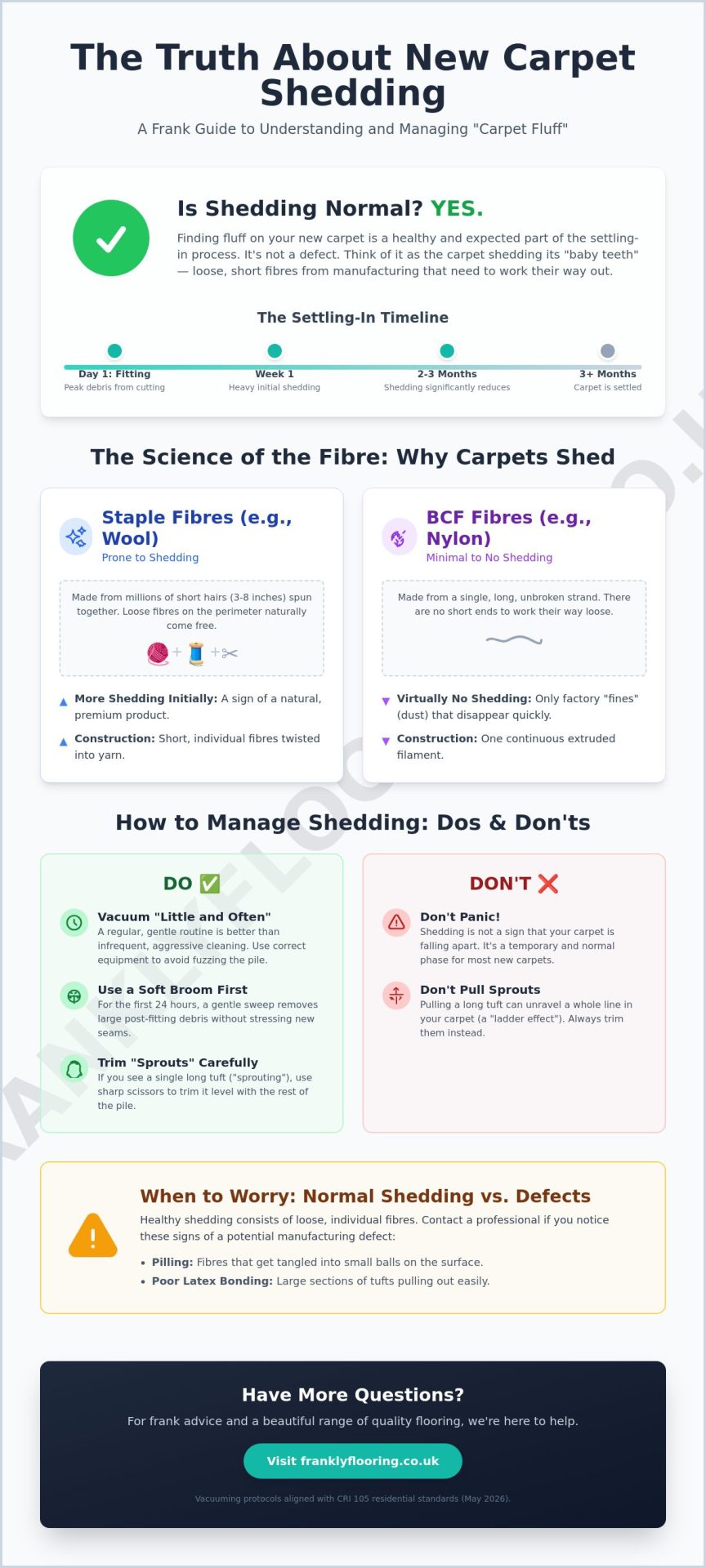
It is a common sight in British homes shortly after a new fitting. You walk into the room and find clumps of fluff migrating across your floor like woolly tumbleweeds. Before you panic and call the showroom to complain, let’s be frank. Your floor isn’t disintegrating. Shedding is simply the release of short, unspun fibres that were trapped in the carpet pile during the manufacturing process.
Think of it as a natural exhalation. When you’re researching how to stop a new carpet from shedding, you need to realise that these fibres are essentially manufacturing leftovers. They don’t contribute to the density, weight, or the long term lifespan of your flooring. Most quality carpets will finish this heavy shedding phase within 6 to 10 weeks, provided you follow a sensible maintenance routine. You aren’t losing the carpet you paid for; you’re just clearing out the excess material that doesn’t belong there.
The Difference Between Shedding and Sprouting
It’s easy to confuse general shedding with “sprouting,” but they require different responses. Shedding is the loose fluff that comes up in handfuls. Sprouting refers to single, long tufts that stand taller than the rest of the pile. Never pull these sprouts. Pulling a sprout can cause a ladder effect, effectively unravelling a line of your new floor. Instead, use a sharp pair of scissors to trim the sprout level with the surrounding pile.
Post-Fitting Debris: Why the First Week is the Worst
The fitting process itself is often the biggest culprit for that initial mess. When a carpet is cut to size, thousands of individual fibres are sliced at the edges, creating immediate surface waste. Additionally, the act of stretching the carpet onto grippers during a professional fitting opens up the pile. This mechanical tension allows trapped manufacturing debris to rise to the surface more easily than it would while sitting on a roll.
We recommend a gentle first day sweep with a soft bristled broom rather than an immediate, aggressive vacuuming session. This removes the large clumps of post-fitting debris without putting undue stress on the fresh seams. Understanding this helps when you’re looking for how to stop a new carpet from shedding, as it sets realistic expectations for the first seven days of ownership. The fluff will peak early and then steadily decline.
The Science of the Fibre: Why Some Carpets Shed More Than Others
To truly master how to stop a new carpet from shedding, you first need to understand what’s happening at a microscopic level. Every carpet you see in a showroom is either a “staple” fibre or a “BCF” (Bulked Continuous Filament) product. The difference between these two constructions is the primary reason why one room might be full of fluff while another remains perfectly clean from day one.
Let’s be frank about the manufacturing process. During spinning, machines run at incredible speeds to twist fibres into yarn. It’s physically impossible for every single hair to be perfectly caught in the yarn’s core. Some end up on the perimeter of the strand, held only by light friction. As you walk on your new floor, that friction is overcome and the fibre pops to the surface. It’s a mechanical reality of textile production that has nothing to do with the quality of the fitting.
Staple Fibres: The Wool Factor
Wool is the classic example of a staple fibre. It’s made from millions of individual animal hairs, typically measuring between 3 and 8 inches in length, which are spun together to create a single yarn. Because these are short, discrete pieces, it’s inevitable that a small percentage won’t be fully anchored. High quality wool carpets actually shed more than cheap, low-grade synthetics during the first 60 days. It’s a sign of a natural, premium product that’s simply exhaling its excess material.
BCF (Continuous Filament) Carpets
BCF carpets are manufactured from synthetic polymers like nylon or polyester. Instead of short hairs twisted together, the yarn is extruded as one long, unbroken strand. Since there are no short ends to work their way loose, these carpets don’t shed in the traditional sense. This makes BCF a reliable choice for busy households or as a low-maintenance alternative for those who find laminate flooring too cold underfoot. You might still find some “fines” (tiny dust-like particles) on the surface, but these are just factory dust and disappear after one or two vacuum sessions.
The “twist” of the yarn is the final piece of the puzzle. A high-twist carpet has more turns per inch, which mechanically locks the fibres together more securely than a loose, shaggy pile. If you’re still in the selection phase and want to avoid the fluff altogether, we recommend browsing our bespoke carpet collections to find a density and twist level that suits your lifestyle.
How to Stop Carpet Shedding: Expert Vacuuming and Grooming
The secret to managing a new floor isn’t a magic chemical; it’s a “little and often” routine. For the first 8 weeks after your fitting, you should aim to vacuum at least 3 times a week. This prevents loose fibres from being crushed back into the pile by foot traffic. Don’t be alarmed if you have to empty your vacuum canister after every single room. In the first month, a single 12 square metre room can produce enough fluff to fill a standard 1.5 litre cylinder. If the canister is more than half full, suction efficiency drops significantly, often by up to 30%, leaving those loose fibres exactly where they started. We’ve seen homeowners assume their vacuum is broken when, in reality, the carpet is simply doing its job of releasing excess material.
Choosing the Right Vacuum Settings
Beater bars are high-speed rotating brushes designed to agitate dirt, but they can be a double-edged sword. If you’re looking for how to stop a new carpet from shedding without causing “fuzzing,” you must adjust your height settings. For wool carpets, we recommend using a suction-only setting or raising the beater bar to its highest position. Setting the brush too low creates unnecessary friction that can actually break stable fibres, creating a cycle of shedding that never ends. It’s a straightforward fix: if you hear the vacuum motor straining or see the pile looking fuzzy rather than clean, your brush is too low. A high quality upright vacuum should glide across the surface, not dig into it.
The Professional Grooming Technique
For heavy shedders, a vacuum alone might not be enough. Professional fitters often use a carpet rake, which is a tool with flexible plastic or silicone tines, to lift loose material to the surface. Raking is a low-impact way to maintain the carpet aesthetics without the heat and friction of a motor. Start by raking the entire room in the direction of the pile to loosen the “tumbleweeds” that hide deep in the base. Follow this with a slow vacuum pass, then rake once more to reset the tufts. This three-step process is the most effective way to clear manufacturing debris in half the usual time. It’s an honest, manual solution that protects your investment while keeping your home fluff-free.
Environmental Factors: Static, Humidity, and Friction
The air in your home plays a larger role in your carpet’s behaviour than you might expect. In the UK, particularly during the winter months from November to March, central heating often strips moisture from the indoor environment. When humidity levels drop below 30%, static electricity begins to build up within the fibres. This static charge acts like a microscopic magnet; it causes fluff to cling stubbornly to the surface and resists the suction of your vacuum. If you’re struggling with how to stop a new carpet from shedding, you may actually be fighting a battle against dry air rather than a faulty product.
Then there is the “Frank” reality of your household’s daily life. Friction is the mechanical force that pushes manufacturing leftovers to the surface. Pets and children are effectively high-speed agitators. A dog running across the room or children playing on the floor will accelerate the shedding process by “working” the loose fibres out of the pile. While this creates more mess in the short term, it’s a necessary part of the carpet’s break-in period. You’re simply seeing the manufacturing debris being brought to the surface where it can be dealt with.
Controlling Humidity to Reduce Static
Maintaining a healthy indoor environment can significantly ease your cleaning routine. We recommend keeping your home’s humidity between 45% and 55%. Using a humidifier during the colder months keeps the fibres supple and prevents the static cling that makes vacuuming difficult. For synthetic carpets, a light application of a static-reducing spray can provide a temporary fix, though it’s no substitute for proper moisture control. This straightforward adjustment helps the pile retain its structure and keeps loose fluff from sticking to everything.
Managing High-Traffic Areas
You might be tempted to cover your new floor with rugs or runners to protect it, but this often just delays the inevitable. Walking on the carpet is actually helpful. Each step helps to loosen the remaining manufacturing debris, allowing you to vacuum it away for good. Don’t be afraid to use the room normally. If you’re wondering how to stop a new carpet from shedding in high-traffic zones, the honest answer is to simply let the process happen. The faster you “work” the carpet through this initial phase, the sooner the shedding will stop. If you’re planning a new project and want advice on the most durable options for busy homes, you can view our full range of quality flooring to find the right fit for your lifestyle.
When to Worry: Identifying Manufacturing Defects
While 99% of shedding cases are simply manufacturing leftovers, you should know when the fluff indicates a genuine problem. If you’ve followed the “little and often” vacuuming routine for more than 6 months and the volume of fibre hasn’t decreased, it’s time for a professional inspection. A healthy carpet loses unspun surface fibres; a defective one loses its actual structure. Most homeowners worry they’ve bought a faulty product, but it’s important to distinguish between a natural “settling in” period and a structural failure.
You can perform a simple “Tug Test” to check the integrity of your floor. Select a single tuft in a low-traffic area and pull it gently upwards. In a well-made carpet, the tuft should stay firmly rooted in the backing. If the tuft slides out with zero resistance, or if you can see the white latex bonding crumbling away like dust, the manufacturing bond has failed. This is a rare occurrence, but it’s one we address directly with our customers to ensure they feel supported. If you’re researching how to stop a new carpet from shedding and the Tug Test fails, no amount of vacuuming will solve the issue.
The Signs of a Defective Carpet
Watch for pilling. This is different from shedding. Pilling occurs when fibres become entangled into small, stubborn balls that stay attached to the pile even after vacuuming. You should also monitor for bald patches or a visible loss of height in specific areas. If your carpet looks significantly thinner in the corners where nobody walks, this isn’t a result of foot traffic. It’s a sign of poor quality control during the spinning process. If you find yourself constantly looking for how to stop a new carpet from shedding after the 24-week mark, the issue is likely a manufacturing defect rather than manufacturing debris.
Taking Action with Your Retailer
If you suspect a defect, start by gathering your documentation. Keep your original receipt and any details regarding the carpet gripper or underlay used during the fitting. Manufacturers often ask for these details to ensure the carpet was supported correctly. Approach your supplier with a professional attitude. Clear photos of the “Tug Test” results and a log of your vacuuming frequency will help speed up a warranty claim. Most reputable businesses value their reputation and will want to put things right if a product isn’t performing to industry standards.
Let’s be frank: you probably don’t have a lemon. In the vast majority of homes we visit, the “snowstorm” of fluff is just a temporary phase of a high-quality product settling in. By following the grooming and environment controls we’ve outlined, you’ll likely find that your floor looks perfect and remains fluff-free for years to come.
Enjoying Your Fluff-Free Floor
Managing a new carpet shouldn’t be a source of stress. By now, you understand that those woolly tumbleweeds are just manufacturing leftovers and not a sign of your floor falling apart. Stick to the “little and often” vacuuming routine and keep your humidity levels near 50% to neutralise static. Most carpets will settle into their permanent, beautiful state within 10 weeks of the fitting.
Knowing how to stop a new carpet from shedding is ultimately about consistency and using the right equipment. At Frankly Flooring, we’ve spent over 20 years as a family-run business providing honest advice to homeowners. We take pride in our craftsmanship and offer national UK delivery on all our flooring options. If you’re ready to upgrade your home with a floor that stands the test of time, browse our range of high-quality, low-shedding carpets today. Your home is a foundational part of your character; let’s make sure the foundation is solid.
Common Questions About Carpet Shedding
How long does a new carpet shed for?
Most quality carpets will stop shedding manufacturing leftovers within 6 to 10 weeks of fitting. This timeline depends on the fibre type and the level of foot traffic in the room. If you still notice significant fluff after 24 weeks, it may indicate a structural issue rather than a normal settling-in period. Consistent vacuuming during these first two months is the most effective way to clear the debris quickly.
Can I stop my carpet from shedding by vacuuming more?
You cannot instantly stop the shedding process through vacuuming, but you can manage the mess and prevent the fluff from matting. We recommend a “little and often” approach, vacuuming 3 times a week for the first 2 months to clear loose fibres. Avoid aggressive, daily vacuuming with a low-set beater bar, as this can actually damage stable fibres and create more fuzzing over time.
Will a cheap carpet shed more than an expensive one?
Price is rarely a predictor of shedding volume, as premium wool carpets often shed more than budget-friendly synthetic options. This is because wool is a natural staple fibre made of short hairs twisted together. A cheaper carpet made from Bulked Continuous Filament (BCF) won’t shed at all because it’s one long strand. Fluff is often a sign of a high-quality natural material rather than a defect.
Is it normal for a wool carpet to shed so much?
It is entirely normal for a wool carpet to produce a high volume of fluff during its first 60 days. Because wool is a natural staple fibre, a small percentage of short hairs aren’t fully anchored during the spinning process. You aren’t losing the density or the weight of your floor; you’re simply clearing out manufacturing leftovers that don’t belong in the finished pile.
Does the type of vacuum cleaner affect carpet shedding?
The settings and brush type of your vacuum directly impact how you manage the fluff. When learning how to stop a new carpet from shedding without causing damage, you should avoid using a heavy beater bar on wool. Use a suction-only setting or a high-set brush to lift loose fibres gently. An aggressive, low-set vacuum can pull at stable tufts, causing the carpet to look worn prematurely.
Should I be worried if I see bald spots on my new carpet?
You should contact your supplier immediately if you notice bald spots or visible patches of backing. While shedding is a uniform release of fluff, bald spots indicate a manufacturing defect or a failure in the latex bonding. Normal shedding should never result in a visible loss of pile height or density. If you can see the primary backing through the yarn, this requires a professional inspection.
Can I use a carpet rake to stop shedding?
A carpet rake won’t stop the shedding process, but it is the best tool for removing loose fibres without using high-speed friction. Using a rake with silicone or plastic tines lifts manufacturing leftovers to the surface so they can be easily vacuumed away. It’s a gentle way to maintain the pile’s appearance. Incorporating a rake into your routine is a smart strategy for how to stop a new carpet from shedding tumbleweeds across your home.
Does underlay affect how much a carpet sheds?
Underlay does not affect the amount of fluff a carpet releases, as shedding is a surface-level manufacturing reality. However, a high-quality underlay protects the carpet’s structure from the pressure of foot traffic over the long term. while the underlay won’t reduce the initial 10-week shedding period, it ensures the durability and comfort of your flooring once the settling-in phase has naturally concluded.