
You might think that Luxury Vinyl Tile is the only serious option for a modern home in 2026, but opting for the most expensive material isn’t always the smartest move. While LVT currently holds a 46% share of the resilient flooring market, many homeowners are rediscovering that modern sheet vinyl offers a seamless, waterproof finish that tiles can’t replicate in a busy bathroom. We understand the hesitation; you don’t want a floor that feels like a “lino” throwback or one that’s ruined the moment you move a sofa. Evaluating the cushion floor vinyl pros and cons is about more than just saving money; it’s about matching the right specification to your specific room.
It’s easy to feel overwhelmed by industry jargon like R-ratings and wear layers when you’re simply looking for a reliable surface. We believe in being frank about what works and what doesn’t for your home. This guide provides an honest breakdown of where cushion vinyl excels and where it might fail, helping you distinguish between a budget £7 per m² roll and a high-quality investment. You’ll gain a clear understanding of how to choose a floor that resists furniture marks and looks bespoke, giving you total confidence before you book your fitting.
Key Takeaways
- Learn why modern cushion vinyl is a sophisticated synthetic material rather than the traditional lino of the past, and why this matters for your home’s moisture resistance.
- We provide a direct breakdown of cushion floor vinyl pros and cons, comparing its superior warmth on cold mornings against the risk of permanent marks from heavy furniture.
- Discover how to use the wear layer rule to choose the right thickness for each room, ensuring you don’t pay for more durability than your space actually needs.
- Find out how to measure your room the Frank way to minimize waste and decide whether a loose lay or full adhesive fitting is the right choice for your subfloor.
What Exactly is Cushion Floor Vinyl? (And Why It Isn’t “Lino”)
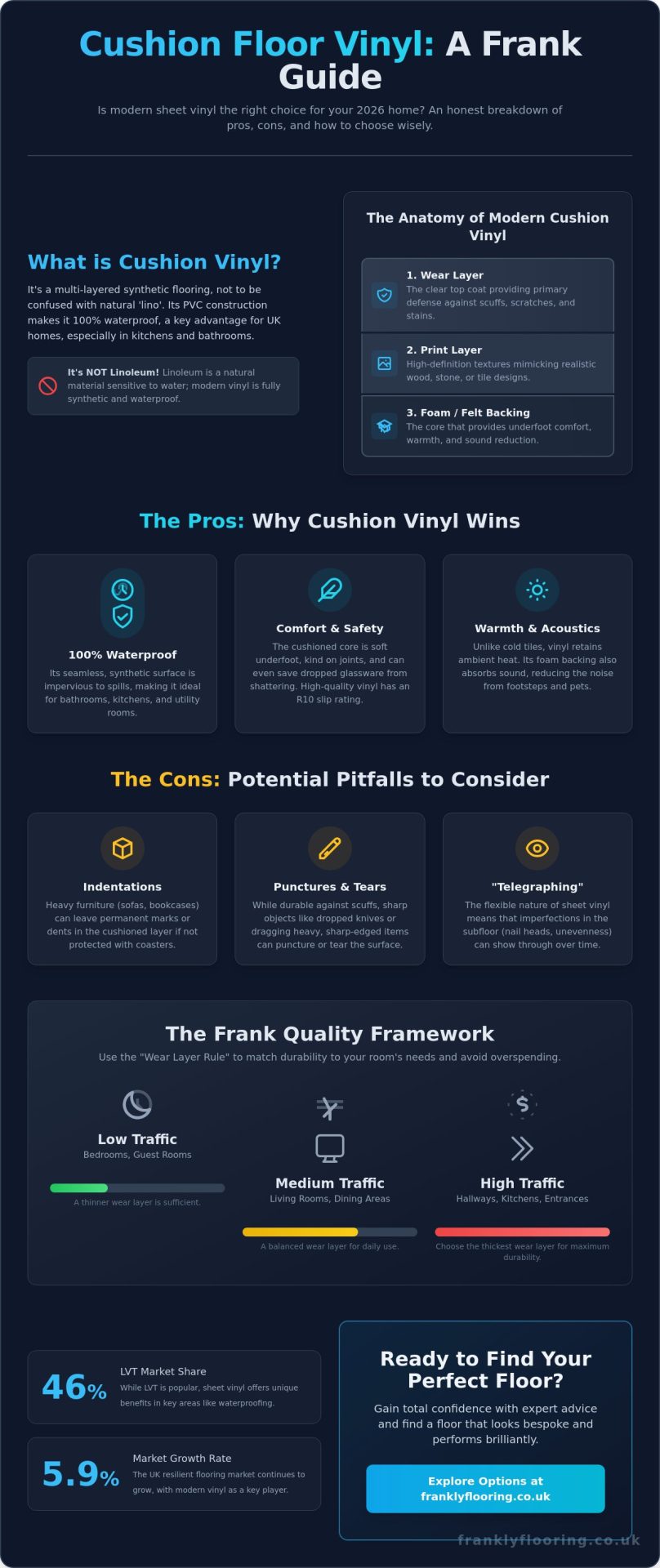
Cushion floor vinyl is a resilient, multi-layered sheet flooring designed specifically for underfoot comfort and 100% moisture resistance. While many people still call it “lino,” that’s technically incorrect. True linoleum is a natural material made from linseed oil and cork dust, whereas modern Sheet vinyl flooring is a sophisticated synthetic product. This distinction is vital for UK homeowners because synthetic PVC is naturally impervious to water, making it a far safer bet for kitchens and bathrooms where spills are a daily reality. Unlike linoleum, which can be sensitive to standing water, modern vinyl won’t rot or swell if your bath overflows.
By May 2026, digital printing technology has advanced to the point where the “plastic” look of the 1990s is a thing of the past. You can now find realistic wood grains and stone textures that are almost indistinguishable from the real thing at a glance. When weighing up cushion floor vinyl pros and cons, it’s clear that the main draw is this blend of high-end aesthetics and practical, cushioned performance. It offers a bespoke look without the high-maintenance requirements of natural materials.
The Anatomy of a Modern Cushion Floor
To understand why this material performs the way it does, you have to look at the three layers that make it up. First, the wear layer is your primary defence against scuffs and scratches; it’s the clear top coating that keeps the floor looking new. Below that sits the print layer, which uses high-definition textures to mimic materials like oak or marble. Finally, the foam or felt backing provides the secret to warmth and sound reduction. This core is what gives the floor its “give,” making it much softer on your joints than ceramic tiles or laminate.
Sheet Vinyl vs LVT: A Frank Comparison
While Luxury Vinyl Tile (LVT) is incredibly popular, sheet vinyl offers a distinct advantage in wet areas. Because it comes in large rolls, you’ll have far fewer seams than you would with individual LVT planks. Fewer joins mean fewer places for water to seep through to your subfloor. Fitting is also more straightforward for a confident DIYer, whereas What Is LVT Flooring? usually requires a professional touch to handle the intricate subfloor preparation. We’ll explore more cushion floor vinyl pros and cons later, but for sheer moisture protection, sheet vinyl remains a heavyweight contender in the UK market.
The Pros: Why Cushion Vinyl Still Wins in Modern UK Homes
When you weigh up the cushion floor vinyl pros and cons, the immediate benefit you’ll notice is the physical comfort. Unlike laminate or stone, which can feel unforgiving underfoot, cushion vinyl is engineered with a foam or felt core that provides a gentle “give.” This isn’t just about a luxury feel; it’s a practical safety net. If you drop a glass on a ceramic tile, it’s guaranteed to shatter, but the padded nature of sheet vinyl often saves your glassware and, more importantly, is much kinder to the joints of elderly residents or toddlers finding their feet.
Thermal insulation is another area where this material excels, particularly on cold British mornings. Ceramic tiles and natural stone act as heat sinks, drawing warmth away from the room and making barefoot trips to the kitchen a chilly experience. Vinyl has a much lower thermal conductivity, meaning it retains a comfortable ambient temperature. When combined with the acoustic benefits of the cushioned backing, which significantly dulls the “click-clack” of pet claws and high heels, it becomes clear why the UK resilient flooring market is seeing a 5.93% growth rate in 2026.
Safety and Hygiene: Beyond the Surface
Safety in wet rooms is a non-negotiable factor for most homeowners. Most high-quality sheet vinyl comes with an R10 or R11 slip rating, indicating the level of grip the surface provides when wet. This makes it an ideal choice for bathrooms and utility rooms where spills are frequent. From a hygiene perspective, the top layer is completely impervious. Unlike floor tiles that require you to scrub discoloured grout lines, a simple mop with a neutral cleaner is enough to keep vinyl pristine. This seamless surface leaves no room for bacteria or allergens to hide, a standard supported by the Resilient Floor Covering Institute (RFCI) for healthy home environments.
Budget-Friendly Style
You don’t need a massive budget to achieve a high-end look. Modern printing allows you to enjoy the aesthetic of Victorian tiles or intricate herringbone wood for a fraction of the cost of the real materials. While budget options start from £7 per m², investing in a standard or luxury sheet vinyl between £15 and £30 per m² ensures a thicker wear layer and better print quality. If you’re looking for a cost-effective way to refresh your space, you can browse our latest vinyl collections to find a style that fits your vision. When fitted correctly on a level subfloor, a quality cushion floor can easily provide 10 to 15 years of reliable service, making it a sound long-term investment for any busy household.
The Cons: Addressing Indentations, Punctures, and “Telegraphing”
Honesty is at the heart of our business, so we won’t pretend that cushion vinyl is indestructible. While the padded core offers the comfort we discussed earlier, that same softness introduces specific vulnerabilities. When evaluating vinyl flooring pros and cons, it’s clear that the material’s “compression memory” is its most significant drawback. Unlike rigid wood or stone, the foam layers can struggle to bounce back after being squashed by heavy objects, leading to permanent dips in your floor.
Puncture risks are another reality for busy UK households. While the wear layer protects against surface scuffs, it isn’t a suit of armour. Sharp objects like dropped kitchen knives or the concentrated pressure of stiletto heels can pierce the surface. Once the top layer is breached, moisture can get into the foam core, causing it to bubble or peel. Because this is a sheet material, you don’t have the luxury of replacing a single plank like you would with LVT; a significant tear often means the entire room needs a new fitting.
The Truth About Furniture Marks
If you plan on placing a heavy sideboard or dining table on your new floor, you need a strategy. We always advise using wide-base protectors or dedicated furniture cups to distribute weight more evenly. The quality of the “rebound” depends heavily on the backing material. Cheaper felt backings often flatten permanently under pressure, whereas high-density foam cores are designed to recover their shape once the weight is removed. Understanding these cushion floor vinyl pros and cons helps you decide if a room with heavy, static furniture is the right place for a softer floor.
Preventing Subfloor “Shadows”
One of the most common complaints with sheet vinyl is “telegraphing.” This is when every tiny lump, bump, or screw head in your subfloor eventually shows through to the surface like a shadow. Because vinyl is flexible, it settles into every imperfection over time. To avoid this, a perfectly smooth subfloor is non-negotiable. This usually requires a fresh layer of 6mm plywood or a high-quality smoothing compound. Most “failures” in cushion vinyl are actually failures in subfloor preparation, not the material itself. Taking the time to get the base right is the difference between a floor that looks bespoke and one that looks like a DIY disaster. If you’re unsure about your subfloor’s condition, we recommend a professional assessment before you commit to a purchase.
How to Choose: The Frank Quality Framework
Choosing the right material involves looking past the pattern and into the technical specifications. When you compare cushion floor vinyl pros and cons, the data sheet tells the real story of how long your floor will actually last. The most critical factor is the wear layer, not the total thickness. A common mistake is buying a 4mm thick vinyl assuming it’s “heavy duty” because it feels chunky. If that floor only has a 0.15mm wear layer, the design will scuff just as easily as a budget roll. For a bedroom or guest room with light footfall, a 0.2mm wear layer is perfectly adequate. However, for high-traffic areas like halls or kitchens, we recommend a minimum of 0.35mm to ensure your investment doesn’t look worn out within a few years.
The backing material also dictates long-term performance. Foam backings offer that classic “bounce” and superior sound insulation, but they are more susceptible to the furniture indentations we discussed in the previous section. Felt backing is often a superior choice for UK homes because it’s more resistant to moisture and can slightly mask minor subfloor imperfections. Regardless of the backing, check the slip resistance rating. An R10 rating is the standard requirement for domestic kitchens and bathrooms, providing enough grip to prevent accidents on a damp surface. If you’re fitting a dedicated wet room or a high-spill utility area, look for R11 or higher for maximum safety.
Room-by-Room Suitability Guide
- Bathrooms: Prioritise a waterproof felt backing and at least an R10 slip rating. Since you’re often barefoot here, the thermal warmth of vinyl is a massive upgrade over cold ceramic tiles.
- Kitchens: Focus on a wear layer of 0.35mm or higher. This protection is vital for resisting the scrapes of dining chairs being pulled out or the occasional movement of heavy appliances.
- Living Areas: This is where you balance comfort with furniture weight. Choose a high-density foam for the best underfoot feel, but ensure you use wide protectors under your sofa legs to prevent permanent dips.
Design Trends for 2026
Modern aesthetics have moved far beyond simple wood effects. In 2026, we’re seeing a massive rise in “Maximalist” patterns, including bold geometric tiles and vibrant Mediterranean-inspired prints that can transform a small utility room into a feature space. For those who prefer a traditional look, “In-Register Embossing” (EIR) is a total game-changer. This process aligns the physical texture of the vinyl with the printed grain of the wood, making it feel remarkably realistic under your fingertips. If you decide that you need something even more robust than sheet vinyl for your living room, you might want to explore the benefits of Laminate Flooring UK for a more rigid alternative. To see how these textures look in a real home setting, you can view our full vinyl range here and find the perfect match for your project.
Buying and Fitting: Getting the Most Value
Measuring up correctly is the first step to ensuring the cushion floor vinyl pros and cons lean in your favour. If you measure too tight, you’ll end up with an awkward seam in the middle of your kitchen or a gap at the skirting board. We always suggest measuring the maximum length and width of the room, then adding 10cm to each dimension for cutting in. Remember that most sheet vinyl in the UK comes in fixed widths of 2m, 3m, or 4m. Choosing the width closest to your room size reduces waste and keeps the job seamless, which is vital for maintaining that 100% waterproof promise we discussed earlier.
When it comes to the actual fitting, you’ll need to decide between a loose lay or a full bond. For smaller spaces like a cloakroom or a tiny bathroom, usually under 12m², you can often get away with a “loose lay” fitting using double-sided vinyl tape around the perimeter. However, for larger areas or rooms with heavy traffic, a full spread of adhesive is essential. Glueing the entire sheet prevents the vinyl from “creeping” or rippling over time as you move furniture or walk across it. It’s a bit more work, but it’s the only way to ensure the floor stays flat for its 10 to 15 year lifespan.
A floor only looks as good as its edges. Use a quality door bar to transition between rooms and, in bathrooms, apply a neat bead of silicone around the perimeter. This prevents water from getting under the sheet, which is the most common cause of subfloor rot. Once the floor is down, be careful with your choice of rugs. A chemical reaction between rubber-backed mats and the vinyl can cause permanent yellowing within 6 to 12 months. Stick to rugs with natural hessian or felt backings to keep your floor looking fresh.
The Frankly Flooring Difference
We don’t believe in high-pressure sales. With 20 years of experience in the British flooring industry, we’ve seen every trend come and go. Our role is to provide honest, straightforward advice, even if that means telling you that cushion vinyl isn’t the right fit for your specific project. Because we ship direct to your door, you aren’t paying for the overheads of a fancy showroom, which means more of your budget goes into the quality of the material itself. We handle the process with the care of a family-run business, ensuring you get the right spec for your home.
Final Verdict: Is it Right for You?
Cushion vinyl remains a top-tier choice for those prioritising warmth, underfoot comfort, and waterproof peace of mind without the higher material costs of LVT. While you need to be mindful of furniture marks and sharp objects, the modern textures and high-definition prints available in 2026 make it a beautiful, practical addition to any home. It’s a specialized solution that, when fitted on a smooth subfloor, offers unbeatable value. Ready to start your project? You can Browse our full range of quality Vinyl Flooring and find a style that works for you.
Ready to Transform Your Space?
Choosing a new floor shouldn’t feel like a gamble. By weighing up the cushion floor vinyl pros and cons, you’ve taken the most important step toward a successful renovation. You now understand that while modern sheet vinyl offers unbeatable moisture resistance and thermal warmth, its longevity depends entirely on proper subfloor preparation and choosing the right wear layer for your room’s traffic. It’s a specialized solution that provides a bespoke look without the high-pressure sales tactics often found in larger retailers. We believe that when you have the facts, you can make a decision that works for your lifestyle and your budget.
At Frankly Flooring, we draw on over 20 years of family-run expertise to help you find the perfect match. We offer honest, no-nonsense advice on every product and provide direct UK delivery on all vinyl and accessories to keep your project moving. We’ll always tell you frankly if a material isn’t suitable for your specific room, because we value your long-term satisfaction over a quick win. If you’re ready to see how modern textures can elevate your home, Explore our Frank range of Cushion Floor Vinyl and start your journey with confidence. Your home is your sanctuary; let’s make sure it has the foundation it deserves.
Frequently Asked Questions
Is cushion floor vinyl the same as lino?
No, they are entirely different materials despite the names often being used interchangeably. Modern vinyl is a synthetic PVC product designed for 100% moisture resistance and flexibility. True linoleum is made from natural ingredients like linseed oil and wood flour. For most UK bathrooms, vinyl is the superior choice because it won’t rot or swell if it gets soaked during a bath time overflow.
Can I put heavy furniture on cushion vinyl?
You can, but you must use wide-base furniture protectors to prevent permanent dents. Because of the “compression memory” in the foam core, heavy wardrobes or sofas can leave lasting dips in the surface. If you’re weighing up cushion floor vinyl pros and cons for a dining room, high-density backings offer better recovery than cheaper, softer alternatives that might flatten permanently under weight.
Does cushion vinyl need underlay?
No, separate underlay is not required for sheet vinyl. The material features an integrated foam or felt “cushion” layer that provides the necessary underfoot give and acoustic insulation. Instead of underlay, focus your budget on subfloor preparation. A layer of 6mm plywood or a fresh smoothing compound is vital to prevent lumps and bumps from showing through the surface over time.
Is cushion vinyl suitable for underfloor heating?
Yes, most modern vinyl is compatible with underfloor heating systems, typically up to a limit of 27°C. It is an efficient conductor of heat, which helps the room warm up quickly on cold British mornings. Always check the specific manufacturer’s data sheet before fitting, as excessive heat can cause the adhesive to fail or the vinyl to discolour over a long period.
How long does cushion vinyl flooring last?
A well-chosen floor typically lasts between 10 and 15 years in a standard domestic setting. This lifespan depends heavily on the wear layer thickness you select during the buying process. While a 0.2mm layer is fine for a guest bedroom, you’ll need at least 0.35mm for a busy kitchen to ensure the pattern doesn’t wear away under heavy daily foot traffic.
Can I lay new cushion vinyl over my old floor?
We strongly advise against laying new vinyl over old flooring. Even if the old surface looks flat, imperfections like grout lines or previous dents will eventually “telegraph” through to your new sheet. For a professional finish that lasts, always strip back to the subfloor and ensure it’s perfectly level. This extra effort prevents the “shadowing” effect that ruins the look of a new floor.
Is cushion vinyl slippery when wet?
It can be, but choosing the right slip rating minimizes the risk. Most domestic vinyls carry an R10 rating, which provides adequate grip for kitchens and bathrooms. If you’re particularly concerned about safety in a dedicated wet room, look for an R11 rating. This indicates a higher level of surface friction that remains effective even when the floor is damp or soapy.
How do I clean cushion vinyl without damaging it?
Use a simple solution of warm water and a neutral, non-abrasive floor cleaner for the best results. Avoid steam mops, as the intense heat can break down the adhesive and damage the cushioned core. A well-wrung damp mop is all you need for weekly maintenance. Never use scouring pads or harsh bleach, as these can scratch the protective wear layer and dull the finish.