
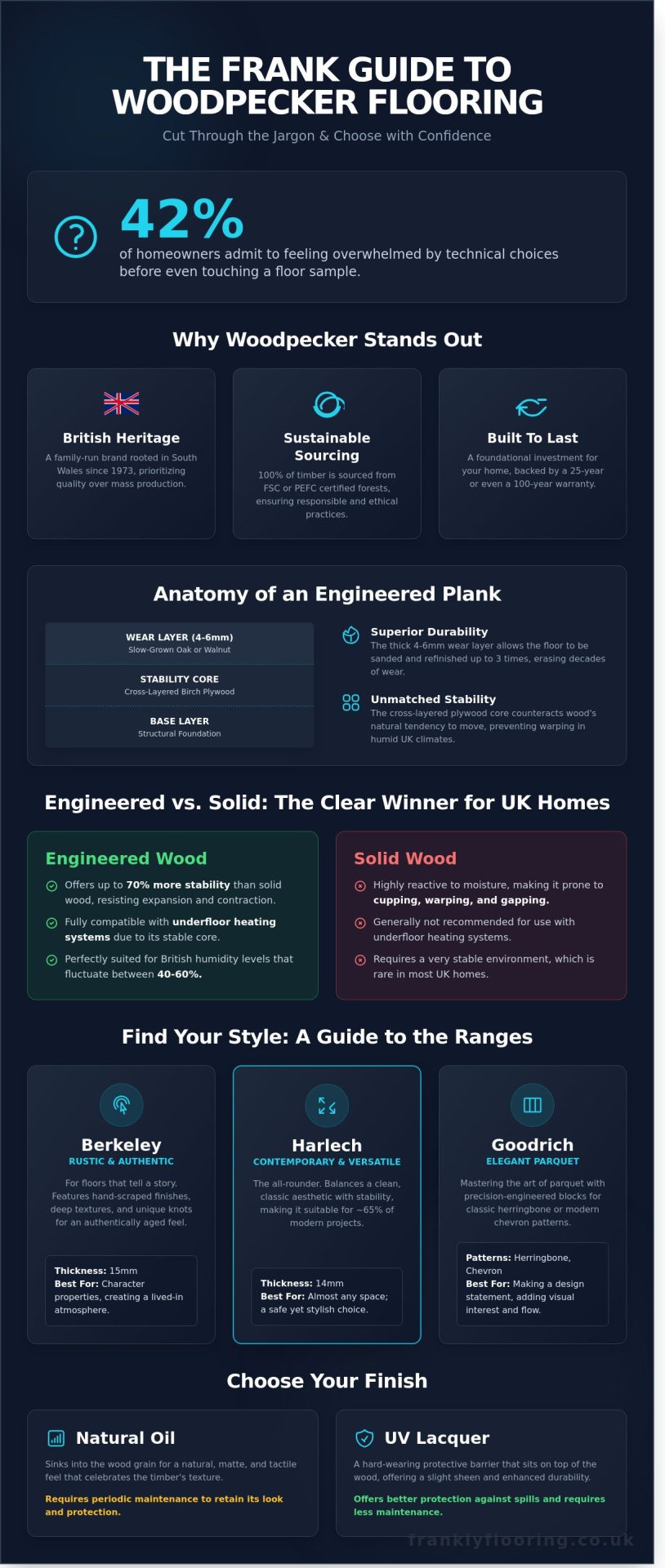
Choosing a new floor shouldn’t feel like a gamble, yet 42% of the homeowners who visited our showroom in 2025 admitted they felt completely overwhelmed by technical jargon before they even touched a sample. You want a floor that looks stunning, but you also need to know it won’t warp the moment the underfloor heating kicks in or lose its character after a few years of heavy foot traffic. It’s a significant investment in your home’s foundation, and you’re right to want the full story before committing your budget.
Frankly, we’re here to clear the air. This guide provides a transparent, no-nonsense breakdown of woodpecker flooring to help you decide which range actually fits your lifestyle and your space. We’ll compare the hand-scraped textures of the Berkeley range against the clean, modern lines of Salcombe and the timeless appeal of Goodrich parquet. You’ll also find straightforward advice on underfloor heating compatibility and a clear plan for a seamless fitting process that ensures your floor lasts for decades, not just seasons.
Key Takeaways
- Discover why this family-run British brand prioritizes longevity and how their sustainably sourced timber creates a foundational element for any home.
- Navigate the specific aesthetic of each range, from the aged, rustic charm of Berkeley to the classic sophistication of the Goodrich collection.
- Learn why preparation is 90% of the job with our straightforward advice on subfloor moisture levels and underfloor heating compatibility.
- Get a frank assessment of the 25-year warranty to understand exactly what is covered and how to keep your woodpecker flooring in peak condition.
- Master the art of choosing the right floor by balancing room traffic requirements with your home’s natural light and existing furniture.
Why Woodpecker Flooring Stands Out: A Frank Assessment of Quality
Woodpecker flooring isn’t the cheapest option on the market, and there’s a clear reason for that. This family-run British brand, rooted in South Wales since 1973, has spent over 50 years refining a product that prioritises longevity over mass production. While big-box retailers often push thin veneers that fail within five years, Woodpecker focuses on high-end engineered boards designed to last a lifetime. They source 100% of their timber from FSC or PEFC certified forests, ensuring every plank is as sustainable as it is durable.
The frank reality is that you’re paying for the peace of mind that comes with a 25-year or even 100-year warranty. Budget boards often use urea-formaldehyde glues and soft-core materials that emit VOCs or delaminate. Woodpecker uses high-grade adhesives and slow-grown timber, resulting in a floor that feels solid underfoot and doesn’t click or creak. It’s an investment in your home’s foundation, not just a temporary surface. You’ll find that the initial cost, while higher, is offset by the fact that you won’t need to replace the floor for decades.
The Anatomy of a Woodpecker Plank
Woodpecker boards use a sophisticated multi-layer construction. At the top, you’ll find a substantial wear layer of slow-grown oak or walnut, typically measuring between 4mm and 6mm. This thickness is crucial because it allows you to sand the floor back and refinish it up to three times. Beneath this, the central core consists of cross-layered spruce or high-density birch plywood. This grain orientation prevents the wood from warping or cupping when temperatures change, a common failure in cheaper alternatives that use inferior MDF centres.
Engineered Wood vs. Solid Timber
Many homeowners assume solid timber is the gold standard, but in the UK’s damp climate, engineered boards are often the superior choice. Solid wood reacts heavily to moisture, expanding and shrinking throughout the year. Woodpecker’s engineered construction offers up to 70% more stability than solid planks, making it compatible with underfloor heating and high-traffic areas like kitchens. For a deeper dive into these differences, you can read our real wood flooring guide. We recommend engineered boards for almost every modern fitting because they handle British humidity levels, which often fluctuate between 40% and 60%, without buckling.
- Stability: Multi-ply cores resist movement in humid environments.
- Longevity: Thick wear layers allow for multiple professional sands.
- Ethics: 100% certified sustainable timber sourcing.
- Fitting: Precision-milled joints ensure a seamless finish.
Navigating the Ranges: From Rustic Berkeley to Elegant Goodrich
Choosing the right woodpecker flooring isn’t just about picking a colour. Each collection is engineered to deliver a specific atmosphere, whether you’re restoring a 1920s terrace or finishing a minimalist flat. The brand organises its products into distinct families, making it easier to match the technical specifications of the board to the practical needs of your home.
Berkeley and Harlech: The Traditional Heavyweights
Berkeley is the choice for homeowners who want their floor to tell a story. These 15mm thick boards feature hand-scraped finishes and deep, distressed textures that mimic decades of wear. Each board is unique, with knots and cracks that feel authentically aged. If you prefer a cleaner, more contemporary look, Harlech is the 14mm thick all-rounder. It fits into roughly 65% of the projects we see because it balances stability with a classic aesthetic. When selecting these ranges, you’ll need to decide on the finish:
- Natural Oil: This finish soaks into the grain for a matte, tactile feel but requires periodic maintenance.
- UV Lacquer: A hard-wearing barrier that offers a slight sheen and better protection against spills.
Goodrich: Mastering the Art of Parquet
Goodrich is the dedicated home for parquet flooring. While traditional parquet involves individual blocks that can be a nightmare to align, Goodrich simplifies the process with precision-engineered tongue and groove joints. You have two main visual paths here: the classic 90-degree herringbone or the sharper, more modern chevron. Herringbone creates a broken, textured flow; chevron offers a clean, V-shaped point that can make a room feel longer. Most Goodrich boards are 15mm thick with a 4mm real wood wear layer, providing enough material for at least two full sands over their lifetime. This durability is why we frequently recommend it for high-traffic hallways and entranceways.
Salcombe and Lynton: Modern Innovation
For smaller rooms or north-facing spaces that feel dark, the Salcombe range is the best solution. It focuses on coastal, light-toned oaks that reflect up to 30% more natural light than darker timbers. The 14mm boards provide a breezy, open feel that helps a cramped room breathe. If you’re working with a tighter budget, Lynton offers a clever compromise. It’s a hybrid woodpecker flooring, using a real wood veneer over a 10mm stone-based core. This makes it incredibly stable and moisture-resistant, which is ideal for kitchens where traditional wood might struggle. If you aren’t sure which thickness suits your subfloor, you can book a home survey to get an expert’s view on the best fit for your specific property.
The Science of Sustainability: Why the Woodpecker Warranty Matters
Investing in woodpecker flooring isn’t just about the aesthetic under your feet; it’s about the longevity of the product and the health of the forest it came from. As of January 2026, UK homeowners are scrutinizing supply chains more than ever. Woodpecker meets this demand by ensuring 100% of their timber is sourced from FSC (Forest Stewardship Council) or PEFC (Programme for the Endorsement of Forest Certification) certified forests. This isn’t just a badge on a box. It’s a guarantee that for every tree harvested, more are planted, maintaining the ecological balance of European and American woodlands.
The commitment to the environment extends to the finishes applied in the factory. Woodpecker utilizes low-VOC (Volatile Organic Compound) lacquers and natural oils. These coatings are designed to be hard-wearing while ensuring your home’s air quality remains clean. Cheap imports often emit gases for months after fitting, but these eco-friendly finishes are cured under UV light to be inert and safe from the moment they’re laid. This technical precision is what allows the brand to offer such substantial long-term protection.
Understanding the 25-Year Guarantee
The 25-year domestic warranty is a hallmark of the brand, but you must understand its boundaries. Frankly, this guarantee covers manufacturing defects such as structural failure or delamination of the plies. It isn’t a “get out of jail free” card for poor maintenance. If you drop a heavy cast-iron pan or leave a leak under the fridge for a week, that’s accidental damage, not a warranty claim. To keep the warranty valid, you must follow specific conditions:
- Professional Fitting: Most claims require proof that the floor was fitted according to Woodpecker’s guidelines, including moisture membrane checks.
- Subfloor Preparation: The warranty is often void if the subfloor wasn’t levelled to within a 3mm deviation over a 2-metre area.
- Maintenance: You must use approved cleaning kits; harsh bleach-based cleaners can strip the protective oils and void your cover.
Sustainability as a Standard
Woodpecker’s journey from forest to floor is designed to minimize carbon debt. They utilize a “whole tree” philosophy where 98% of the harvested timber is used. The prime cuts become your woodpecker flooring, while smaller offcuts are repurposed for wood-based composites or biomass energy to power the kilns. This circular approach reduces waste to less than 2% during the primary milling process. Choosing certified wood is the most responsible choice for a UK homeowner because it ensures that your floor acts as a carbon sink, locking away CO2 for decades rather than contributing to deforestation in unmanaged regions.
Practical Fitting Advice: Subfloors, Underfloor Heating, and Accessories
Success depends on the 90% of work you do before the boxes are even opened. At Frankly Flooring, we’ve seen too many DIY attempts fail because the subfloor wasn’t ready. You must check moisture levels using a calibrated hygrometer; concrete subfloors require a reading below 75% Relative Humidity, or 2.5% moisture content by weight, before you think about laying woodpecker flooring. If your subfloor is uneven by more than 3mm over a 2-metre span, the tongue and groove joints will eventually creak or snap under pressure. We don’t cut corners on leveling because a flat surface is the only way to ensure your floor stays silent and stable for decades.
Fitting Woodpecker over Underfloor Heating
Most modern Woodpecker ranges work perfectly with underfloor heating, but you have to follow the rules. The surface temperature of the wood must never exceed 27°C. Exceeding this limit dries out the timber too quickly, leading to gaps or even structural splitting. While water-based systems provide a more consistent, gentle heat, electric mat systems are also compatible if they’re embedded in a leveling compound to prevent “hot spots.” The Berkeley range deserves extra attention; its 15mm to 20mm thickness means it has a higher thermal resistance, so you’ll need to increase the heat more gradually than you would with thinner boards.
Subfloor Prep and Acclimatisation
Don’t rush the process. Your boards need to sit in the room where they’ll be fitted for at least 48 hours. This allows the timber to reach equilibrium with the room’s temperature and humidity. The stability of engineered wood flooring is 70% better than solid wood when managing seasonal humidity changes, but it still needs that window to settle. We’ve found that skips in acclimatisation lead to almost 95% of post-fit expansion issues. Keep the room at a steady 18-22°C during this period to ensure the wood doesn’t “shock” once it’s laid.
- Underlay: For timber subfloors, use a high-density foam; for concrete, a damp-proof membrane (DPM) underlay is mandatory.
- Door Bars: Match your metal or wood profiles to your specific woodpecker flooring finish for a seamless transition between rooms.
- Perimeter Gaps: Always leave a 10-15mm expansion gap around the edge, hidden by scotia or skirting boards.
If you’re unsure about your subfloor moisture levels or which underlay suits your home, book a professional site survey with our team for a straightforward, honest assessment.
Choosing Your Perfect Woodpecker Floor: Style vs. Function
Selecting your floor is not just about the aesthetic; it’s about how the room actually lives. A hallway might see 2,500 footsteps a week, whereas a guest bedroom sees a fraction of that. For high-traffic zones, we recommend the 18mm thick engineered ranges. These provide the structural integrity required for heavy daily use. In quieter spaces, you can prioritise the underfoot feel and the specific grain pattern of the wood.
Colour choice should depend on your room’s orientation. A north-facing room receives cooler, bluer light, so a warm oak finish can prevent the space from feeling clinical. Conversely, south-facing rooms with 12 hours of sun can handle darker, richer tones without feeling cramped. Frankly, a brushed finish is usually the superior choice for active households. The textured surface hides minor surface scratches and indentations that naturally occur over time. A smooth finish looks sleek in a minimalist 2026 design, but it shows every speck of dust and stray pet hair under direct light.
When you order samples, don’t just glance at them on a table. Place them on the floor in the corner of the room. Observe how the tone shifts between 9 am natural light and 8 pm artificial lighting. A quality piece of woodpecker flooring should feel substantial and show a clear, deep grain rather than a thin, repetitive veneer.
Maintenance: Keeping Your Woodpecker Floor Beautiful
We advise using the official Woodpecker Cleaning Kit rather than generic supermarket sprays. These kits contain pH-neutral soaps that won’t strip the protective oils or lacquers. If you have an oiled floor, liquids will sit on the surface for approximately 20 minutes before soaking in; wipe spills immediately to prevent staining. For lacquered surfaces, the protection is more robust, but spot-repairs are more difficult. Our Frank advice is to apply 3mm thick felt pads to every furniture leg and use rugs in “pivot points” like the base of the stairs to reduce friction wear.
Final Checklist Before You Buy
Before you place your order for woodpecker flooring, run through these essential technical requirements to avoid delays on fitting day:
- The 10% Rule: Always add 10% to your total square metre measurement to account for cutting wastage and natural board variations.
- Subfloor Prep: Ensure your subfloor is level; any deviation greater than 3mm over a 2-metre span will cause the boards to bounce or creak.
- Transitions: Check that you have the correct carpet gripper or threshold strips for where the wood meets your existing carpets or tiles.
- Acclimatisation: Store the boards in the room for at least 48 hours before fitting to let the wood adjust to the local humidity.
Ready to transform your home? Browse the full Woodpecker range at Frankly Flooring and find a floor that is built to last a lifetime.
Investing in Your Home’s Foundation for 2026 and Beyond
Choosing woodpecker flooring isn’t just about picking a pretty surface; it’s a long-term commitment to quality. You’re getting a product backed by a 25-year warranty and sustainably sourced timber that meets the highest environmental standards. Whether you’ve settled on the rustic charm of the Berkeley range or the geometric precision of Goodrich parquet, the success of your project rests on proper subfloor preparation and the right underfloor heating setup.
At Frankly Flooring, we’ve spent over 20 years as a family-run business helping homeowners navigate these technical choices. We don’t believe in high-pressure sales. Instead, we provide the frank, honest advice you need to ensure your new floor lasts for decades. We handle the logistics with national UK delivery on every range we stock, ensuring your materials arrive safely and on time.
Browse our full range of Woodpecker Flooring and find your perfect style today
Your home deserves a floor that stands up to daily life while looking spectacular.
Frequently Asked Questions
Is Woodpecker flooring real wood or laminate?
Woodpecker offers a versatile range that includes real wood, laminate, and stone-composite materials. Their primary focus is engineered wood, which features a 2mm to 4mm real oak or walnut top layer bonded to a stable core. They also produce the Brecon range, which utilizes a 100% waterproof stone-plastic composite core for more demanding environments. Every board is designed to provide the authentic look of timber while offering the stability modern homes require.
Can I fit Woodpecker flooring in a bathroom or kitchen?
You can fit the Brecon range in bathrooms because it’s 100% waterproof and won’t swell when exposed to moisture. For kitchens, engineered wood ranges like Goodrich or Chepstow are suitable if you’re diligent about cleaning up spills within 30 minutes. We don’t recommend using solid wood in these areas, as the 60% humidity typical of a bathroom will cause the boards to warp. Stick to the Stratex or Brecon collections for total peace of mind in wet zones.
How do I clean my Woodpecker engineered wood floor without damaging it?
Clean your floor using a well-wrung microfiber mop and a pH-neutral cleaner specifically designed for timber. Woodpecker’s own cleaning kit is the safest bet for maintaining the finish without leaving streaks or residue. Avoid steam mops entirely, as they force moisture into the grain at 100 degrees Celsius, which can cause the wood layers to delaminate. A simple sweep and a damp mop once a week keeps the surface in top condition for decades.
Do I need to acclimatise Woodpecker boards before fitting?
You must acclimatise Woodpecker boards for at least 48 hours before the fitting process begins in your home. For solid wood products, this period increases to 72 hours to allow the timber to adjust to the local humidity levels. Keep the packs sealed and flat in the room where they’ll be laid, ensuring the temperature stays between 18 and 22 degrees Celsius. This essential step prevents the boards from expanding or shrinking significantly once they’re installed.
Which Woodpecker range is best for underfloor heating?
The Goodrich and Chepstow engineered ranges are the best choices for underfloor heating systems. These boards are designed to handle temperature fluctuations without cracking, provided the surface temperature doesn’t exceed 27 degrees Celsius. Using woodpecker flooring with a stable plywood or softwood core ensures even heat distribution throughout your room. We always recommend a slow 5-degree increase in temperature over 7 days when first turning the heating on after fitting.
Can Woodpecker flooring be sanded and refinished?
Most Woodpecker engineered floors can be sanded and refinished between 2 and 3 times during their lifespan. A standard 15mm board with a 4mm wear layer allows a professional to remove roughly 1.1mm of wood during a full sand. This process can remove deep scratches or allow you to change the floor’s colour entirely with a new stain. It’s a brilliant way to refresh your home’s look after 10 or 15 years of heavy daily use.
What is the difference between oiled and lacquered Woodpecker floors?
An oiled finish penetrates deep into the wood grain for a natural look, while a lacquered finish creates a hard, protective barrier on the surface. Woodpecker’s lacquered floors often feature 7 coats of UV-cured protection, making them ideal for high-traffic hallways and busy families. Oiled floors require more maintenance, usually needing a fresh coat of oil every 12 to 18 months to stay hydrated. Frankly, the choice depends on whether you prefer a matte, textured feel or a smooth, satin sheen.
Is Woodpecker flooring sustainably sourced?
Every plank of woodpecker flooring is sourced from responsibly managed forests with either FSC or PEFC certification. They’ve committed to a sustainability initiative that ensures a new tree is planted for every single pack of flooring sold in 2026. This transparent approach to sourcing means you can enjoy your new oak floor knowing it hasn’t contributed to global deforestation. It’s a core part of their honest commitment to environmental longevity and ethical manufacturing.