
Imagine it’s a Saturday morning in April 2026, and a glass of blackcurrant squash has just met your brand-new lounge floor. For many UK homeowners, this feels like a £1,200 mistake waiting to happen, but it really shouldn’t be that way. Frankly, finding the right stain resistant carpet for families shouldn’t feel like a high-stakes gamble with your household budget. We understand the frustration of watching a “luxury” pile turn shabby and matted within six months just because it wasn’t built for the reality of kids and pets.
You probably feel that you have to choose between a home that looks sophisticated and one that can actually handle muddy paws or spilled juice. It’s a common worry, but we’re here to show you that you can have both. This guide will help you understand technical terms like polypropylene and twist pile without the usual sales fluff, ensuring you find a floor that survives the chaos while staying soft underfoot. We’ll break down which fibres suit your specific budget and explain how a solid warranty provides the peace of mind you need before the fitting starts.
Key Takeaways
- Understand the crucial difference between built-in fibre protection and after-market treatments to ensure your flooring survives the rigours of a modern UK home.
- Compare polypropylene and polyester to identify the ideal stain resistant carpet for families that offers both bleach-cleanable durability and a soft feel underfoot.
- Learn how specific pile types, like the versatile twist pile, can effectively hide vacuum tracks and footprints in high-traffic family areas.
- Discover why investing in a quality underlay is a non-negotiable step for protecting your carpet’s lifespan and maintaining its appearance against daily wear.
- Find out how to use home samples to conduct your own “spill tests,” ensuring your chosen flooring is truly life-proof before you book a fitting.
What Does Stain Resistant Carpet Actually Mean for a Busy UK Home?
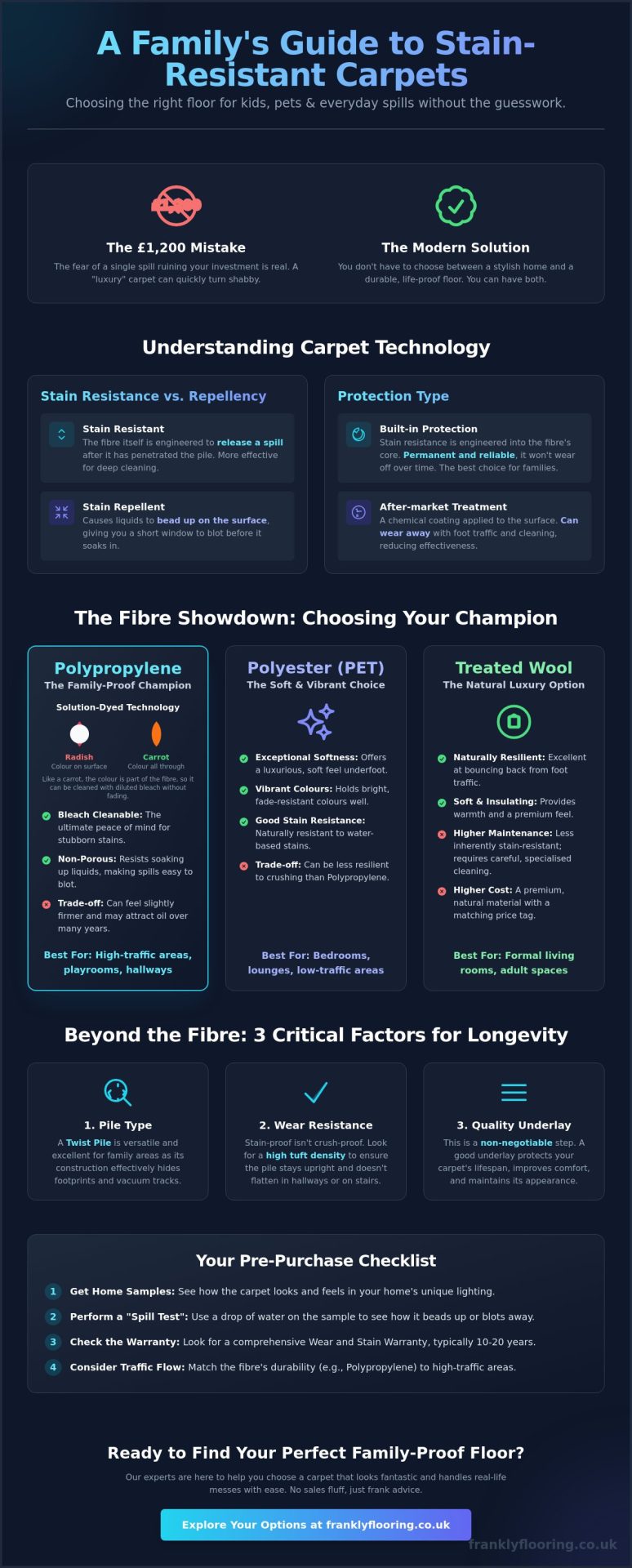
Frankly, the term “stain resistant” is often used as a catch-all phrase in showrooms, but it’s important to understand what you’re actually buying. In 2026, the technology behind a stain resistant carpet for families has moved far beyond simple spray-on coatings. Resistance now usually comes from the way the fibre is engineered. Some carpets use after-market chemical treatments that sit on the surface, while others have protective properties built directly into the material itself. The latter is much more reliable for a home with children, heavy foot traffic, or pets.
You’ll often hear the terms “stain resistant” and “stain repellent” used interchangeably, but they aren’t the same thing. A repellent carpet makes liquids bead up on the surface, giving you a brief window to blot the spill before it sinks in. Resistance refers to the fibre’s ability to release a spill once it has already penetrated the pile. It’s the difference between a quick wipe and a deep clean. Setting realistic expectations is part of our honest approach. While these floors are incredibly resilient, they aren’t invincible. They can handle mud, juice, and the occasional wine spill, but they won’t necessarily survive permanent ink or hot grease if left untreated for days.
The Evolution of Easy-Clean Flooring
Modern manufacturing has finally removed the “plastic” feel that used to plague older synthetic carpets. By 2026, the industry has perfected the use of Carpet Fibers like solution-dyed polypropylene. This process involves adding the colour to the liquid polymer before the yarn is even spun. Because the colour goes all the way through like a carrot rather than a radish, you can often clean these carpets with a diluted bleach solution without fading the pile. This technology has become significantly more affordable over the last five years, making high-end performance accessible for standard family budgets.
Stain Resistance vs. Wear Resistance
It’s a common mistake to assume that a carpet that stays clean will also stay looking new. A carpet might be immune to stains but still “flatten” or “crush” in high-traffic areas like the landing or the bottom of the stairs. When browsing our showroom, look for a high tuft density alongside the stain-free labels. This ensures the pile stays upright while the fibres reject dirt. A standard UK Wear and Stain Warranty is a written guarantee from the manufacturer that the carpet will retain its pile weight and resist permanent staining from most common household food and drink for a specific duration, often ranging from 10 to 20 years.
The Science of Spills: Polypropylene vs. Polyester vs. Treated Wool
Choosing the right stain resistant carpet for families involves looking past the price tag and into the chemistry of the yarn. Not all “life-proof” claims are equal. The material determines whether a spilled glass of blackcurrant squash becomes a five-minute fix or a permanent reminder of a bad afternoon. Most modern homes settle on three main contenders: polypropylene, polyester, or a wool blend. Each has a specific role in a busy household.
Polypropylene is the undisputed heavyweight champion of the family market. It’s a synthetic fibre that is naturally non-porous. This means liquids don’t soak into the fibre itself. Instead, they sit on the surface, waiting to be blotted away. According to this Carpet and Rug Institute guide, the construction of your carpet is just as vital as the material when it comes to long-term performance. For pure cleanability, polypropylene is hard to beat.
Why 100% Polypropylene is the Frank Choice for Kids
We recommend polypropylene for high-traffic areas because it’s usually “solution-dyed.” This means the colour is added while the plastic is still in a molten state. The pigment goes all the way through the fibre like the orange in a carrot, rather than just sitting on the surface like the red on a radish. Because of this, you can use a diluted bleach solution (usually 10% bleach to 90% water) to shift stubborn marks without stripping the colour.
There is a trade-off. Polypropylene can feel slightly firmer or more “plastic-y” than natural fibres. It also has a memory for oil. If you walk on it with bare, greasy feet for years, it can attract a dull film that’s harder to clean than a water-based spill. It’s a practical, no-nonsense choice for playrooms and hallways where durability is the priority.
The Truth About Stain-Resistant Wool Blends
Many homeowners prefer the luxury of natural materials. Wool has a built-in advantage: lanolin. This natural oil acts as a light protective coating. However, lanolin has its limits. It won’t stand up to the harsh chemicals found in modern felt-tip pens or fizzy drinks. This is why 80/20 blends exist. By mixing 80% wool with 20% synthetic fibres like nylon or polypropylene, manufacturers create a floor that feels premium but has extra backbone.
- Wool: Offers superior bounce-back and fire resistance.
- Synthetics: Provide the stain-shielding and lower the overall cost.
- The Reality: You cannot use bleach on wool. It will dissolve the natural proteins and ruin the fitting.
If your children are past the “spill everything” stage, a wool blend is a fantastic investment. If you’re still in the thick of toddler-led chaos, stick to 100% synthetic. While wool is a classic, synthetic options often prove to be the most effective stain resistant carpet for families with young children. If you want to compare the textures and see how they handle a “frank” durability test, visit our local showroom to see the samples in person.
The Polyester Alternative
Polyester sits in the middle. It’s softer than polypropylene and holds vibrant colours beautifully. It’s often made from recycled plastics, which appeals to eco-conscious parents. While it’s very stain-resistant, it isn’t quite as resilient to heavy furniture crushing as wool or high-grade polypropylene. It’s a solid, budget-friendly choice for bedrooms where comfort is more important than heavy foot traffic.
Choosing the Right Pile: Twist, Saxony, or Berber for Kids and Pets?
Selecting the right construction is just as vital as picking the material itself. The way a carpet is built directly dictates how much effort you’ll spend vacuuming on a Sunday morning. A dense, tight construction prevents crumbs and pet hair from sinking deep into the backing. This makes surface cleaning significantly more effective compared to loose, shaggy alternatives. When you’re looking for the best stain resistant carpet for families, the pile type determines whether a spill stays on top or disappears into the depths of the floor.
- Twist Pile: This is the reliable all-rounder. The yarn is twisted tightly to create a textured surface that’s incredibly resilient. It’s the best choice for hiding footprints and those annoying hoover tracks that show up on flatter carpets.
- Saxony Pile: These carpets feature longer, cut piles that feel deep and luxurious. They look magnificent in a master bedroom, but they’re often too delicate for a busy playroom. The longer fibres tend to show “shading” and can trap debris more easily.
- Berber and Loop: These are made from continuous loops of yarn. While they’re famous for durability, pet owners should be cautious. A single snag from a cat or dog claw can pull a thread and create a visible run across the entire room.
High-Traffic Areas: Stairs, Hallways, and Landings
For the parts of your home that see the most “boot traffic,” density is more important than depth. If you can feel the carpet backing when you press your thumb into the pile, it won’t last on your stairs. We recommend a pile height between 6mm and 8mm for these zones to prevent the fibres from “matting” or flattening over time. Choosing a “heathered” or speckled colour is a frank necessity here. These multi-toned designs are masters at disguising the odd bit of lint or dried mud between deep cleans.
Comfort vs. Cleanability in the Living Room
The living room is where you need to find the “Sweet Spot” between a soft feel and practical maintenance. A mid-height twist pile offers enough cushion for kids to play on the floor without becoming a magnet for every dropped biscuit. Pile direction also matters. If the pile is pushed against the grain, it can trap dirt more easily. A shorter, denser stain resistant carpet for families ensures that spills sit on the surface longer, giving you those crucial extra seconds to grab a cloth.
- Playroom: Short Twist (Durable and easy to hoover).
- Main Bedroom: Saxony (Luxury feel with lower foot traffic).
- Hallway & Stairs: Heavy-duty Loop or Dense Twist (High resilience).
- Lounge: Mid-height Twist (Balance of comfort and cleaning).
Beyond the Fibres: The Role of Underlay and Proper Maintenance
Buying the best stain resistant carpet for families is only half the battle. If you put a high-quality carpet over a cheap, thin underlay, you are essentially throwing money away. Think of the underlay as a shock absorber. Every time a child runs down the hall or you move a heavy armchair, the underlay takes the impact. Without that support, the carpet fibres take the full force. This leads to premature crushing and “bald” spots in high-traffic areas within the first 24 months of fitting.
- Fibre Protection: Good underlay prevents the carpet backing from stretching and losing its shape.
- Thermal Insulation: Quality padding can reduce household heat loss by up to 15 percent.
- Soundproofing: High-density options significantly dampen the sound of heavy footsteps on upper floors.
Choosing the Right Underlay for a Family Home
We recommend high-density foam for most busy households. Products like Cloud 9 provide excellent recovery underfoot and won’t crumble over time like traditional rubber crumb. You should realistically budget between £8 and £12 per square metre for a decent 10mm or 11mm underlay. If you have underfloor heating, check the tog rating carefully. You’ll need a low-tog underlay, typically below 1.0, to ensure the heat actually reaches the room. For standard rooms without heating pipes, a tog of 2.5 offers the best balance of warmth and comfort.
The Frank Guide to Emergency Spill Management
Accidents happen. When they do, the “Blot, Don’t Rub” rule is your absolute priority. Rubbing a stain creates friction heat and physically distorts the carpet pile, making the damage permanent even if the colour eventually comes out. Use a clean white cloth or kitchen roll to lift as much liquid as possible. For 100% polypropylene carpets, use a solution of one part domestic bleach to ten parts lukewarm water to tackle stubborn stains.
While DIY spot treatments work for minor mishaps, call a professional if you’ve spilled more than half a glass of liquid. They have the industrial suction power to pull moisture from the underlay before mould starts to grow. Maintenance also includes your weekly hoovering. Use a vacuum with a rotating brush bar for cut pile carpets to lift the dirt, but stick to suction-only for loop piles to prevent the fibres from fraying. A quick sweep isn’t enough. Slow, deliberate passes twice a week will stop grit from acting like sandpaper on your floor’s foundation.
Ready to see the difference quality makes? Book a home visit to find the perfect combination of carpet and underlay for your home.
Finding Your Perfect Family Carpet at Frankly Flooring
Choosing the right stain resistant carpet for families shouldn’t feel like a high-stakes gamble. At Frankly Flooring, we’ve built our reputation on being, well, frank. We don’t believe in the high-pressure tactics or the confusing “70% off” sales often found in retail parks. Instead, we offer straightforward advice and transparent pricing that reflects the true value of the product. Our goal is to ensure you feel confident that your investment will survive the reality of kids, pets, and the occasional glass of red wine.
Why Buy Carpet Online from a Family-Run Business?
We bring over 20 years of experience in the UK flooring industry directly to your screen. By operating primarily online, we cut out the massive overheads of maintaining nationwide showrooms. This allows us to pass those savings directly to you, often beating big-box high street retailers on price without compromising on quality. Our “no-fluff” guarantee means you get clear specifications on durability and pile height. We only stock what we’d trust in our own homes; if a carpet isn’t up to the task of a busy household, we won’t sell it to you.
The Frankly Flooring “Stress-Free” approach is built on trust. We know you can’t feel a carpet through a screen, which is why we’ve made our sample process so robust. We encourage you to order samples and put them through their paces. Don’t just look at them; pour a bit of coffee or smear some mud on them. Seeing how the fibres react to a real-life spill at your kitchen table is far more useful than any showroom demonstration.
Next Steps: Measuring and Fitting
You don’t need to be a professional surveyor to get started. Our online tools help you generate an honest quote based on your room dimensions. Once you’ve chosen your style, we recommend finding a reliable local fitter. Most independent fitters across the UK are happy to work with high-quality materials you’ve sourced yourself. This often results in a more personal service and a better finish than a generic store-assigned installation. You get the best of both worlds: trade-level pricing on premium stain resistant carpet for families and a craftsman’s touch for the fitting.
- Is the pile material 100% bleach-cleanable for those inevitable accidents?
- Does the warranty cover the specific type of heavy foot traffic my hallway expects?
- Have I tested a physical sample with a real-life spill like blackcurrant juice?
- Does the total price include the necessary high-density underlay for long-term comfort?
- Is the colour tone consistent under both natural daylight and your evening lamps?
Ready to upgrade your home with a floor that works as hard as you do? Browse our full range of stain-resistant carpets here and find the perfect match for your family’s lifestyle.
Secure a Floor That Survives the School Run
Choosing the right stain resistant carpet for families is about more than just picking a colour. It requires a balance between the bleach-cleanable durability of polypropylene and the natural resilience of treated wool. You’ve learned that the pile type matters just as much as the fibre; a sturdy twist or a tight Berber will always outlast a delicate Saxony in high-traffic areas. As a family-run business with over 20 years of expertise, we’ve seen every type of spill and scuff imaginable. We’ve built our reputation on transparent, honest pricing with no hidden extras, ensuring you know exactly what you’re paying for from the outset. Our direct-to-door UK delivery makes the process seamless, removing the stress usually found with larger corporate retailers. We’re here to help you build a foundation for your home that looks great and stays that way.
Explore our Frank collection of family-proof carpets and find the perfect match for your busy household. We look forward to helping you create a space your family can truly live in.
Frequently Asked Questions
Can you really clean stain-resistant carpet with bleach?
You can clean 100% polypropylene carpets with a diluted bleach solution, typically a mix of 10% bleach to 90% water. This is possible because the colour is added during the fibre production stage, making it solution-dyed and resistant to fading. However, you must never use bleach on wool or wool-blend carpets as it will dissolve the natural fibres. Always check the manufacturer’s specific guidelines before you start scrubbing your floor.
Is stain-resistant carpet safe for babies and toddlers to crawl on?
Modern stain resistant carpet for families is safe for crawling toddlers, provided it meets Eurofins Indoor Air Comfort Gold standards. Most quality carpets now feature low VOC emissions to ensure indoor air quality remains high for developing lungs. We recommend choosing a felt back or action back carpet fitted with a high-quality 10mm underlay. This adds a necessary layer of cushioning for those inevitable tumbles and protects delicate knees from friction.
Do stain-resistant carpets lose their effectiveness over time?
The longevity of the stain resistance depends on whether the protection is a topical coating or built into the fibre. Topical treatments can wear away after approximately 5 years of heavy foot traffic or multiple professional cleans. In contrast, 100% polypropylene fibres are inherently stain-resistant for their entire lifespan because the resistance is part of the material itself. We suggest a professional steam clean every 12 months to remove abrasive grit.
What is the best carpet colour for hiding pet hair and mud?
A mid-toned heather or flecked carpet is the most practical choice for hiding pet hair and dried mud. Solid dark colours like navy or chocolate brown actually highlight light-coloured pet fur and dust. Instead, look for a grey-beige or a biscuit tone with multi-coloured fibres. These variegated patterns break up the visual surface, meaning you won’t feel the need to vacuum every single time the dog runs inside from the garden.
How much more does a stain-resistant carpet cost compared to a standard one?
You can expect to pay between £3 and £7 more per square metre for a high-quality stain-resistant carpet compared to a basic entry-level alternative. While a standard budget cord might start at £10 per square metre, a durable, family-friendly polypropylene twist often sits between £18 and £30 per square metre. Investing this extra amount upfront usually saves money over a 10-year period by delaying the need for a full replacement.
Can I install stain-resistant carpet myself or do I need a pro?
We always recommend professional fitting to ensure your carpet stays flat and your manufacturer warranty remains valid. A professional fitter uses a power stretcher to prevent ripples, which can appear within 6 months if the carpet is only knee-kicked into place. In the UK, professional fitting rates typically range from £4.50 to £6.50 per square metre. It’s a small price to pay for a seamless finish and long-term peace of mind.
What happens if I spill red wine on a 100% polypropylene carpet?
Red wine won’t permanently ruin a 100% polypropylene carpet because the synthetic fibres are non-porous. Unlike wool, which absorbs liquid into its core, the wine sits on the surface of the plastic-based fibre. You should blot the spill immediately with a clean white cloth to lift the liquid. For stubborn marks, a simple mixture of soap and water usually removes the pigment without leaving a ghostly pink stain behind on your floor.
Are stain-resistant carpets compatible with underfloor heating?
Modern stain resistant carpet for families is perfectly compatible with underfloor heating as long as the combined TOG rating of the carpet and underlay doesn’t exceed 2.5. Most family-friendly twists have a TOG rating between 1.0 and 1.5. When you pair this with a specialist 8mm underfloor heating underlay, which is roughly 0.8 TOG, the heat transfers efficiently into the room. This setup keeps your home warm while maintaining soft comfort.