
A floor that lets a wheelchair roll easily can still be a poor fit if it feels slippery or has a raised edge at a doorway. Finding the best flooring for wheelchair users uk means weighing up more than surface smoothness: grip, transitions and everyday cleaning matter too.
Deep carpet can take more effort to cross when self-propelling, while marks and wheel noise may be more noticeable on hard flooring. The right balance depends on the wheelchair, how the user moves around at home and what each room needs from its floor.
This guide compares LVT, vinyl, laminate, wood and carpet for rolling effort, grip, transitions and maintenance. You’ll find practical ways to compare products and samples, assess rooms and plan smoother routes between spaces. Frankly Flooring is a family-run UK retailer with more than 20 years of flooring experience. Free samples let you assess a floor’s appearance at home before choosing.
Key Takeaways
- The best flooring for wheelchair users uk depends on the person, their wheelchair and the demands of each room, not a one-size-fits-all label.
- Compare LVT, vinyl, laminate, wood and carpet for rolling feel, grip, joins, edges and cleaning. Product details matter as much as material type.
- Assess entrances, kitchens and bedrooms separately, then map the routes used most often to spot transitions that may interrupt movement.
- Use flooring samples at home to compare appearance and surface feel before settling on a shortlist.
- Explore Frankly Flooring’s online LVT, vinyl, laminate, wood and carpet ranges, with free samples and delivery across the UK.
Best flooring for wheelchair users in the UK starts with everyday movement
There isn’t one flooring type that works equally well for every wheelchair user. Wheelchair-friendly flooring is a practical fit: a surface that supports the person’s movement, chair and daily routines, with manageable rolling effort, stable grip, smooth transitions and straightforward cleaning. It isn’t a universal product category or a certification that guarantees a floor will suit every home.
Consider these factors together. A smooth surface may make wheels easier to move, but grip still matters. A suitable floor can also be let down by a raised doorway edge, an uneven join or a spill that is difficult to clean. The best flooring for wheelchair users uk is the option that balances these practical details for the individual using it.
How wheelchair type and daily routines change flooring priorities
Self-propelling in a manual wheelchair involves repeated pushes, so resistance under the wheels may be a key concern. Powered-chair users may weigh movement and turning differently, while assisted movement can bring other considerations. These are starting points, not rules: people’s needs and equipment vary.
Think about where the chair travels most: between the entrance and living room, through narrow doorways or around kitchen worktops. Note where you turn, pause or cross between rooms. Household routines matter too. Frequent cooking means spills may need wiping up, while a busy entrance may bring in dirt and moisture. A bedroom used mainly for rest may have different priorities from a route used throughout the day.
What to look for in an accessible flooring surface
A firm, even surface may make wheel movement feel more predictable than a soft or deep-pile one, though the experience depends on the user and chair. Grip is a separate consideration: the surface should feel stable to the person moving across it, but no flooring choice can promise to prevent falls. Consider how it feels when dry and how everyday spills may affect it.
Look closely at the route between rooms. Abrupt level changes, loose edges and uneven joins can catch or interrupt wheels, especially at doorways. Smooth transitions matter; wheelchair ramps are one way of addressing changes in level, while flooring choices should also account for smaller changes between adjoining surfaces. Check how thresholds meet the floor, not just how each material looks on its own.
Picture an ordinary day rather than judging a sample by appearance alone. Can the chair move along the main route without avoidable resistance? Does the surface feel secure? Are joins and thresholds even? Can routine dirt and spills be cleaned without fuss? These questions give you a practical basis for comparing flooring materials.
LVT, vinyl, laminate, wood or carpet: how wheelchair flooring compares
Material names are only a starting point. A product’s finish, pile, joints, edges and condition can all affect how it feels under the wheels and how much attention it needs. Use this comparison to build a shortlist, then check individual product specifications rather than assuming every product in a category performs alike.
| Flooring | Rolling feel | Grip, joins and edges | Cleaning and caveats |
|---|---|---|---|
| LVT | Firm surface may suit frequent routes. | Check surface finish and how joints meet. | Wipeable surface; product details vary. |
| Sheet vinyl | Continuous-looking surface can feel even under wheels. | Inspect edges and any joins in the room. | Practical for routine cleaning; confirm suitability for the room. |
| Laminate | Hard surface, though feel depends on the product and condition. | Check board joints and transitions at doorways. | Consider cleaning needs and the surface finish. |
| Wood | Firm under wheels when the surface is even. | Look for uneven boards, gaps or raised edges. | Maintenance depends on the finish and condition. |
| Carpet | Softness and pile can increase rolling effort. | Check pile, underlay and the edge at thresholds. | May need more effort to clean than a hard surface. |
When LVT or vinyl may suit wheelchair routes
For routes used throughout the day, you may want to shortlist firm, relatively even surfaces that are straightforward to wipe clean. LVT and vinyl are both hard-surface options, but they aren’t interchangeable: product construction, finish and format affect the feel and the details at joins. The guide to LVT flooring for UK homes explains the material in more detail.
With click and glue-down LVT, check how the chosen product’s joints and perimeter meet adjoining floors. With sheet vinyl, consider where seams and edges fall along the route. Neither format should be assumed to create a perfectly level transition in every room. For further context, Community Health Partnerships guidance on accessible flooring discusses firm, even surfaces and avoiding changes in floor level.
When laminate, wood or carpet may still be considered
Laminate and wood can remain on your shortlist if their surface condition and joins suit your routes. Look for uneven boards, gaps, worn finishes or edges that interrupt movement, and consider how each doorway transition meets the next floor. A sample can help you assess appearance and surface feel at home.
Carpet isn’t automatically unsuitable. Deep or soft pile, especially with yielding underlay, may make self-propelling more demanding; a shorter, firmer pile may feel different. Consider the wheelchair user’s experience, and weigh comfort and room use against rolling effort. For more on carpet choices, see this guide to choosing carpet.
There’s no single material that is “best” for every home. To compare the best flooring for wheelchair users uk options for your needs, browse Frankly Flooring’s flooring range and use free samples to assess appearance at home.
Common wheelchair flooring concerns: grip, thresholds and wear
A hard floor isn’t automatically safer or easier for every wheelchair user. One surface may reduce rolling effort but feel less secure to someone transferring or walking beside the chair. Another may offer more grip but take greater effort to push across. These are separate considerations, and no flooring can guarantee that falls or accidents won’t happen.
Product suitability depends on the surface and the completed route, including its joins, edges and level changes. A sample won’t tell you whether a doorway threshold is abrupt or whether an edge will loosen over time, so assess both the material and the route it will form.
Does a smoother surface always mean easier movement?
Not necessarily. Rolling feel depends on the surface, the wheelchair’s wheels, the user’s control and their mobility needs. A polished finish, textured surface or resilient covering shouldn’t be treated as universally safest or easiest. Appearance and material labels can’t tell you exactly how a floor will feel in use. Compare samples at home and consider how they feel under the wheels and during everyday movement.
Check grip separately. A floor can provide a firm rolling surface yet feel different underfoot, particularly if it is wet or has residue on it. Think about where spills are likely and how quickly they can be cleaned. For broader context, this overview of British Standards for accessible flooring discusses firm, level surfaces, slip resistance, visual contrast and smooth transitions. It concerns accessible design in public spaces, so treat it as background, not product approval or a guarantee of suitability in a private home.
Why thresholds, joins and loose edges deserve attention
Check the whole route, especially at doorways and where one floor covering meets another. Look for raised threshold strips, uneven joins, gaps, loose edges or changes in level that could catch wheels or make movement less predictable. A floor covering alone won’t remove a difference in height between rooms. Consider how each transition meets the adjoining surface, including where a chair turns or crosses the join repeatedly.
UK accessibility references can help frame the questions, but they have specific contexts. Approved Document M relates to access to and use of buildings under Building Regulations; its guidance includes categories for new dwellings. BS 8300-2:2018 provides recommendations for designing an accessible and inclusive built environment. Neither should be read as a wheelchair-suitability certificate for an individual floor covering or as a simple rule for every private-home choice. The best flooring for wheelchair users uk is still a personal decision shaped by the user, the room and the finished route.
Wear matters too. Repeated turning can make busy areas show marks, while dirt, spills or damage may change how a surface feels and cleans. Look at high-use sections and check periodically for lifted edges or changes in the floor’s condition. A well-chosen material is only one part of a route that remains practical in everyday use.
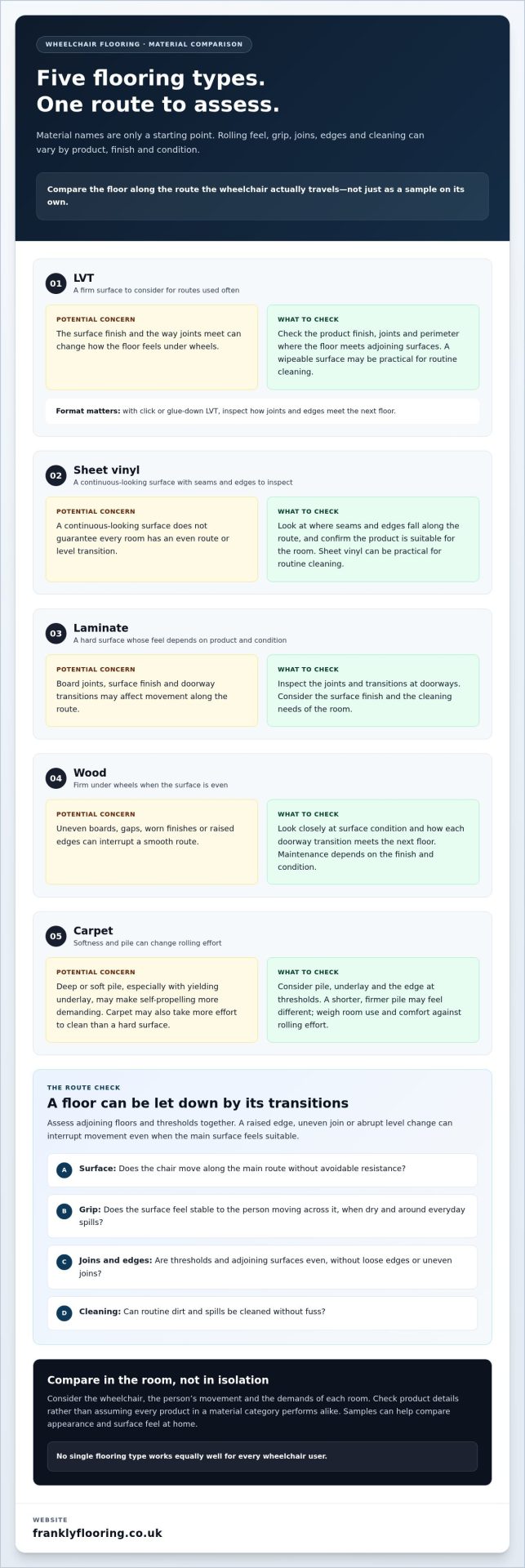
A UK wheelchair flooring checklist: assess rooms, samples and transitions
Planning makes comparisons more useful than choosing by colour or material name alone. Work through this checklist and record what matters for the person using the wheelchair and the rooms in your home.
- Map the routes. Note regular journeys between the entrance, living areas, kitchen, bathroom and bedroom. Mark turning spaces, doorways and places where the floor covering changes.
- Set mobility priorities. Consider whether the wheelchair is manual or powered, how often the user self-propels and where assisted movement is common. Decide which routes need to feel easiest to cross and where stable grip is a particular concern.
- Account for each room. Entrance flooring may need to cope with tracked-in dirt and moisture. In a kitchen, consider spills and frequent cleaning. A bedroom used mainly for quieter activities may have different priorities from a busy route through the home.
- Compare product details. Look beyond the material category. Check the product’s format, thickness, surface finish, join details and stated room suitability. These details can affect how it meets adjoining floors and whether its care guidance suits your household.
- Inspect transitions and test samples. Record changes in floor height, doorway thresholds, uneven joins and loose or damaged edges. Then compare samples in the spaces where you expect to use them, considering the route as a whole.
How to test flooring samples at home
Place each sample on the existing floor and, if possible, along a frequently used route. Try moving and turning with the wheelchair the user normally uses. Notice effort, control and how secure the surface feels. Consider how you’d clean a small spill in line with the product’s care guidance. A sample is only a small area, so also picture how its format and edges would meet the floor at doorways or between rooms.
Questions to resolve before choosing a floor
Before settling on a shortlist, write down which rooms need the firmest, easiest-to-clean route, where dirt or spills are most likely and whether a quieter bedroom surface matters. Note existing floor heights and any thresholds, uneven joins or loose edges along regular journeys. Finally, check that the product’s stated use and maintenance guidance fit the room and your household routine.
This process helps you judge the best flooring for wheelchair users uk against the way your home is actually used. Once you have a shortlist, explore flooring and request free samples to compare options at home.
Choose and buy wheelchair-suitable flooring from Frankly Flooring
Your shortlist should reflect what you’ve assessed at home, not a claim that one material is best for everyone. Frankly Flooring sells LVT, vinyl, laminate, wood and carpet online, giving you several material types to compare against your wheelchair routes, room needs and cleaning routine. Product details matter as much as the category, so use your notes to narrow the choice rather than relying on appearance alone.
How to narrow the product shortlist
Start with the priorities that proved important during your assessment: rolling feel, grip, transitions and maintenance. Compare product specifications and stated room suitability with the route each floor would serve. A product that seems suitable for one room may not meet the needs of another, so consider the entrance, kitchen, living spaces and bedroom separately.
- LVT or vinyl: Compare the surface and format, then consider where joins and edges would sit along your main routes.
- Laminate: Review the product details and care guidance alongside the floor’s joins and transitions to adjoining rooms.
- Wood: Consider the surface finish, condition requirements and how it would meet existing thresholds.
- Carpet: Take pile and softness into account, particularly on routes where self-propelling effort is a priority.
Buying online gives you time to compare product information before ordering. The UK guide to buying flooring online with confidence can help you think through the process as you review your options.
A straightforward next step with Frankly Flooring
Free samples let you assess colour and surface appearance in your own home, where lighting and surrounding finishes can affect how a floor looks. If you’re comparing several options, place samples in the rooms you’re considering and revisit your notes on movement and cleaning. Frankly Flooring is a family-run retailer with more than 20 years of flooring-industry experience and delivers flooring across the UK.
When planning your choice, consider how the finished route, including thresholds and joins, will work for the wheelchair user.
Compare the product information, take time with samples and choose the option that best matches your household’s priorities. Quite frankly, why go anywhere else? Browse flooring products and request free samples.
Take the next step towards a floor that suits your home
You don’t have to choose flooring for every room at once. Start with the route or space that matters most to the wheelchair user, then use what you learn to guide the next decision. A thoughtful shortlist can make the process manageable and keep your priorities centred on everyday life at home.
The best flooring for wheelchair users uk is the option that fits the person, the room and the finished route. Compare products at your own pace, and use samples to assess how a surface looks in your home rather than relying on a label or appearance alone.
Frankly Flooring is a family-run retailer with more than 20 years of flooring-industry experience. Free samples and UK-wide online delivery let you review flooring options at home before deciding.
Take your time, compare what matters and choose a floor that feels right for your household. Browse flooring and request free samples.
Frequently Asked Questions
Is LVT flooring suitable for wheelchair users?
It can be suitable, but the specific product and finished route matter. LVT comes in different formats and surface finishes, so check its product details, stated room suitability and how its joins meet doorways or other flooring. A sample can help you judge how the surface looks and feels. Treat LVT as an option to assess, not a guarantee of wheelchair suitability.
Can a wheelchair damage vinyl or LVT flooring?
Wheelchair use may contribute to marks or wear, particularly where wheels turn repeatedly or grit gets trapped beneath them. The result depends on the floor product, its condition and the wheelchair’s wheels. Keep the floor free of loose dirt, follow the manufacturer’s cleaning and care instructions, and avoid dragging heavy items across it. If you notice a mark, use only a cleaning method allowed by the product guidance.
Are rugs safe to use on floors used by wheelchairs?
A loose rug can shift, bunch or create an edge that interrupts a wheelchair route, so take care before placing one across a frequently used path. If you use a rug, consider its position, backing and edges, and whether it stays flat during everyday movement. A non-slip label alone doesn’t establish that a rug is suitable. Test it in the intended spot and remove it if it moves or obstructs access.
Can carpet work for someone who uses a wheelchair indoors?
Yes, carpet may work in some rooms, depending on the user’s wheelchair and how they move around. A softer, deeper pile can make pushing more demanding, particularly for someone who self-propels. If you’re considering carpet, compare how its pile and underlay feel under the chair and consider how it meets hard flooring at the doorway. A carpet that suits a quieter room may not suit a high-use route.
Do UK building regulations specify flooring for wheelchair users?
There isn’t one flooring product prescribed for every wheelchair user. Approved Document M provides building-regulations guidance on access to and use of buildings in England, including considerations for floor surfaces. Its application depends on the building and work involved; it isn’t a product certification for private-home flooring choices. Other UK nations have their own building standards and guidance, so don’t treat one reference as a universal rule for every home.
How can I reduce tyre marks on flooring?
Regularly remove dust and grit from the floor, since debris beneath wheels can contribute to scuffing. Clean tyre marks promptly using the method recommended for that flooring, and avoid abrasive tools or unapproved cleaners that could affect the finish. If marks tend to appear where the chair turns, note that spot and check whether the wheels or floor need attention. Test any permitted cleaner on an inconspicuous area first.
Should I choose the same flooring throughout my home?
No, different rooms can have different needs. You might prefer a firm, easy-care surface on a frequently used route, while choosing another material for a room used less often. If you mix flooring types, plan the doorway junctions carefully so changes in surface or height don’t disrupt movement. A consistent floor through key routes can simplify navigation, but it isn’t essential if transitions are considered as part of the choice.