
The sticker price you see on a retail website is rarely the number that ends up on your final invoice. It’s a frustrating reality for many homeowners who just want a straight answer about their renovation budget. You likely already know that real wood is a premium investment that adds character and long-term value to your home. However, the search for a definitive solid wood flooring cost often leads to a maze of “starting from” figures and hidden extras that most retailers prefer to keep in the small print.
We believe in a bit of old-fashioned candor. You deserve to know exactly what goes into your project before you commit to a purchase. This guide provides a transparent breakdown of the true expenses involved in a real wood floor, moving past the surface-level marketing to the technical details that actually drive prices. We will explore how different wood species and grades impact your bottom line, identify the essential accessories you’ll need for a professional finish, and highlight the site-specific factors that can quietly inflate a budget if you aren’t prepared. By the end, you’ll have the confidence to choose the right material without the fear of unexpected costs.
Key Takeaways
- Identify the three main factors that drive material prices, helping you balance aesthetic preferences with your actual budget.
- Gain a transparent view of the total solid wood flooring cost by accounting for specific subfloor needs that differ from engineered options.
- Avoid mid-project surprises by learning how to calculate waste accurately and budgeting for the essential accessories retailers rarely mention upfront.
- Evaluate the long-term value of real timber, which can last up to a century and offers a significantly higher return on investment than shorter-lived synthetic floors.
- Follow a practical guide to measuring your room and using samples to ensure your final selection matches your home’s unique character and lighting.
What Determines the Cost of Solid Wood Flooring in 2026?
Solid wood flooring is exactly what the name suggests. Each plank is milled from a single, continuous piece of timber from top to bottom. Unlike engineered alternatives that use a layered construction, solid boards are a pure slice of nature. This simplicity is why many homeowners view the solid wood flooring cost as a lifetime investment rather than a temporary fix. When you buy solid wood, you aren’t just buying a floor; you’re buying a feature that can be sanded and refinished for generations.
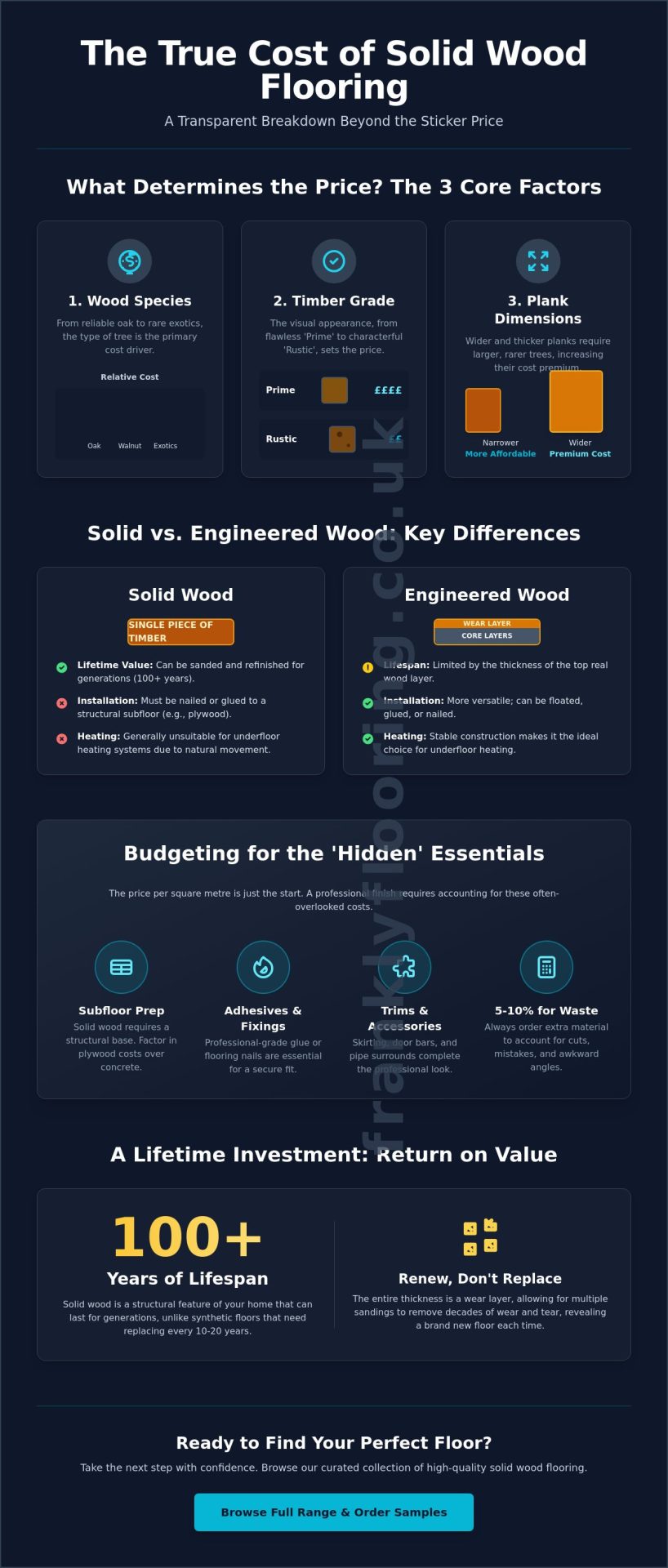
In 2026, the price you pay is influenced by global supply chains and local UK market shifts. Timber is a commodity, and costs fluctuate based on harvest yields and the energy required for kiln-drying. However, three main variables will always dictate the price: the species of the tree, the grade of the timber, and the physical dimensions of the planks. Understanding these wood flooring types and their specific characteristics helps you decide where to spend and where to save.
The Impact of Wood Species: Oak, Walnut, and Beyond
European Oak remains the industry standard for a reason. It offers a reliable balance of durability and price. It’s tough enough for busy hallways but common enough to keep costs relatively grounded. If you move toward American Walnut, expect a significant jump in your solid wood flooring cost. Walnut trees grow much slower and produce narrower trunks, making large, clear planks far rarer. Exotic species like Teak or Iroko sit at the top of the price bracket. These are often imported from specific climates, adding shipping and sustainability certifications to the final bill.
Plank Width and Thickness: Why Size Matters
Size is a silent price driver. A standard 18mm or 20mm thickness provides immense stability and a massive wear layer. In solid timber, the ‘wear layer’ is effectively the entire depth of the board down to the tongue and groove. This allows for multiple deep sandings over several decades. Plank width also changes the economics of your project. Wider planks require larger, older trees, which are harder to source. Choosing a 180mm wide board over a 120mm board might seem like a small design choice, but it often carries a premium because fewer planks can be cut from a single log. Stick to narrower strips if you want the look of real wood without the wide-plank price tag.
The Material Difference: Solid vs. Engineered Wood Pricing
Comparing solid wood to engineered wood isn’t just about the price per square meter. While solid wood is often perceived as the gold standard, high-quality engineered planks frequently command a higher price. This happens because the multi-layered construction of engineered wood requires complex manufacturing processes to ensure stability. If you’re weighing up these options, our Engineered Wood Flooring: The Frank 2026 Guide to Quality & Value explains these technical differences in greater detail.
A hidden factor in the solid wood flooring cost is the subfloor. Solid timber is reactive to humidity and temperature. It cannot be floated over an underlay like laminate. It must be nailed or glued to a structural subfloor, such as plywood or timber battens. If your home has a concrete base, you’ll need to account for the cost of installing a wooden sub-layer first. This preparation is essential for the long-term value of wood floors, as it prevents the planks from warping or cupping over time.
Peace of mind also has a price tag. Solid wood is generally unsuitable for underfloor heating because the natural expansion and contraction can lead to gaps or cracks. Engineered wood is the safer, albeit often more expensive, choice for modern heating systems. Choosing the right material depends entirely on your home’s environment and your tolerance for natural wood movement. If you’re still unsure which material suits your room, you can browse our full range of wood samples to see the differences first-hand.
Timber Grades: From Prime to Rustic
Timber is graded based on its visual appearance. Prime grade is the most expensive. It features very few knots and a highly uniform color. It looks sleek and modern, but it comes with a heavy premium because only a small percentage of any harvested tree meets these strict criteria. For most homeowners, Rustic or Character grades offer the best value. These planks include natural knots and color variations that showcase the true personality of the timber. They are more affordable and, frankly, better at hiding the inevitable scratches of daily life.
Finish Costs: Unfinished, Oiled, or Lacquered?
You can often save money on the material by purchasing unfinished planks. However, this shift in the solid wood flooring cost usually reappears in the form of higher labor and material costs for onsite sanding and sealing. Pre-finished boards, whether UV-oiled or lacquered, arrive ready to walk on. Lacquered finishes provide a hard-wearing shield that’s easy to clean, while oiled finishes penetrate the wood for a more natural look. While oiled floors require more frequent maintenance, they are easier to spot-repair than a scratched lacquered surface.
The ‘Frank’ Truth About Hidden Installation & Accessory Costs
The price per square meter on a product page is just the starting point. To build a realistic budget, you must account for the “Frank” costs that retailers often brush over. The most basic of these is the 10% waste rule. You cannot buy the exact square footage of your room. Every corner, alcove, and doorway requires a cut, and those offcuts are rarely reusable. If your room is particularly irregular, that waste margin might even climb to 15%. Ignoring this almost guarantees you’ll be one box short on the final day, which is an expensive mistake once you factor in additional delivery fees and fitter delays.
Unlike other materials, solid timber demands a mechanical bond to the subfloor. You don’t “float” these planks on a thin foam underlay. They are either glued down with high-quality polymer adhesive or secret-nailed into a wooden subfloor. This requirement significantly impacts the total solid wood flooring cost because the materials and the time required are far greater than a simple click-system floor. For a broader look at the moving parts of a budget, you might consult a comprehensive guide to hardwood flooring costs which details how these variables stack up.
Essential Accessories Checklist
A professional finish relies on the parts of the floor you never actually see. If you’re installing over a concrete slab, a liquid damp-proof membrane (DPM) is non-negotiable. It creates a barrier that prevents moisture from rising and warping your new timber. You’ll also need specific thresholds or door bars to manage the transition between rooms. While we provide a guide on carpet gripper for your textile areas, wood transitions require solid profiles that match your species. Don’t forget the perimeter. If you aren’t removing your skirting boards, you’ll need scotia beads to cover the mandatory expansion gap around the edge of the room.
Labour Costs: What Fitters Charge in 2026
Fitting solid wood is a craft, and the day rates for specialists reflect that expertise. In 2026, UK floor fitters generally charge more for solid timber than they do for laminate flooring because the process is slower and more physically demanding. A professional must check moisture levels, prepare the subfloor, and carefully space the planks to allow for natural movement. You should also budget for “prep” tasks. Removing old carpets, disposing of debris, or trimming the bottom of doors to clear the new floor height are all standard tasks that can add several hours to the job. Understanding these hidden labor costs is the only way to arrive at an accurate solid wood flooring cost before the first plank is even laid.
Calculating the Long-Term ROI of Real Wood Floors
While the initial solid wood flooring cost can feel substantial, viewing it through the lens of a single decade is a mistake. When you compare it to synthetic options like LVT or laminate, you’re comparing a permanent architectural feature to a disposable floor covering. Most high-quality synthetic floors have a lifespan of 10 to 20 years before the wear layer fails or the clicking mechanism breaks. In contrast, a solid timber floor can easily last between 50 and 100 years. If you divide the total project cost by its expected lifespan, real wood often becomes the most economical choice you can make for your home.
Estate agents frequently highlight real wood in property listings because it carries a perceived value that synthetic materials cannot match. It suggests a level of quality and care that resonates with buyers, often allowing you to recoup a significant portion of your investment during a sale. You aren’t just paying for a surface to walk on; you’re increasing the equity in your property. It’s a foundational element that anchors the character of a room, growing more beautiful as it develops a natural patina over time.
Refinishing vs. Replacement
The true genius of solid timber lies in its depth. Because each plank is a solid piece of wood, it can be sanded and refinished between 5 and 7 times over its life. If your floor becomes scratched after years of heavy use, you don’t need to rip it up. A professional sand-and-seal service costs a fraction of a full replacement and makes the boards look brand new. Solid wood is the only flooring that ‘heals’ through maintenance, allowing you to change the stain or finish to match evolving interior trends without ever buying a new square meter of material.
Sustainability and Environmental Value
Choosing natural timber is also a vote for the planet. Wood is a carbon-sequestering material, meaning the carbon absorbed by the tree remains locked within your floor for as long as it stays in your home. Buying a floor once and keeping it for 80 years is far more sustainable than sending plastic-based floors to a landfill every decade. We always recommend looking for FSC or PEFC certifications to ensure your timber is sourced from responsibly managed forests where growth outpaces harvest. If you’re ready to invest in a floor that lasts a lifetime, view our selection of premium solid wood planks and start your project with confidence.
How to Budget and Buy Your Wood Flooring Online
Buying your materials online is often the most cost-effective way to manage your project, but it requires a methodical approach to avoid expensive mistakes. The final solid wood flooring cost is heavily influenced by the accuracy of your initial order. Ordering too little leads to project delays and extra delivery fees, while ordering too much leaves you with expensive surplus stock that takes up space in your garage. Precision at the planning stage is the best way to protect your budget.
Before you add anything to your cart, you must account for the physical realities of timber delivery. Solid wood is exceptionally heavy. Unlike a standard parcel, timber usually arrives on large pallets via a tail-lift lorry. It is vital to check for hidden delivery surcharges, especially if you live in a remote area or a location with restricted access. Most retailers provide kerbside delivery, meaning you should have a plan in place to move the planks inside your home to let them acclimate to your room’s humidity levels before the fitting begins.
Measuring for Success
Accurate measurement is about more than just a quick length-times-width calculation. To get it right, follow these steps:
- Measure the room at its longest and widest points.
- Treat alcoves, bay windows, and fireplaces as separate rectangles. Calculate their area and add them to your main room total.
- Add your 10% waste margin to the final square meterage. If you have complex angles or a herringbone pattern, increase this to 15%.
- Always round up to the nearest full pack. Wood is sold in fixed box sizes, and you cannot buy partial packs.
We also strongly advise ordering physical samples before making a final decision. A digital image on a smartphone cannot replicate the tactile grain of oak or the way a specific finish reacts to your home’s unique lighting. Seeing the wood in your own space, next to your furniture and under your evening lamps, ensures you won’t regret the investment once the floor is laid.
The Frankly Flooring Approach
We believe that buying a premium floor should be a stress-free experience built on integrity. Our approach is rooted in providing no-nonsense, expert advice that helps you navigate the technical nuances of timber without the high-pressure sales tactics found elsewhere. We view our role as an advisor, ensuring you choose a product that matches the character of your home and the demands of your lifestyle. By focusing on transparency and quality, we help you manage your solid wood flooring cost with total confidence. Our curated collection is selected for its longevity and craftsmanship, providing a foundational element for your home that you can take pride in for decades to come.
Browse our full range of Wood Flooring and Accessories and start your journey toward a beautiful, lasting real wood floor.
Investing in a Lifetime of Character
Choosing real wood is a decision that transforms your home from the ground up. You’ve seen that the true solid wood flooring cost involves more than just the planks themselves; it’s about accounting for the right grade, the essential subfloor preparation, and the 10% waste margin that ensures a seamless finish. While the upfront investment is higher than synthetic alternatives, the ability to sand and refinish your floor over several decades makes it the most sustainable and financially sound choice for the long term.
As a family-run business with over 20 years of technical expertise, we take pride in helping you get the details right. We offer direct-to-consumer prices on premium Oak and Walnut, supported by reliable national UK delivery on all flooring and accessories. You don’t need to settle for unclear pricing or hidden surprises. Shop our high-quality Wood Flooring collection with a Frank 2026 Price Guarantee and bring the lasting beauty of natural timber into your property today. Your home deserves a foundation that only gets better with age.
Frequently Asked Questions
Is solid wood flooring more expensive than engineered wood?
Not always. While solid wood is a premium product, high-end engineered boards with thick wear layers and complex construction can actually cost more. The total solid wood flooring cost also depends on the subfloor preparation. Solid wood requires a structural wooden base, whereas engineered wood is often more versatile and can be installed over various surfaces.
How much extra should I budget for flooring waste?
You should budget for a minimum of 10% waste for standard rectangular rooms. If your space has alcoves, bay windows, or complicated angles, increase this to 15%. This extra material covers the offcuts created during the fitting process. It’s much cheaper to buy the extra box now than to pay for a separate delivery later if you run short.
Does the cost of solid wood flooring include installation?
No, the prices you see on retail sites almost exclusively cover the materials alone. You will need to budget separately for professional fitting and the necessary accessories like adhesives or underlays. Since solid timber requires specialist tools for nailing or gluing, labor is a distinct and significant part of your overall project budget that should be planned for early.
Why is Oak flooring cheaper than Walnut?
Oak is more affordable because it is more abundant and grows faster than Walnut. European Oak is a sustainable, widely harvested species that produces high yields of usable timber. Walnut trees take longer to reach maturity and have smaller trunks. This means there is less clear timber available per tree, which naturally drives up the market price for Walnut planks.
Can I save money by installing solid wood flooring myself?
You can save on labor, but solid wood installation is technically demanding and carries higher risks for beginners. Unlike click-system laminate, solid planks must be nailed or glued to a structural subfloor. Errors in spacing or moisture testing can lead to warping or gapping. Most homeowners find that the cost of a professional fitter is worth the long-term peace of mind.
How much does it cost to refinish a solid wood floor later on?
Refinishing costs are significantly lower than a full floor replacement. A professional sand-and-seal service involves removing the top layer of wood and applying a fresh coat of oil or lacquer. While we don’t provide these services, it’s a standard maintenance task that restores the floor to its original beauty. It allows you to refresh your home without the need to buy new materials.
What are the ‘hidden’ costs of buying flooring online?
The main hidden costs are delivery surcharges and essential accessories. Heavy timber pallets often require specialized transport, which can lead to higher shipping fees for certain postcodes. Additionally, the headline solid wood flooring cost usually excludes the damp-proof membranes, adhesives, and matching door bars required to complete the installation. Always check the total price of the basket, not just the price per meter.
Is solid wood flooring worth the investment for a rental property?
Generally, solid wood isn’t the best choice for rentals due to the specific maintenance it requires. Tenants may not use the correct cleaners needed to protect the finish, and scratches from heavy furniture can be deep. For a rental property, high-quality LVT or laminate often provides a better return on investment. These materials are more resistant to misuse and easier to replace if damaged.