
Most wood flooring failures in the UK aren’t actually caused by a faulty product; they are the direct result of ignoring wood flooring acclimatisation before a single board is laid. You’ve likely felt the pressure from a fitter wanting to start the job immediately, or perhaps you’re staring at stacks of boxes wondering if you should open them or leave them sealed. It’s natural to worry about your expensive new investment warping or gapping once the heating goes on. We understand that you want a floor that stays stable, not one that moves the moment the seasons change.
Let’s be frank: skipping this process is the fastest way to guarantee a costly installation failure. This guide provides a candid look at how to bridge the gap between the warehouse climate and your home’s unique environment. We’ll cover the specific moisture levels required by British Standard BS8201, the exact timelines for solid versus engineered boards, and the room conditions you must maintain to ensure a perfect fit. You’ll gain the confidence to manage your project properly, ensuring your floor remains a foundational element of your home’s character for years to come.
Key Takeaways
- Grasp the frank reality of why wood flooring acclimatisation is the only way to bridge the gap between a warehouse climate and your home’s unique environment.
- Learn the specific minimum timelines for solid and engineered wood to prevent the boards from moving once they’re fitted.
- Follow the non-negotiable rule regarding wet trades to ensure moisture from plastering or screeding doesn’t compromise your floor.
- Master the precise room conditions, including the 40% to 65% humidity range, needed for a stable and long-lasting installation.
- Follow a simple step-by-step guide for inspecting and storing your boards to ensure they’re ready for a perfect fit.
What is Wood Flooring Acclimatisation and Why Is It Non-Negotiable?
Think of wood flooring acclimatisation as a necessary period of adjustment for your new purchase. Timber is a natural, living material that never truly stops reacting to the environment around it. Technically, this process is about equalising the moisture content of the wood with the relative humidity of your specific room. When the wood reaches this balance, it hits what professionals call Equilibrium Moisture Content. If you skip this step, you’re essentially forcing a product that has been sitting in a cold, often damp warehouse to suddenly live in a warm, dry UK home. That shock leads to movement, and movement leads to disaster.
Let’s be frank about the risks involved here. Rushing the installation is the number one cause of flooring failure in the UK. Many homeowners feel pressured by fitters who want to get the job done and move on to the next project. However, even high-quality engineered wood flooring requires this time to settle. It doesn’t matter how premium the product is; if it isn’t given the chance to adapt to your home’s unique micro-climate, it will eventually protest. Proper wood flooring acclimatisation is the only way to ensure the boards stay where you put them.
The Consequences of Rushing the Install
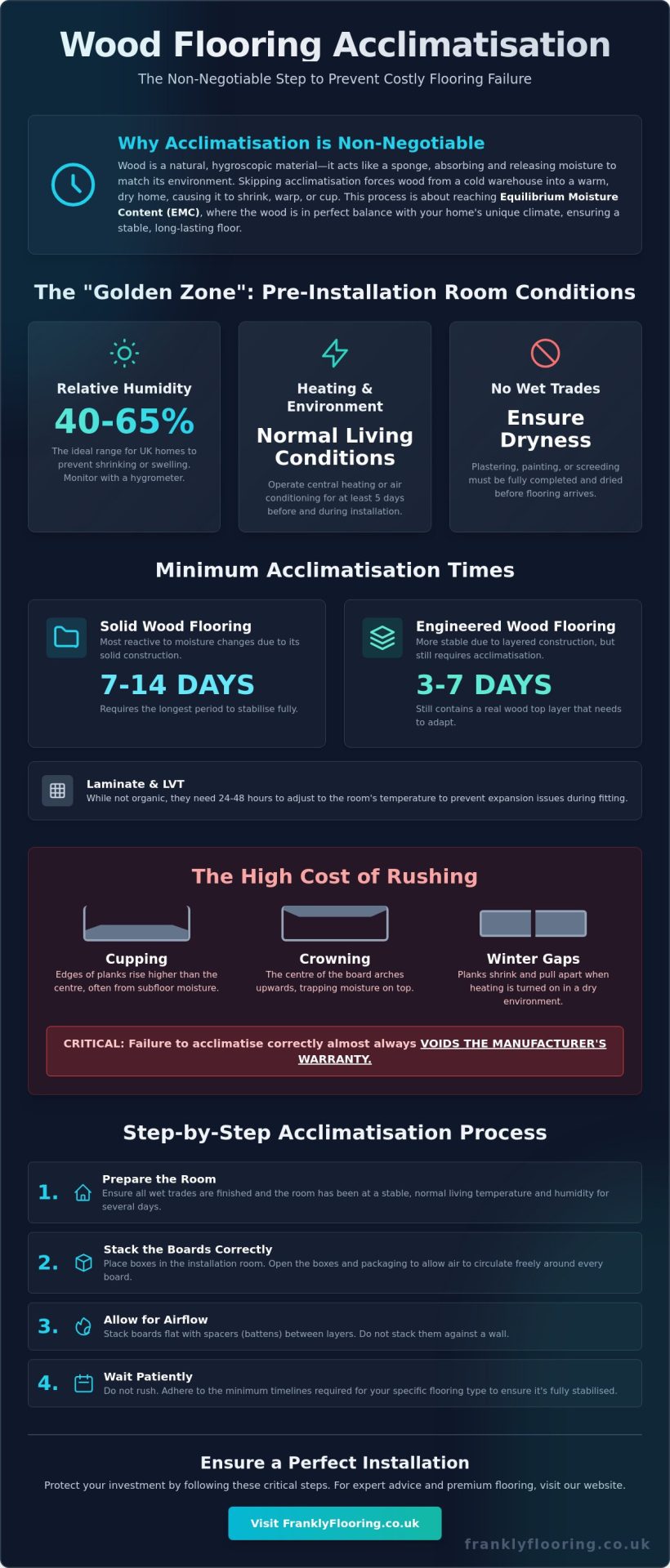
When wood moves unexpectedly, it doesn’t do so gracefully. You might see “cupping,” where the edges of the planks rise higher than the centre, creating a concave shape. This usually happens when the underside of the board absorbs moisture from a damp subfloor. Conversely, “crowning” occurs when the centre of the board arches upward. Then there is the “winter gap” phenomenon. If you install wood that hasn’t properly dried out to match your home’s indoor humidity, the planks will shrink the moment you turn the heating on in October, leaving unsightly gaps between every board. Most importantly, almost every manufacturer warranty is voided if you cannot prove the floor was correctly acclimatised according to British Standards.
Is Every Flooring Type the Same?
Not all materials react with the same intensity, but most require a breather. Wood flooring in its solid form is the most volatile and needs the longest time to stabilise. Engineered wood is more stable due to its layered construction, yet it still contains real timber that expands and contracts. Even laminate and LVT (Luxury Vinyl Tile) need time to reach room temperature. While LVT isn’t organic, the PVC cores can expand or soften slightly depending on the heat of the room. Carpet is the only major exception to this rule, as its flexible nature doesn’t rely on rigid moisture tolerances. For everything else, patience is the best tool in your kit.
The Science of Moisture: How UK Homes Affect Your Wood Floor
Timber is a hygroscopic material. This means it acts like a sponge, constantly breathing in moisture when the air is damp and releasing it when the environment dries out. This isn’t a defect; it’s a natural characteristic of organic material. Because of this, wood never truly stops moving. The goal of wood flooring acclimatisation is to help the planks reach their Equilibrium Moisture Content (EMC). This is the specific point where the moisture within the wood is in perfect balance with the humidity in your home. Once it hits this state, the wood stops trying to expand or contract, giving you a stable surface that stays put.
In the UK, the ideal relative humidity for a lived-in home sits between 40% and 65%. Modern building standards in 2026 have made our homes incredibly airtight and well-insulated. While this is excellent for your energy efficiency, it creates a unique micro-climate that can be quite dry. The National Wood Flooring Association guidelines highlight that maintaining these stable conditions is essential for the longevity of any timber installation. If the humidity drops below 40%, the wood will likely shrink; if it climbs above 65%, you risk expansion and cupping.
Central Heating and the “Dry Out” Effect
Radiators and central heating systems are notorious for stripping moisture from the air. When the air becomes too dry, it seeks out moisture from its surroundings, including your floorboards. This is why the first winter is the biggest test for any new floor. If the boards weren’t properly prepared, the sudden drop in humidity when the heating goes on will cause them to pull apart. We suggest using a hygrometer to keep a close eye on your room’s conditions. It’s a simple, low-cost tool that provides the data you need to protect your investment. If you are still in the planning stages, you can browse our range of wood flooring to find the right match for your room’s environment.
The Underfloor Heating (UFH) Factor
If you’re using underfloor heating, the rules of wood flooring acclimatisation become even more strict. You cannot simply blast the heat the moment the floor is laid. There is a specific protocol to follow. The water temperature within the pipes should never exceed 27°C to prevent the wood from overheating. Before and after installation, you must implement a gradual warm-up, increasing the temperature by only a couple of degrees each day. This slow adjustment allows the timber to settle without the shock of extreme heat. For these systems, engineered wood is almost always the better choice. Its layered construction is designed to handle the thermal stress much more effectively than solid timber ever could.
How Long Does Acclimatisation Actually Take?
The question we hear most often is exactly how many days a floor needs to sit before the first plank is nailed or glued down. While it’s tempting to rush the process to see your finished room, wood flooring acclimatisation is a game of patience. There is no magic number that applies to every home, but there are strict minimums based on the material’s construction. It’s vital to remember that these timelines are the absolute baseline. If you have the luxury of time, giving your flooring a few extra days is always a wise investment in its long-term stability.
Solid Wood vs. Engineered Wood Timelines
Solid wood is the most demanding material. Because each plank is a single, dense piece of timber, it reacts significantly to environmental shifts. For solid boards, you should allow at least 14 days for the wood to settle. This window ensures the core of the wood reaches the same moisture level as the surface. In contrast, engineered wood flooring is much more stable due to its multi-layer construction, which resists natural movement. Most engineered products require a minimum of 72 hours prior to fitting. However, the thickness of the wear layer matters. A thicker oak top layer behaves more like solid wood and may benefit from the full three-day period or longer. If you’ve opted for a different material altogether, our laminate flooring guide provides specific advice on how those synthetic cores require their own time to reach room temperature.
Factors That Extend the Wait
Sometimes, the standard timeline isn’t enough. If your flooring was delivered during a week of torrential rain or freezing temperatures, it likely arrived with a moisture profile far outside the norm. In these cases, you should extend the wait. Newly built homes also present a challenge. Even if the walls look dry, the structure often holds high residual moisture from “wet trades” like plastering and screeding. This hidden humidity can seep into your new floor if you install it too early. Finally, consider the size of your planks. Large format or extra-wide boards have more surface area to move. They are less forgiving than narrow strips, so they frequently need extra time to ensure the Equilibrium Moisture Content is consistent across the entire width of the plank. Don’t let a fitter’s schedule dictate your floor’s lifespan; the wood will tell you when it’s ready, not the calendar.
The Frank Guide to Pre-Installation: Humidity and Wet Trades
Let’s be frank about the order of your renovation. Wood flooring acclimatisation isn’t a process you can run in parallel with your plastering or painting. In the trade, we refer to these as “wet trades” because they introduce a massive amount of moisture into the air and the structure of your home. The golden rule is simple: never bring your timber into a house where the plaster is still wet. If you ignore this, the dry wood will act like a giant silica packet, sucking moisture out of the air and the walls before it’s even laid. This leads to immediate expansion, which can’t be reversed once the house finally dries out.
Moisture migration is a silent killer for new floors. Even if the room feels warm, water vapour from fresh screed or plaster will settle into your boards. This causes the timber to swell beyond its manufactured dimensions. If you are transitioning from your new oak floor into a carpeted bedroom, you’ll also want to ensure you have the correct carpet gripper ready for a seamless finish. Planning these details early prevents the project from stalling once the environment is finally stable.
The Plastering Timeline
One of the biggest mistakes homeowners make is trusting their eyes. Walls often look “touch dry” within a few days, but they are still holding litres of water deep within the masonry. You should wait at least 4 to 6 weeks after major plastering works before even thinking about bringing wood into the property. For concrete screeds, the wait can be much longer. We strongly advise using a moisture meter to check your subfloor. According to British Standards, a concrete subfloor must be below 75% relative humidity, or less than 4% moisture content, before installation begins. If you’re checking a timber subfloor, it should be less than 14% Wood Moisture Equivalent.
Ideal Room Conditions for Success
To give your floor the best start, the room must be in a “lived-in” state. This means the windows are in, the space is weather-tight, and the heating has been running at a normal level for at least 5 days. Aim for a stable temperature between 18°C and 22°C. Your relative humidity should sit between 45% and 60%. This range mimics the conditions the floor will live in for the next twenty years. If your home hasn’t reached these levels yet, keep the flooring in the warehouse. Before you commit to a delivery date, check our current stock to ensure your materials arrive exactly when your room is ready for them.
Step-by-Step: How to Acclimatise Your New Wood Flooring Correctly
Once your room is dry and the environment is stable, it’s time for the physical phase of wood flooring acclimatisation. This isn’t just about moving boxes from the van to the house. How you handle and position the timber during these final days will determine whether the boards remain flat or begin to pull. Following a disciplined sequence ensures that the technical theory we’ve discussed translates into a floor that fits perfectly on day one and stays that way for decades. It’s a straightforward process, but there is no room for shortcuts here.
- Step 1: Delivery and Inspection. As soon as the boards arrive, check for transit damage. If a box is crushed or wet, the timber inside may already be compromised. Catching this now prevents a mid-install halt later.
- Step 2: The Right Room. You must store the wood in the specific room where it will be installed. Moving it from a cold hallway to a warm lounge on fitting day defeats the entire purpose of the wait.
- Step 3: Stacking. Position the packs in the centre of the room, away from direct sunlight or radiators. This ensures an even temperature across the entire batch.
- Step 4: Monitoring. Keep your hygrometer active. If the humidity spikes because of a rainy spell, you may need to extend the acclimatisation period until the room returns to its 45% to 60% baseline.
The Stacking Masterclass
The Frank Verdict on stacking is simple: airflow matters. For engineered wood, flat stacking is the standard. You can lay the boxes on top of each other, but keep the height to a maximum of 3 to 5 packs to prevent the bottom boards from being crushed or distorted. Solid wood is a different beast. It often requires “lattice stacking,” where you criss-cross the layers to allow air to circulate around every side of the pack. This is essential for the denser, more reactive nature of solid timber. Whatever you do, never store your wood in a garage, shed, or conservatory. These spaces are subject to extreme temperature swings and dampness that will ruin the timber before it even touches your subfloor.
To Open or Not to Open?
Conflicting advice on opening packs is common, but the rule depends on the product. For engineered wood, keep the boxes sealed. The packaging is designed to keep the boards under slight tension, which prevents bowing while they reach room temperature. For solid wood, we recommend snipping the ends of the shrink-wrap. This allows the ends of the planks to breathe without exposing the entire board to a sudden change in humidity. Finally, always keep the wood off direct concrete floors. Even a “dry” concrete floor can hold trace moisture. Use spacers or timber battens to create a small gap between the floor and your first layer of packs. This small step protects the bottom boards from moisture wicking and ensures a successful, long-lasting installation.
Secure Your Investment for a Lifetime
Success in flooring isn’t just about picking the right oak; it’s about respecting the natural science of timber. By now, you understand that wood flooring acclimatisation is a non-negotiable bridge between the warehouse and your home. You know how to manage moisture from wet trades and why the first winter is the biggest test for any new installation. Following these steps ensures your floor remains a stable, beautiful foundation for your property rather than a source of stress and extra cost.
As a family-run business with over 20 years of experience, we take pride in providing the transparent, expert advice you need to get the job done right. We don’t just sell materials; we offer the technical depth to support your project from start to finish. With national UK delivery on all wood and accessories, we make it easy to source quality products that stand the test of time. Take the next step in your home renovation with confidence. Browse our full range of premium Engineered Wood Flooring and find the perfect match for your space. Your future floor will thank you for the patience you show today.
Frequently Asked Questions
Can I acclimatise wood flooring in a garage or shed?
No, you should never store or acclimatise your boards in a garage or shed. These spaces lack the climate control found in your living areas. Exposure to dampness and extreme temperature shifts will damage the timber before it’s even laid. Always store the packs in the room where they’ll be fitted to ensure the wood adjusts to the specific humidity of your home. This prevents the boards from absorbing excess outdoor moisture.
What happens if I install wood flooring without acclimatising it?
Skipping this step leads to structural failure, including cupping, crowning, and unsightly gaps between planks. If the boards haven’t reached balance with your room’s air, they’ll move aggressively once installed. Most manufacturers will also void your warranty if you can’t prove that proper wood flooring acclimatisation took place according to British Standards. It’s a risk that simply isn’t worth taking for the sake of a few days.
Do I need to open the boxes of engineered wood flooring to acclimatise?
You should keep engineered wood flooring sealed in its original boxes during the adjustment period. The packaging is designed to keep the planks under slight tension, which helps prevent them from bowing. Opening the packs too early can expose the timber to uneven moisture levels, causing the boards to twist before the fitter even arrives. Only open the boxes when you’re ready to start laying the floor.
Is 24 hours enough time for wood flooring to settle?
No, 24 hours is nowhere near enough time for a successful installation. Engineered wood requires at least 72 hours, while solid wood needs a full 14 days to reach a stable state. Rushing this timeline is the fastest way to guarantee your new floor will shrink or expand once your central heating is turned on. You need the wood to reach its equilibrium moisture content, which takes days, not hours.
How do I know if my room is ready for the wood to arrive?
Your room is ready when all wet trades like plastering and painting have been dry for at least 4 to 6 weeks. The heating should have been running at a normal level for at least five days to stabilise the indoor climate. Use a hygrometer to confirm the humidity is between 40% and 65% before bringing the wood into the property. If the room feels damp, wait longer.
Does underfloor heating change the acclimatisation process?
Yes, underfloor heating requires a more cautious approach and a specific warm-up protocol. You must follow a gradual process, increasing the temperature by only a few degrees each day to avoid shocking the timber. The water inside the pipes shouldn’t exceed 27°C. This slow adjustment prevents the timber from suffering thermal shock, which can cause the wood to crack, gap, or delaminate after the job is finished.
Should I acclimatise LVT or laminate flooring as well?
Yes, both LVT and laminate flooring benefit from 48 hours in the room to reach ambient temperature. While LVT isn’t organic like timber, the PVC cores can expand or contract slightly depending on the heat of the space. Giving these materials time to settle ensures the click systems remain stable and don’t pop or gap after the floor is laid. It’s a simple step that prevents long-term issues.
Can I use a dehumidifier to speed up the process?
No, you shouldn’t use a dehumidifier to force the wood flooring acclimatisation process. Doing so creates an artificial environment that won’t reflect the room’s natural, lived-in conditions once the project is complete. Once you turn the dehumidifier off, the wood will simply react to the sudden change in humidity, undoing all your efforts and potentially causing the floor to fail. It’s better to let the room reach its balance naturally.