
Most kitchen rugs are effectively expensive sponges waiting for a red wine disaster. You shouldn’t have to choose between a stylish home and the reality of a Tuesday night pasta spill. It’s a common frustration to settle for cold, hard tiles because you fear a textile will end up in the bin after one grease splash. However, the latest generation of washable rugs for kitchens has moved far beyond the thin, plastic mats of the past. In 2026, high-performance polyester and advanced tufted constructions allow you to bring warmth and texture into the room without the constant anxiety of permanent stains.
We agree that a rug should be a tool for comfort, not a trip hazard or a maintenance nightmare. This guide will help you discover how to choose a kitchen rug that survives spills, stains, and the washing machine without sacrificing your home’s character. We will preview the most reliable performance materials, explain the importance of manufacturer-verified grip, and provide a frank look at which styles actually stand up to the rigours of a busy household. It’s time to stop treating your kitchen floor like a no-go zone for design and start building a space that’s both practical and inviting.
Key Takeaways
- Learn why modern washable rugs for kitchens have evolved from disposable mats into high-performance textiles that offer both comfort and longevity.
- Understand the technical benefits of low-pile and flatweave constructions for maintaining a hygienic, crumb-free cooking environment.
- Identify which non-slip backings are safe for LVT and vinyl floors to prevent permanent chemical staining or damage to your home’s foundation.
- Avoid appliance damage by learning how to calculate your washing machine’s weight capacity against the dimensions of a heavy, wet rug.
- Master professional placement techniques, including the “island rule,” to ensure your rug protects high-traffic zones without becoming a trip hazard.
What Are Washable Kitchen Rugs and Do You Really Need One?
A washable kitchen rug is not just a standard mat with a fancy label. It is a specifically engineered textile, usually featuring a low-pile or flatweave construction, designed to withstand the heat and agitation of a domestic washing machine. Unlike traditional rugs that rely on heavy jute or wool backings, these versions use integrated or separate non-slip layers that won’t crumble after the first spin cycle. We’ve seen a significant shift in the market lately. Homeowners are moving away from disposable, plastic-feeling mats and choosing high-quality area rugs that actually look like they belong in a living room while performing like a piece of industrial equipment.
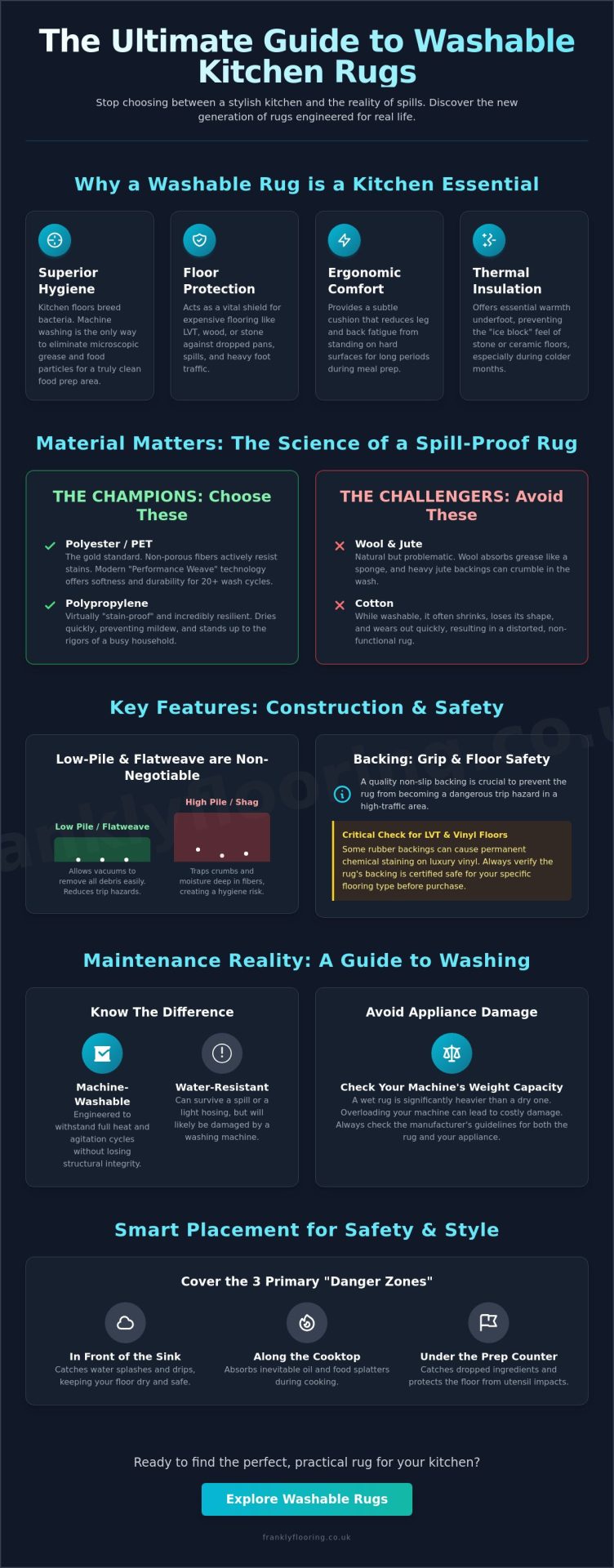
The frank truth is that kitchen floors are breeding grounds for bacteria. While vacuuming removes crumbs, it does nothing for the microscopic grease particles that settle into fibres every time you fry an egg or sear a steak. Machine washing is the only way to ensure true hygiene in a room where food is prepared. You should consider placing washable rugs for kitchens in three primary danger zones where they provide the most value: directly in front of the sink to catch splashes, along the cooktop to absorb oil spatters, and under the main food preparation counter where dropped ingredients are inevitable.
The Difference Between ‘Water-Resistant’ and ‘Machine-Washable’
Many retailers use confusing terminology to hide a product’s limitations. A water-resistant rug might survive a spilled glass of water or a quick hosing down in the garden, but it isn’t designed for the drum. To be truly washable, a rug must be able to undergo a full agitation cycle without any loss of fibre or structural integrity. This durability usually comes from an understanding of carpet materials and the use of advanced synthetic fibres like polypropylene and polyester. These materials are non-porous by nature, which means they resist staining and dry much faster than natural alternatives.
Why Your Kitchen Flooring Needs a Rug
Beyond the aesthetics, a rug serves as a vital protective layer for your home’s foundation. If you’ve invested in premium LVT flooring, wood, or stone, a rug acts as a shield against heavy foot traffic and the occasional dropped heavy-bottomed pan. There is also a practical comfort element to consider. Standing on hard tiles for hours during meal prep can lead to significant leg fatigue; a well-placed rug provides a subtle cushion that makes a noticeable difference. During British winters, these textiles also provide essential thermal insulation, preventing the ice block feel that often accompanies stone or ceramic floors in the morning. When you choose washable rugs for kitchens, you’re essentially buying insurance for your expensive flooring while making your daily routine more comfortable.
Decoding Materials: What Makes a Kitchen Rug Truly Durable?
Choosing the right material for washable rugs for kitchens is where most homeowners make their first mistake. The frank truth is that natural fibres like wool, jute, or cotton are often poor choices for a high-spill environment. Wool is naturally resilient but it absorbs grease like a sponge. Cotton is easy to wash, yet it frequently loses its shape or shrinks, leaving you with a distorted textile that won’t sit flush against your cabinets. For a rug to survive the reality of a modern kitchen, you need to look toward advanced synthetic polymers.
Modern PET (recycled plastic) has become the gold standard for stain resistance in 2026. While early versions of recycled rugs were notoriously stiff and felt like outdoor carpeting, “Performance Weave” technology now allows these fibres to mimic the softness of natural wool. This construction is vital because it ensures the rug maintains its structural integrity after 20 or more wash cycles. A low-pile height is also non-negotiable for hygiene. High-pile rugs trap crumbs and debris deep within the weave, whereas a flatweave or low-pile surface allows your vacuum to actually reach the dirt. This aligns with official safety standards for floor coverings, which emphasize that firm, stable surfaces are essential for preventing trips and ensuring easy movement in high-traffic zones.
Polypropylene and Polyester: The Practical Choice
If you want a rug that’s virtually “stain-proof,” polypropylene and polyester are your best bets. These fibres are non-porous, meaning liquids sit on the surface rather than soaking into the core. We recommend looking for solution-dyed options. In this process, the colour is added while the fibre is still in a liquid state, rather than being printed on top. This ensures the vibrant patterns won’t fade or “bleed” even after multiple hot washes with heavy-duty detergents. If you are looking for a foundation that pairs perfectly with these durable textiles, you can explore our latest home flooring options.
The Role of Backing Materials
The part of the rug you don’t see is often the most important for longevity. Many cheap washable rugs for kitchens use basic latex backings that brittle and crack when exposed to the heat of a washing machine or dryer. We prefer TPR (Thermoplastic Rubber) backings because they remain flexible and “grippy” over time without the risk of off-gassing. It’s particularly important to choose a breathable backing if you have engineered wood flooring. Non-breathable rubber pads can trap moisture or condensation between the rug and the floor, which may lead to warping or finish damage on natural wood products. A high-quality TPR backing provides the necessary grip without suffocating the material beneath it.
The Safety Check: Non-Slip Backing and Flooring Compatibility
Kitchens are high-velocity environments. Between rushing to catch a boiling pot and navigating around an open dishwasher, the last thing you need is a floor covering that acts like a banana skin. While most washable rugs for kitchens claim to be non-slip, the reality often falls short on sleek surfaces like polished tile or LVT. A rug that shifts even a few centimetres can quickly become a trip hazard, especially if the edges begin to curl after a few trips through the washing machine. You should look for rugs with reinforced edge-stitching and “stay-flat” corners, which are designed to maintain their weighted profile even after repeated agitation.
There is a specific “Frank” warning every homeowner needs to hear: cheap rubber backings can ruin your floor. Many budget-friendly rugs use low-grade synthetic rubber that can cause permanent discolouration. This isn’t a surface stain you can wipe away; it is a chemical reaction that can leave your expensive flooring with a yellow or brownish tint. To avoid this, you must ensure the backing is compatible with your specific floor type. If the integrated backing feels sticky or has a strong chemical odour, it’s a red flag for potential floor damage.
Is Your Rug Safe for LVT and Vinyl?
The technical term for the damage mentioned above is plasticiser migration. This occurs when the chemicals in a rubber backing react with the top layer of vinyl or laminate flooring. Over time, these chemicals leach out and bond with the floor finish. For modern homes, the only safe choices are felt-backed rugs or those using high-quality, non-marring Thermoplastic Rubber (TPR). We generally recommend using a felt-and-rubber hybrid pad for maximum floor protection. This combination provides the necessary grip to prevent sliding while offering a soft, breathable barrier that protects the floor’s integrity.
Flatweave vs. Tufted for High-Traffic Areas
When choosing washable rugs for kitchens, the construction method dictates how the rug handles daily wear. Flatweave rugs are our top recommendation for areas under dining tables or near islands because chair legs glide across them without snagging. They are also significantly thinner, which is vital for the “door clearance” test. Before you buy, measure the gap between your floor and the bottom of your cabinet kickplates or pantry doors to ensure the rug won’t jam the opening. Based on expert recommendations for cleaning textiles, flatweave designs dry much faster than tufted versions. A tufted rug might feel more cushioned underfoot, but its density can trap moisture for longer, which can be problematic if your kitchen lacks high-quality ventilation.
Maintenance Reality: A Frank Guide to Washing and Drying
The golden rule of washable rugs for kitchens is simple: your washing machine is the boss, not the rug manufacturer. Before you purchase a large area rug, you must check your appliance’s drum capacity. A rug that feels manageable when dry will gain significant “wet weight” once saturated. This extra mass can easily throw a domestic machine out of balance, potentially damaging the bearings or the motor during the spin cycle. To be frank, if your machine is making a loud banging noise, the rug is too big. Stop the cycle immediately to prevent an expensive repair bill.
When it’s time for a deep clean, your choice of detergent is just as important as the cycle setting. You should skip the fabric softener entirely. Softeners leave a waxy residue on synthetic fibres that actually attracts dirt and reduces the rug’s natural stain resistance over time. For pre-treating common kitchen disasters, speed is your best friend. For tomato sauce, use cold water to prevent the pigments from setting into the weave. For coffee, blot with a dry cloth first, then use a mild detergent. Oil is often the trickiest to remove; a clear degreasing dish soap applied directly to the spot for ten minutes before washing is usually the most effective solution.
Rug Size vs. Washing Machine Capacity
As a general guide, a standard runner measuring 80x150cm will fit comfortably in a 7kg drum. However, larger area rugs measuring 200x300cm or more usually require the heavy-duty capacity of a commercial laundrette. Overcrowding the machine prevents the rug from being cleaned properly and puts unnecessary stress on your home appliances. You should always roll the rug loosely before placing it in the drum rather than folding it to ensure the water and detergent reach every fibre evenly. If you are looking for a durable foundation for your home, you can view our full range of rugs and flooring.
Dealing with Spills Between Washes
You don’t need to trigger a full wash cycle for every minor accident. The “blot, don’t rub” method is the most effective way to handle liquid spills; rubbing only serves to grind the particles deeper into the textile. Even washable rugs for kitchens require regular vacuuming to stay hygienic. Fine grit and sand act like sandpaper on synthetic fibres, wearing them down from the base over time. If you notice a lingering smell from cooking, a simple solution of one part white vinegar to three parts water can neutralise odours without the need for a full soak.
The drying process is where many people accidentally ruin their rugs. Tumble drying on high heat can cause the TPR or latex backing to warp or lose its “grip” on the floor. If you must use a dryer, keep it on the lowest possible setting. Line drying in the shade is the gold standard for rug longevity. It prevents UV fading and protects the integrity of the non-slip backing, ensuring the rug continues to sit flat against your floor for years to come.
Placement and Styling: Choosing the Right Size for Your Kitchen
Placement isn’t just about aesthetics; it’s about defining the flow and function of your home. In a galley kitchen, a runner is your best friend. It protects the primary “work triangle”, the high-traffic path between your sink, stove, and fridge, where spills and splashes are most frequent. By choosing a runner that spans almost the full length of your cabinetry, you create a visual line that makes a narrow kitchen feel significantly longer and more intentional. It’s a simple trick that moves the room away from feeling like a utility space and towards a finished design.
If you have a kitchen island with seating, the “island rule” is a non-negotiable for safety and comfort. Your rug must extend at least 60cm beyond the stools when they are tucked under the counter. This ensures that when someone pulls a stool out to sit down, the back legs stay firmly on the rug. This prevents the stool from wobbling on the edge of the textile and stops the constant “catching” of the rug’s border, which is a leading cause of premature wear and tripping accidents. We often see homeowners choose a rug that is too small, which only serves to make the kitchen look cluttered and disjointed.
Let’s be frank about colour psychology in the kitchen. Solid white rugs look stunning in a showroom but are a nightmare in a house where tomato sauce and coffee exist. Conversely, solid black rugs are just as difficult to maintain, as they show every single crumb, pet hair, and speck of dust. Mid-tone colours and busy patterns, such as traditional Persian or distressed vintage designs, are the most practical choice for washable rugs for kitchens. These styles effectively “camouflage” the daily debris of a busy household, allowing you to maintain a clean look between wash cycles without reaching for the vacuum every ten minutes.
The Runner vs. The Area Rug
Choosing between a runner and a full area rug depends entirely on your layout. Runners are designed for narrow walkways and “sink-to-stove” protection. However, if your kitchen includes a dining table or a large open floor area, a large area rug is better suited to anchor the space. In open-plan living/kitchen areas, rugs are the most effective tool for “zoning.” They provide a clear visual boundary between the cooking zone and the relaxation space, helping to organise the room without the need for physical barriers or walls.
Choosing a Style That Lasts
Your rug should be a foundational element that ties the room together. You can coordinate the tones of your floor covering with your quality furniture to create a professional, cohesive look. Traditional patterns are excellent for hiding the inevitable signs of a “lived-in” kitchen, while modern geometrics can provide a sharp, contemporary edge. Our final “Frank” tip is simple: buy for the life you actually have, not just the one you want to show on Instagram. If you have kids, pets, or a passion for weekend cooking marathons, prioritise patterned washable rugs for kitchens that can handle the chaos of a real home.
Building a Kitchen That Works for You
Choosing the right floor covering is about balancing advanced fibre technology with the technical needs of your home’s foundation. We’ve explored why synthetic polymers like PET and polypropylene outperform traditional materials in high-spill zones and how to avoid damaging your LVT or wood floors with incompatible backings. Investing in high-quality washable rugs for kitchens ensures you can enjoy a soft, stylish environment without the constant fear of a permanent stain or a ruined appliance.
As a family-run business with over 20 years of experience, we provide no-nonsense expert advice to help you make the right choice for your property. Whether you are protecting a galley path or zoning an open-plan space, we’re here to help you find a solution that lasts. Browse our range of durable, stylish rugs at Frankly Flooring and take advantage of our national UK delivery on all flooring and accessories. You don’t have to settle for cold, hard tiles; it’s time to build a kitchen that handles the chaos of real life with ease.
Frequently Asked Questions
Will a washable rug damage my washing machine?
Only if you exceed the drum’s weight limit or ignore the balance of the load. A rug becomes significantly heavier when wet, which can put immense strain on the motor or bearings of a domestic machine during the spin cycle. Always check your appliance manual for the maximum load capacity before you begin. If the rug fills more than three-quarters of the drum when dry, it’s safer to use a commercial machine at a laundrette.
Can I put a washable kitchen rug in the tumble dryer?
Air drying is always the safest choice for preserving the integrity of the non-slip backing. While some rugs are rated for tumble drying, the high heat can cause synthetic backings like TPR to become brittle or warp over time. If you must use a dryer, select the lowest heat setting possible to prevent damage. Line drying in the shade protects the colour and ensures the rug continues to sit flat against your floor.
How often should I wash my kitchen rug?
Deep washing every two to four months is usually sufficient for most busy households. Washing too frequently can lead to premature fibre wear and may eventually degrade the non-slip backing. It’s better to rely on regular vacuuming to remove grit that can grind down the pile from the base. You should only trigger a full wash cycle when there are multiple visible stains or if the rug begins to hold persistent cooking odours.
Are washable rugs suitable for underfloor heating?
Most modern washable rugs for kitchens are compatible with underfloor heating, provided you check the backing type first. You need a textile that allows heat to transfer through the fibres rather than acting as a thick insulator. Avoid heavy, solid rubber backings that might trap heat and potentially damage the heating system or the rug itself. Breathable, low-pile options are the most reliable choice for maintaining a consistent temperature.
Do washable rugs stay flat or do they curl at the corners?
High-quality washable rugs for kitchens are engineered with reinforced edge-stitching and weighted corners to stay flat. Cheaper alternatives often suffer from corner curl after the first wash because the backing shrinks at a different rate than the top layer. To prevent this, ensure you follow the drying instructions perfectly and consider using a thin rug pad to provide extra stability. This helps the rug maintain a flush profile even in high-traffic zones.
Are these rugs really non-slip on tiled floors?
They are effective, but the level of grip depends on how clean your tiles are. Dust and grease on a tiled floor act as a lubricant, making even the best non-slip backing slide across the surface. For maximum safety, ensure your floor is completely clean and dry before placement. If you have particularly glossy or polished tiles, adding a separate high-friction rug pad can provide an extra level of security and peace of mind.
What happens if I spill red wine on a washable rug?
Because synthetic fibres like polyester or PET are non-porous, red wine will usually bead on the surface rather than soaking in immediately. You should blot the spill straight away with a clean, dry cloth to remove the bulk of the liquid. The beauty of a washable textile is that any remaining shadow of a stain will typically disappear entirely during a standard machine wash cycle, leaving the rug looking as good as new.
Is a washable rug better than a vinyl kitchen mat?
A washable rug provides a level of comfort and warmth that a vinyl mat simply cannot match. While vinyl is easy to wipe, it doesn’t provide anti-fatigue benefits for your legs or thermal insulation for your feet during the winter months. Rugs also offer a more sophisticated aesthetic, allowing you to bring living-room style into the hardest working room of your home without sacrificing the practical need for cleanliness.