
Is the rug you’re eyeing a genuine investment in your home’s character, or is it just a temporary texture that will feel like sandpaper under your feet within six months? When you’re weighing up a jute vs wool rug, it’s easy to get lost in beautiful photography while ignoring the practicalities of your daily life. You want a foundation that lasts at least five years, yet the fear of excessive shedding or a surface that’s too rough for the kids to play on often leads to total decision paralysis. With natural fibers now making up roughly 32% of the global rug market, the options are more varied than ever, making the right choice even more critical for your long-term satisfaction.
We understand that a rug isn’t just a commodity; it’s a foundational element of your room’s identity. That’s why we’ve put together this frank guide to help you choose between these two popular materials without the usual sales pressure. We’ll show you exactly how each material handles high traffic, which one is truly easier to clean after a spill, and how to get the best value for your money. By the end, you’ll have the technical confidence to pick the right material for your specific lifestyle, whether you need the rugged charm of plant fibers or the engineered durability of wool.
Key Takeaways
- Understand the fundamental differences between vegetable-derived jute and animal-derived wool to predict how they’ll age in your specific home environment.
- Learn why wool’s natural lanolin and elasticity offer superior stain resistance and “bounce back” capability for high-traffic living areas.
- Discover the sustainability benefits of jute and how its organic texture can anchor a room’s design without the higher price tag of premium wool.
- Evaluate the performance of a jute vs wool rug against the daily demands of pets and children to ensure your investment lasts five years or more.
- Identify the best room placements for each material, from the plush comfort needed in bedrooms to the practical flatweave required for dining room chairs.
Understanding the Basics: Why Jute and Wool Are the Top Contenders
Choosing between a jute vs wool rug isn’t just about matching a color palette. It’s about understanding the biological makeup of what’s under your feet. One is a tough plant stalk, the other is a protective animal coat. In 2026, UK homeowners are increasingly moving away from synthetic polymers in favor of these natural alternatives. Recent data shows that natural fibers now represent roughly 32% of the global rug market. This shift isn’t just a trend. It’s a return to materials that offer genuine character and longevity.
The frank truth is that you cannot pick a rug based solely on a filtered photo from Instagram. Social media is excellent for inspiration, but it doesn’t tell you how a rug handles a spilled glass of red wine or how it feels under bare feet on a cold Monday morning. Your decision needs to be grounded in the reality of your home’s daily life. Before you commit to a purchase, you must honestly assess the foot traffic in your target room. A quiet guest bedroom requires a completely different material profile than a busy hallway where the kids and pets spend most of their time.
What is Jute? The Golden Fibre Explained
Sourced primarily from the Corchorus plant, Jute is often called the “golden fibre” because of its natural shimmer and immense value to the textile industry. It’s a vegetable-derived material that’s entirely biodegradable, making it a favorite for the eco-conscious homeowner. Jute grows quickly with minimal need for pesticides or excessive water. This efficiency is why it remains the most budget-friendly natural option on the market today. You’ll find it in a range of textures, from chunky, rustic bouclé weaves that provide a tactile foot massage to finer, tighter weaves that mimic the look of traditional fabric. It’s the perfect choice for creating a grounded, organic aesthetic without a massive financial outlay.
What is Wool? Nature’s Original Performance Fabric
Wool is an animal-derived protein fiber that has set the benchmark for quality carpets for centuries. The science behind wool is fascinating. Each fiber has a natural “crimp” or springiness. This elasticity allows the rug to “bounce back” after being compressed by heavy furniture or constant walking. Wool also contains lanolin, a natural oil that acts as a built-in stain repellent. When you’re weighing up a jute vs wool rug, consider the construction. Wool rugs vary significantly in pile height and density. A higher density usually indicates better durability and a more luxurious feel underfoot. While it requires a larger initial investment, wool’s inherent performance features make it a difficult material to beat for pure comfort and long-term resilience.
The Case for Wool: Why It Remains the Gold Standard for Comfort
Wool has earned its reputation through centuries of performance. It remains the benchmark for home comfort for several technical reasons that synthetic or plant-based fibers simply cannot match. The debate over a jute vs wool rug often ends the moment you sink your feet into a high-quality wool pile. Unlike plant fibers, wool has a natural elasticity. This “bounce back” capability means you won’t be left with permanent, unsightly divots when you decide to rearrange your furniture. The fibers have a structural memory that allows them to recover their shape even after heavy compression.
The secret to wool’s resilience lies in its biological makeup. According to the International Wool Textile Organisation, the complex structure of the fiber is designed by nature to protect sheep from diverse environments. This protection extends to your living room through a natural coating of lanolin. This microscopic wax layer acts as a built-in stain repellent, giving you a vital window of time to blot up spills before they penetrate the core of the fiber. Beyond cleanliness, wool provides significant thermal benefits. It acts as a natural insulator, trapping heat during cold British winters and remaining breathable enough to stay cool during the summer months. If you invest in a premium weave and maintain it properly, a wool rug can easily serve your home for 20 years or more.
The “Shedding” Truth: What to Expect
Shedding is the elephant in the room that many retailers prefer to ignore. The reality is that almost all new wool rugs will shed small fibers for the first few months. This isn’t a sign of poor quality; it’s simply loose staple fibers working their way out of the twist. To manage this, you should vacuum your rug at least twice a week during the initial phase. However, you must turn off the beater bar or “power brush” on your vacuum. High-speed brushes are too aggressive and will pull out more fiber than necessary, potentially damaging the weave. You may also notice “sprouting,” where a single loop of yarn sits higher than the rest. Don’t pull these. Simply snip them level with the pile using sharp scissors.
Wool in High-Traffic Areas
Wool thrives in busy hallways and living rooms because it doesn’t “ugly out” as quickly as cheaper alternatives. While synthetics can melt or crush under friction, wool maintains its texture and appearance. It’s also a safety win for homes with open fires or wood burners. Wool is naturally flame-retardant; it’s difficult to ignite and usually self-extinguishes if a stray ember lands on it. For a truly premium finish, we often recommend pairing these rugs with engineered wood flooring. The soft, matte texture of the wool provides a sophisticated contrast to the hard surface, creating a layered look that feels both grounded and intentional. If you’re looking for a long-term foundation, exploring our range of quality rugs is a sensible place to start your search.
The Case for Jute: The Sustainable, Earthy Alternative
Jute is the go-to choice for homeowners who want to bring an organic, “outside in” vibe to their living spaces. It’s earthy. It’s textured. It’s also one of the most sustainable flooring options available in 2026. Because it grows so rapidly with minimal water and zero pesticides, it has a significantly lower environmental footprint than many synthetic alternatives. If you need a large-format rug to anchor an open-plan room, jute is often the most cost-effective way to achieve a high-end, designer look without a massive financial outlay.
Let’s be frank about the under-foot experience. Many people fear that a jute rug will feel like walking on a garden path. While it doesn’t offer the plush, sink-in feeling of wool, it isn’t necessarily scratchy. High-quality jute has a naturally waxy, smooth surface that actually softens over time. Think of it as a firm, tactile massage rather than a soft cloud. For many, this connection to a raw, natural material is exactly why they prefer a jute vs wool rug for their communal areas.
The Texture Spectrum of Jute
Not all jute rugs are manufactured the same way. Hand-knotted varieties tend to be softer and show more beautiful irregularities, while machine-braided options are typically denser and more uniform. The thickness of the weave is a practical detail you shouldn’t overlook. A chunky, heavy weave looks stunning, but it can become a trip hazard or prevent doors from swinging freely. Because jute fibers are naturally quite slippery, a high-quality rug pad is a non-negotiable accessory. Without one, the rug will shift across your floor, which accelerates fiber breakdown and can even cause fine scratches on the surface beneath.
Where Jute Struggles: The Moisture Warning
We need to be very direct here: jute and water are a terrible match. You should never place a jute rug in a bathroom, a damp basement, or any area prone to spills. When jute fibers get wet, they release oils that lead to a “browning” effect. This results in permanent, tea-colored stains that are notoriously difficult to remove. Because the fibers are so absorbent, they can also hold onto moisture and develop a musty odor if they don’t dry out quickly. To be frank, you should treat jute as a “dry-clean only” material. Blot any accidental spills immediately with a clean, dry cloth, and avoid the use of steam cleaners or wet shampoos at all costs.
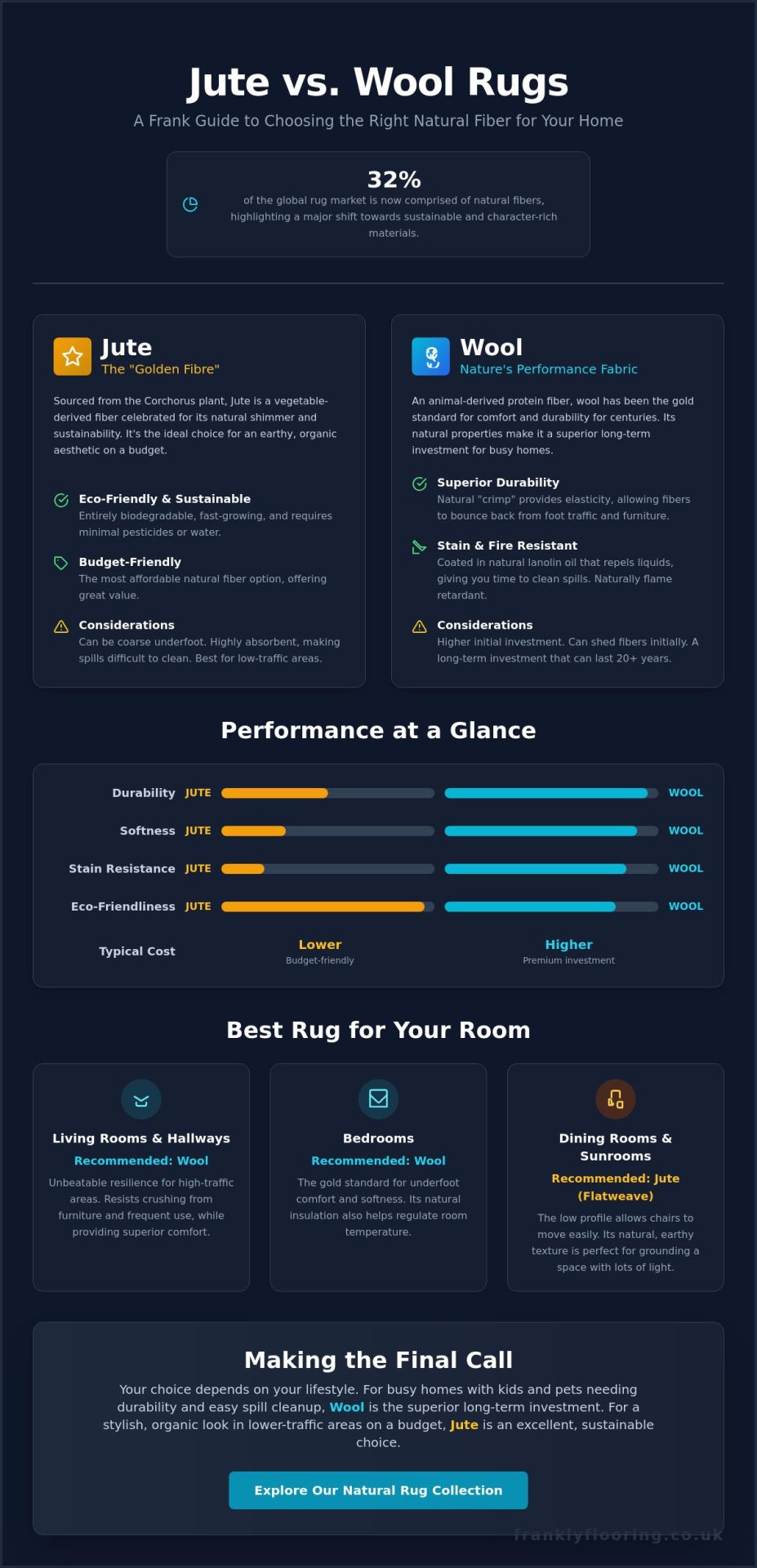
Jute vs Wool: The Direct Comparison on Performance & Maintenance
When you look at the financial reality in 2026, wool typically requires a higher initial investment than jute. While market rates fluctuate, you can generally expect to pay twice as much for a quality wool piece. This isn’t just a “luxury tax.” It represents the cost of a material that can withstand decades of use rather than years. If you’re choosing a foundation for a high-traffic family room, the jute vs wool rug debate often comes down to how frequently you’re willing to replace your flooring. Wool is a long-term asset; jute is a stylish, shorter-term solution that’s easier on the bank balance today.
The “Feel Test” is where the differences become most apparent. Wool offers a soft, elastic pile that cushions your step and provides a sense of luxury. Jute is much firmer. It feels grounded and raw. If you have toddlers crawling on the floor, wool is the kinder choice for their knees. However, for a home office or a hallway where you’re usually wearing slippers, the rustic texture of jute provides a sophisticated, organic aesthetic that many homeowners find more appealing than traditional carpet.
The Cleaning Reality Check
Daily maintenance for both materials involves regular vacuuming, but the emergency response to spills is where they diverge. Wool is remarkably forgiving. If you spill a drink, the natural lanolin gives you a few minutes to act. The golden rule is to dab, never rub. Rubbing pushes the liquid deeper into the fibers and can damage the pile. Jute is far more difficult to rescue. A red wine spill on jute is often a permanent addition to the room’s decor because the plant fibers act like a sponge. On the positive side, the mottled, earthy tones of jute are excellent at hiding dry dust and pet hair between cleanings.
Pet-Friendliness and Allergies
If you have cats or dogs, the construction of the rug matters as much as the material. Many jute rugs feature chunky, looped weaves. These loops are prime targets for pet claws, which can snag and pull the fibers, leading to a “shaggy” look that’s hard to fix. Wool rugs, especially those with a cut pile, are much more resilient to zoomies and scratching. For allergy sufferers, wool acts as a natural air filter by trapping dust and allergens in its fibers until they can be vacuumed away. Be warned: “pet accidents” on either material require immediate attention, but jute’s tendency to brown when wet makes it a risky choice for a puppy still in training. If you’re ready to make a choice, you can browse our full range of rugs to find the right fit for your home.
Making the Final Call: Which Rug Suits Your Specific Room?
Choosing between a jute vs wool rug ultimately depends on the specific function of your space. In the bedroom, wool is the undisputed winner. There is nothing quite like the warmth and softness of a natural wool pile when you take that first step out of bed on a frosty morning. Because wool is a natural insulator, it helps maintain a consistent temperature in the room, making it a functional choice for comfort as well as style.
The dining room presents a different set of challenges. Here, a flatweave jute rug is often the more practical selection. Dining chairs need to slide back and forth easily; a thick wool pile can catch on chair legs and make movement difficult. Jute is naturally thin and durable, allowing furniture to move without bunching the fabric. In the living room, the choice is more nuanced. You want the cosiness of wool for evening relaxation, but you might prefer the rugged, organic look of plant fibers. If you’re torn between the two, a wool-jute blend is our frank recommendation. These blends offer the tactile softness of wool with the structural strength and earthy aesthetic of jute.
The Best of Both Worlds: Layering Rugs
One of the most effective designer tricks is layering. You can use a large, inexpensive jute rug as a neutral base to define the area and then place a smaller, plush wool rug on top. This approach provides the trendy Scandi-Boho look while giving you softness exactly where you need it, such as under a coffee table or seating area. To prevent this from becoming a tripping hazard, you must secure the top rug to the base. Specialised double-sided rug tapes or high-friction grippers are essential. You can achieve this high-end aesthetic easily by exploring the variety of Frankly Flooring rugs available to suit different layering combinations.
Checklist Before You Buy
Before you make your final decision, take a moment to run through this practical checklist. A rug that is too small for a room will make the space look disjointed. Measure your area twice and ensure that at least the front legs of your furniture sit on the rug to anchor the room properly. Don’t forget to check the underside of your chosen piece. Most natural rugs require a separate gripper or pad to prevent sliding and to protect the floor beneath from the abrasive nature of plant fibers. Finally, consider how your new foundation will look alongside your existing pieces. A well-chosen rug should complement quality furniture, acting as the final element that ties your entire interior design together.
Grounding Your Home with Confidence
Deciding on a jute vs wool rug doesn’t have to be a gamble. If you prioritize the sink-in comfort of a bedroom or the long-term resilience of a busy hallway, wool remains your gold standard. It’s a genuine investment that can serve your home for over twenty years with the right care. If you’re after that organic, earthy aesthetic for a dining room or a budget-friendly way to define an open-plan space, jute is a fantastic, sustainable contender. Just remember to keep it away from moisture and always use a quality gripper to protect the floors beneath.
At Frankly Flooring, we provide the straight facts so you can make a choice that actually works for your daily life. As a family-run business with over 20 years of experience, we’ve seen how these materials perform in real-world environments. We offer no-nonsense flooring advice and direct-to-door UK delivery to make your selection process as stress-free as possible.
Browse our full collection of rugs and find your perfect match today. Whether you choose the plushness of wool or the raw charm of jute, we’re here to help you build a home with character and longevity.
Frequently Asked Questions
Is a jute rug softer than a wool rug?
No, wool is significantly softer and more cushioned underfoot. While high quality jute has a smooth, waxy surface that feels pleasant, it remains a firm plant fiber. Wool possesses natural elasticity and a plush pile that provides a sink in feeling. If you’re choosing a jute vs wool rug for a nursery or a bedroom where you’ll be spending time on the floor, wool is the superior choice for comfort.
Do jute rugs shed as much as wool rugs?
Jute rugs don’t shed in the same way that wool does. New wool rugs release loose staple fibers for the first few months, creating a fluffy pile on the surface. Jute, however, produces a fine, sand like dust as the plant fibers break down over time. While wool shedding eventually stops after regular vacuuming, jute will continue to drop small amounts of fiber debris throughout its entire lifespan.
Can you vacuum a jute rug with a regular vacuum cleaner?
Yes, you can use a regular vacuum, but you must turn off the beater bar or power brush. The aggressive spinning of a vacuum brush can fray the natural jute fibers and cause the weave to look fuzzy or worn prematurely. Use the suction only setting and pass over the rug multiple times to pull out the fine dust that settles at the bottom of the weave.
Which is better for high-traffic areas: wool or jute?
Wool is generally the better choice for high traffic living areas because it doesn’t crush or “ugly out” easily. Its natural springiness allows it to recover its shape after thousands of footsteps. Jute is very tough, but it’s prone to fraying and cannot bounce back once the fibers are flattened. Jute is excellent for dining rooms where chairs need to slide, but wool wins for hallways.
Are wool rugs worth the extra money compared to jute?
Wool is worth the investment if you want a rug that lasts 20 years or more. While jute is an excellent budget friendly option for a stylish update, it typically needs replacing within 3 to 5 years in busy homes. When you calculate the cost per year of use, wool often proves to be the better value. It also offers superior stain resistance and thermal insulation that jute simply cannot provide.
How do I get a stain out of a jute rug?
You must act quickly and use as little liquid as possible. Blot the spill immediately with a clean, white paper towel to soak up the moisture. Avoid using water or steam, as this often leads to permanent “browning” stains. For tougher marks, use a specialized dry cleaning powder designed for natural fibers. If the stain is liquid based and has already set, it’s often permanent on jute.
Are wool rugs better for people with allergies?
Yes, wool is a better choice for allergy sufferers. The complex structure of wool fibers naturally traps dust and common allergens, holding them deep in the pile until you vacuum them away. This prevents irritants from floating in the air you breathe. Jute can actually be problematic for some people because it produces its own fine plant dust as the fibers break down, which can irritate sensitive respiratory systems.
Can I use a jute rug on top of a carpet?
You can certainly layer a jute rug over a carpet to add texture and a Scandi Boho vibe. However, you must use a specific rug to carpet gripper. Jute has an abrasive underside that can act like sandpaper against your carpet pile if it’s allowed to shift. A proper gripper prevents the rug from “creeping” across the room and protects your primary flooring from friction damage and premature wear.