
You might have heard that grey is “out” for 2026, but the truth is that a poorly chosen grey wood dining table was never really “in” to begin with. It’s a common frustration for UK homeowners who want a modern look but fear their furniture will feel clinical or dated before the decade is through. You are likely stuck between choosing a cheap “grey effect” laminate and a genuine grey wash timber that actually celebrates the grain. Choosing the wrong one often leads to a table that clashes with your flooring or fails to stand up to daily life.
In the spirit of being frank, we agree that a dining table is a foundational investment, not a disposable trend. This guide shows you how to find a grey wood dining table that balances current aesthetics with the longevity your home deserves. We will look at the technical side of durability, including how the June 2026 fire safety smoulder tests and new timber import regulations affect your purchase. You will walk away with a clear plan for matching tones with your flooring and the confidence to pick a piece that remains a stylish, high-quality centerpiece for years to come.
Key Takeaways
- Learn why a high-quality grey wood dining table serves as a “textural neutral” that bridges the gap between rustic charm and modern minimalism.
- Understand the “Frank” truth about solid timber versus veneers to ensure your furniture stands up to years of daily family use.
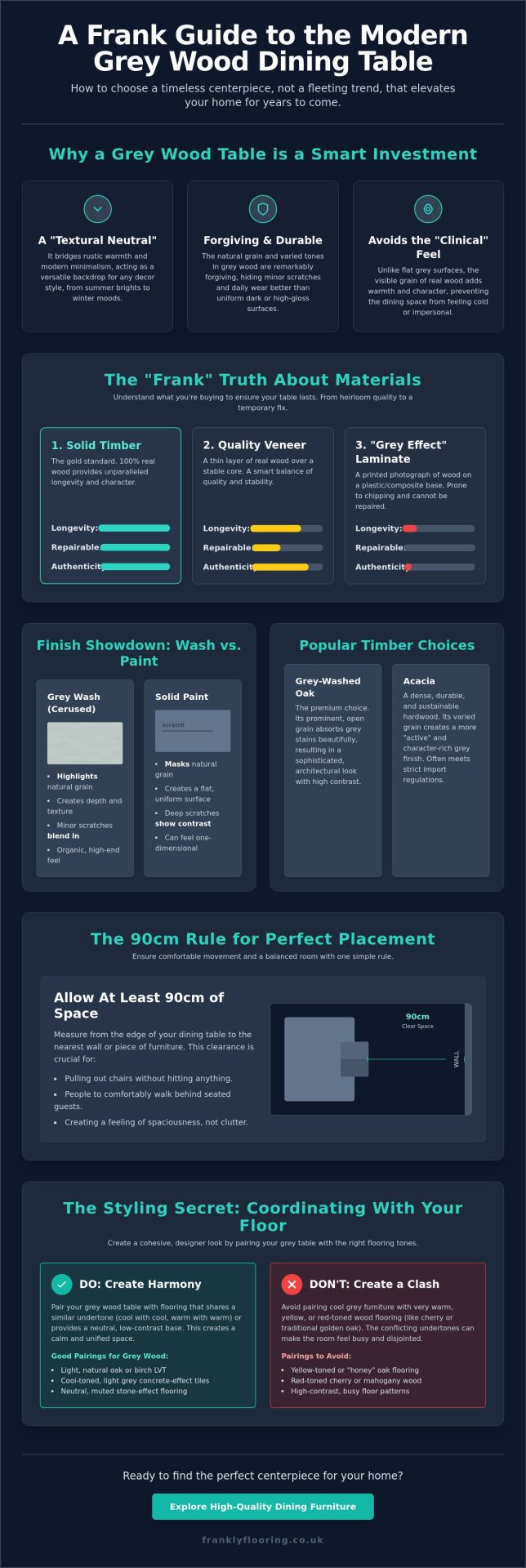
- Master the 90cm rule to calculate the ideal table size for your room, ensuring there is always enough space for comfortable movement.
- Discover the golden rule of coordinating wood tones with your flooring, including how to pair grey wood with LVT for a cohesive, designer finish.
Why the Grey Wood Dining Table is a Modern British Classic
The grey wood dining table has earned its place as a staple in British homes for a simple reason: it offers a balance that few other materials can strike. It acts as a bridge between the rugged, tactile warmth of traditional rustic furniture and the sharp, clean lines of modern minimalism. While some see grey as a temporary trend, we view it as a “textural neutral.” It provides a sophisticated backdrop that does not demand attention but certainly rewards it upon closer inspection. This versatility makes it an ideal base for seasonal decor, allowing you to swap out bright linens in summer for deep, moody tones in winter without ever clashing with your furniture.
Choosing timber over concrete or plastic “grey effect” alternatives is a decision rooted in both longevity and atmosphere. Concrete tables are notoriously heavy and can feel cold to the touch, while laminate finishes often lack the depth and variation of real grain. Natural wood responds to the environment; it feels warmer under your hands and develops a unique character over time. The varied tones within a grey timber grain are also exceptionally practical. Unlike high-gloss black or dark walnut stains that highlight every speck of dust and minor scratch, a grey finish is remarkably forgiving for a busy household. It hides the evidence of daily life while maintaining an upscale appearance.
The Psychology of Grey in the Dining Room
Dining rooms should be spaces of calm and conversation. Grey creates a sophisticated, grounded atmosphere that encourages guests to relax. However, there is a risk of a room feeling “clinical” if the materials are too flat. This is where visible wood grain becomes essential. By selecting a table where the natural patterns of the timber are still present, you avoid the “cold” trap. In the UK, where natural light levels can be unpredictable and often lean toward the cooler end of the spectrum, grey wood harmonizes with the environment rather than fighting against it.
Grey Wood vs. Painted Grey Furniture
It is easy to confuse a grey wash with a solid painted finish, but the results are worlds apart. A grey wash is a translucent layer that allows the unique story of the timber to shine through. This involves specific wood finishing techniques designed to enhance the grain rather than mask it. Solid paint, while popular, creates a uniform surface that can feel somewhat one-dimensional and lacks the organic feel of raw material.
From a durability standpoint, a natural grain finish usually wins. If a painted table gets a deep scratch, the original wood colour peeks through, creating a jarring contrast. On a grey wood dining table with a washed finish, a minor ding often blends into the existing texture of the grain. This makes it an ideal choice for those who value both style and a stress-free maintenance routine.
Materials and Finishes: From Grey Wash Oak to Acacia
The “Frank” truth about materials starts with understanding exactly what you are paying for. When you shop for a grey wood dining table, you will encounter three main tiers: solid wood, high-quality veneers, and “grey effect” laminates. Solid timber is the gold standard for longevity. It can be sanded down and refinished if life gets a bit too rowdy. High-quality veneers use a thin layer of real wood over a stable core, which isn’t necessarily a bad thing; it prevents the warping that can sometimes plague solid slabs in centrally heated UK homes. However, you should avoid “grey effect” laminates if you want a piece that lasts. These are essentially just photographs of wood grain printed onto plastic, and once they chip, they are impossible to repair.
Real timber is alive. It has a depth that artificial surfaces simply cannot replicate. When identifying furniture woods, look closely at the grain patterns and the underside of the table. A genuine grey wash, often called a cerused finish, involves rubbing pigments into the open pores of the wood. This technique highlights the natural texture rather than hiding it under a flat coat of paint. If you’re looking for a foundation that lasts, checking out our range of furniture is a good place to start your search for quality materials.
Timber Species and Their Grey Potential
- Grey-washed Oak: This is the premium choice. Oak has a prominent, open grain that takes grey stains beautifully, creating a high-end, architectural look.
- Acacia: A incredibly dense and durable hardwood. It’s naturally sustainable, and as of June 2026, it often meets the strictest new UK timber import regulations for ethical sourcing. Its varied grain results in a more “active” grey finish with lots of character.
- Pine: The budget-friendly route. Pine is softer and has a more rustic feel. It’s perfect for a farmhouse aesthetic, though it will pick up “character marks” like dents and scratches more easily than oak or acacia.
Understanding the Finish: Lacquer vs. Wax
The finish is your table’s suit of armour. For a busy family dining room, matt lacquer is almost always the right answer. It provides a hard, transparent seal that protects against water rings and food stains without adding an artificial shine. Waxed finishes feel more organic and velvety to the touch, but they’re high-maintenance. They require regular re-waxing and offer very little protection against heat or liquids.
One technical detail often overlooked is UV protection. Grey stains are susceptible to “ambering” or yellowing when exposed to direct sunlight. Ensure your table has a UV-stable finish. This keeps your sophisticated grey from turning a sickly shade of yellow after a few summers in a bright conservatory or dining room.
Finding the Right Fit: Size, Shape, and Seating
Selecting a grey wood dining table is often an emotional decision based on how it looks in a showroom or a glossy catalogue. However, the most beautiful table in the world will become a source of daily frustration if it doesn’t fit the physical reality of your room. The most common mistake we see isn’t picking the wrong style, but failing to account for “clearance zone.” You need to measure your space with the chairs pulled out, not just tucked neatly under the edge. The 90cm rule is a non-negotiable standard for comfortable living; you should maintain at least 90cm of space between the table edge and the nearest wall or piece of furniture. This allows guests to sit down and rise without performing a gymnastic routine, and it leaves enough room for someone to walk behind a seated person.
Manufacturer seating claims are often optimistic. A table marketed as a “six-seater” might technically fit six chairs, but it doesn’t guarantee six adults can eat a meal without clashing elbows. For real-world comfort, allow 60cm to 70cm of width per person. If you regularly host dinner parties, aim for the higher end of that scale. In the UK, where dining rooms often double as home offices or craft spaces, the demand for multifunctional furniture is rising. In fact, the market for multifunctional dining sets with expandable features is projected to grow 2.4% annually through 2026. This reflects a shift toward furniture that works hard in limited square footage.
Shape Matters: Round vs. Rectangular
Round grey tables are the secret weapon for small kitchens and open-plan apartments. They lack sharp corners, which improves the flow of foot traffic and makes a room feel less cluttered. A pedestal base is particularly effective here, as it eliminates the four corner legs that often get in the way of your guests’ knees. Rectangular tables remain the classic choice for dedicated dining rooms. They provide a formal centrepiece and generally offer more surface area for serving dishes, making them better suited for large family gatherings or traditional Sunday roasts.
The Practicality of Extendable Grey Tables
If your guest list fluctuates, an extendable grey wood dining table is a sensible investment. Butterfly extensions are the most convenient; the extra leaf is stored on a hinge inside the table frame, so you don’t have to find a cupboard to hide it in. Removable leaf extensions are simpler but require separate storage and are more prone to accidental damage. When choosing an extendable model, check that the grey finish on the extension panel matches the main tabletop perfectly. It’s also vital to measure your room for the “fully extended” length. You don’t want to find out on Christmas Day that your extended table prevents the kitchen door from opening.
The Styling Secret: Coordinating Flooring and Chairs
The most common design trap homeowners fall into is trying to match their grey wood dining table exactly to their grey flooring. On paper, it sounds logical. In reality, it creates a flat, muddy atmosphere where your furniture simply disappears into the background. Every grey has an undertone; some lean toward blue or silver, while others have a hint of beige or “greige.” If these undertones fight each other, the room will feel off-balance. The golden rule is to seek contrast rather than a perfect match. If you have light silver-grey floors, choose a charcoal grey table. If your flooring is a deep slate, a pale grey-washed oak will pop beautifully.
Pairing your table with LVT flooring is an excellent way to achieve a high-end look without the maintenance of real stone or traditional wood. LVT allows you to define a waterproof dining zone that handles spills from a busy family dinner while still looking sophisticated. If you’re worried about the room feeling too cold, consider using carpet in an adjacent lounge area or placing a large, textured rug under the table. This creates what designers call a “furniture island.” It physically anchors the dining set and provides a tactile break between the wood of the table and the hard surface of the floor.
Matching Grey Tables with Different Floors
When working with engineered wood flooring, the grain is your best friend. Don’t be afraid to mix a grey-washed table with a natural oak or walnut floor. The contrast in warmth makes the grey tones look intentional rather than accidental. In rooms where you’ve chosen a grey-on-grey palette, a textured rug is essential. It adds a layer of shadow and depth that prevents the table legs from blending into the floorboards.
Chair Pairings for Grey Wood
The chairs you choose will dictate the final “vibe” of your dining space. For a clean, Scandi-inspired look, pair your grey wood dining table with white or light oak chairs. This keeps the room feeling airy and bright. If you prefer something more rugged, black metal or distressed leather seating creates an industrial edge that complements the cool tones of the timber. For those wanting a more traditional feel, upholstered chairs in deep navy or forest green provide a stunning splash of colour that makes the grey wood look even more refined.
If you’re still undecided on how to ground your furniture, take a look at our full range of flooring options to find the perfect partner for your new table.
Why Buy Your Dining Furniture from Frankly Flooring?
With over 20 years of expertise in home interiors and materials, we don’t just sell furniture; we understand the technical craftsmanship behind it. Our brand was built on a foundation of transparency. We believe you deserve a “Frank” approach to quality, which means providing no-nonsense descriptions and honest value rather than high-pressure sales tactics. When you browse for a grey wood dining table on our site, you’re looking at a piece that has been vetted for its structural integrity and material quality. We’ve seen how typical high-street retailers often hide the truth about veneers and laminates, and we’ve decided to do things differently.
Our business model is built around national UK delivery with a focus on customer integrity. We manage the full journey of your order to ensure a stress-free experience. Because we handle everything from flooring and accessories to furniture, we have a unique perspective on how a room fits together. We aren’t just selling a standalone object; we’re providing a foundational element of your home’s character. This comprehensive range allows us to offer advice that considers your entire space, from the floorboards up to the tabletop.
Our Commitment to Quality
Every item in our collection is carefully curated to meet high durability standards. As a family-run business, we operate on a simple principle: we only sell what we would be proud to put in our own homes. We’ve moved away from the traditional “showroom tax” by utilizing a direct-to-consumer model. This allows us to offer competitive pricing on premium materials like solid oak and acacia without the unnecessary overheads of a physical storefront. You get the same professional-grade furniture at a price that reflects its true value.
The Complete Room Solution
Creating a cohesive home shouldn’t be a struggle between different suppliers. We offer expert advice on matching your new table with our quality furniture, ensuring that your sideboards, chairs, and flooring all speak the same design language. We’ve spent two decades refining our knowledge of how different timbers and finishes interact, and we’re happy to share that expertise with you. Whether you’re starting a full renovation or just updating your dining area, we provide a one-stop shop for a high-end, durable finish.
If you’re ready to find a centerpiece that balances modern aesthetics with long-lasting quality, browse our latest Grey Wood Dining Tables at Frankly Flooring and discover furniture built with integrity.
Investing in a Centrepiece That Lasts
Choosing a new dining table is a decision that impacts the daily flow and character of your home. You now have the technical knowledge to look past superficial “grey effect” finishes and identify the genuine timber grains that offer real longevity. By applying the 90cm clearance rule and the golden rule of flooring contrast, you can ensure your space remains functional and visually balanced. A grey wood dining table is more than a modern trend; it is a versatile neutral that serves as a foundation for years of family gatherings and quiet mornings alike.
At Frankly Flooring, we believe in making these big decisions simple through transparency and technical expertise. We bring over 20 years of family-run experience to our curated collections, cutting out the “showroom tax” to provide honest value directly to your door. Our no-nonsense approach means you get exactly what is described, delivered UK-wide with a focus on integrity. We are here to help you move from initial inspiration to a completed room that you can take pride in for decades.
Find your perfect grey wood dining table at Frankly Flooring and start building a space that truly works for your home.
Frequently Asked Questions
Is a grey wood dining table still in style for 2026?
Grey wood remains a modern staple in 2026, though the trend has shifted from cool, flat greys to warmer “textural neutrals.” A high-quality grey wood dining table that showcases natural timber grain is considered a modern classic. It bridges the gap between industrial and rustic styles. As long as you avoid artificial, plastic-looking finishes, your table will remain a stylish foundation for years.
How do I clean a grey-washed wood table without damaging the finish?
Use a slightly damp, lint-free microfiber cloth for daily cleaning. Avoid abrasive chemicals, bleach, or silicone-based polishes, as these can strip the protective lacquer or settle into the grain of a grey-washed finish. For stubborn marks, a drop of mild dish soap in warm water is sufficient. Always wipe in the direction of the grain to maintain the table’s integrity.
Will a grey table make my dining room look too dark?
A grey table won’t darken a room if you choose the right shade and contrast. If your space lacks natural light, opt for a pale grey-wash rather than a deep charcoal. Pairing the table with lighter chairs or a textured rug helps bounce light around the base. It is the lack of contrast, not the grey colour itself, that usually makes a room feel heavy.
Can I pair a grey wood table with oak flooring?
You can certainly pair a grey wood table with oak flooring, and we often recommend it for the natural contrast it provides. The warmth of natural oak prevents a grey table from looking too clinical. Ensure the undertones don’t clash; a cool grey table works best against the golden hues of oak. This creates a layered, designer look that feels intentional.
What is the best wood for a grey dining table?
Oak and Acacia are the superior choices for grey finishes due to their dense structure and prominent grain patterns. Oak’s open grain takes grey stains exceptionally well, allowing the “cerused” look to shine. Acacia is a sustainable hardwood that offers incredible durability and a unique, varied texture. These species ensure your grey wood dining table handles daily wear while looking premium.
How do I know if a dining table is real wood or just a veneer?
Look at the grain patterns and the underside of the tabletop. Real wood has unique, non-repeating grain, while cheap laminates often show a repeating “photographic” pattern every few feet. Check the edges; a veneer will show a visible seam where the thin layer meets the core material. Solid wood will show the end-grain continuing through the thickness of the plank.
What size dining table do I need for 6 people?
For six people to sit comfortably, you need a table between 150cm and 180cm in length. This allows for the standard 60cm to 70cm of width per person required for elbow room. If you prefer a round table, a diameter of at least 150cm is necessary to accommodate six adults without clashing knees or feeling cramped during a meal.
Do I need to use placemats on a lacquered grey wood table?
Yes, you should still use placemats and coasters even on a lacquered surface. While modern lacquers provide excellent protection against moisture, they are not entirely immune to heat damage or sharp scratches. Hot plates can cause “blooming,” which are white cloudy marks trapped under the finish. Using simple protection ensures your table’s sophisticated finish remains pristine for the long term.