
The most expensive rug in the shop isn’t always the one that survives your hallway. It’s a hard truth many homeowners learn only after their luxury wool purchase starts shedding or matting down within the first six months. When you’re hunting for the best rug for high traffic areas, the goal isn’t just to find something that looks good on day one. You need a piece that handles the “front line” of your home without losing its character or becoming a nightmare to scrub.
We agree that a rug should be a foundational element of your home’s character, not a source of constant stress. You shouldn’t have to choose between a stylish aesthetic and a material that can actually withstand pet accidents and heavy boots. In this guide, we’ll provide a frank assessment of the materials and constructions that offer the best balance of durability and design. You’ll discover why low pile heights and resilient fiber memory are more important than a high price tag. We’ll also break down which specific weaves keep their texture and stay easy to clean, ensuring your investment looks as good in three years as it does today.
Key Takeaways
- Learn why wool and polypropylene are the top contenders when selecting the best rug for high traffic areas, balancing natural resilience with easy-to-clean synthetic fibres.
- Discover the “1cm Rule” for pile height that prevents your floor coverings from looking worn out and matted within months.
- Learn how to distinguish between high-traffic “passes” and low-use zones to ensure you aren’t overspending on the wrong materials.
- Understand why the right rug pad is the only way to stop the “sandpaper effect” from damaging your laminate or wood floors.
Defining High Traffic: Why Your Current Rug is Failing
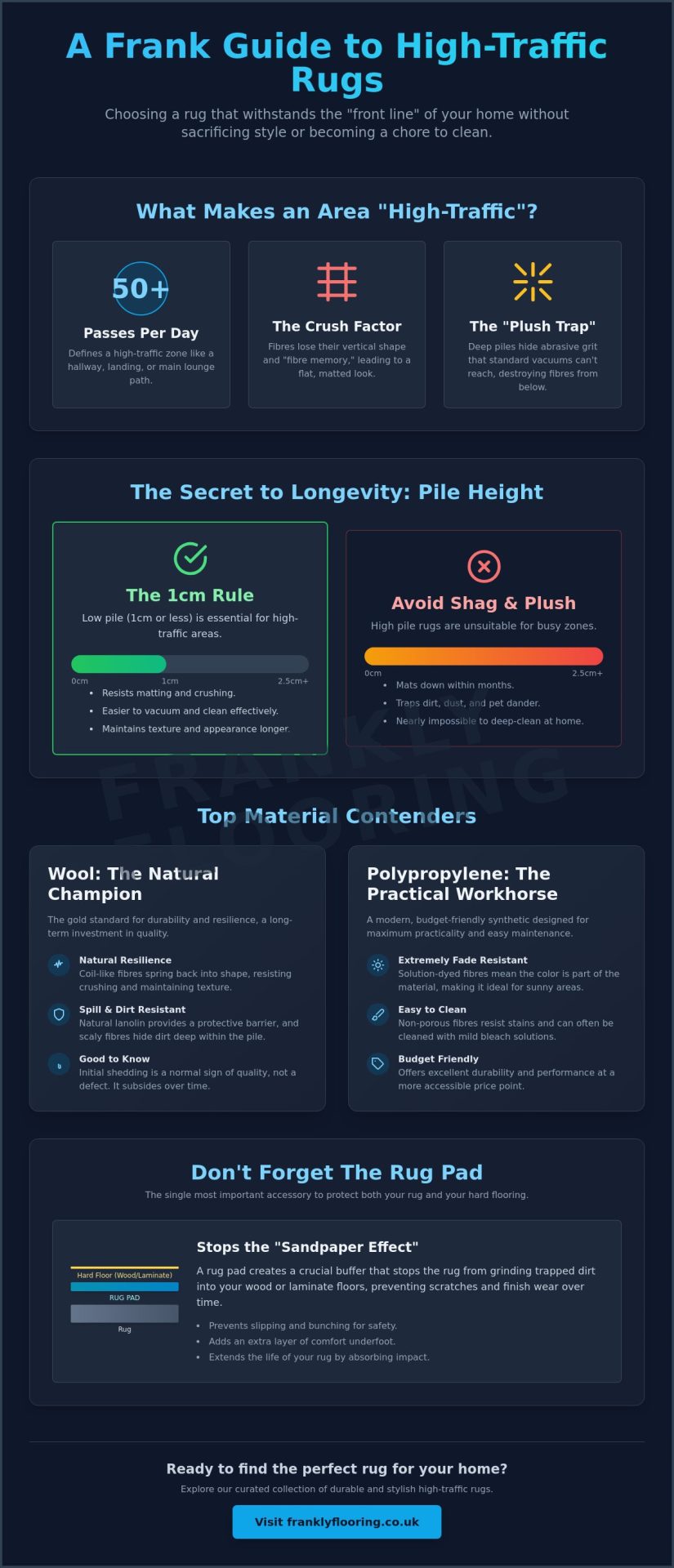
How do you actually know if a room is high traffic? Most homeowners rely on a gut feeling, but we prefer a more precise audit. A high-traffic zone is any area that sees 50 or more “passes” in a single day. This includes the main hallway, the landing, and the specific paths into your lounge. When you are searching for the best rug for high traffic areas, you’re looking for a product that can withstand this constant cycle of compression and release without looking tired.
The primary reason rugs look “dead” after a year is the Crush Factor. This is the physical point where fibres lose their vertical integrity under the weight of footsteps. Once the pile is crushed, the rug loses its ability to reflect light and trap warmth. Fibre memory is the ability of a rug to bounce back to its original shape after being stepped on. Without strong fibre memory, a rug is essentially a disposable item that will flatten into a dull, hard mat in mere months.
We also need to address the “Plush Trap.” While deep, soft piles are tempting in a showroom, they act as a magnet for microscopic grit. This dirt settles at the base of the pile where a standard vacuum cannot reach. Every time someone walks over it, that grit acts like sandpaper on the rug fibres, slowly sawing through them from the bottom up. It’s a silent process that destroys the rug’s foundation long before the surface looks dirty.
The Anatomy of Rug Wear and Tear
Friction damage is the most visible form of wear. Every step involves a slight twisting motion that breaks down the protective scales of natural fibres. Over time, this makes the rug look fuzzy or frayed. Dirt abrasion is even worse; it’s the hidden killer that does the most structural damage. Tiny particles of sand and soil cut through the rug backings, leading to holes and excessive shedding. In bright UK conservatories or south-facing lounges, UV fading is a secondary high-traffic issue. Constant sun exposure breaks down chemical dyes. Understanding Carpet construction and materials is vital here, as different weaves respond differently to these environmental stresses.
The “Frank” Truth About Shag and Plush Rugs
We believe in being direct with our customers. If a rug is described as “soft and cloud-like,” it’s almost certainly the wrong choice for a hallway. These rugs usually end up matted and flat within six months of heavy use. Deep-cleaning a high-pile rug in a busy household is a losing battle. The density of the fibres prevents suction from reaching the backing, which means pet dander and dust stay trapped. Save the plush rugs for the bedroom where they belong. In your “front line” areas, they simply won’t survive the pressure. Focus on low-profile options that prioritize durability over initial softness.
The Best Materials for Busy Homes: Wool vs. Synthetics
The best rug for high traffic areas is often a toss-up between natural resilience and synthetic science. You’re looking for a fibre that doesn’t just look good under a spotlight but stays upright under the weight of a busy household. Choosing the right material is about prioritizing long-term satisfaction over a quick, cheap purchase that you’ll have to replace next season.
Wool: Nature’s High-Performance Fibre
Wool remains the gold standard for a reason. Each individual fibre has a natural, coil-like structure that acts like a tiny spring, allowing the rug to recover its shape after being stepped on. Beyond its “memory,” wool contains natural lanolin, which creates a protective barrier against spills. The scaly surface of the fibre is also excellent at trapping dust and dirt deep within the pile so it doesn’t sit on the surface. This is why wool maintains its appearance far longer than smooth synthetics. Experts often highlight the durability of natural materials, noting that a well-crafted wool piece can easily last for decades if maintained properly.
Many homeowners worry about shedding, but it’s often a sign of quality. It’s simply short, excess fibres working their way out of the weave; it doesn’t mean the rug is falling apart. Because of its weight and texture, a wool rug is a perfect partner for engineered wood flooring, providing a soft contrast to the clean lines of timber floors.
Polypropylene and PET: The Modern Practical Choice
When searching for the best rug for high traffic areas on a budget, polypropylene is your workhorse. These rugs are solution-dyed, meaning the colour is part of the fibre itself rather than just a coating. This makes them incredibly resistant to fading and allows for cleaning with mild bleach solutions. We’ve seen a massive rise in the “Outdoor-In” trend, where weather-resistant rugs are brought into muddy UK boot rooms because they can literally be hosed down. For those focused on sustainability, PET rugs made from recycled plastic bottles offer a surprisingly soft texture while keeping waste out of landfills.
Nylon is another synthetic contender that often gets overlooked. It offers even higher resilience and “bounce back” than polypropylene, which prevents the permanent furniture marks you might see on cheaper rugs. While it usually comes with a higher price tag, the durability makes it a smart long-term investment for stairs or busy landings. However, you should avoid viscose, silk, or thin cotton flat-weaves in busy zones. These materials lack structural integrity. They’ll stain permanently the moment a drink is spilled and flatten out within weeks. If you’re ready to find a rug that actually lasts, you can browse our latest rug collections to see these materials in action.
Construction Matters: Why Pile Height is the Secret to Longevity
The architecture of a rug is just as important as the material it’s made from. You can buy the finest wool in the world, but if the construction is too tall and loose, it will still flatten in a matter of months. When you’re looking for the best rug for high traffic areas, we recommend following the “1cm Rule.” Ideally, you want to keep the pile height under 10mm. Anything taller creates a leverage point where the fibres can easily bend and snap under the weight of a footstep. Staying under this limit also ensures your rug won’t interfere with door clearances, which is a common frustration in narrow UK hallways.
Loop pile rugs, commonly known as Berber, are far superior to cut piles for durability. Because the yarn is looped back into the backing, the fibre is naturally stronger and less prone to “shading” or tracking. Cut pile rugs, while softer, show every footprint and vacuum line, which can make a busy room look messy even when it’s clean. For the absolute maximum in durability, consider a flat-weave. These rugs have zero pile height. They are thin, incredibly tough, and offer the ultimate “front line” protection for entryways that see constant action.
The Benefit of Low Pile for Maintenance
Low-pile surfaces are the only way to ensure your cleaning equipment actually functions properly. Standard upright vacuums and modern robot vacuums perform significantly better on low-pile rugs because the suction can reach the very base of the weave. This prevents the “sandpaper effect” we mentioned earlier. A low pile doesn’t have to mean low comfort if you pair it with a high-quality dual-surface underlay to provide that missing cushioning. It also reduces the trip hazard in transition zones, making your home safer for children and elderly guests.
Pattern and Colour: Hiding the Evidence
The best rug for high traffic areas isn’t just about the build; it’s about the visual strategy. Solid colours are a trap for busy households. Every crumb, pet hair, and speck of dust stands out against a uniform background. Instead, look for “heathered” or multi-tonal designs. These rugs use a blend of different coloured yarns to create a textured look that naturally camouflages daily debris. Mid-tones like greys and tans are the sweet spot for hiding dirt. Many homeowners find that the same logic applying to grey carpet trends, where multi-tonal fibres hide daily wear, works perfectly for rug selection too.
Room-by-Room Guide: Matching the Rug to the Traffic Pattern
Every room in your home has a unique footprint of wear. Identifying these specific patterns helps you choose the best rug for high traffic areas without overspending on durability where it isn’t strictly necessary. You wouldn’t put a rough sisal rug in a nursery, and you certainly shouldn’t put a delicate silk rug in a mudroom. Each space requires a distinct strategy to handle the daily grind.
Hallways are the front line of your home. This is where outside grit first meets your internal flooring. We often recommend natural fibres like Sisal or Jute for these narrow strips. They are incredibly tough and have a textured, multi-tonal look that naturally masks dirt and debris. Because they lack a tall pile, they don’t show the “track marks” that often ruin the look of plush hallway carpets.
Entrance Halls and Mudrooms
Think of coir matting as your “first strike” against grit. It scrapes the worst of the mud off shoes before it can even reach your main rug. In narrow corridors, runner rugs need an extra-secure backing to prevent them from bunching up or sliding. If you’re considering a runner for your staircase, you’ll need to understand how carpet gripper works to keep the material tight and safe underfoot. A loose runner isn’t just a trip hazard; the constant movement will also cause the backing to disintegrate against the floor.
Living and Dining Room Balance
Kitchens and dining areas present a different challenge. Here, the focus is on spill resistance and chair-slide durability. A dining rug must be large enough that when chairs are pulled out, the back legs stay firmly on the rug. This prevents the edges from curling or fraying over time. In open-plan homes, rugs are essential tools for zoning. Pairing a durable rug with quality furniture creates a clear boundary between the lounge and the eating area.
Our top “Frank” tip for longevity is simple: rotate your rug 180 degrees every six months. This ensures that the main path from the kitchen to the sofa doesn’t become a permanent, worn-down track in the pile. By equalising the traffic patterns, you can double the lifespan of your investment. Landings also require special attention. They are “pivot points” where people turn to enter bedrooms. This twisting motion grinds dirt into the fibres like a pestle and mortar. For these zones, stick to the low-pile wool or high-resilience nylon we discussed earlier.
If you’re ready to protect your floors with a style that lasts, you can explore our full range of durable rugs to find the perfect fit for your home’s busiest zones.
Making It Last: Rug Pads and Maintenance for Busy Zones
Even the best rug for high traffic areas will fail if you ignore what is happening underneath it. Most homeowners buy a rug pad for comfort, but its real job is structural protection. Without a pad, your rug acts like a sheet of sandpaper. Every time you step on it, microscopic grit trapped between the rug and the floor grinds against your finish. This is especially dangerous for laminate flooring, where the top wear layer can be permanently scratched by this constant friction.
Choosing the right pad depends on your specific needs. Felt pads offer the best cushioning for large area rugs in lounges. Rubber pads provide the essential grip for narrow runners that would otherwise slide underfoot. Dual-surface pads are the superior choice for high-traffic zones because they combine a felt top with a rubber base. This provides both the “bounce back” comfort and the non-slip safety required for busy entryways. We recommend a three-tier maintenance schedule to keep your investment in top shape. Daily vacuuming is your first line of defence. It removes grit before it sinks into the base of the pile. Perform a weekly spot-check for small stains. Finally, schedule an annual deep clean to remove embedded oils that a vacuum cannot reach. If a spill happens, remember the only rule that matters: blot, don’t rub. Rubbing a stain breaks the fibre structure and permanently ruins the rug’s texture.
Protecting Your Sub-floor
A well-placed rug is a great way to prevent scratches on LVT flooring. However, you must be careful with cheap, rubber-backed rugs. The chemicals in low-quality rubber can react with vinyl, causing permanent yellowing or staining that cannot be cleaned off. We always recommend breathable, high-quality pads. These allow air to circulate, which prevents moisture from being trapped against the floor surface and protects your sub-floor’s integrity.
Professional Cleaning vs. DIY
Knowing when to call a professional is vital for the best rug for high traffic areas. Wool rugs are sensitive to high heat and harsh chemicals. They should almost always be handled by an expert who understands natural fibres. Conversely, a rental machine is frankly enough for most synthetic polypropylene rugs. The biggest danger with DIY cleaning is over-wetting. If the backing stays damp for too long, it leads to mould growth and structural breakdown. Before you make your final purchase, check that the pile height is under 10mm, the material is resilient, and you have a breathable pad ready to go.
Invest in a Rug That Stands Its Ground
Finding the best rug for high traffic areas doesn’t have to be a gamble. By sticking to the 1cm Rule for pile height and choosing resilient materials like wool or polypropylene, you’re setting your home up for long-term success. Don’t forget that the foundation is just as important as the surface; a quality pad and regular rotation are the secrets to avoiding that matted look. You want a rug that maintains its texture and character despite the daily chaos of boots, pets, and children.
As a family-run business with over 20 years of flooring expertise, we pride ourselves on offering no-nonsense advice and direct-to-consumer prices on premium LVT, carpets, and rugs. We believe your home deserves products built with technical craftsmanship and integrity. Our team prioritises your long-term satisfaction, ensuring you receive honest guidance on every product page rather than high-pressure sales tactics.
Browse our range of durable rugs and flooring at Frankly Flooring to find a piece that handles the daily grind with ease. Your floors are the heart of your home’s character. It’s time they had a rug that works as hard as you do.
Frequently Asked Questions
Are wool rugs actually good for high traffic areas?
Wool is arguably the best rug for high traffic areas because of its natural “crimp” or coil-like structure. This allows the fibres to bounce back after being stepped on rather than staying flattened. It also contains natural oils that repel stains. While it might cost more upfront, its lifespan often doubles that of cheaper synthetic alternatives in busy hallways.
What is the easiest rug material to clean with pets?
Polypropylene is the most practical choice for households with pets. It’s a non-absorbent synthetic fibre that doesn’t soak up accidents or odours. You can even use a mild bleach solution on many polypropylene rugs to sanitise them without stripping the colour. It’s the ultimate workhorse for dealing with mud, fur, and the occasional accident.
Do high traffic rugs need a rug pad?
A rug pad is non-negotiable for busy zones. It prevents the rug from sliding, which is a major safety hazard in halls and landings. More importantly, it acts as a buffer to stop the rug backing from grinding against your floor. This protects your LVT or wood from the scratches caused by trapped grit under the weight of footsteps.
How often should I vacuum a rug in a busy hallway?
You should aim to vacuum high-traffic rugs daily. This might sound excessive, but it’s the only way to remove sharp grit before it sinks deep into the pile. If that dirt stays at the base, it acts like a saw and cuts through the rug fibres every time you walk over it, leading to premature balding.
Can I use an outdoor rug inside for high traffic rooms?
Using outdoor rugs in kitchens and mudrooms is a smart, direct solution for heavy use. Most outdoor rugs are made from UV-stabilised PET or polypropylene, meaning they can handle direct sunlight and heavy scrubbing. They lack the softness of wool, but they are practically indestructible in a busy boot room where mud is a constant factor.
Why is my rug matting down in the middle?
Matting usually happens because the rug material lacks “fibre memory” or the pile is too tall. When fibres are crushed underfoot, they eventually snap or stay bent if they aren’t resilient enough. This is why we recommend low-pile constructions for the best rug for high traffic areas; they have less vertical height to collapse in the first place.
What is the best rug pile height for heavy foot traffic?
The sweet spot for durability is a pile height under 10mm. Low-pile rugs are much easier for vacuums to clean and don’t create a trip hazard in transition zones. Staying under this height also ensures that your internal doors can swing freely over the rug without catching or dragging on the fibres.
Are flat-weave rugs comfortable enough for a living room?
Flat-weave rugs can be very comfortable if you use a high-quality dual-surface underlay. The rug provides the style and durability, while the underlay provides the “squish” and cushioning you expect in a lounge. This combination gives you the toughness of a zero-pile rug with the comfort levels of a much thicker, less durable carpet.